Topic 8 (IPv4 Addressing)
 Call Kai
 Learn
Learn Practice Test
 Spaced Repetition
 Match
Match Flashcards
 Knowt Play
1/63

There's no tags or description
Looks like no tags are added yet.
Name | Mastery | Learn | Test | Matching | Spaced | Call with Kai |
|---|
No analytics yet
Send a link to your students to track their progress
64 Terms
Binary addressing
Network devices use __________ to identify each other.
32 bits and four octets
Each address contains
8 bits
Each octets contains
dotted decimal
The dotted notation is converted to
IPv4 address
is a 32-bit hierarchical address that is made up of a network
portion and a host portion.
Network portion and the host portion
An IPv4 address is a 32-bit hierarchical address that is made up of a ___________________.
subnet mask
is used to determine the network and host portions.
Subnet mask
To identify the network and host portions of an IPv4 address, the subnet mask is
compared to the IPv4 address bit for bit, from left to right.
ANDing
The actual process used to identify the network and host portions is called _______.
prefix length
is a less cumbersome method used to identify a subnet mask address.
prefix length
is the number of bits set to 1 in the subnet mask.
slash notation
It is written in ________ therefore, count the number of bits in the subnet mask and prepend it with a slash.
Logical AND
is the comparison of two bits where only a 1 AND 1 produces a 1 and any other combination results in a 0.
logically ANDed
The host IPv4 address is _______, bit by bit, with the subnet mask.
Network address
all host bits set to 0
Host addresses
host bits range 00000001 – 11111110
Broadcast address
all host bits set to 1
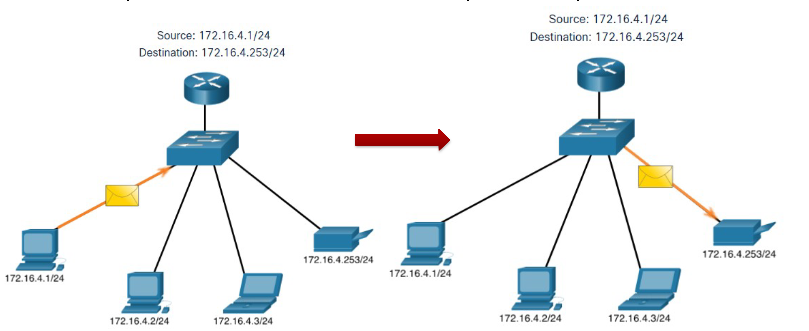
Unicast transmission
is sending a packet to one destination IP address.
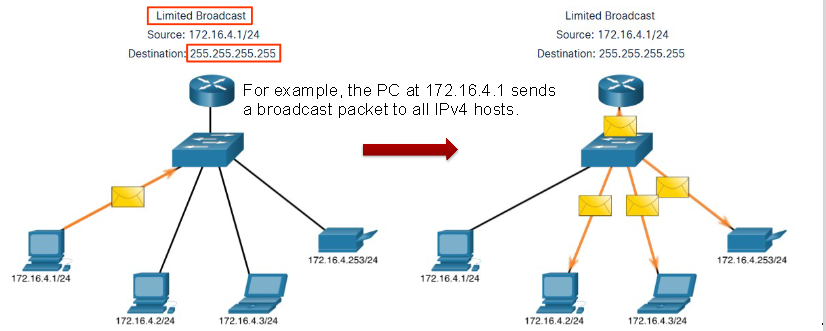
Broadcast transmission
is sending a packet to all other destination IP addresses.
Unicast
Broadcast Packet
must be processed by all devices in the same broadcast domain. A broadcast
domain identifies all hosts on the same network segment.
Broadcast Transmission
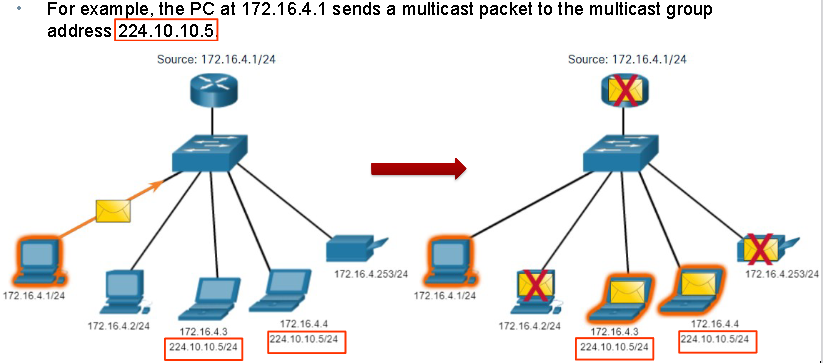
Multicast Transmission
is sending a packet to a multicast address group.
Multicast Transmission
Public IPv4 addresses
are globally routed between internet service provider (ISP) routers.
Private Addresses
Not globally routable.
Private Addresses
Common blocks of addresses used by
most organizations.
Private Addresses
Not unique and can be used internally
within any network.
Network Address Translation
what does NAT stand for
Network Address Translation
translates private IPv4 addresses to public IPv4 addresses.
Network Address Translation
is typically enabled on the edge router connecting to the internet.
Network Address Translation
It translates the internal private address to a public global IP address.
127.0.0.0 /8 (127.0.0.1 to 127.255.255.254)
what is the range of the loopback addresses
Loopback addresses
Commonly identified as only 127.0.0.1
Loopback addresses
Used on a host to test if TCP/IP is operational
Link-Local addresses
Commonly known as the Automatic Private IP Addressing (APIPA) addresses or self-assigned addresses.
Link-Local addresses
Used by Windows DHCP clients to self-configure when no DHCP servers are available.
0.0.0.0/8 to 127.0.0.0/8
Class A
Class A, B, C, D, E
what are the 5 classes of IPv4
128.0.0.0 /16 – 191.255.0.0 /16
Class B
192.0.0.0 /24 – 223.255.255.0 /24
Class C
224.0.0.0 to 239.0.0.0
Class D
240.0.0.0 – 255.0.0.0
Class E
Classful Addressing
Wasted any IPv4 addressing
Classless addressing
ignores the rules of classes (A, B, C)
Internet Assigned Numbers Authority
manages and allocates blocks of IPv4 and IPv6 addresses to five Regional Internet Registries
Internet Assigned Numbers Authority
What does IANA stand for
Regional Internet Registries
What does RIRs stand for
Regional Internet Registries
are responsible for allocating IP addresses to ISPs who provide IPv4 address blocks to smaller ISPs and organizations.
Switches
propagate broadcasts out all interfaces except the interface on which it was received
router
The only device that stops broadcasts
is a _____
Routers
do not propagate broadcasts.
True
True or False:
Each router interface connects to a broadcast domain and broadcasts are only propagated within that specific broadcast domain.
large, excessive broadcasts
A problem with a ____ broadcast domain is
that these hosts can generate ___________ and negatively affect the network.
Subnetting
The solution is to reduce the size of the network to create smaller broadcast domains in a process called ________
smaller
Broadcasts are propagated within the _____
broadcast domains.
basis of subnetting
Notice how the prefix length has changed from a single /16 network to two /24 networks. This is the ___________: using host bits to create additional subnets.
improves network performance, implement security policies, group the users
Reasons for segmenting networks
IPv4 subnets
are created by extending the subnet mask to borrow some of the bits from the host portion of the address to create additional network bits. The more host bits are borrowed, the more subnets are created with fewer hosts per subnet
/8, /16, and /24.
Networks are most easily subnetted at the octet boundary of ______.
Subnets
are created by borrowing bits from the host bits, creating longer masks
doubled
For each bit borrowed in the fourth octet, the number of subnetworks available is _______, while reducing the number of host addresses per subnet
VLSM (Variable Length Subnet Mask)
was developed to avoid wasting addresses by enabling us to subnet a subnet.
VLSM(Variable Length Subnet Mask)
always begin by satisfying the host requirements of the largest subnet and continue subnetting until the host requirements of the smallest subnet are satisfied.