22 ChapterL Carbonyl Condensation Reactions

0.0(0)
Studied by 0 people
call kaiCall Kai
learnLearn
examPractice Test
spaced repetitionSpaced Repetition
heart puzzleMatch
flashcardsFlashcards
GameKnowt Play
Card Sorting

1/9

encourage image

There's no tags or description

Looks like no tags are added yet.

Last updated 4:47 AM on 5/21/26
Name
Mastery
Learn
Test
Matching
Spaced
Call with Kai

No analytics yet

Send a link to your students to track their progress

10 Terms

1
New cards

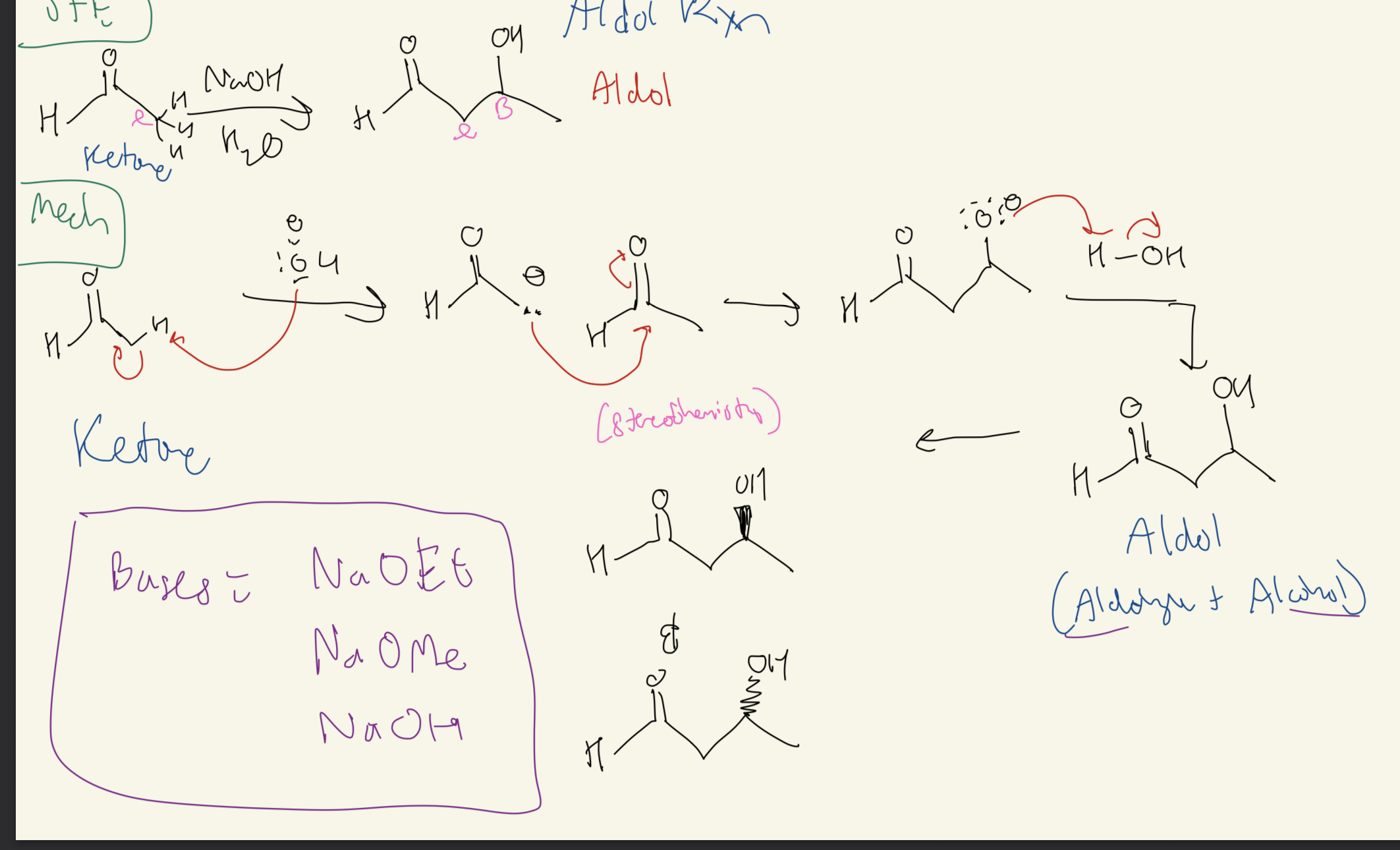
1) NaOH, H2O (PART 1 OF ALDOL RXN)

(Bases = NaOH NaOEt and NaOMe are also acceptable)

2 Aldehyde → Beta Hydroxy Aldehyde

2 Ketone → Beta Hydroxy Ketone

Aldol Reaction (Aldehyde + Alcohol)
<p><strong><u>2</u> Aldehyde → Beta Hydroxy Aldehyde</strong></p><p><strong><u>2</u> Ketone → Beta Hydroxy Ketone</strong></p><p></p><p><strong>Aldol Reaction (Aldehyde + Alcohol)</strong></p>
2
New cards

1b) ∆ (PART 2 of ALDOL RXN, if there is HEAT)

(Bases = NaOH NaOEt and NaOMe are also acceptable)

2 Aldehyde → Beta Hydroxy Aldehyde → Alpha Beta Unsaturated Aldehyde

2 Ketone → Beta Hydroxy Ketone → Alpha Beta Unsaturated Ketone

Aldol Condensation

E1cB = Elimination Unimolecular Conjugate Base

E1 = Enolate Intermediate lone pair makes a C double bond C AND OH leaves as L.G. E1 because eliminated comes from UNIMOLECULAR ENOLATE

cB = When NaOH or other base DEPROTONATES the Aldol Addition to form an ENOLATE which is the CONJUGATE BASE of the Aldol
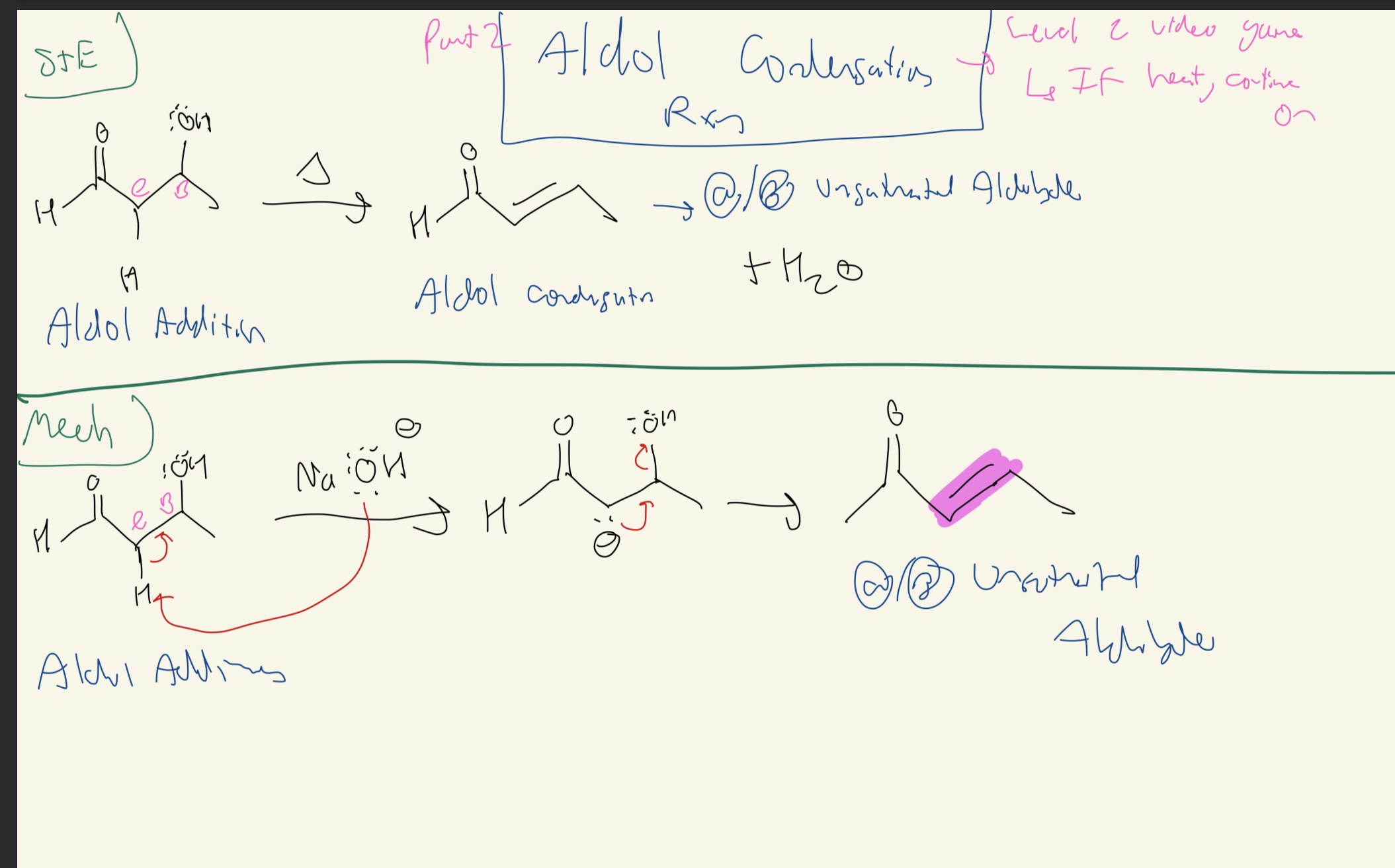
<p><strong><u>2</u> Aldehyde → Beta Hydroxy Aldehyde → Alpha Beta Unsaturated Aldehyde</strong></p><p><strong><u>2</u> Ketone → Beta Hydroxy Ketone →  Alpha Beta Unsaturated Ketone</strong></p><p></p><p><strong>Aldol Condensation </strong></p><p><strong>E1cB = Elimination Unimolecular Conjugate Base</strong></p><p></p><p>E1 = Enolate Intermediate lone pair makes a C double bond C AND OH leaves as L.G. E1 because eliminated comes from <strong>UNIMOLECULAR ENOLATE</strong></p><p>cB = When NaOH or other base DEPROTONATES the Aldol Addition to form an <strong>ENOLATE  which is the CONJUGATE BASE of the Aldol </strong></p>
3
New cards

1c) Same Reagents 1a + 1b COMBINED

Cross Aldol Reaction

4 Different Products

1) A + B

2) B + A

3) A + A

4) B + B
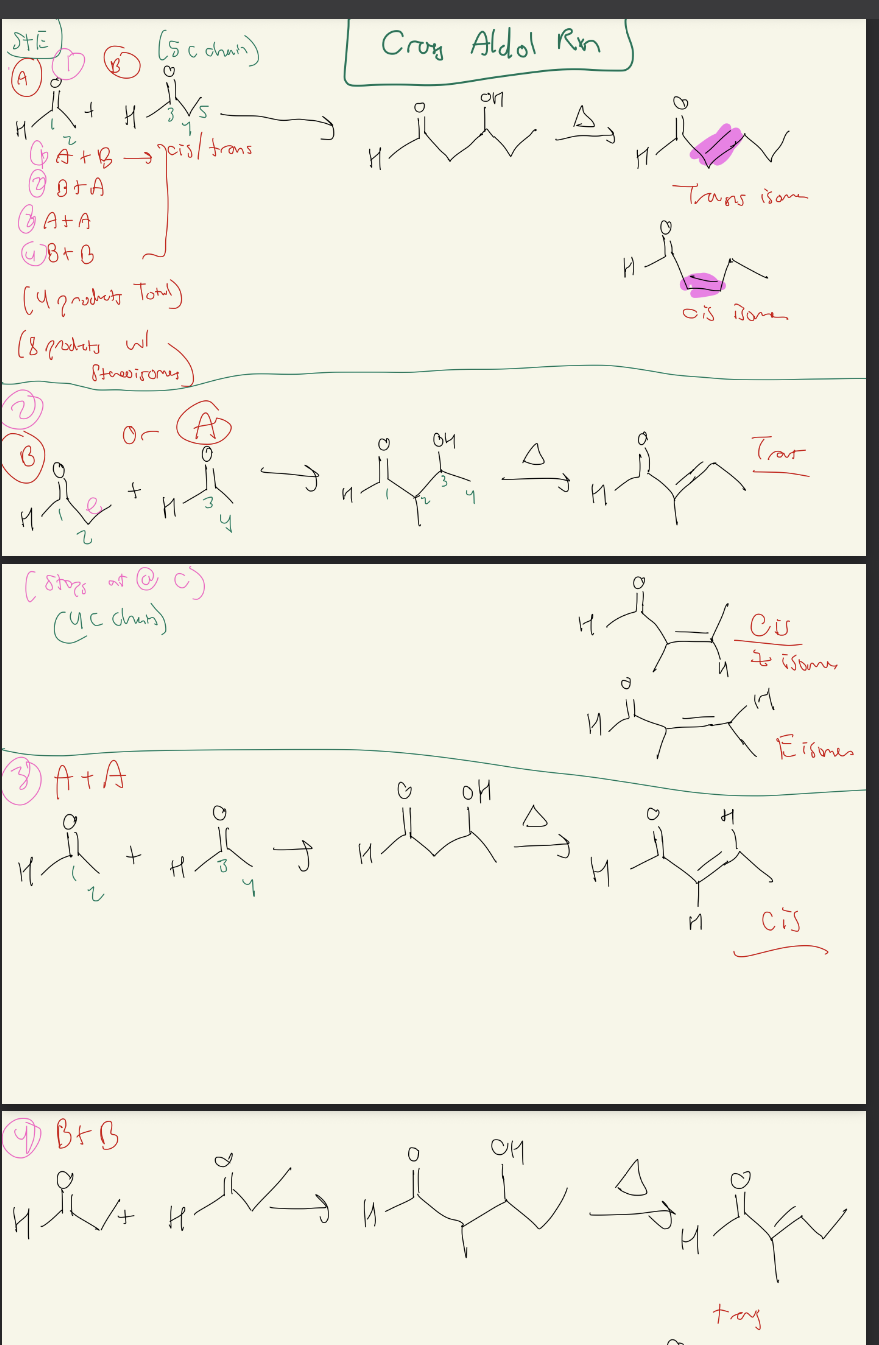
<p><strong>Cross Aldol Reaction</strong></p><p></p><p><strong>4 Different Products</strong></p><p><strong>1) A + B </strong></p><p><strong>2) B + A</strong></p><p><strong>3) A + A</strong></p><p><strong>4) B + B</strong></p>
4
New cards

1d)
LDA

Direct Aldol Reactions

1) A + B ONLYYY

Reacting 1 Aldehyde with with LDA (VERY STRONG BASE) to get to 100% conversion of aldehyde to an ENOLATE

Add 2nd Aldehyde to Enolate

1) Control Over which Enlate Forms

2) Can Stop at Aldol Product (No Condensation)

Aldol Condensation only possible when…
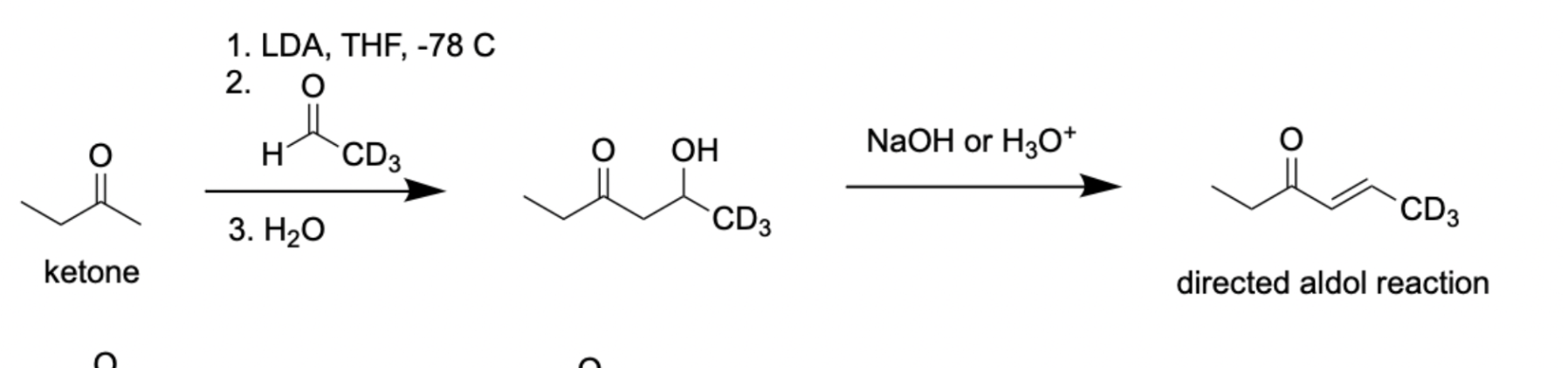
<p><strong>Direct Aldol Reactions</strong></p><p><strong>1) A + B ONLYYY</strong></p><p></p><p>Reacting 1 Aldehyde with with LDA (VERY STRONG BASE) to get to 100% conversion of aldehyde to an ENOLATE</p><p>Add 2nd Aldehyde to Enolate</p><p></p><p>1) Control Over which Enlate Forms</p><p>2) Can Stop at Aldol Product (No Condensation) </p><p></p><p>Aldol Condensation only possible when…</p>
5
New cards

1e) Reagents:

1a) NaOH, H2O (PART 1 OF ALDOL RXN)

(Bases = NaOH NaOEt and NaOMe are also acceptable)

1b) ∆ (PART 2 of ALDOL RXN, if there is HEAT)

Intermolecular Aldol Reaction
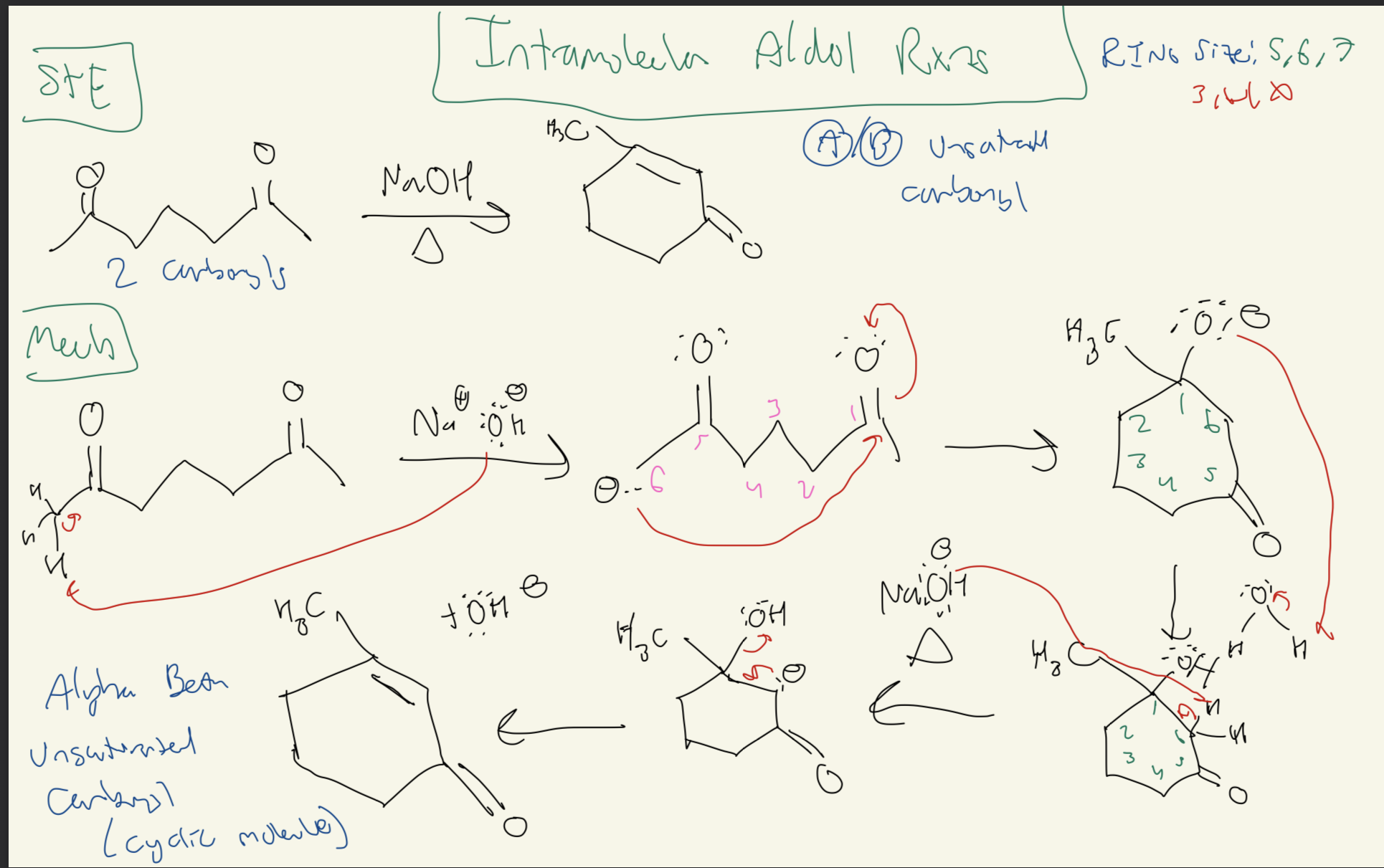
<p><strong>Intermolecular Aldol Reaction</strong></p>
6
New cards
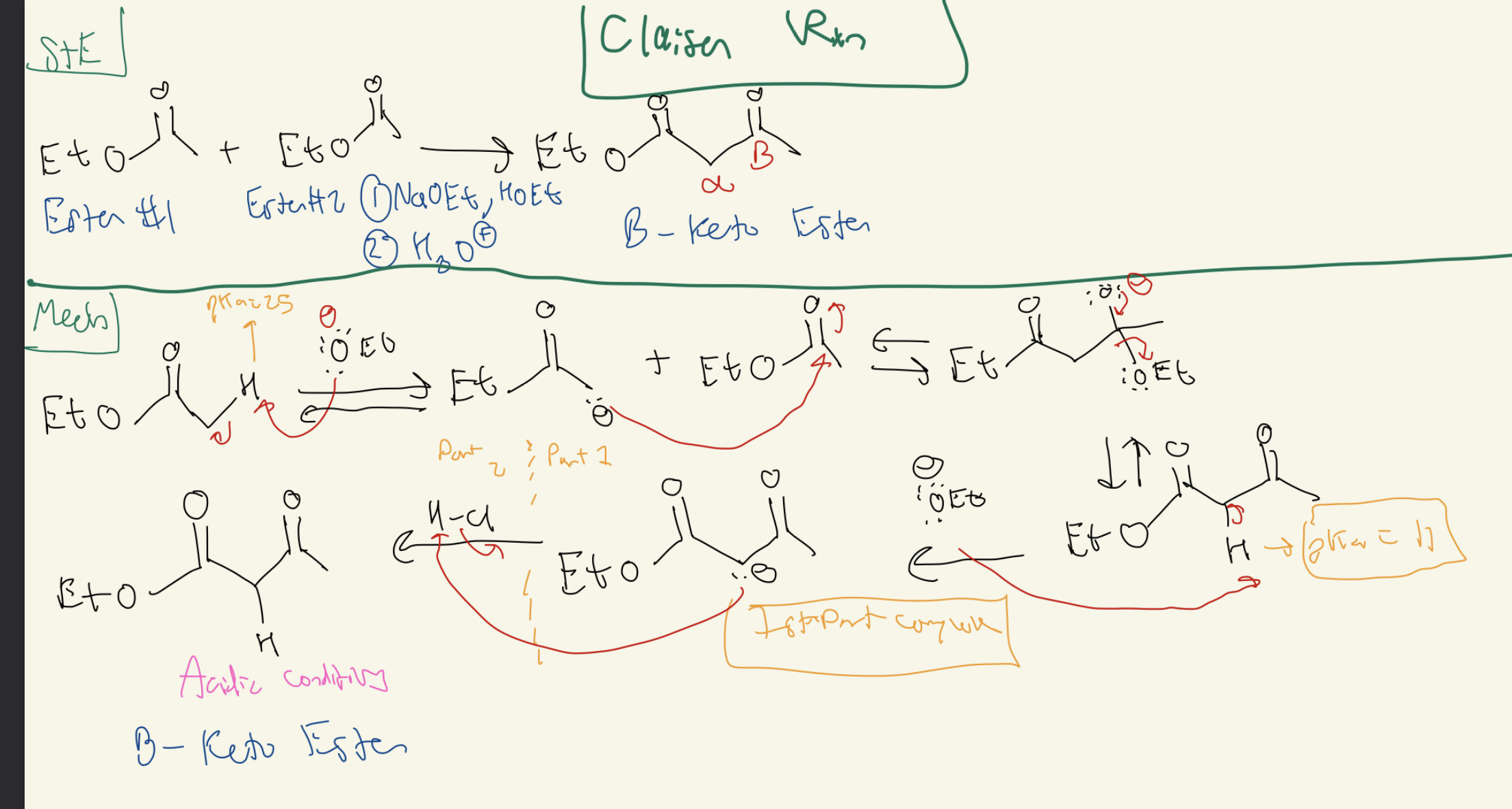
<p>2) Reagent: <strong>Claisen Reaction</strong></p><p>1) NaOEt, HOEt</p><p>2) H3O+</p>

2) Reagent: Claisen Reaction

1) NaOEt, HOEt

2) H3O+

2 SAME Esters → Beta-Keto Ester

Enolate → Adding 2nd Ester → Kick Out L.G → Neutral → Deprotoanted → Back to Neutral

<p></p><p><strong><u>2 SAME </u>Esters → Beta-Keto Ester</strong></p><p></p><p></p><p></p><p><strong>Enolate → Adding 2nd Ester → Kick Out L.G → Neutral → Deprotoanted → Back to Neutral</strong></p>
7
New cards

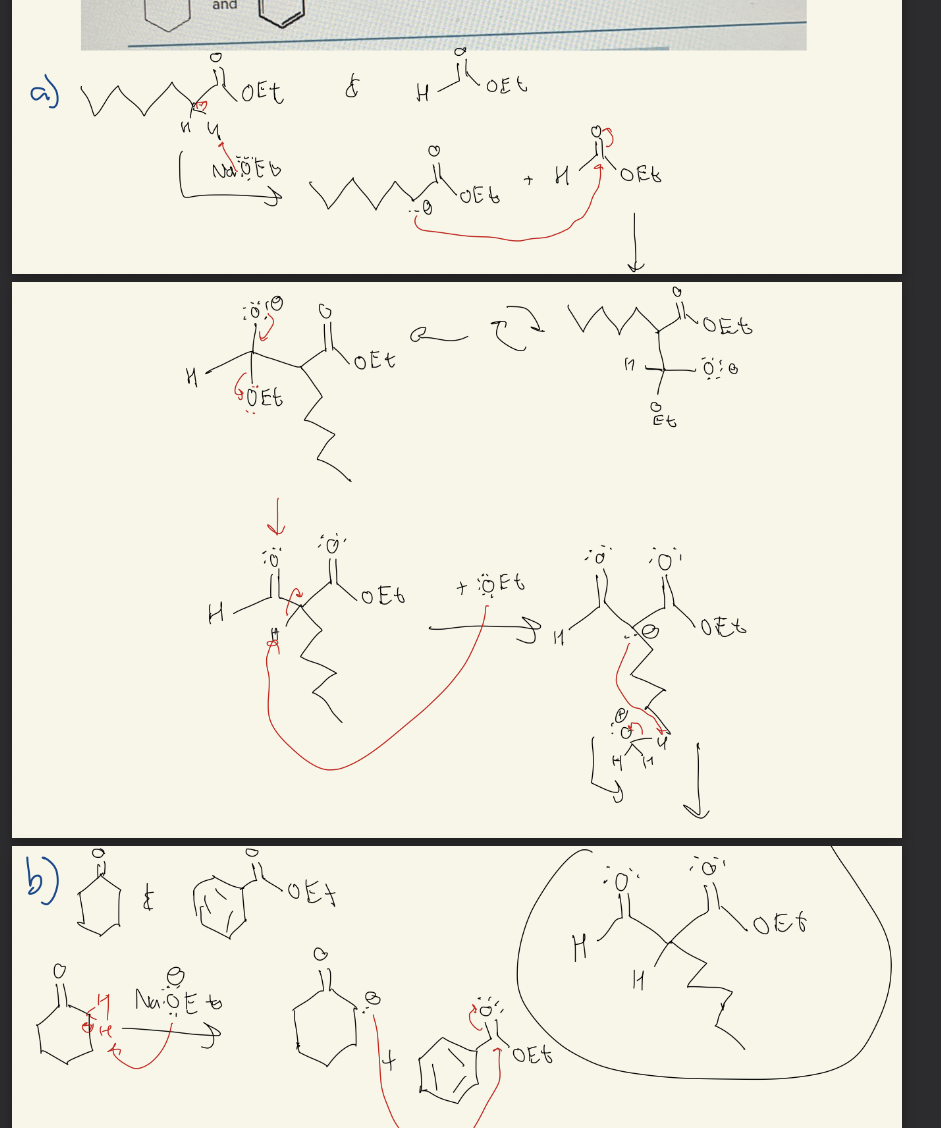
2b) Reagent: Cross Claisen Reaction

1) NaOEt, HOEt

2) H3O+

2 DIFFERENT Esters → Beta-Keto Ester (1 Ester has NO alpha Hydrogens)

-1 Ester No Alpha Hydrogens → ELECTROPHILE

-1 Ester Has Alpha Hydrogens → NUCLEOPHILE

1 Ketone and 1 Ester

-Ketone → NUCLEOPHILE

-Ester → NO Alpha Hydrogens → ELECTROPHILE

Ethyl Chloroformate or Diethyl Carbonates as ELECTROPHILES

Cross Claisen Reaction

-Make up to 4 products

-Best by converting 1 ester to enolate using LDA and then add 2nd ester

OR

-If One ester has 0 alpha hydrogens, it can’t be an enolate and it can only be attacked
<p><strong><u>2 DIFFERENT </u>Esters → Beta-Keto Ester (1 Ester has NO alpha Hydrogens)</strong></p><p><strong>-1 Ester No Alpha Hydrogens → ELECTROPHILE</strong></p><p><strong>-1 Ester Has Alpha Hydrogens → NUCLEOPHILE </strong></p><p></p><p><strong><u>1 Ketone and 1 Ester</u></strong></p><p><strong>-Ketone → NUCLEOPHILE</strong></p><p><strong>-Ester → NO Alpha Hydrogens → ELECTROPHILE</strong></p><p></p><p><strong><u>Ethyl Chloroformate or Diethyl Carbonates as ELECTROPHILES</u></strong></p><p></p><p><strong>Cross Claisen Reaction</strong></p><p></p><p>-Make up to 4 products</p><p></p><p>-Best by converting 1 ester to enolate using LDA and then add 2nd ester</p><p>OR</p><p>-If One ester has 0 alpha hydrogens, it can’t be an enolate and it can only be attacked</p>
8
New cards
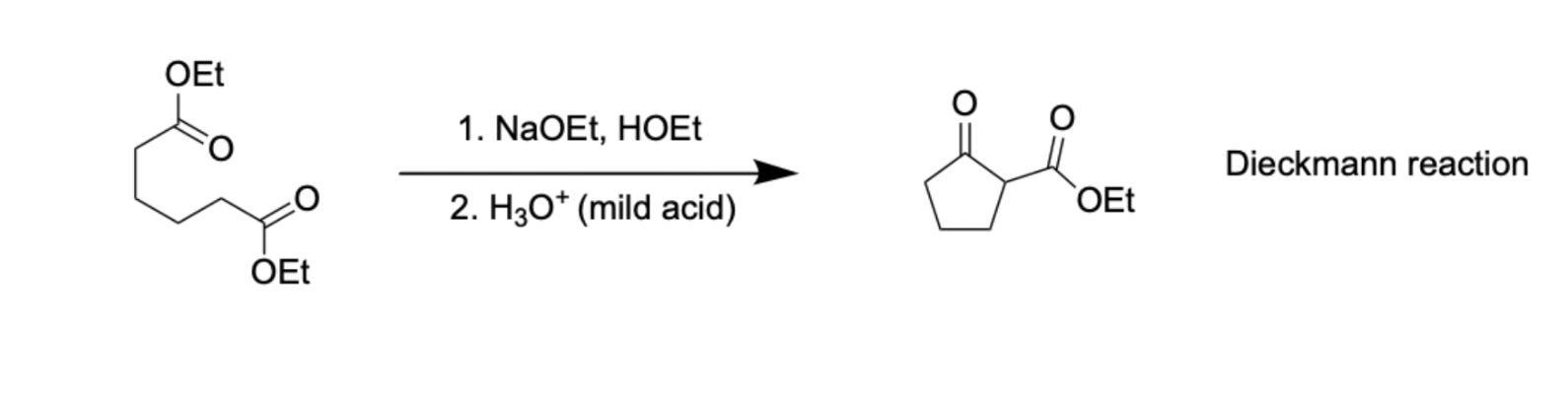
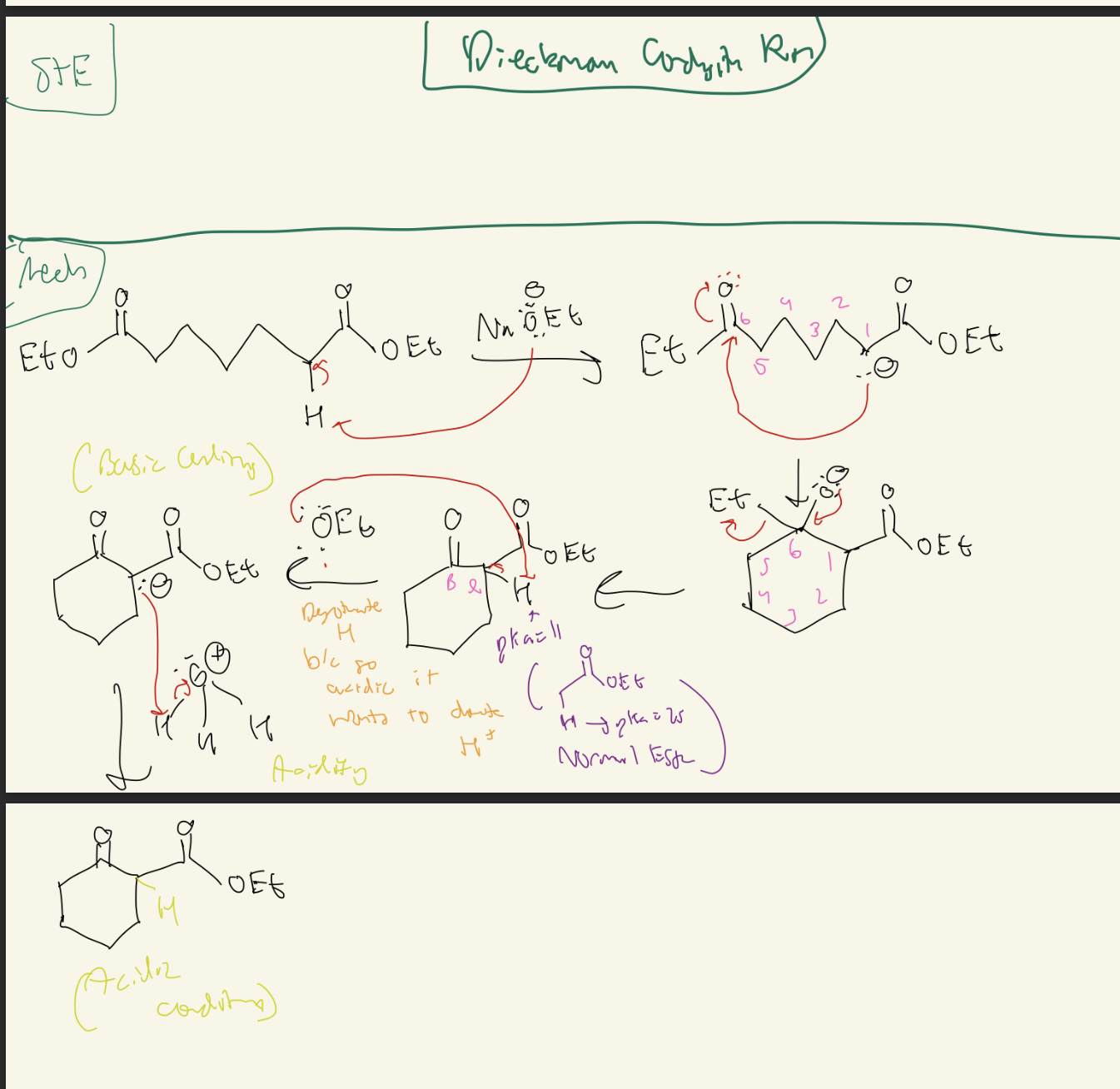
<p>3) <strong>Dieckmann Condensation</strong></p><p><strong>1) NaOEt, HOEt</strong></p><p><strong>2) H3O+ (mild acid)</strong></p>

3) Dieckmann Condensation

1) NaOEt, HOEt

2) H3O+ (mild acid)

Intromolecular + Claisen Condensation Reaction

Enolate → Intramolecular Claisen → L.G. → Neutral → Deprotonated → Neutral
<p><strong>Intromolecular + Claisen Condensation Reaction</strong></p><p></p><p><strong>Enolate → Intramolecular Claisen → L.G. → Neutral → Deprotonated → Neutral</strong></p>
9
New cards
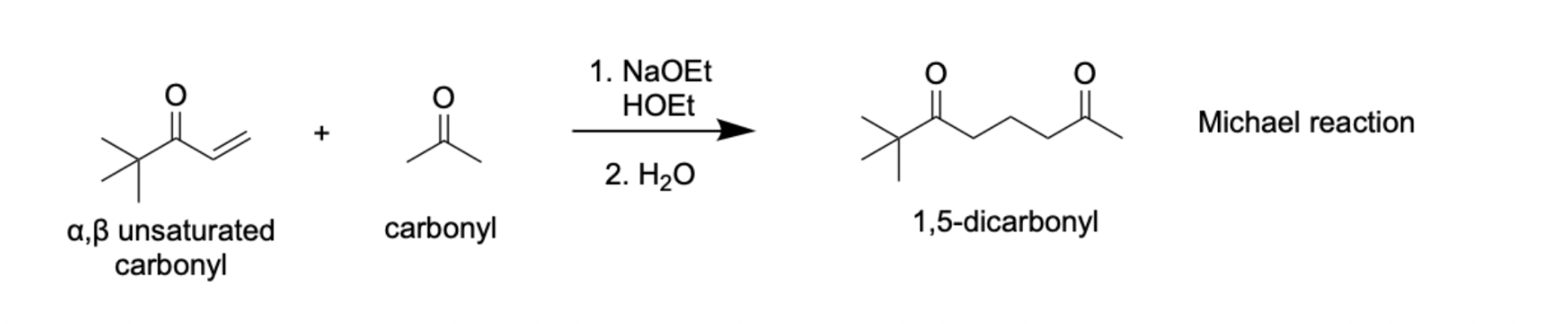
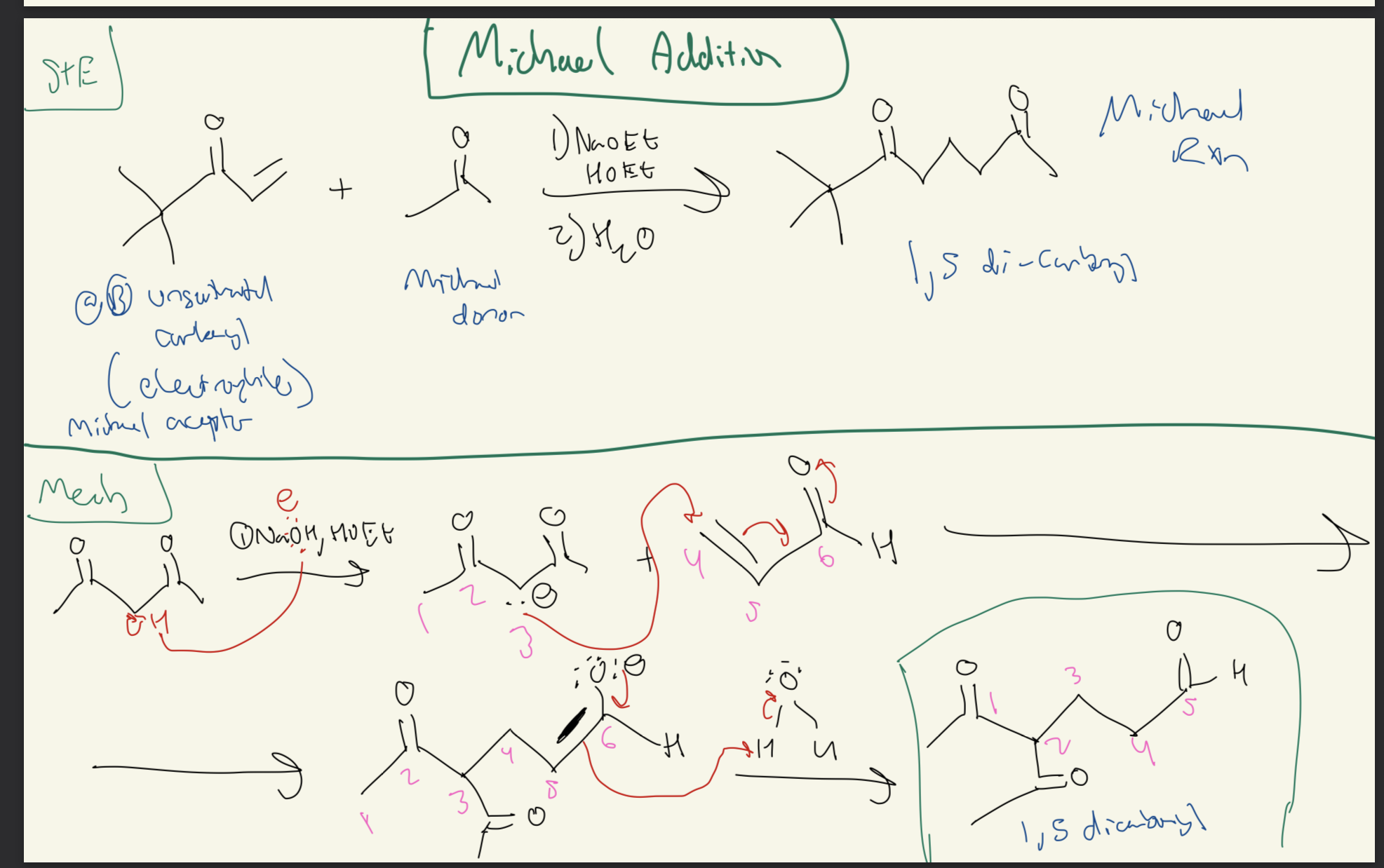
<p><strong>4) Michael Reaction</strong></p><p>1) NaOET, HOEt</p><p>2) H2O</p>

4) Michael Reaction

1) NaOET, HOEt

2) H2O

Alpha/Beta Unssaturated Carbonyl (Electrophile) + Michael Donor (Nucleophile)

→ 1,5 Di-Carbonyl

Enolate → Michael Donor Attacks the Alpha Beta Unsaturated Carbonyl → Form Alkoxide and ALkene → Reform Carbonyl and have Alkene Attack the H from H2O → 1,5 Dicarbonyl
<p><strong>Alpha/Beta Unssaturated Carbonyl (Electrophile) + Michael Donor (Nucleophile) </strong></p><p><strong>→ 1,5 Di-Carbonyl</strong></p><p></p><p>Enolate → Michael Donor Attacks the Alpha Beta Unsaturated Carbonyl → Form Alkoxide and ALkene → Reform Carbonyl and have Alkene Attack the H from H2O → 1,5 Dicarbonyl</p>
10
New cards

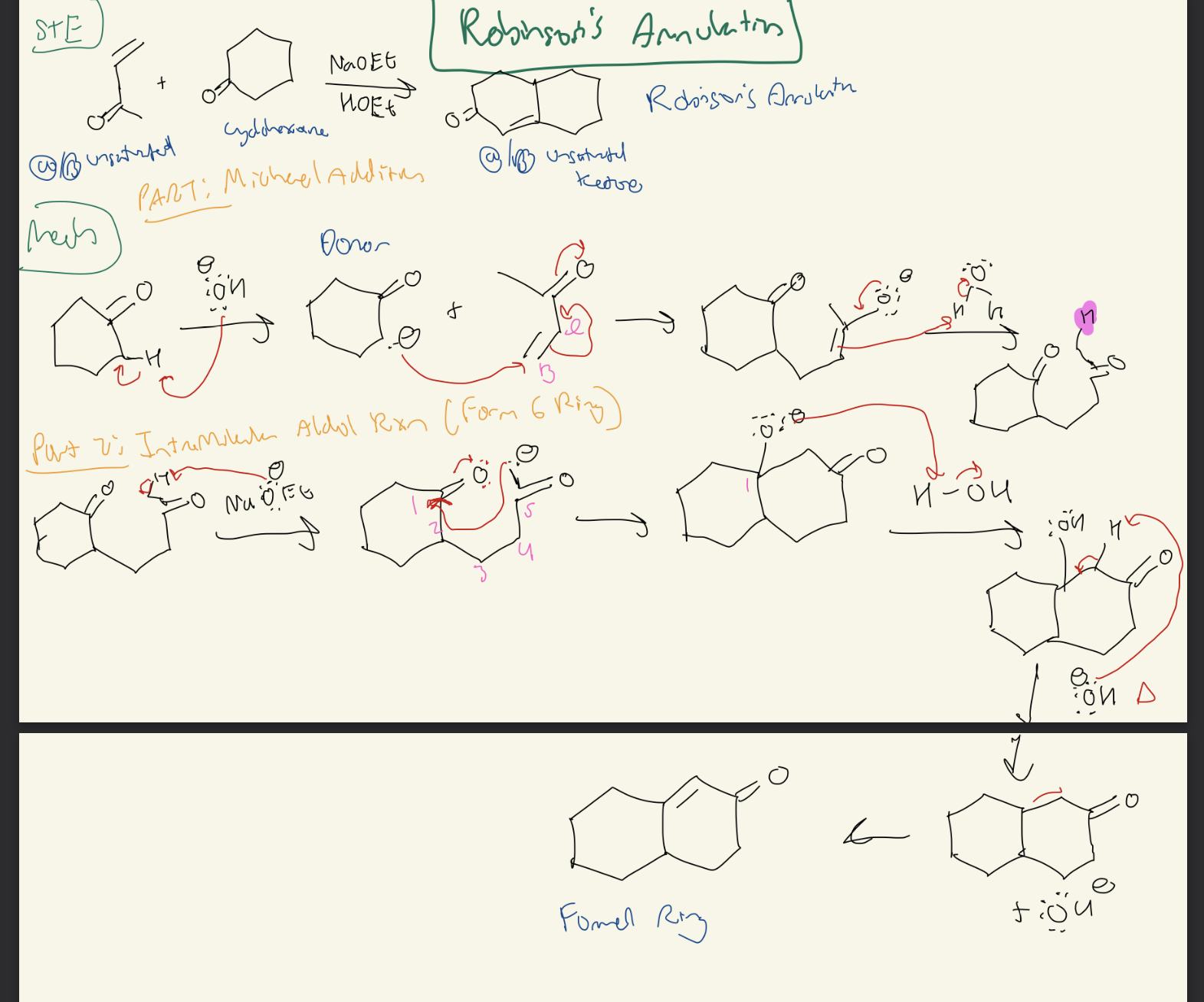
5) Robinson Annulation
1) NaOEt, HOEt

2) H2O

Michael Reaction + Intramolecular Aldol Reaction

Part 1: Michael Reaction

Enolate → Addition attacking Alkene and Forming Alkoxide → Water forms back Carbonyl and Breaks Alkene (1,5 Dicarbonyl)

Part 2: Intramoleclar Aldol Reaction

1,5 Dicarbonyl → Closest H near both Carbonyls Deprotonated → Attacks Carbon of Carbonyl O → H2O forms back the OH → E1cB to kick out OH and form Alkene
<p><strong>Michael Reaction + Intramolecular Aldol Reaction</strong></p><p></p><p><strong>Part 1: Michael Reaction</strong></p><p>Enolate → Addition attacking Alkene and Forming Alkoxide → Water forms back Carbonyl and Breaks Alkene (1,5 Dicarbonyl)</p><p></p><p><strong>Part 2: Intramoleclar Aldol Reaction</strong></p><p>1,5 Dicarbonyl → Closest H near both Carbonyls Deprotonated → Attacks Carbon of Carbonyl O → H2O forms back the OH  → <strong>E1cB </strong>to kick out OH and form Alkene</p>