AQA A level Chem 2.2 Group 2 Metals
 Call Kai
 Learn
Learn Practice Test
 Spaced Repetition
 Match
Match Flashcards
 Knowt Play
1/32

Earn XP
Description and Tags
33 Terms
State one observation when magnesium reacts with steam. Give an equation, including state symbols, for this reaction. (2)
Bright/white light/ white powder/ash/solid (1)
Mg(s) + H2O(g) → MgO(s) + H2(g) (1)
Describe the structure and bonding in magnesium (2)
Giant lattice of (Mg2+) cations/ (giant) lattice of (Mg) atoms (1)
(electrostatic) attractions between cations/ Mg2+ ions/nuclei and delocalised elctrons (1)
Explain, in terms of structure and bonding, why magnesium chloride has a high melting point. (3)
Giant ionic lattice (1)
strong (electrostatic) forces of attraction (1)
between Mg2+ and Cl- ions (1)
Give one medical use for magnesium hydroxide. (1)
indigestion relief/laxative /neutralise (excess stomach) acid (1)
Explain why the melting point of magnesium is higher than the melting point of sodium. (2)
Mg2+has a higher charge than Na+(1)
stronger attraction to delocalised sea of electrons (1)
Magnesium is used in one of the stages in the extraction of titanium.
Give an equation for the reaction between titanium(IV) chloride and magnesium.
State the role of magnesium in this reaction. (2)
2 Mg + TiCl4 → Ti + 2 MgCl2 (1)
role : reducing agent (1)
State what is observed when dilute aqueous sodium hydroxide is added to separate solutions of magnesium chloride and barium chloride. (2)
Observation with MgCl2: (slight) white ppt (1)
Observation with BaCl2 : no (visible) change/colourless solution (1)
Which property would you expect the element radium, Ra, to possess?
A It forms a soluble sulfate.
B It does not react with water.
C It is a good conductor of
electricity.
D It forms a covalent fluoride. (1)
C (1)
Which statement is not correct?
A Strontium has a lower first ionisation energy than
calcium.
B Strontium has a larger ionic radius than calcium.
C Strontium reacts less vigorously with water than
calcium.
D Strontium hydroxide is more soluble in water
than calcium hydroxide. (1)
C (1)
What is the correct observation when barium metal is added to an excess of water (1)
forms a colourless solution and effervesces (1)
An aqueous solution of a salt gives a white precipitate when mixed with aqueous silver nitrate and when mixed with dilute sulfuric acid. Which could be the formula of the salt?
A BaCl2
B (NH4)2SO4
C KCl
D Sr(NO3)2 (1)
A BaCl2 (1)
Explain why the second ionisation energy of calcium is lower than the second ionisation energy of potassium. (2)
In Ca+ (outer) electron(s) is further from nucleus (1)
More shielding (in Ca+) (1)
A student added 6 cm3 of 0.25 mol dm–3 barium chloride solution to 8 cm3
of 0.15 mol dm–3 sodium sulfate solution.
The student filtered off the precipitate and collected the filtrate.
Give an ionic equation for the formation of the precipitate.
Show by calculation which reagent is in excess.
Calculate the total volume of the other reagent which should be used by
the student so that the filtrate contains only one solute. (3)
Ba2+ + SO42– → BaSO4 (1)
n BaCl2 (6/1000 × 0.25) = 1.5 × 10⁻³ and n Na2SO4 = (8/1000 × 0.15) = 1.2 × 10⁻³ and BaCl2 /barium chloride in excess (1)
10 cm3 (of 0.15 mol dm–3 sodium sulfate)(1)
This question is about the elements in Group 2.
Explain why the third ionisation energy of beryllium is much higher than the
second ionisation energy of beryllium (3)
Electron is removed from 1s rather than 2s (1)
Lower in energy than 2s/less shielding (1)
Stronger attraction between nucleus and outer electron (1)
A student is provided with separate unlabelled samples of four different solutions for analysis.
The four solutions are known to be ammonium nitrate, potassium sulfate, sodium carbonate and magnesium nitrate, but the student does not know which sample is which.
Outline a series of test-tube reactions that the student can use to identify each of these solutions.
Include:
• the expected observations
• ionic equations for any reactions. (6)
Add NaOH
Mg2+ / Mg(NO3)2 will give a white ppt with NaOH
Mg2+ + 2 OH- → Mg(OH)2
then hold damp red litmus at mouth of tube
red litmus (at mouth of the tube) will turn blue for NH4+
NH4+ + OH- → NH3 + H2O
Add hydrochloric acid
CO32- / Na2CO3 will effervesce with acid/gas formed turns limewater cloudy
Add acidified BaCl2
CO32- + 2 H+ → CO2 + H2O
SO42-/K2SO4 will give a white ppt with BaCl2
SO42- + Ba2+ → BaSO4 (6)
Give an equation, including state symbols, for the reaction of magnesium
with steam.
State two observations for this reaction. (3)
Mg(s) + H2O(g) → MgO(s) + H2(g) (1)
Bright/white flame/light
white/grey ash/powder (1)
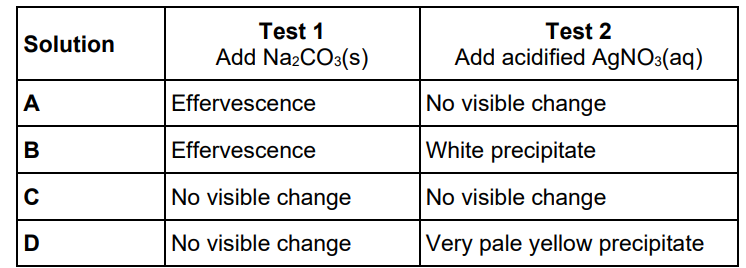
A student does two test-tube reactions on four colourless solutions (A, B, C and D).
The table below shows the student’s observations.
Identify the gas formed in Test 1
Describe a further test to confirm the identity of this gas (2)
Identity of gas : Carbon dioxide (1)
Test: When gas bubbled through limewater, a white ppt formed/turns milky (1)
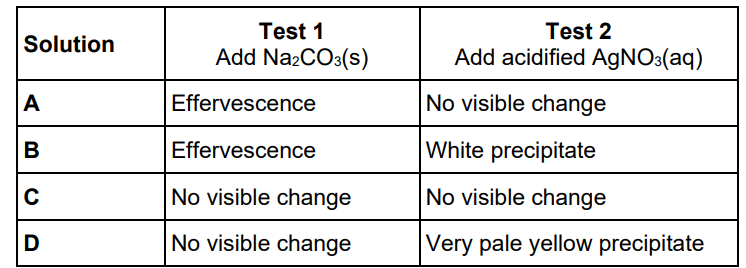
A student does two test-tube reactions on four colourless solutions (A, B, C and D).
The table below shows the student’s observations.
Explain how the observations from Test 1 and Test 2 can be used to show that solution B contains hydrochloric acid. (2)
Effervescence (with Na2CO3), so contains H+ ions / Effervescence (with Na2CO3), so is acidic (1)
White ppt (with AgNO3), so contains chloride ions (1)
Describe a series of tests that the student can use to show that solution C contains ammonium sulfate. (4)
(Warm with some) NaOH (1)
Damp red litmus at the mouth of the tube turns blue (1)
Add (acidified) BaCl2 / Ba(NO3)2 (1)
white ppt formed (1)
Describe how a student could distinguish between aqueous solutions of potassium nitrate, KNO3, and potassium sulfate, K2SO4, using one simple test-tube reaction.(3)
BaCl2 (1)
no visible change/colourless solution (1)
white precipitate (1)
Describe how a student could distinguish between aqueous solutions of magnesium chloride, MgCl2, and aluminium chloride, AlCl3, using one simple test-tube reaction. (3)
add NaOH (1)
if it contains magnesium, white precipitate is formed (1)
if it contains aluminum, white ppt is formed which dissolves in excess (NaOH) (1)
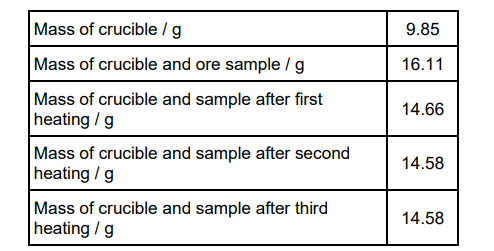
A sample of strontium ore is known to contain strontium oxide, strontium carbonate and some inert impurities. To determine the mass of strontium carbonate present, a student weighed a sample of the solid ore and then heated it in a crucible for 5 minutes. The sample was allowed to cool and then reweighed. This heating, cooling and reweighing was carried out three times. The results are set out in the table
Use the data in the table to calculate the mass of strontium carbonate in the original ore sample. Give your answer to an appropriate precision. (5)
Mass CO2 = 16.11 − 14.58 = 1.53 g (1)
Mr CO2 = 44.0 (1)
Mol CO2 = 1.53 / 44.0 = 3.48 × 10⁻² (1)
Mol SrCO3 = 3.48 × 10⁻² (1)
Mass SrCO3 = mol × Mr = 3.48 × 10−2 × 147.6
Mass SrCO3 = 5.13 (g) (1)
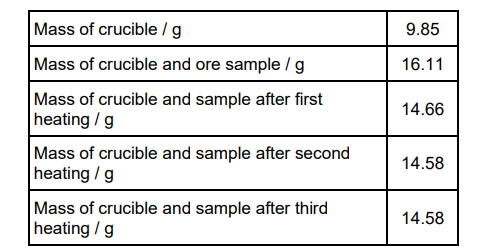
A sample of strontium ore is known to contain strontium oxide, strontium carbonate and some inert impurities. To determine the mass of strontium carbonate present, a student weighed a sample of the solid ore and then heated it in a crucible for 5 minutes. The sample was allowed to cool and then reweighed. This heating, cooling and reweighing was carried out three times. The results are set out in the table
The mass of inert impurities in the sample was 347 mg.
Deduce the mass of SrO in the sample and justify any assumption made in
calculating your answer
mass of strontium carbonate = 5.13 (2)
Original Mass SrO = 6.26 − 0.347 − 5.13 = 0.783g/783 mg (1)
All SrCO3 reacted because heated to constant mass(1)
Strontium metal can be extracted by heating strontium oxide with aluminium metal. In this reaction, strontium vapour and solid aluminium oxide are formed.
What is the role of the aluminum in the process and Explain why strontium forms a vapour but aluminium oxide is formed as a solid. (4)
Al acts as a reducing agent (1)
Sr is collected as a vapour because (1)
Al2O3 is an ionic lattice and so has strong ionic attractions (1)
than Sr which is a metallic structure with relatively weaker bonding (1)
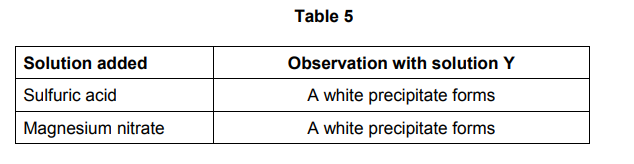
An aqueous solution Y is known to contain one type of group 2 metal ion and one type of negative ion. Aqueous solutions of sulfuric acid and magnesium nitrate are added to separate samples of solution Y. The observations are shown in Table 5.
Suggest the identity of the group 2 metal ion present in solution Y. Write an ionic equation, including state symbols, for the reaction that takes place when sulfuric acid is added to solution Y.
Suggest the identity of the negative ion present in solution Y. Write an ionic equation, including state symbols, for the reaction that takes place when magnesium nitrate is added to solution Y. (4)
Ba2+ OR Sr2+ (1)
SO42- (aq) + Ba2+ (aq) → BaSO4 (s) (1)
OH- (1)
Mg2+ (aq) + 2OH- (aq) → Mg(OH)2 (s)
The following pairs of compounds, each in aqueous solution, can be distinguished by simple test-tube reactions.
Give a reagent, or combination of reagents, that can be added to the solutions in each pair to distinguish between them in a single reaction.
State what is observed in each case.
NaCl (aq) and BaCl2 (aq)
Reagent
Observation with NaCl
Observation with BaCl2 (3)
Reagent: H2SO4 / Na2SO4 / any soluble sulfate (1)
Observation with NaCl: no (visible) change (1)
Observation with BaCl2: white ppt / white solid formed (1)
Write an ionic equation, with state symbols, to show the reaction of calcium with an excess of water. (1)
Ca (g) → Ca+ (g) + e- (1)
Suggest one economic advantage of using a process with a high percentage atom economy (1)
Idea of maximising the mass of reactants that ends up in the useful products
OR
Idea of minimising waste/biproduct (to be disposed of)
This question is about the Group 2 metals Mg to Ba
Strontium and calcium have the same metallic structure. Explain why strontium has a lower melting point than calcium. (2)
Cations/positive ions/atoms are larger
OR
(cations/positive ion/atom or) it has more (electron) shells /more shielding (1)
Sr has weaker attraction between the cations/positive ions/nucleus and the delocalised electrons (1)
Which of these substances reacts most rapidly to produce a silver halide precipitate with acidified silver nitrate?
A CH3Br
B CH3Cl
C CH3F
D CH3I (1)
D (1)
Reducing power of halides increases down group 7
Explain why the third ionisation energy of magnesium is much higher than the second ionisation energy of magnesium. (2)
The electron is removed from 2p sub-shell (1)
(Electron being removed is) less shielded (than 3s) (1)

Which represents the correct order of increasing radius of the ions?
C (1)
Cations have a bigger radius as they have lost electron shells

This question is about the identification of ions in unknown solutions. A student completes a number of test-tube reactions on solutions A, B and C.
Table 2 shows the student’s observations.
Different gases are formed when solution B reacts in Test 1 and in Test 2.
Suggest the identity of each gas.
Give the simplest ionic equation for the formation of the gas in Test 2. (2)
Gas in Test 1: CO2
Gas in Test 2: NH3 (1)
NH4+(aq) + OH-(aq) → NH3(g) + H2O(l) (1)