2.0 memory INITIAL THEORETICAL MODELS
 Call Kai
 Learn
Learn Practice Test
 Spaced Repetition
 Match
Match Flashcards
 Knowt Play
1/59

Earn XP
Description and Tags
INITIAL THEORETICAL MODELS
Name | Mastery | Learn | Test | Matching | Spaced | Call with Kai |
|---|
No analytics yet
Send a link to your students to track their progress
60 Terms
The initial theoretical models of memory
Ebbinghaus
Barlett, Hebb
Structural models
Broadbent
Atkinson
Shiffrin
Functional models
Craik & Lockhart
Dicotomys
Explicit vs Implicit.
Neuromodular model.
system
Group of elements that interact with each other to obtain a result or objective.
Examples of systems
Nature systems (the cycle of water)
Artificial systems (created by humans)
Psychological systems (memory, attention)
Hippocampus
essential for storing episodic memory to long term
Memory is understood
A system with different elements that interact with each other to obtain a result
(to encode, store and retrieve information).
Model
A simplified representation or explanation of a system.
A model tries to
define & emphasize the main elements of a system and their functioning
Memory models try to explain the memory system
✓ Structural models
✓ Functional models
Dual model was proposed by
William James
Dual model → memory is composed of
Primary memory
Secondary memory
Primary memory
Inmediate memory → conscious & with a short duration.
Secondary memory
Long-term duration → permanent but less accesible.
Information-processing Approach
Human mind worked as a computer program
information is stored in the states or representations of the system to be retrieved and manipulated later
memory system requires
The capacity to encode, or enter information into the system.
The capacity to store it.
The capacity to find & retrieve it.
Structural memory models try to examine
structure of memory
Memory is not unitary
Different structures (“boxes”, “stores”) with different functions
DONALD BROADBENT developed
FILTER MODEL OF ATTENTION
THE FILTER MODEL OF ATTENTION
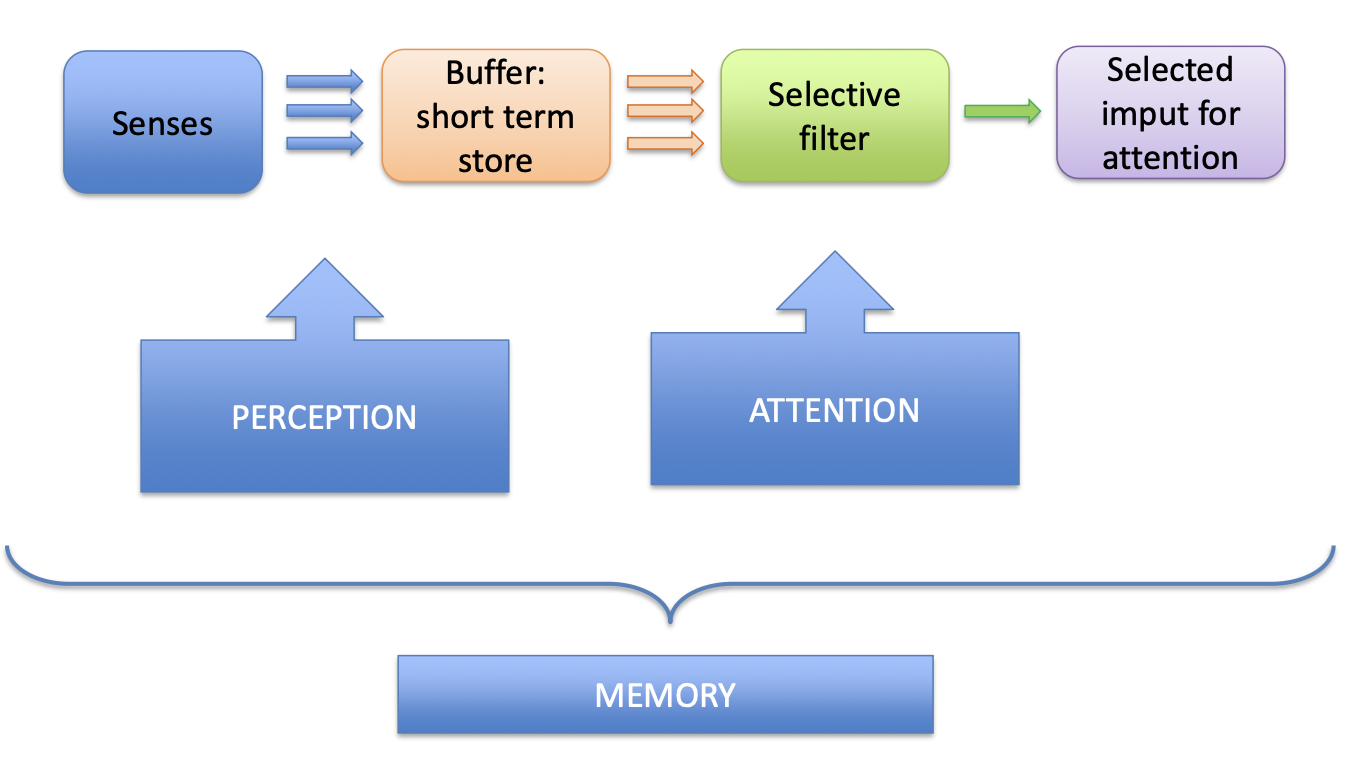
Attention according to Broadbent
A mental filter
Everything reaches to the brain (perception), but only a small part goes through the filter, thus we remember only the small amount of information.
Senso-perceptive processes involve
Different brain areas (auditory, visual, etc.)
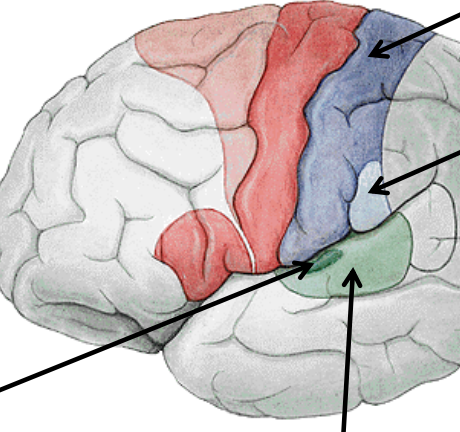
Dark blue area
Primary somatosensory area
Light blue area
Secondary somatosensory area
Dark green area
Primary auditory area
Light green area
Secondary auditory area
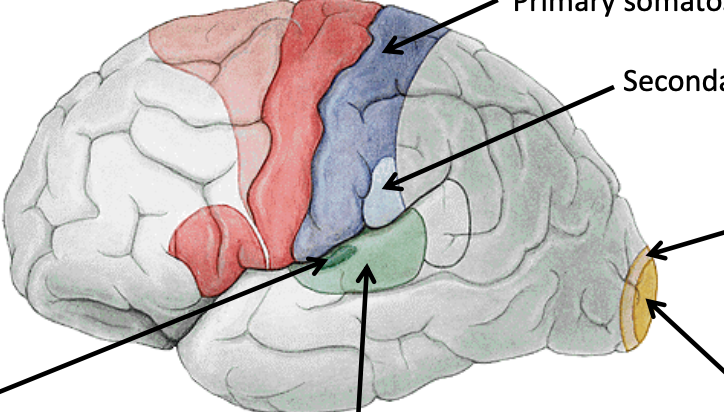
Light yellow area
Secondary visual area
Dark yellow area
Primary visual area
Process of filter model attention
Senses → Buffer (shirt term store) → selective filter → selected input for attention.

SENSES
The sensorial information is processed in parallel by our senso-perceptive systems.
BUFFER
It stores the sensorial information for a very short amount of time (PERCEPTION).
SELECTIVE FILTER
It allows or denies information to be attended (ATTENTION).
This filter focusses on physical characteristics of information (not meanings).
Selected input for attention
We are only aware of what goes beyond the filter.
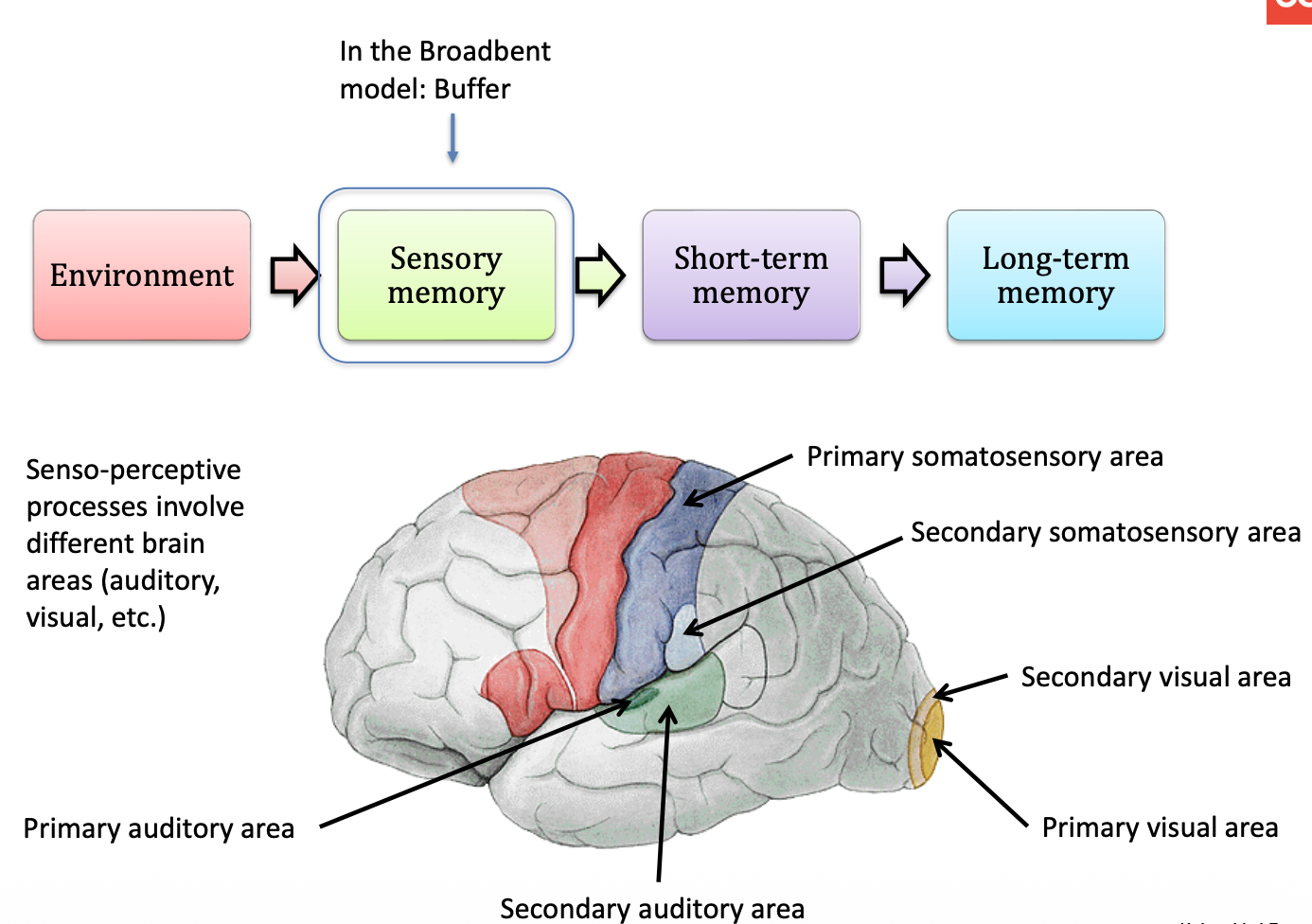
THE MODAL MODEL proposed by
ATKINSON & SHIFFRIN
THE MODAL MODEL process
Environment → sensory memory → Short-term memory → Long-term memory
Modal model represents
many similar models
Modal model establishes the distinctions between 3 types of memory
Sensory Memory
Short-term Memory
Long-term Memory
Modal model assumes that information
flows simply from left to right
SENSORY MEMORY
Very brief (1/2 to ¼ of a second) storage of information within a specific modality (auditory, visual…).
Represents the initial senso-perceptive process of information.
The information is processed in parallel.
Sensory memory in the Broadbent model
Buffer
SENSORY MEMORY can be
Iconic memory
Echoic memory
Iconic memory
A term applied to the brief storage of visual information.
“Visual sensory memory”
Echoic memory
A term applied to the brief storage of auditory information.
“Auditory sensory memory”
THE MODAL MODEL explains the brain processes
More information than you can attend
→ from the data processed by the brain areas, you can attend and declare only part of that information
Only the stimuli attended go to the short-term memory store
→ we are conscious of that information
Then, the processing goes from being parallel to being serial
→ one stimulus each time
SHORT-TERM MEMORY in the In the Broadbent model
Filter
rehearsal
SHORT-TERM MEMORY
Limited capacity (7+/- 2 elements) & duration (forgetting: after 30 seconds).
The information fades quickly, but not as much as sensory memory does.
The longer the information is held in short-term memory, the better the learning.
Rehearsal (rehearsal loop)
Rehearsal
A process through which I maintain the information in the short-term memory longer.
LONG-TERM MEMORY
The information goes from short-term to long-term memory
It has an unknown capacity & a lifetime duration.
Involved in retrieval
Posterior authors differentiated between different kinds of long-term memories (declarative, procedural, etc.).
When I remember the information previously learned
Retrieval
That information goes from the long-term memory to the short-term memory (we are aware of that information again
Storage
Information goes from short-term to long-term memory
In the MODAL MODEL the STORES are
→ “the boxes”
are fixed but the processes are dynamic
Working memory concept
An extension of the short-term memory concept
HOTEL METAPHOR
The flow of people & information between the rooms represents memory processes!
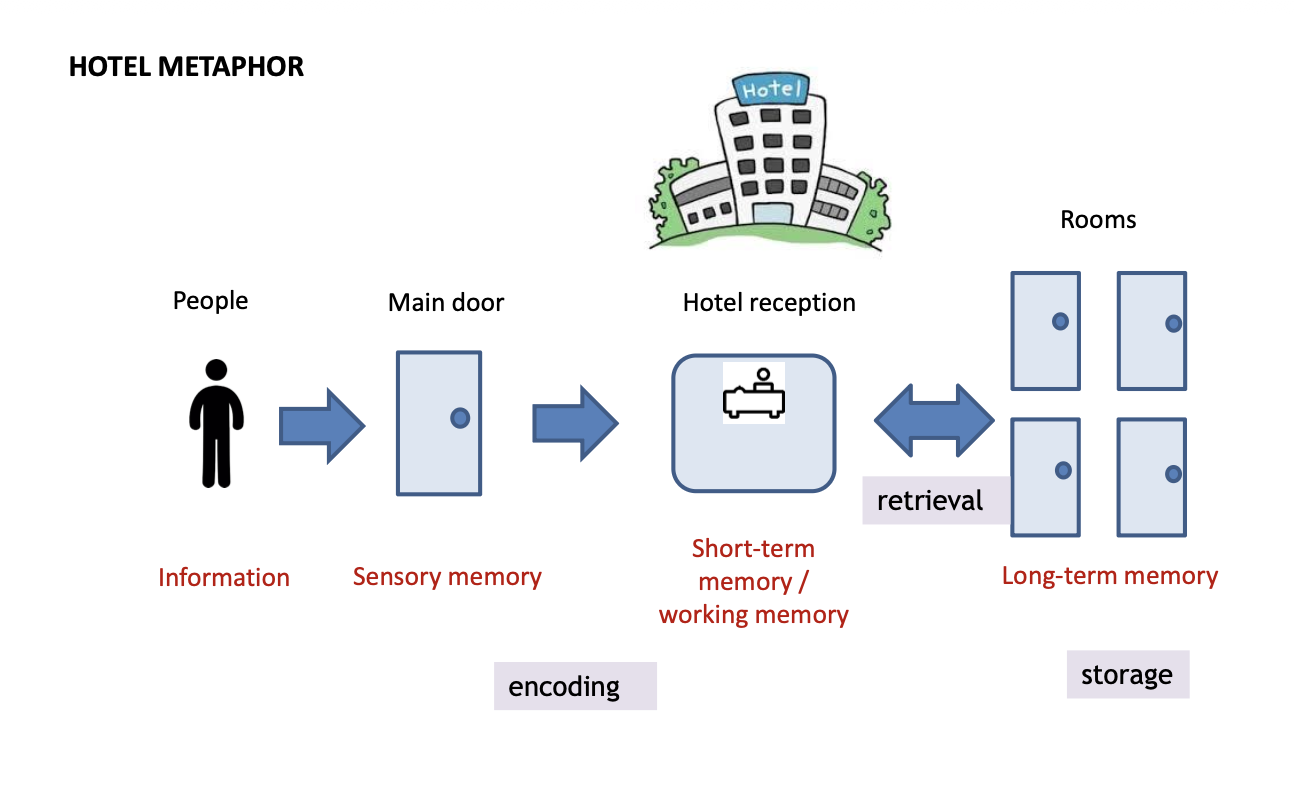
Encoding
The perceptual processing of information & its processing in the short-term memory (attention).
Encoding is a key process in
Perception & attention.
Storage
Is the generation of a memory trace in long-term memory.
Retrieval
Is the transfer of information from long-term to short-term memory (we attend to that information again).
Different tyopes of retrieval
Free retrieval → retrieval with clues → recognition tasks
According to the modal model, a crucial strategy for storing information in long-term memory is
Is holding it in short-term memory (the longer the information is held in short-term memory, the better the learning)