Drafting and Interpreting Financial Statements
 Call Kai
 Learn
Learn Practice Test
 Spaced Repetition
 Match
Match Flashcards
 Knowt Play
1/186

Earn XP
Description and Tags
All 8 chapters combined
Name | Mastery | Learn | Test | Matching | Spaced | Call with Kai |
|---|
No analytics yet
Send a link to your students to track their progress
187 Terms
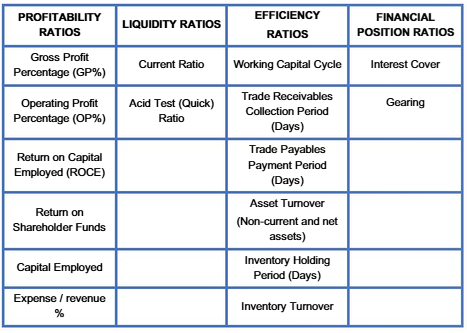
Financial Analysis
Profitability
Liquidity
Efficiency
Financial Position
Profitability
Measures looks at how successfully the business has made money during the period
Liquidity
Ability to meet its financial obligations
Efficiency
How well is business managed - and how successfully it uses resources
Financial Position
How well structured - financed by debt / equity holders
Ways of calculating financial measures
As a ratio - How the figures relate to each other.
As a percentage - One number is expressed as a proportion of another.
Making comparisons
Our own performance in previous years
Our performance this year against our own targets or benchmarks
Our performance this year against the performance of our competitors
Profitability Ratios - profits are required for;
Shareholders expect to receive a reward for the risk they have taken in investing their money in the business - this reward is the dividends.
Re-invest in new assets, or pay dividends in the future if it doesn’t perform well.
Gross Profit %
Gross Profit / Revenue
Shows how much gross profit a business makes for every £1 of sales revenue it earns.
Rising GP% = Increase in prices without an increase in COS, or reduced COS
Falling GP% = reverse of the above.
Operating Profit %
Operating Profit / Revenue
Gross Profit% but factoring in overheads
Rising OP% = Increase in GP% / Better control on expenses
Falling is the reverse of the above
Expense / Revenue
Wishing to compare how well entities control their expenses
Return on Capital Employed (ROCE)
Operating profit / (Total Equity + Non-current liabilities)
Higher the % the better, it means increasing profits whilst maintaining size.
Return on Shareholder funds %
(Profit after tax - (preference share / non con-trolling interest dividends)) / Total Equity
Used to compare existing or potential investments in different companies
Efficiency Ratios
Efficient business uses its resources on a day-to-day basis. Concerned with the management of its working apital
Inventory
Inventory Holding days = Inventory / Cost of Sales * 365
Inventory Turnover (times) = Cost of Sales / Inventory
This shows the efficiency of selling products, how long it takes on average to shift product, average number of times inventory has been sold in the period
Receivables Collection Period (in days)
Receivables / TUrnover * 365
Should match credit period offered to customers
Payables Collection Period (in days)
Trade Payables / Cost of Sales *365
The longer the better - to long may cause supplier issues
Working Capital Cycle (days)
Inventory Days + Receivables Days - Payable Days
This reflects the period of time that must be financed for when they first pay for goods or materials to the time when they receive payment from customers for sales made to them. The shorter the better
Asset Turnover (times)
Revenue / (Total Assets - Current Liabilities)
Revenue (Non-Current Assets)
The Liquidity Ratios
Current Ratio
Quick Ratio
The Current Ratio
Current Assets / Current Liabilities
This shows you how many times the company will be able to pay its current liabilities using its current level of short-term assets (Inventories, Trade Receivables, Bank and Cash Balances). Ideally sitting at 1.5-2:1
Quick Ratio (Acid Test)
(Current Assets - Inventory) / Current Liabilities
Inventories are removed as in most businesses there is a significant delay from inventory being converted into cash
Thus making this a more robust measure
A ratio less than 1:1 is often seen as a sign of as a risky level of liquidity.
Financial Position Ratios
Gearing
Interest Cover
Gearing
Non-Current Liabilities / (Total Equity + Non-Current Liabilities)
This calculates how much of the total value of the business is financed through debt
Interest Cover
Profit from Operations / Interest
How many times an entity is able to ‘cover’ its interest charges out of its profits.
Limitations of Ratio Analysis
Ratio analysis is looking at the past and not the present
Ratio analysis does not consider external factors, such as economical factors and the business environment for that industry, recession and inflation.
Ratio analysis does not measure the human element of an organisation (e.g. product quality, customer service, employee moral).
Ratio Analysis can be only truly useful when comparing with other businesses of the same size and type.
When does a group exist?
When one entity controls anothers shares by 50% or more
Goodwill
“THe difference between the amount paid by the parent for the shares in the subsidiary, and the value that has been acquired
How to measure the value acquired (goodwill)
Share Capital + Other Reserves + Retained Profit
Post acquisition profits
Post acquisition profits belong not only to the subsidiary, but also to the group.
Non-Controlling Interest
The equity in a subsidiary not attributable, directly or indirectly, to a parent.
Non-Controlling Interest must be show in the equity section
This will reflect the value of the subsidiary company which is owned by shareholders outside of the group.
Fair Values in Consolidated Financial accounts
The consolidated Financial Statements reflect the cost of the business acquired at the fair values of all of the assets and liabilities as at the date of acquisition.
Intra-Group Transactions
Loans from one company to another
Sales of Goods or services from one company to another
Payment of dividends paid by one company to another
Loans from one company to another
There is no obligation (liability) between the group and the outside world, and so there is no need to record the loan in the consolidated accounts and we must remove it.
Sales of goods or services from one company to another
Intra-Group transactions do not affect the level of obligation to the outside world, and therefore must be removed in the consolidated statements.
It may be necessary to make an adjustment to the individual company balances at the year end to reflect items in “transit” - this could be cash or goods which have been accounted for in one entity’s accounts but not the other.
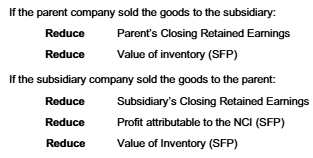
So long as the goods have all been sold to the outside world there there is no problem. The profit element of an intra-group sale is recorded in the selling company’s SPL and retained earnings in the SFP, but this is effectively cancelled out by the purchasing company recording the cost of these goods in its cost of sales computations
Unrealized profit must be removed from the consolidated statements. THerefor, a provision for unrealized profit (PUP) must be made. This provision reduces the progit and the value of the closing inventory.
The consolidated Statement of Profit or Loss
The adjusted profit of the group belongs primarily to the shareholders of the parent company. However, where there is a non-controlling interest (NCI) in the subsidiary, the NCI is entitled to receive a percentage share of the subsidiary’s profits only. this proportion of the group’s profits which ‘belonds’ to the NCI should be caculated first, with the proportion ‘belonging’ to the parent company then being calculated as a balancing figure.
ELimiate intra-group transactions from the revenue and cost of sales figures
Eliminate unrealized profits on goods still in inventory at the year end.
nifty cheat sheet
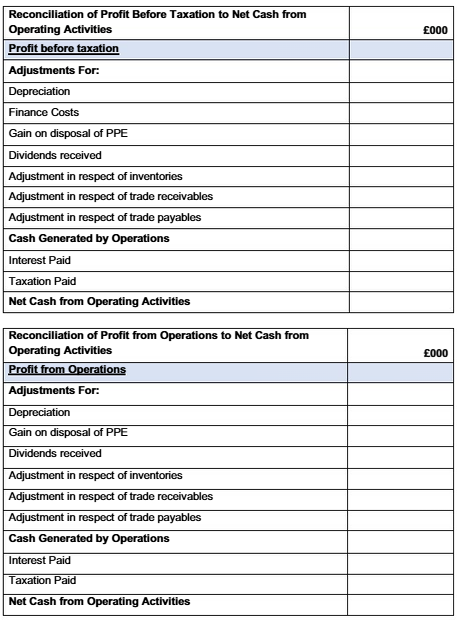
Starting point of a Statement of Cash Flows
To reconcile the profit for the year to the net cash that has been generated during the year.
What do we need to start then?
Trading Profit of the business
How do we calculate the Trading Profit from Profit before tax?
Profit before tax
+
Finance Costs
+
Depreciation
+
Loss on disposal of PPE
-
Dividends Received
=
Trading Profit
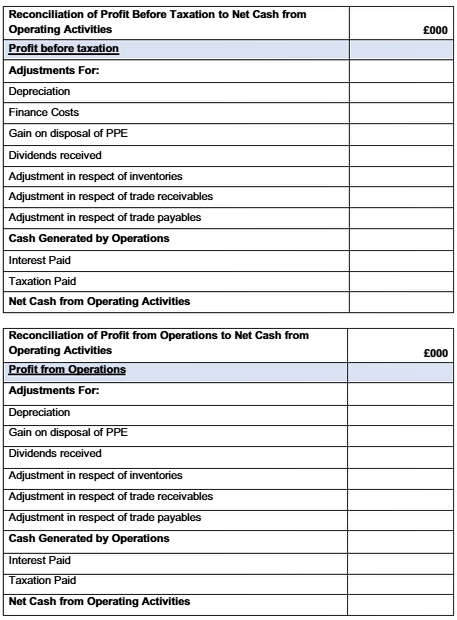
How do we calculate the Trading Profit from Profit from Operations?
Profit from Operations
+
Depreciation
+
Loss on disposal of PPE
-
Dividends Received
=
Trading Profit
Depreciation (Cash Flow)
Identify the depreciation charge for the year. It is a non-cash item that has decreased our profit and is not part of our ordinary trade, so we will need to add it back to our profit.
Dividends received (Cash Flow)
Dividends received are not part of profit from operations - they will be dealt with under investing activities
Gain/Loss on Disposal of PPE (Cash Flow)
A gain or a loss arising from the sale or other disposal of a non-current asset should not be included in the profit from normal trading/operations.
Finance Costs (Cash Flow)
This is not ordinary trade, and is thus added back. It is later deducted in the second half of the Cashflow Statement
Inventory (Cash Flow)
Calculate the difference between the start and end of the year, decrease in inventories = add, increase in inventories = deduct.
Receivables (Cash Flow)
Calculate the difference between the start and end of the year, decrease in receivables = add, increase in receivables = deduct.
Payables (Cash Flow)
Calculate the difference between the start and end of the year, decrease in payables = deduct, increase in payables = add.
Finance Costs (Interest) and Taxation
The amount of tax or interest actually paid during the period can be calculated from:
Balance at start of the year + Charge for this year - Balance at end of year = Amount paid.
Second half of the Statement of Cash Flows
Investing Activities
Financing Activities
Investing Activities
Purchase of non-current assets
Disposal of non-current assets
Receipts of dividends
Financing Activities
Repayment of bank loans
Taking out new loans
Issue of new share capital (including share premium)
Payment of dividends
Disposal of PPE
Carrying amount of PPE sold + Loss (Or Gain) on disposal of PPE
Purchases of PPE
PPE at start of the year - Depreciation Charge[Acc.dept at end-Acc.dept at Start] - Carrying amount of PPE sold - PPE at end of year = -Total PPE additions
Operating Activities Cash Flows
Add Depreciation
Less investment income
Changes in Inventories, receivables and payables
Less interest paid
Less taxes on income
Interest Activities Cash Flows
Inflows
Sale proceeds from sale of PPE and other non-current assets
Interest and dividends received
Outflows
Purchases of PPE and other non-current assets
Financing Activities Cash Flows
Inflows
Receipts from increases in share capital
Increases in long-term loans
Outflows
Repayment of share capital / loans
Dividends paid
IAS 10 Events After the Reporting Period
Events after the reporting period are those events, favorable and unfavorable, that occur between the end of the reporting period and the date when the financial statements are authorized for issue.
An adjusting event
Provides evidence of conditions that existed at the end of the reporting period
Non-adjusting evenet
Is indicative of conditions that arose after the reporting period
Typical Adjusting Events
Conclusion of a court case which had been ongoing at the financial year end
Impairment of assets
A reduction in value of inventories where net realisable value falls below cost
Insolvency of a major trade customer
Discovery of fraud by an employee
Typical Non-adjusting Events
A new business combination - purchase of, or sale to, another entity
THe major purchase of non-current assets
Damage to non-current assets or loss of production capacity to fire or flood
Issue of new share capital
Taking out a new (or increasing an existing) loan
Material Adjusting Events
Are accounted for by altering the amounts shown in the financial statements to reflect the event
Material Non-adjusting events
Are included as a note to the accounts giving, where possible, an indication of the likely financial effect of the event.
IAS 12 Income Taxes
The actual tax liability is usually not agreed until the financial statements are published - hence there will often be an under-provision or over-provision of taxation in any given financial period.
IFRS 15 - Revenue from Contracts with Customers
This introduced a new model of revenue recognition that is based on the transfer of control, at what point the transfer takes place and the amount to recognize
A Contract
An agreement between two or more parties that creates enforceable rights or obligations - written, oral or implied
A Customer
A party that contracts with an entity to purchase goods or services that are the output of the entity’s ordinary activities in exchange for consideration
Income
Increases in assets, or decreases in liabilities, that result in increases in equity, other than those relating to contributions from holders of equity claims
Revenue
The gross inflow of economic benefits during the period arising in the course of the ordinary activities of the entity, when those inflows result in increases in equity, other than increases relating to the contributions from equity shareholders
Difference between Income and Revenue
Revenue is only derived in the “course of the ordinary activities of the entity”
The five step model
Identify the contract with the customer
Identify the performance obligations in the contract
Determine the transaction price
Allocate the transaction price
Recognize revenue when (or as) a performance obligation is satisfied
Identify the contract with the customer
Be approved by both parties
Identify the rights of each party
Identify the payment terms
Have commercial substance
SHow that it is probable that the entity will collect the consideration when it falls due, in exchnage for goods and services
Identify the performance obligations in the contract
Performance obligation is a promise in a contract with the customer to transfer goods or services to the customer.
Determine the transaction price
The transaction price is the amount to which the entity, in exchange for transferring the provided goods and services. Variable consideration can only be included if it is highly probable that there will not be a signifcant reversal of revenue in the future
Allocate the transaction price
Allocation is based on the relatie standalone (separate) selling price of each performace obligation. ANy overall discounts should also be proportioned evenly between each individual part.
Recognize revenue when (or as) a performance obligation is satisfied
Revenue is recognized in financial statements when an entity satisfies a performance obligation by transferring promised goods or services to a customer. This is the point that the control of the product is passed to the customer.
Performance obligation can be satisfie
Over time
The customer simultaneously receives and consumes all the benefits provided by the entity and the entity performs
The entity’s performance creates or enhances an asset that the customer controls as the asset is created
The entity’s performance does not create an asset with an alternative use to the entity, and the entity has an enforceable right to the payment for performance completed to date.
Point in time
The customer has legal entitlement to the asset
The customer has physical possession and has accepted the asset
The significant risks and rewards have passed to the customer
The entity has a present right to payment for the asset.
IAS 37 - Provisions, Contingent Liabilities and Contingent Assets
IAS 37 defines and specifies the accounting for and disclosure of provisions, contingent liabilities, and contingent assets.
Provision
A liability of uncertain timing or amount
When should a provision be recognized?
The company has a present obligation as a result of a past event
It is probable that there will be an outflow of economic resources required to settle the liability
A reliable estimate of the liability can be made
When should the value of provisions be re-assessed?
The value of all provisions should be re-assessed at the end of each financial year, and adjusted if necessary
Contingent Liability
Possible obligation arising from past events whose existence will only be confirmed by one or more uncertain future events not entirely within the entity’s control
Or
A present obligation that arises from past events. but which is not recognized because it is not probable that an outflow of economic benefits will be required, or that obligation cannot be measured with sufficient reliability
Difference between a Provision and Contingent Liability
The difference is based on the degree of certainty,
Provision is equal to or greater than 50% certainty.
Contingent Liabilities are between 20% and 50% certain - these are notes only.
Anything below 20% is known as a Remote Contingent Liability - which gets no disclosure at all including in the notes.
Contingent assets
A possible asset arising from past events which will only be confirmed by uncertain future events not wholly within the entity’s control
When are contingent assets declared in financial statements?
A contingent asset is never shown in the financial statements unless virtually certain.
If it is probable (greater than 50%) A note is included.
Otherwise, it is left out completely like a remote contingent liability.
Objective of the International Accounting Standards Board (IASB)
to develop, in the public interest, a single set of high quality, understandable and enforceable global accounting standards that require high quality, transparent and comparable information in financial statements and other financial reporting to help participants in the world's capital markets and other users make economic decisions.
Purpose of IASB's Conceptual Framework for Financial Reporting
IASB's Conceptual Framework for Financial Reporting provides us with
The Main users of Financial Statements
Investors, Lenders, Government, Suppliers, General Public, Management, Employees, Trade Unions, Competitors, and Customers
Most important users of financial statements
Current and potential investors are the most important due to being owners, thus they are put at the forefront, alongside lenders and creditors, as these three have the most to loose.
What are the underlying assumption on which financial statements should be prepared on
What is Going Concern
The financial statements are assumed to have been prepared on the basis that the entity will continue in business for the foreseeable future, and the enterprise as neither the intention nor the need to liquidate or curtail materially the scale of its operations.
What is the Accrual Basis
The effects of transactions and other events are recognised when they occur and not when the cash is received or paid.
Qualitative Characterists of useful financial information
What are the Fundamental Qualitative Characteristics of useful financial information
Relevance, and Faithful Representation
What makes information Relevant?
It is capable of making a difference in the decision-making process AND has one of the following:
What makes information have the quality of “Faithful Representation”
What are the Enhancing Qualitative Characteristics of useful financial information
Verifiable, Comparable, Understandable, Timely