Radiation Generating Equipment
 Call Kai
 Learn
Learn Practice Test
 Spaced Repetition
 Match
Match Flashcards
 Knowt Play
1/38

There's no tags or description
Looks like no tags are added yet.
Name | Mastery | Learn | Test | Matching | Spaced | Call with Kai |
|---|
No analytics yet
Send a link to your students to track their progress
39 Terms
Cathode
boils off electrons thru thermionic emission which are accelerated toward the target
anode
the target is usually made of tungsten due its high melting point
why is the kV x-ray target usually made of tungsten?
due its high melting point
How is heat dealt with in kV x-ray tubes?
rotating anode, beveled anode, oil
rotating anode
used to spread heat around the edge of rotating disc
beveled anode
allows electrons to strike a large area while maintaining a small effective focal spot
heel affect
x-ray coming from deep within the targe are hardened to higher energies, while relative number (intensity) of x-rays is higher towards the cathod
kV x-ray power supply
supplied by transformer and is rectified to generate a constant voltagere
rectification
uses diodes to modulate the alternating AC potential so that the negative section of the waveform is inverted causing a constant positive potential
Why is the power rectified in a kV x-ray tube?
allows tube to generate x-rays during the whole wave cycle and prevents electrons from flowing backward toward the cathode potentially damaging it
categories of kV machines:
grenx-ray therapy, contact therapy, superficial therapy, orthovoltage therapy, supervoltage therapy
grenz-ray therapy
below 20 kVp (little use)
contact therapy
40-50 kVp
papillon technique for rectal cancer
superficial therapy
50-150 kVp
skin treatments within 5 mm of surface
Orthovoltage therapy
150-500 kVP
Superficial lesions within 2 cm of surface
Supervoltage therapy
500-1000 kVp
not practical due to difficulties in generating these voltages without a transformer without arcing
Electrons vs. Superficial x-rays
superficial x0rays deliever a PDD with essentially no buildup region
superficial x-ray exhibit increase dose to bone due to more photoelectric interactions
x-rays do not have finite range and will give more dose to underlying tissues
x-rays have a sharper penumbra than electrons
calibrating superficial x-ray units is difficult (large energy dependencies of most detectors)
Van De Graaff Generators
x-rays up to 10 MV
functions by using a belt to strip electrons off donor source and carries thenm up to dome where they are removed creating a high voltage differential (used to accelerate electrons to target to produce x-rays)
No longer used
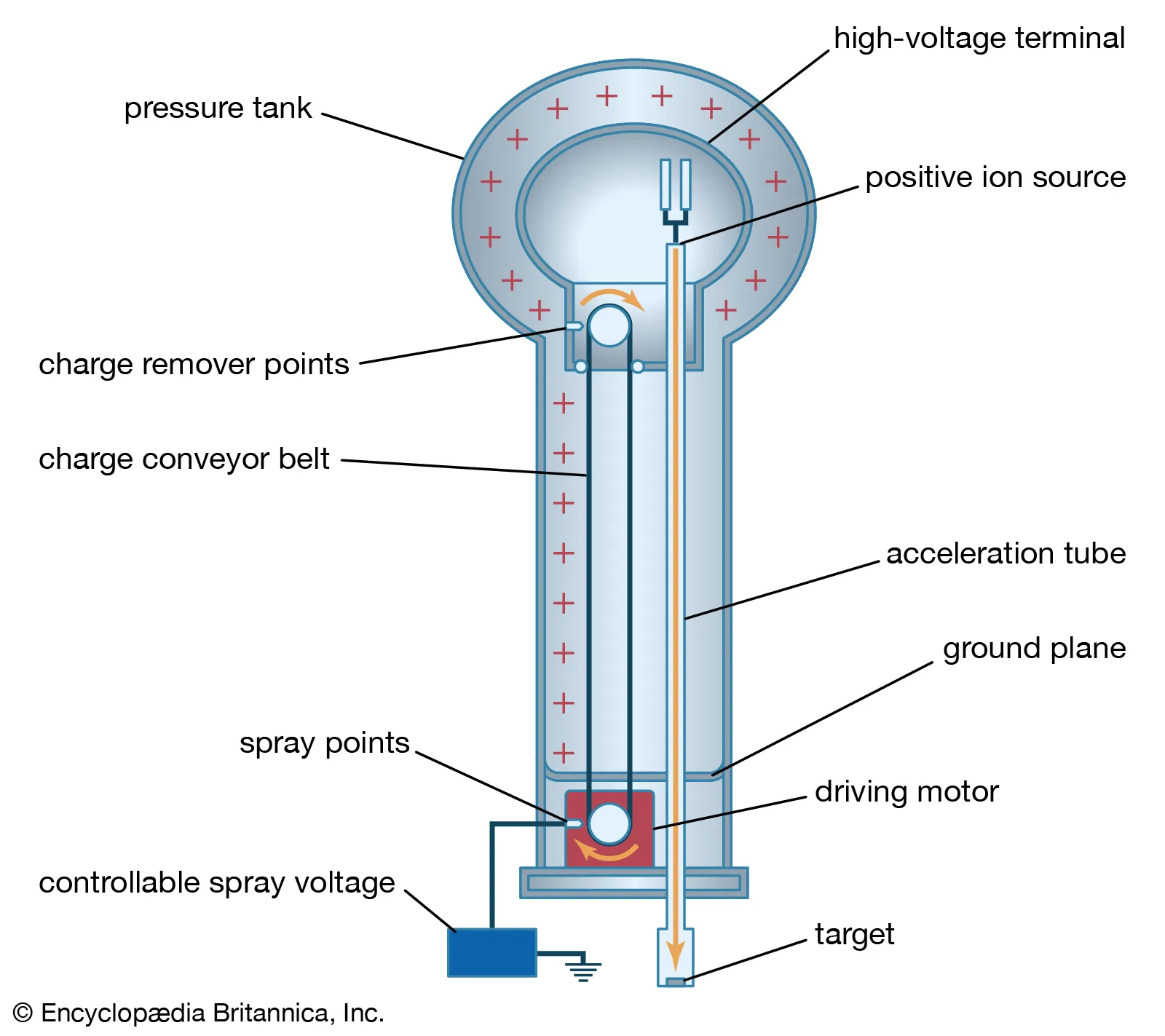
Van de Graaff Generator (ball that makes hair spike)
Co-60 Teletherapy
relatively high energy 1.25 MeV (similar to 4 MV linac)
allowed for skin sparing due to 5 mm buildup region and deeper treatments
larger penumbra
C0-60 generation
by placing Co-59 into a nuclear reactor where it absorbs a neutron converting it to Co-60
shutter effect
due to co-60 source being movied into shielded or active position
slight delay in source turning on and off
co-60 penumbra
due to transmission and geometric penumbra
transmission penumbra of co-60
can be reduced by using divergent collimators
geometric penumbra co-60
due to somewhat large source size
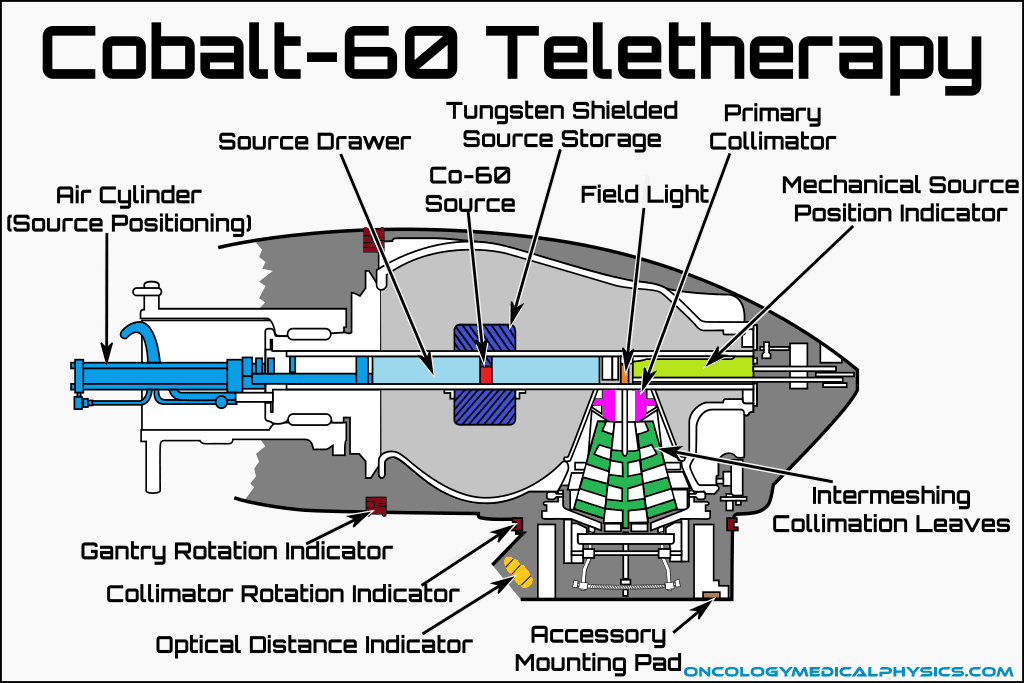
Cobalt-60 machine
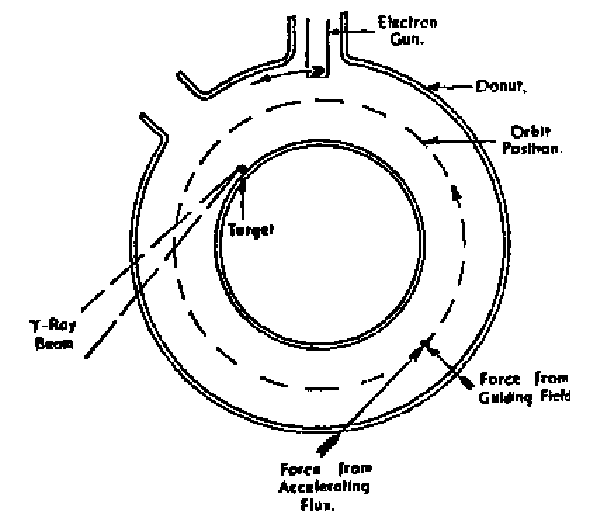
Betatron
Betatron
used to accelerate electron up to 40 MeV
-electrons in a changing magnetic field are accelerated in circular orbit
-limited by max beam current
no longer used
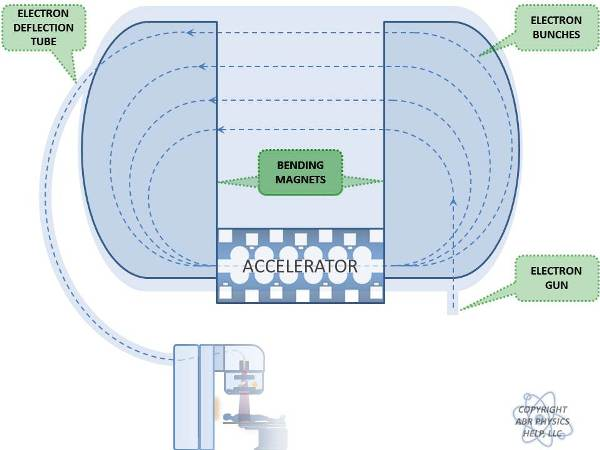
Racetrack Microtrons
Racetrack Microtrons
uses a small linac utilizing microwave cavities to accelerate electrons which are returned back to accelerating structure by a magnetic field
needs phase adjusted so electrons return to accelerator in phase with microwaves
allow easy energy selection and small size, may power multiple gantries
think: cyclotron plus linac
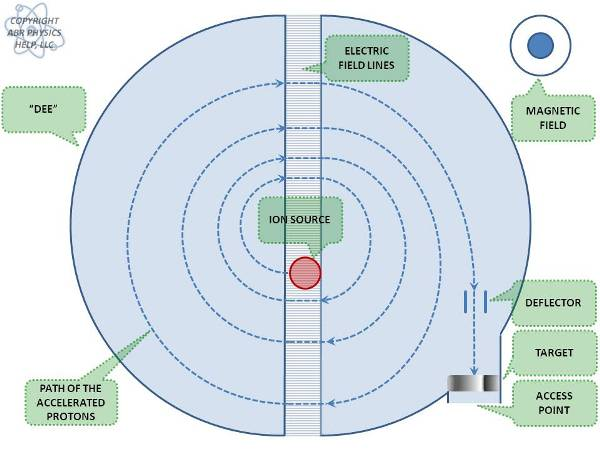
Cyclotron
Cyclotrons
uses a constant magnetic field and constant frequency electron field
has 2 hemispherical magnets that bend electrons back toward the gap between them
gap has an alternating electric field to increase electron energy
Problem: at relativistic energies where particles drift out phase due to decreased acceleration with increasing mass
Synchrotrons
solves cyclotron problem by adjusting magnetic and electric fields so that particles always traverse the same path thru the magnets
used to produce radiopharmaceuticals and in proton therapy
Linacs
use microwave energy to accelerate electrons
advantages: high dose rates, falate uniform beam profiles with sharp penumbra, are not radioactive when off, wide range of energies
very mechanically complex
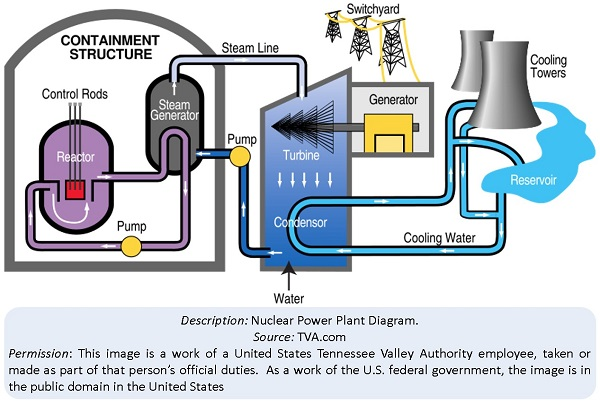
Nuclear Reactors
designed to harness power of nuclear fission
U-235 most common fuel
fission
occurs in heavy isotopes where atoms break apart after being struck by a neutron into smaller constituents and release energy along with additional neutrons
additional neutrons go on to strike more atoms and create a chain reaction
typical: U-235 and Pt-239
U-235
most common fuel in a nuclear reactor
naturally occuring
Requirements for a chain reaction
-geometry of fuel must be such that enough is in close proximity to allow neutrons to reach additional fuel
-neutrons emitted must be moderated to lower energies (done with water)
- reaction must be controlled with some sort of neutron absorbing material (usually in control rods that can be inserted and removed from core, materials like boron, cadmium, and indium)
how do nuclear reactors create radioactive materials
if a sample is inserted into the core, it can absorb excess neutrons and change it to another isotope that is radioactive
Ex. stable co-59 to co-60
stable Ir-191 to Ir-192