Connective tissue proper
 Call Kai
 Learn
Learn Practice Test
 Spaced Repetition
 Match
Match Flashcards
 Knowt Play
1/27

There's no tags or description
Looks like no tags are added yet.
Name | Mastery | Learn | Test | Matching | Spaced | Call with Kai |
|---|
No analytics yet
Send a link to your students to track their progress
28 Terms
Connective tissue proper definition
Connective tissue proper (general connective tissue) is classified into two major types based on the density of connective tissue fibres: loose connective tissue and dense connective tissue.
Classification of connective tissue proper
Connective tissue proper is divided into two types based on fibre density: loose connective tissue and dense connective tissue.
Loose connective tissue characteristics
Loose connective tissue is characterised microscopically by a relative abundance of cells and ground substance and a loose arrangement of fibres.
Dense connective tissue characteristics
Dense connective tissue is distinguished microscopically by closely packed fibres with relatively few cells and little ground substance.
Loose connective tissue general features
Loose connective tissue is found between organs where it cushions, supports and binds structures together and facilitates diffusion of water, salts and nutrients to nearby cells.
Types of loose connective tissue
The three types of loose connective tissue are areolar connective tissue, adipose tissue and reticular connective tissue.
Areolar connective tissue definition
Areolar connective tissue is the most common type of connective tissue proper and contains all connective tissue cell types and fibre types arranged in a loosely organised web-like pattern.
contains: fibroblasts, macrophages, mast cells
contains: loose arrangement of collagenous and elastic fibers
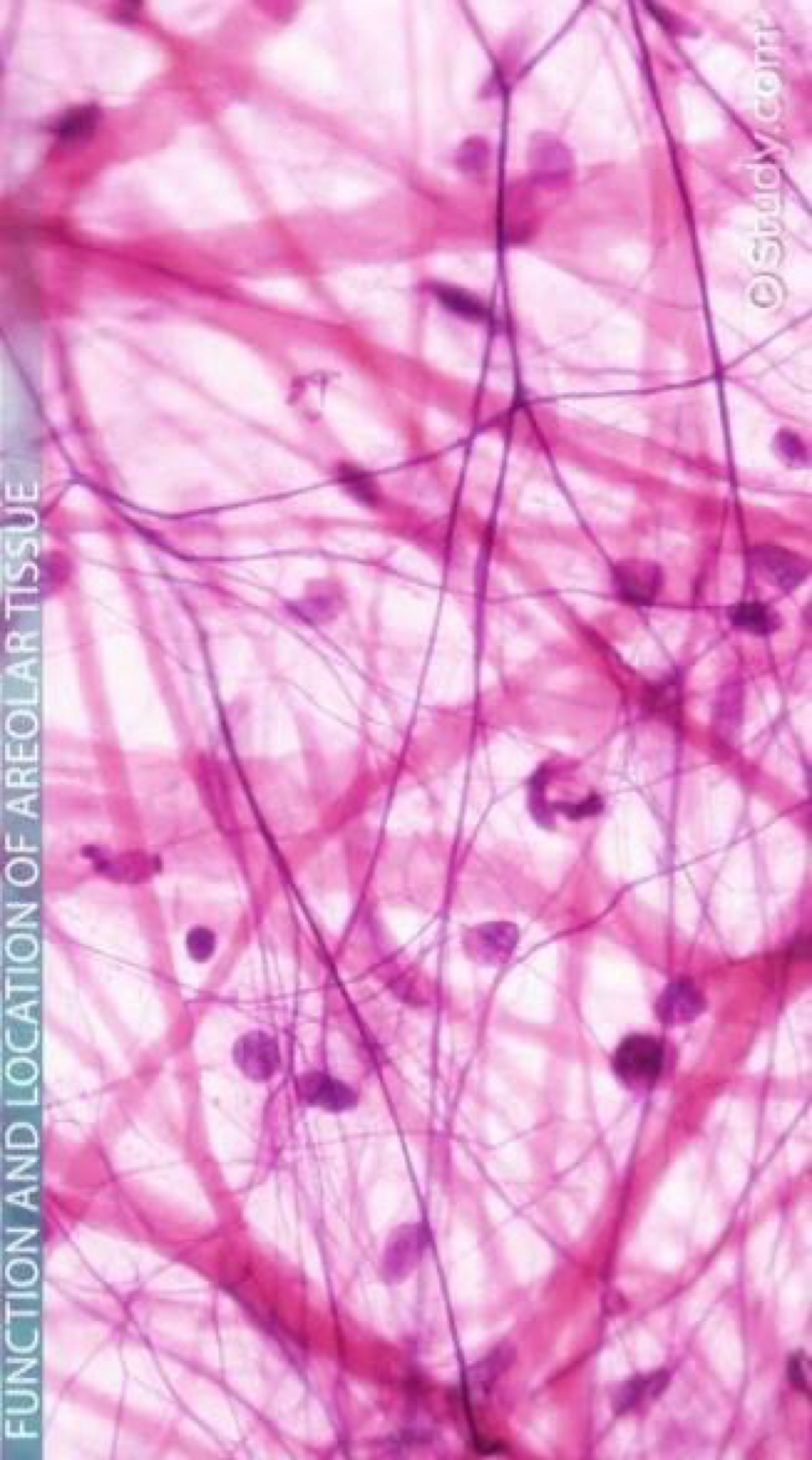
Microscopic features of areolar tissue
Areolar tissue contains a variety of connective tissue cells and fibres arranged loosely in a web-like pattern with relatively abundant ground substance.
Locations of areolar connective tissue
Areolar tissue fills spaces around muscles, surrounds blood vessels and lymph vessels, supports abdominal organs and lies beneath most epithelia forming part of epithelial membranes.
Function of areolar connective tissue
Areolar connective tissue acts as a packing tissue that fills spaces, supports organs and allows diffusion of water, salts and nutrients to nearby cells.
Adipose tissue definition
Adipose tissue is a type of loose connective tissue composed mostly of adipocytes with very little extracellular matrix. no fibers, little ground substance
Microscopic features of adipose tissue
Adipose tissue consists mainly of adipocytes containing large lipid droplets with little extracellular matrix and numerous capillaries (blood vessles that store lipids quickly or quick release into blood stream)
Function of capillaries in adipose tissue
The large number of capillaries present in adipose tissue allows rapid storage and mobilisation of lipid molecules.
Reticular connective tissue definition
Reticular tissue is a type of loose connective tissue that forms a mesh-like supportive framework for soft organs.
Microscopic features of reticular tissue
Reticular tissue consists of reticular fibres arranged in a network produced by fibroblasts forming a net-like framework. abundant ground substance so large space between cells
Locations of reticular connective tissue
Reticular tissue forms a supportive framework for soft organs including lymphatic tissues, the spleen and the liver.
Origin of the name reticular tissue
The name reticular tissue derives from the Latin word "reticulus" meaning "little net".
Dense connective tissue definition
Dense connective tissue contains a higher concentration of collagen fibres than loose connective tissue giving it greater tensile strength.
Types of dense connective tissue
The two forms of dense connective tissue are dense regular connective tissue and dense irregular connective tissue.
Dense regular connective tissue structure
Dense regular connective tissue contains parallel collagen fibres arranged in the same direction. contains elastic fibers only in some examples, contains fibroblasts (elongated flattened nuclei of inactive fibroplasts wedged between bundles of collagenous fibers)
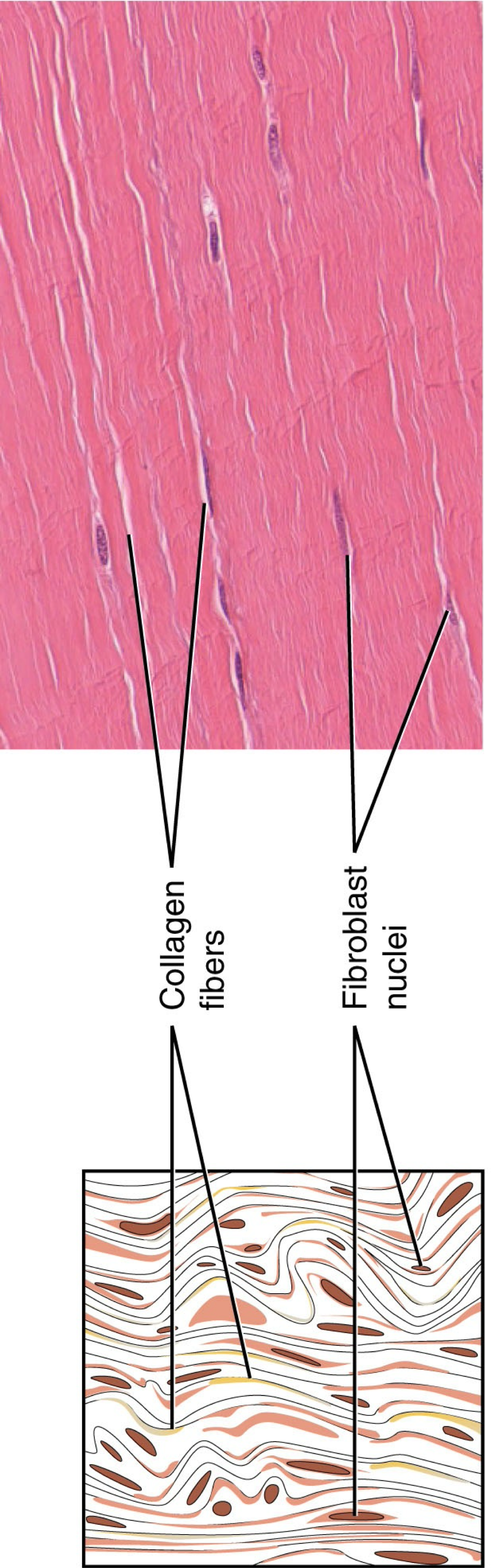
Function of dense regular connective tissue
The parallel arrangement of collagen fibres in dense regular connective tissue allows resistance to stretching in one direction.
Examples of dense regular connective tissue
Tendons and ligaments are examples of dense regular connective tissue. ligaments have more elastic fibers then tendons
Difference between tendons and ligaments
Ligaments contain more elastic fibres than tendons which allows them greater flexibility.
Appearance of collagen fibres in dense regular tissue
In photomicrographs collagen fibres in dense regular connective tissue appear wavy due to natural crimping which straightens under tension.
Dense irregular connective tissue structure
Dense irregular connective tissue contains collagen fibres arranged randomly or in layered orientations.
Function of dense irregular connective tissue
The irregular arrangement of collagen fibres provides strength and resistance to stress in multiple directions.
Locations of dense irregular connective tissue
Dense irregular connective tissue is found in the dermis of the skin, organ capsules, periosteum, endosteum and deep fascia.
Microscopic appearance of dense irregular connective tissue
Photomicrographs of dense irregular connective tissue show collagen bundles in both cross-section and longitudinal views due to the irregular orientation of fibres.