PLTW Medical Interventions Unit 2.2 Review
 Call Kai
 Learn
Learn Practice Test
 Spaced Repetition
 Match
Match Flashcards
 Knowt Play
1/34

There's no tags or description
Looks like no tags are added yet.
Name | Mastery | Learn | Test | Matching | Spaced | Call with Kai |
|---|
No analytics yet
Send a link to your students to track their progress
35 Terms
Plasmid
- Gene of any size
- No cell specificity
- No immune response
- Does not integrate into the host genome
- Less efficient at entering cells
Liposome
- Gene of any size
- No cell specificity
- No immune response
- Does not integrate into the host genome
- Less efficient at entering cells
Herpes Virus
- Gene up to 20,000bp
- Nervous system cells
- Immune response
- Does not integrate into genome
- Less efficient at entering cells
Adeno-Associated Virus
- Gene up to 5,000bp
- No cell specificity
- No immune response
- Integrate into genome
- Efficient at entering cells
Adeno Virus
- Gene up to 7,500bp
- No cell specificity
- Immune response
- Does not integrate into genome
- Efficient at entering cells
Retro Virus
- Gene up to 8,000bp
- Only diving cells
- Immune response
- Integrates into genome randomly
- Less efficient at entering cells
Lenti Virus
- Gene up to 8,500bp
- No cell specificity
- No immune response
- Integrates into genome randomly
- Efficient at entering cells
Invivo
- Inside patient
- Pros: Benefits occur more rapidly
- Cons: Greater chance of immune response, vector may enter unselected cell, cannot be analyzed to see results
Exvivo
- Outside of patient
- Pros: Less likely to cause immune response, can ensure cell selection and ensure results of therapy
- Cons: Patient has to wait for benefits of therapy
Concerns of Gene Therapy
- Immune response
- Selected cells
- Function of vector
How is the new gene transferred into the hosts cells?
There are two different ways that the DNA can be integrated into the cells. When using a virus as a vector, they will attach to the outside of the cell (as they usually do) but will release the modified DNA that will code for the correct protein in the cell. As for the use of other vectors, plasmids would be taken up and integrated by surrounding cells (through pili)
What does CRISPR stand for?
Clustered Regularly Interspaced Short Palindromic Repeats
Where does CRISPR come from?
It is a system used by bacteria to defend themselves against viruses (found in ecoli)
What part of CRISPR is used by humans?
CAS9
What is the CAS9?
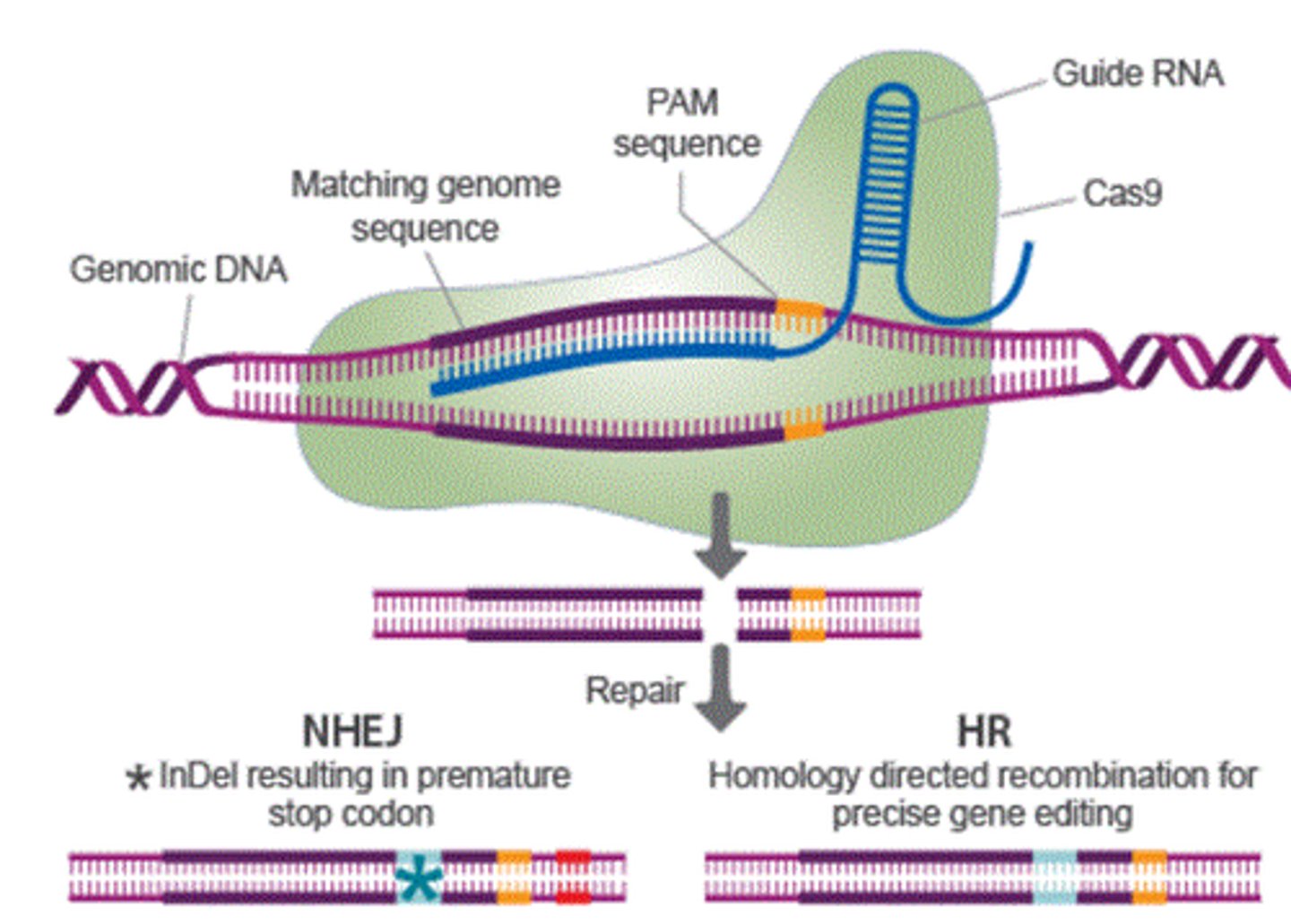
CAS9 is a CRISPR associated protein/enzyme that contains both helicases and nucleases. These unwind and cut the DNA at certain spots. This does the gene editing.
Nucleases
Enzymes that naturally cut DNA
Helicases
Enzymes that unwind and expose DNA sequence
gRNA
Manipulated RNA that targets DNA of interest and provides new healthy DNA to be replaced after cut by CAS9
PAM
A guide that tells the nucleases where to cut the DNA and interrupt the sequence
Target Gene
The unhealthy gene
CAS9 Diagram
IVF (in vitro fertilization)
A procedure in which gametes are fertilized in a dish in the laboratory, and the resulting zygote is implanted in the uterus for development.
Zygote
A diploid cell resulting from the fusion (fertilization) of two haploid gametes (first cell of embryo)
Embryo
The early stages of development during the growth of a multicellular organism (2-8 weeks after fertilization)
Uses of PGD (preimplantation genetic diagnosis)
- Look for chromosomal abnormalities
- Sex of fetus
How does PGD work?
1-2 cells are extracted from the embryo and analyzed through the use of a karyotype
Reproductive Endocrinologist
A surgical subspecialty of obstetrics and gynecology that trains physicians in reproductive medicine addressing hormonal functioning as it pertains to reproduction as well as the issue of infertility.
Andrologist
The medical specialty that deals with male health, particularly relating to the problems of the male reproductive system and urological problems that are unique to men.
Embryologist
A fertility specialist that helps to create viable embryos to either be used in IVF right away or to be frozen for later use.
Why was Dolly so important?
She was the first successfully cloned mammal using the nucleus of somatic cells.
Therapeutic Cloning
The cloning of human cells by nuclear transplantation for therapeutic purposes, such as the generation of embryonic stem cells to treat disease.
Reproductive Cloning
Using a somatic cell from a multicellular organism to make one or more genetically identical individuals.
How does cloning work?
A mature somatic cell is taken from a patient and the nucleus is inserted into a donor egg. After the egg has developed, the embryo will either be implanted into a mother to fully develop or will grow to 100 cells (blastocyst) and then be destroyed for specific stem cell use.
Process of Gene Cloning (Basic)
A bacterial plasmid is altered through the use of restriction enzymes, recombinant DNA, ligase, and other tools. These are then grown with other bacteria and through conjugation are spread through a colony. These reproduce the integrated gene through protein synthesis and can then be used for human purposes.
Specific Use for Each Cloning
Gene: Used for the synthesis and mass production of a specific gene (vitamins, hormones, antibiotics)
Therapeutic: Used to make cells that can be inserted to produce the needed proteins
Reproductive: Used to make an exact copy of an entire organism