Lecture 20 (Protein Regulation, Allostery, Phosphorylation & Degradation)
 Call Kai
 Learn
Learn Practice Test
 Spaced Repetition
 Match
Match Flashcards
 Knowt Play
1/44

There's no tags or description
Looks like no tags are added yet.
Name | Mastery | Learn | Test | Matching | Spaced | Call with Kai |
|---|
No analytics yet
Send a link to your students to track their progress
45 Terms
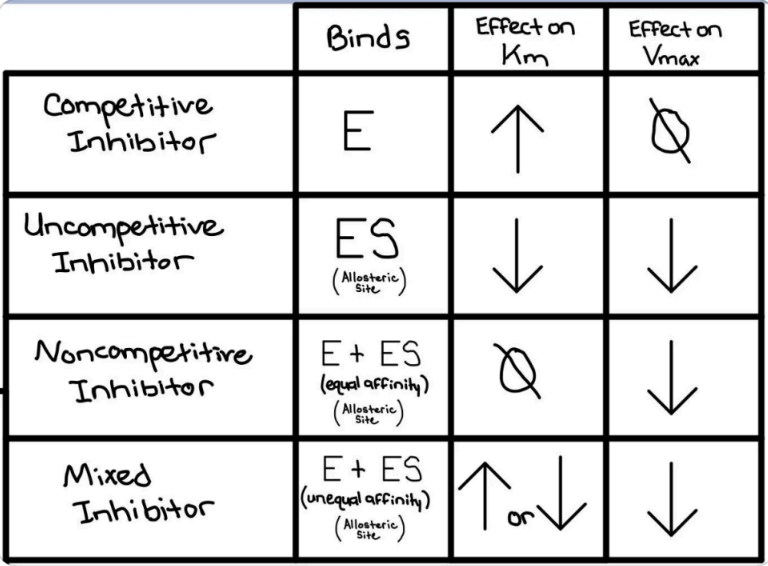
What are apparent Vmax/Km effects of reversible inhibitors?
Competitive: Vmax same, Km ↑
Uncompetitive: Vmax ↓, Km ↓
Mixed: Vmax ↓, Km ↑ or ↓
Noncompetitive: Vmax ↓, Km same
What are the major ways proteins are regulated?
Allosteric regulation/feedback inhibition
Covalent modification/phosphorylation
Cellular compartmentalization
Zymogen activation
Protein synthesis/gene regulation
Protein degradation
What are zymogens?
Inactive precursor forms of enzymes
What is a good enzyme candidate for regulation?
Start of pathway enzyme with a strongly favored forward reaction
What is the allosteric modulator?
May be substrate in which the allosteric site and the active site are the same.
Example of homotrophic allosteric modulation
What are allosteric enzymes?
Usually multimeric enzymes regulated by ligand binding at sites affecting activity
What is homotropic allostery?
Substrate acts as allosteric modulator
What is heterotropic allostery?
Non-substrate modulator binds a separate regulatory site
What do allosteric activators do?
Enhance catalytic activity
Decrease Km/K0.5 and/or increase Vmax
What do allosteric inhibitors do?
Decrease catalytic acitivity
Increase Km/K0.5 and/or decrease Vmax
What is cooperativity in allosteric enzymes?
Binding one ligand changes activity/affinity at other sites
What is positive vs negative cooperativity?
Positive enhances activity/affinity
Negative decreases activity/affinity
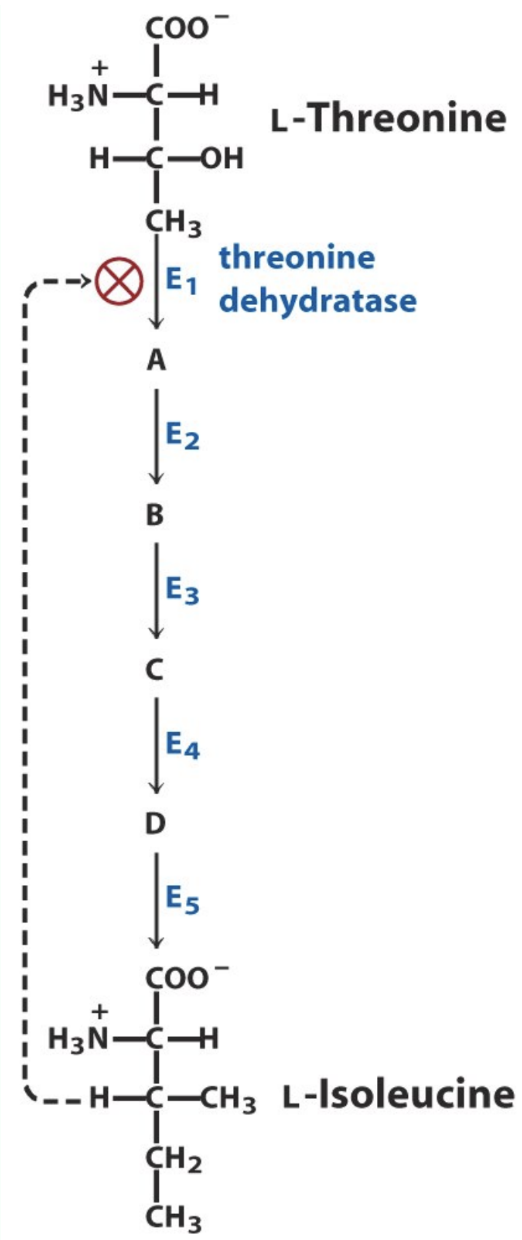
What is feedback inhibition?
Late pathway product binds an allosteric/regulatory site on an early enzyme and inhibits it
Is feedback inhibition reversible?
Yes; dissociation of the modulator reverses the conformational change
What is positive regulation?
Product from one pathway stimulates an early enzyme in another pathway
How are allosteric and active sites linked?
Binding at one site affects binding/activity at the other site
How can high substrate oppose feedback inhibition?
Substrate stabilizes active form, reducing affinity for allosteric inhibitor
What is catabolism?
Breakdown of nutrients to energy-depleted products; energy stored in ATP/NADH
What is anabolism?
Synthesis of complex molecules from simple ones; requires free energy
What indicates a high-energy cell state?
High ATP, acetyl-CoA, and citrate
What indicates a low-energy cell state?
High ADP and AMP
How do energy signals affect catabolism?
ATP inhibits; ADP/AMP activate
How do energy signals affect anabolism?
ATP activates; ADP/AMP inhibit
What residues are phosphorylated for regulation?
Ser, Thr, and Tyr
What does protein phosphorylation do?
Reversibly changes conformation or enables binding/signaling
How common is phosphorylation in eukaryotic cells?
About 1/3 of proteins are phosphorylated at a time
What enzymes phosphorylate proteins?
Kinases and phosphorylases
How do kinases vs phosphorylases differ?
Kinases transfer phosphate from ATP; phosphorylases transfer phosphate from Pi
What enzymes remove phosphate groups?
Protein phosphatases
Can phosphorylation activate or inhibit enzymes?
Yes; it can switch enzymes on or off
How is pyruvate dehydrogenase regulated by phosphorylation?
Phosphorylation inactivates PDH; dephosphorylation activates it
What stimulates PDH phosphorylation/inactivation?
Acetyl-CoA and NADH
What stimulates PDH dephosphorylation/activation?
ADP and Ca2+
What inhibits PDH phosphorylation?
High NAD+ and pyruvate
How does compartmentalization regulate enzymes?
Signal sequences target enzymes to specific compartments where they act
How is trypsinogen activated?
Enteropeptidase cleaves an N-terminal peptide, creating active trypsin
How are proteases prevented from unwanted activity?
Protease inhibitors bind tightly to active sites
What is the proteasome?
Eukaryotic machinery that degrades proteins
What is proteasome structure?
20S core plus two 19S caps
How are proteins targeted to proteasome?
Polyubiquitin tags
What is ubiquitin?
76-AA protein covalently attached to Lys side chains via isopeptide bonds
What enzymes mediate ubiquitination?
E1 activates ubiquitin, E2 carries it, E3 ligase attaches it to target
How can degradation signals be revealed?
Phosphorylation, conformational change, complex dissociation, or protease cleavage
What is the N-end rule?
N-terminal amino acid identity can determine protein half-life/degradation rate
How can new N-termini trigger degradation?
Protease cleavage reveals an N-terminal residue that acts as a degradation signal