LC CHEM - electronegatvity and intermolecular forces!
 Call Kai
 Learn
Learn Practice Test
 Spaced Repetition
 Match
Match Flashcards
 Knowt Play
1/51

There's no tags or description
Looks like no tags are added yet.
Name | Mastery | Learn | Test | Matching | Spaced | Call with Kai |
|---|
No analytics yet
Send a link to your students to track their progress
52 Terms
Define electronegativity
the relative attraction an atom has for a shared pair of electrons in a covalent bond
Pure covalent bond (Non-polar covalent)
two atoms share a pair of electrons EQUALLY
Polar covalent bond
two atoms share a pair of electrons unequally
types of covalent bonds
polar, non polar
Why are electrons shared unequally in polar covalent bonding
the difference in electronegativity values is significant
the shared pair of electrons are pulled closer to the more electronegative atom
Why are electrons shared equally in polar covalent bonding
The difference in electronegativity values is 0, or so small
the shared pair of electrons are not pulled significantly closer to either atom and are shared equally
What is the significance of a molecule having polar covalent bonds
shared pair of electrons are pulled closer to the more electronegative atom
more electronegative atom has a negative dipole
less electronegative atom has a positive dipole
what electronegativity difference do pure covalent / non polar bonds have
no or tiny difference
between 0 - 0.39
what electronegativity difference do polar covalent bonds have
significant difference
0.4 - 1.69
what electronegativity difference do ionic bonds have
VERY large difference
greater than 1.7
If a question uses the word “molecule” is the compound covalent, or ionic?
covalent !
Exceptions to the electronegativity stuff
Lithium hydride (LiH)
Sodium hydride (NaH)
Potassium hydride (KH)
Calcium hydride (CaH2)
Hydrogen flouride (HF)
Boron Trifluoride (BF3)
What is a polar molecule?
molecule with an uneven distribution of electrical charge
one end of the molecule is partially positive, and the other end is partially negative
(has a positive and negative dipole)
When is a molecule polar ?
It has polar covalent bonds (EN difference is 0.4 - 1.69)
the molecule is not symmetrical (v shaoed or pyramidal)
What is a non polar molecule
molecule with an even distribution of electrical charge
no overall positive of negative end
when is a molecule non polar
if all bonds are pure covalent (ED DIFFERENCE 0.0 - 0.39)
or if the molecule is symmetrical (linear, trigonal planer, tetrahedral)
How can a molecule have polar covalent bonding but still be non polar molecules
If a molecule is symmetrical, the negative and positive dipole coincide with eachother and cancel out - there is no overall positive or negative ned
if a molecule is symmetrical, it is completely non polar regardless of the type of bonding it has
Symmetrical shapes of molecules
linear
trig planar
tetrahedral
Non symmetrical shapes of molecules
pyramidal
v shaped
shape of a molecule with two atoms
linear
shape of a molecule with three atoms and no lone pairs
linear
shape of a molecule with three atoms and lone pairs
v shaped
shape of a molecule with four atoms and no lone pairs
trigonal planer
shape of a molecule with four atoms and lone pairs
pyramidal
shape of a molecule with five atoms
tetrahedral
intramolecular bonds
type of bond INSIDE the molecule or compound (ionic, covalent)
intermolecular forces
forces of attraction existing BETWEEN one molecule and another (eg van der waals forces)
What are the vanderwaals forces
intermolecular forces of attractions that exist between all molecules
list the types of van der waals forces in order of weakest to strongest
london dispersion → dipole dipole force → ion dipole force
two types of dipole dipole forces
normal
hydrogen bonding
How are london dispersian forces caused?
all molecules can form temporary dipoles at each end due to the movement of electrons
when attractions form between the negative dipole of one molecule and the positive dipole of another molecule
Why are london dispersian forces so weak?
because the attraction is between temporary dipoles that only exist for an instant
what types of molecules do london dispersion forces come between
All types! (polar / non polar)
what type of molecules do dipole dipole forces exist between
polar molecules !
How are dipole dipole forces caused ?
polar molecules have permanent dipoles at each end
attractions that form between the permanent negative dipole of one molecule and the positive end of another molecule are dipole dipole forces
Why are dipole dipole forces stronger than london dispersion forces
because the attraction between the dipoles is permanent
what is hydrogen bonding
type of dipole dipole force
occurs between a POSITIVE HYDROGEN DIPOLE in one molecule
and a NEGATIVE NITROGEN, OXYGEN OR FLUORINE in another
why does hydrogen bonding occur between molecules with negative nitrogen, oxygen and fluorine dipoles
as they are highly electronegative elements
when they bond to hydrogen
it causes strong polarity in the bond
are hydrogen bonds strong or weak in comparison to normal dipole dipole forces
MUCH STRONGER
three effects of hydrogen bonding
explains
why the three hydrides h2o, hf and nh3 have much higher boiling points than other hydrides
explains hwy h2o has a higher boiling point than other molecules of similar size/molecular mass
explains surface tension on water, the water molecules on the surface are strongly attracted to eachother by hydrogen bonding
what are ion dipole forces
force that exists between an ion and polar molecule (permanant dipole)
if the molecules are non polar + non polar what is the most dominant intermolecular forces present ?
london dispersion
if the molecules are polar and polar what is the most dominant intermolecular forces present ?
dipole dipole forces
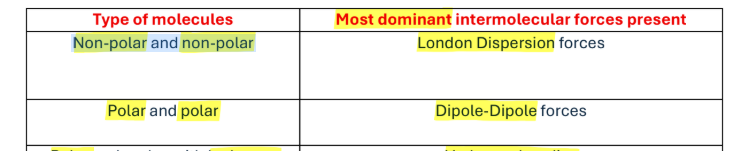
if the molecules are polar molecules with hydrogen bonded to nitrogen, oxygen or fluorine what is the most dominant intermolecular forces present ?
hydrogen bonds
if the molecules are an ion and a polar molecule what is the most dominant intermolecular forces present ?
ion dipole forces
if you are comparing boiling points of substances, what are your steps ?
type of msot dominant force formed (is it polar or non polar, which van der waals force is it)
check its MR (larger molecules have more/stronger london dispersion forces)
if the molecule is polar, how polar is the bond? (the more polar thee bond, the stronger the dipole dipole forces/hydrogen bonding will be)
What elements exist in twos rather than ones? + whats the acronym
hydrogen, nitrogen, flourine, oxygen, iodine, chlorine, berillium
HAVE NO FEAR OF ICE COLD BEER
what is needed, force wise, for a substance to dissolve in another
intermolecular forces need to form that are stronger/equal to the ones already present
When might ionic compounds dissolve
polar solvent = will dissolve
non polar solvent = will not dissolve
in water (polar solvents)
ionic compounds are very soluble in polar solvents/water
in cyclohexane (non polar solvent)
ionic compounds WILL NOT DISSOLVE in polar solvents
why do ionic compounds dissolve in water
ion dipole forces form between the partially negative oxygen in polar water, and the postivie ion in the ionic compound
ion dipole forces form between the partially positive hydrogen in polar water and the negative ion in the ionic compound
these ion dipole forces pull apart the crystal lattice structure of the ionic compound
why dont ionic compounds dissolve in water
ion dipole forces cant form, the lattice structure cannot be pulled apart
(due to no permanent dipoles being present)
what is the rule for the soluability of covalent compounds
LIKE DISSOLVES LIKE
polar dissolves polar
non polar dissolves non polar