Week 1 - Electrical Signals

0.0(0)
Studied by 0 people
call kaiCall Kai
learnLearn
examPractice Test
spaced repetitionSpaced Repetition
heart puzzleMatch
flashcardsFlashcards
GameKnowt Play
Card Sorting

1/12

encourage image

There's no tags or description

Looks like no tags are added yet.

Last updated 1:04 AM on 4/8/26
Name
Mastery
Learn
Test
Matching
Spaced
Call with Kai

No analytics yet

Send a link to your students to track their progress

13 Terms

1
New cards

2 types of Electric signals travel down neurons

Voltage-changes across the neuron’s cell membrane can trigger 2 types of electrical signals:

  1. Graded potentials

  2. Action Potentials

2
New cards

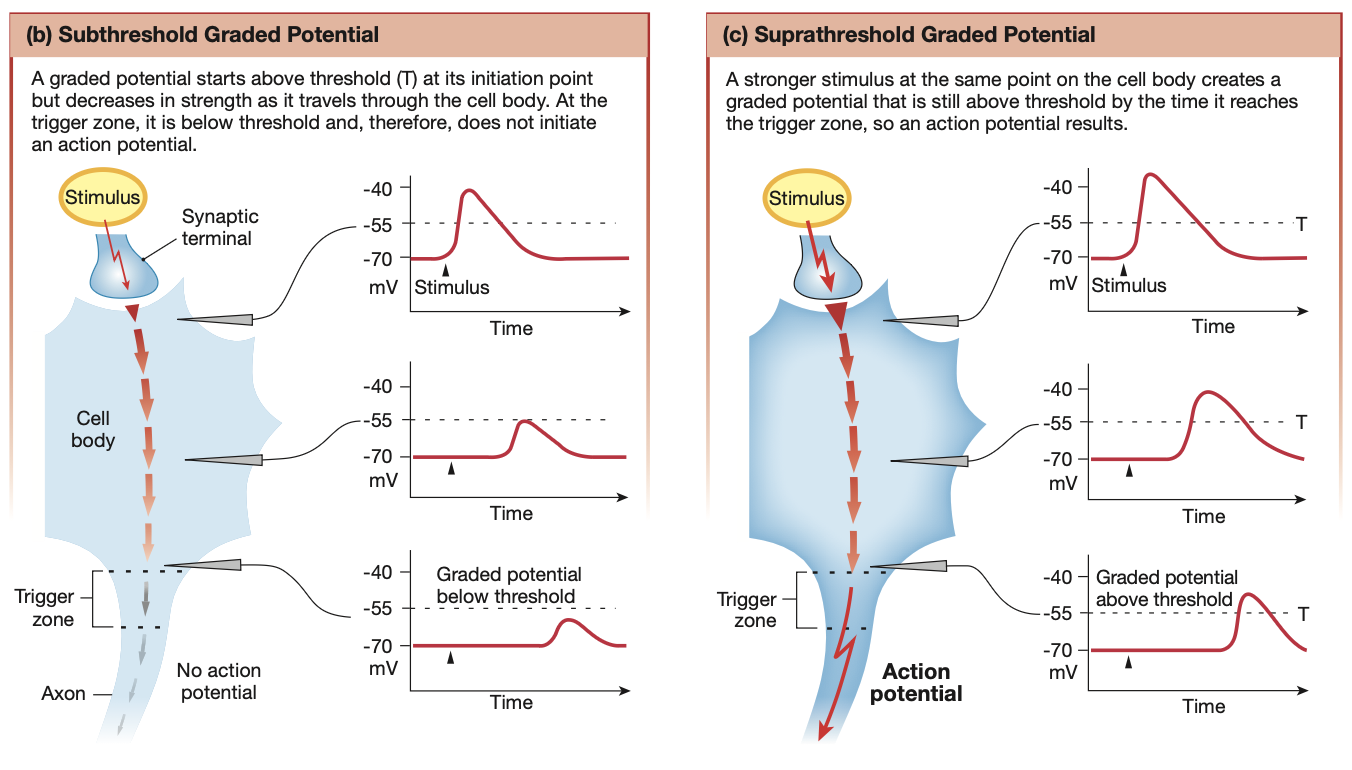
What are graded potentials?

What?

  • Vary in strength, but cause changes to the neuron’s membrane potential.

  • Travel over short distances and lose strength as they travel through the cell

    • Strength is proportional to distance travelled within the neuron

    • If strong enough to pass threshold potential, becomes an action potential

  • Used for short distance communication

    • Dendrite, through to cell body. Stops at trigger zone

  • If strong enough via signal summation, can initiate an action potential

3
New cards

Where and how do graded potentials occur?

Where?

  • Dendrites & cell body

How?

  • mechanical, chemical or voltage-gated ion channels

  • Ions involved: Na+, K+, Ca2+ & Cl-

Trigger Signal

  • Ions entering through gated channels

Signal type

  • More positive: Depolarising (e.g Na+ entering) - excitatory

  • More negative: Hyperpolarising (e.g Cl- entering or Na+ leaving) - inhibitory
<p><strong><mark data-color="purple" style="background-color: purple; color: inherit;">Where?</mark></strong></p><ul><li><p>Dendrites &amp; cell body</p></li></ul><p><strong><mark data-color="purple" style="background-color: purple; color: inherit;">How?</mark></strong></p><ul><li><p>mechanical, chemical or voltage-gated ion channels</p></li><li><p>Ions involved: Na+, K+, Ca2+ &amp; Cl-</p></li></ul><p><strong><mark data-color="purple" style="background-color: purple; color: inherit;">Trigger Signal</mark></strong></p><ul><li><p>Ions entering through gated channels</p></li></ul><p><strong><mark data-color="purple" style="background-color: purple; color: inherit;">Signal type</mark></strong></p><ul><li><p><strong>More positive</strong>: Depolarising (e.g Na+ entering) - excitatory</p></li><li><p><strong>More negative</strong>: Hyperpolarising (e.g Cl- entering or Na+ leaving) - inhibitory</p></li></ul><p></p>
4
New cards

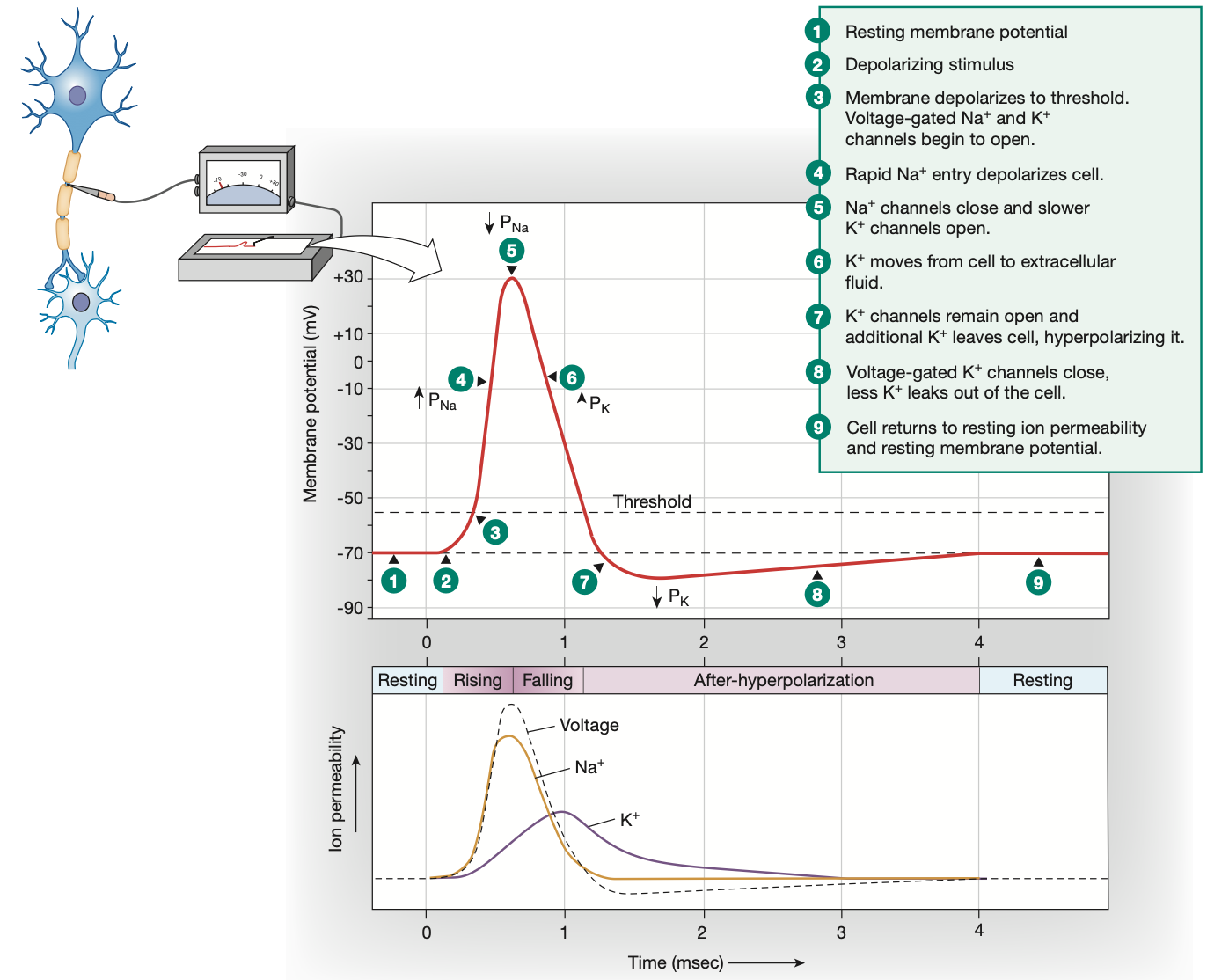
What are action potentials?

What?

  • Brief, large depolarisations that travel the entire length of the neuron

  • The electrical signal is strong, All-or-nothing

5
New cards

Where and how do action potentials occur?

Where?

  • Trigger zone of axon / axon hillock

How?

  • Voltage-gated ion channels

  • Ions involved: Na+ & K+

Trigger Signal

  • A graded potential that pushes the membrane potential above the threshold potential in the axon hillock

  • This opens ion-channels, letting Na+ and/or K+ rush in

Signal type

  • Depolarising (e.g Na+ entering)

6
New cards

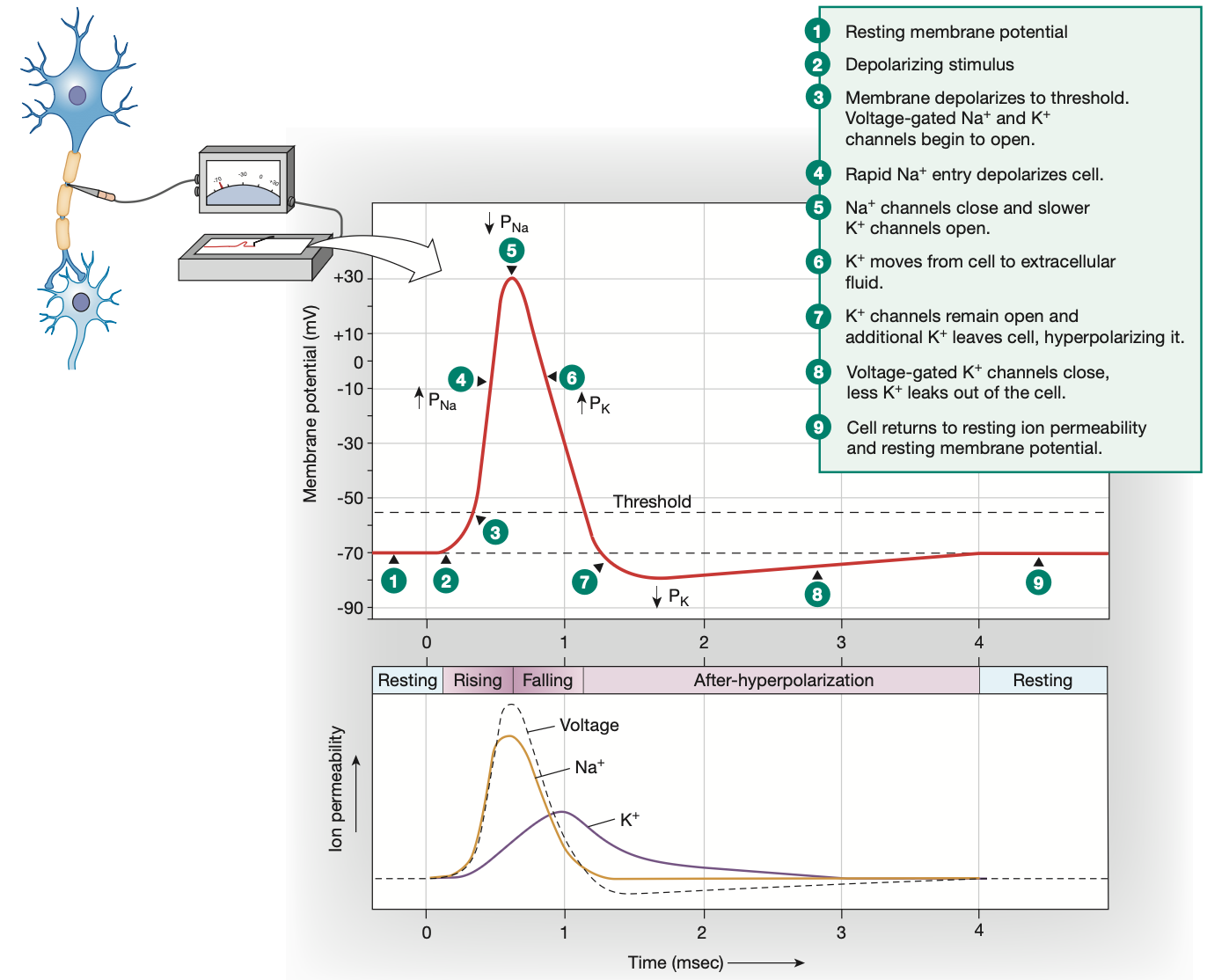
Threshold potential

-55mv

7
New cards

Action potential: Depolarisation

  1. Graded potential reaches threshold potential of -55mv

  2. All voltage-gated Na+ channels along the axon hillock open quickly, voltage-gated K+ channels start opening slower

  3. Na+ rushes in

  4. Membrane potential becomes extremely positive (+30mv)
<ol><li><p>Graded potential reaches threshold potential of -55mv</p></li><li><p>All voltage-gated Na+ channels along the axon hillock open <strong>quickly, </strong>voltage-gated K+ channels start opening <strong>slower</strong></p></li><li><p>Na+ rushes in</p></li><li><p>Membrane potential becomes extremely positive (+30mv)</p></li></ol><p></p>
8
New cards

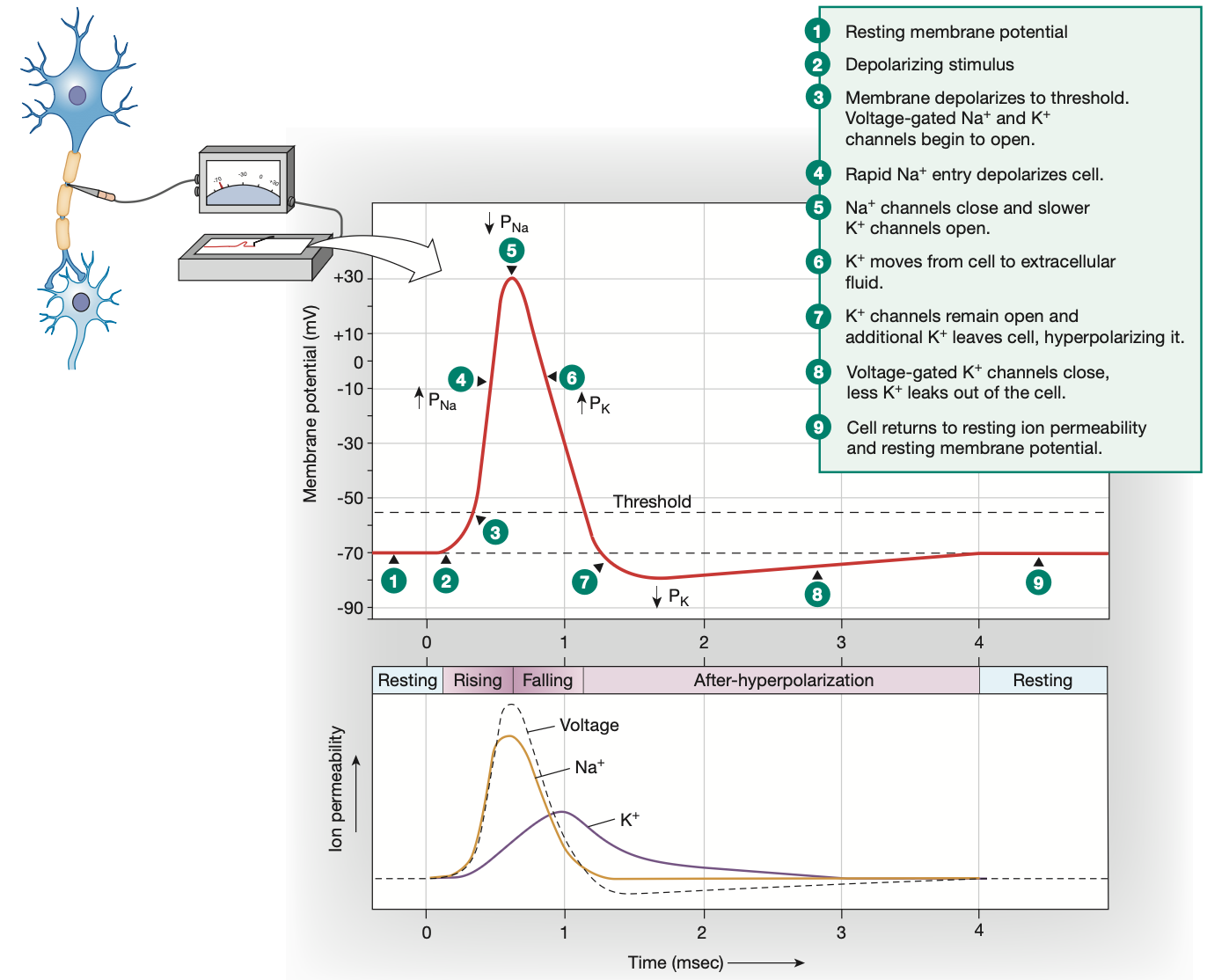
Action potential: Repolarisation

  1. Voltage-gated Na+ channels shut quickly to stop Na+ from flooding in further

  2. At the same time, slow voltage-gated K+ channels fully open

  3. K+ ions move out of the cell to counteract the high positive charge brought in by the excess Na+ ions

  4. Voltage-gated K+ channels remain open

<ol><li><p>Voltage-gated Na+ channels shut <strong>quickly</strong> to stop Na+ from flooding in further</p></li><li><p>At the same time, <strong>slow</strong> voltage-gated K+ channels fully open</p></li><li><p>K+ ions move out of the cell to counteract the high positive charge brought in by the excess Na+ ions</p></li><li><p>Voltage-gated K+ channels remain open</p></li></ol><p></p>
9
New cards

Action potential: Hyperpolarisation

  1. Neuron overreacts, leaving voltage-gated K+ channels open, causing excess K+ to leave the cell, alongside leaky K+ channels working overtime

  2. Voltage-gated K+ channels are slow to close

  3. Excess K+ leaves the cell, overshooting the resting membrane potential and making the cell membrane too negative

  4. This hyperpolarisation is the reason for the absolute & relative refractory periods lasting so long, preventing another action potential from happening too soon

  1. Leaky channels and 3Na-2K pump work to have neuron return to resting membrane potential (a.k.a homeostasis)
<ol><li><p>Neuron overreacts, leaving voltage-gated K+ channels open, causing excess K+ to leave the cell, alongside leaky K+ channels working overtime</p></li><li><p>Voltage-gated K+ channels are slow to close</p></li><li><p>Excess K+ leaves the cell, overshooting the resting membrane potential and making the cell membrane <strong>too negative</strong></p></li><li><p>This hyperpolarisation is the reason for the <strong><mark data-color="green" style="background-color: green; color: inherit;">absolute &amp; relative refractory periods lasting so long</mark></strong>, preventing another action potential from happening too soon</p></li></ol><ol start="5"><li><p>Leaky channels and 3Na-2K pump work to have neuron return to resting membrane potential (a.k.a homeostasis)</p></li></ol><p></p>
10
New cards

4 states of Voltage-gated Na+ channels

  1. Closed: Resting membrane potential, Na+ can only enter via leak channels

  2. Open: During depolarisation phase of action potential, Na+ rushes into cell

  3. Inactivated: During an action potential, when the membrane potential reaches its peak of +30mv, the inactivation gate quickly closes the voltage-gated channel, preventing further entry of Na+. This inactivation gate also lengthens the absolute refractory period.
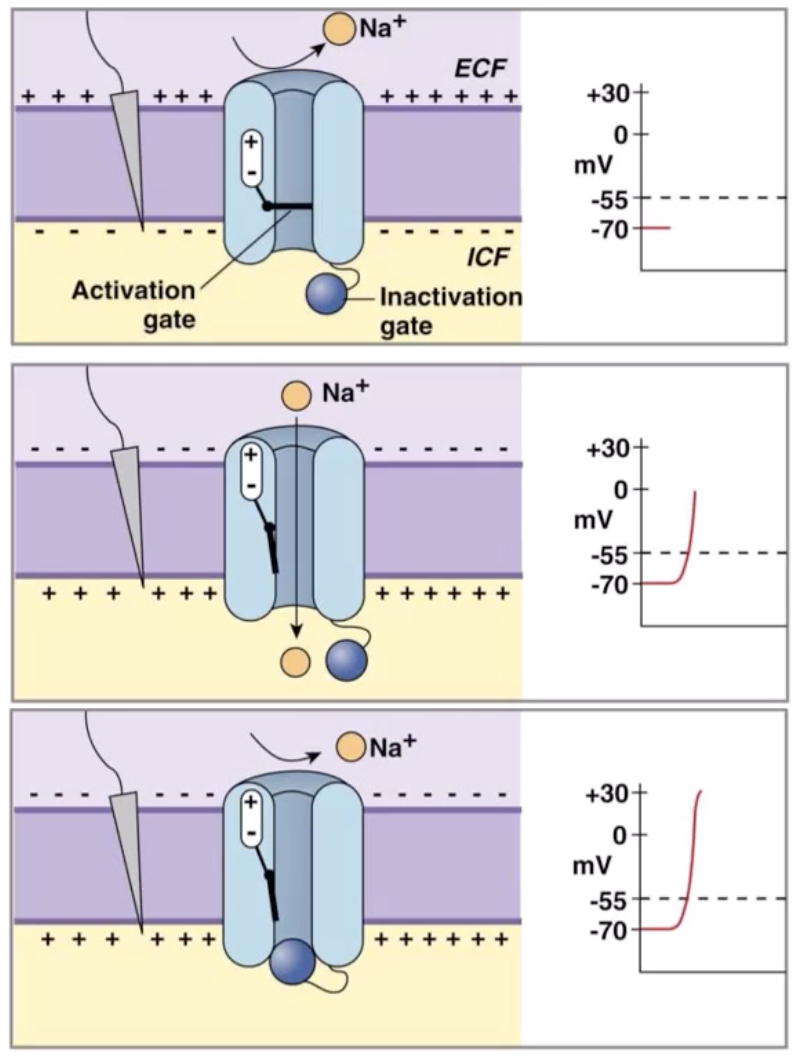
<ol><li><p><strong><mark data-color="red" style="background-color: red; color: inherit;">Closed:</mark></strong> Resting membrane potential, Na+ can only enter via leak channels</p></li><li><p><strong><mark data-color="red" style="background-color: red; color: inherit;">Open:</mark></strong> During depolarisation phase of action potential, Na+ rushes into cell</p></li><li><p><strong><mark data-color="red" style="background-color: red; color: inherit;">Inactivated:</mark></strong> During an action potential, when the membrane potential reaches its <strong>peak</strong> of +30mv, the inactivation gate quickly closes the voltage-gated channel, preventing further entry of Na+. This inactivation gate also <strong><mark data-color="green" style="background-color: green; color: inherit;">lengthens the absolute refractory period</mark></strong>.</p></li></ol><p></p>
11
New cards

Absolute vs Relative refractory periods

  1. Absolute refractory period

Time taken from the start of an action potential, until after depolarisation phase of action potential where voltage-gated Na+ channels to transition from inactivated (open gate, closed ball), to closed but activated (closed gate, open ball, state found at resting membrane potential).

  • Absolutely no action potential can occur during this 1-2 millisecond phase

  1. Relative refractory period

Some voltage-gated Na+ channels have returned to their closed, but activated positions.

Voltage gated K+ channels are still open.

Due to the membrane potential still being hyperpolarised, the threshold potential is further away than usual (however it is still -55mv).

  • Thus, an oddly strong graded-potential will be required to trigger an action potential.
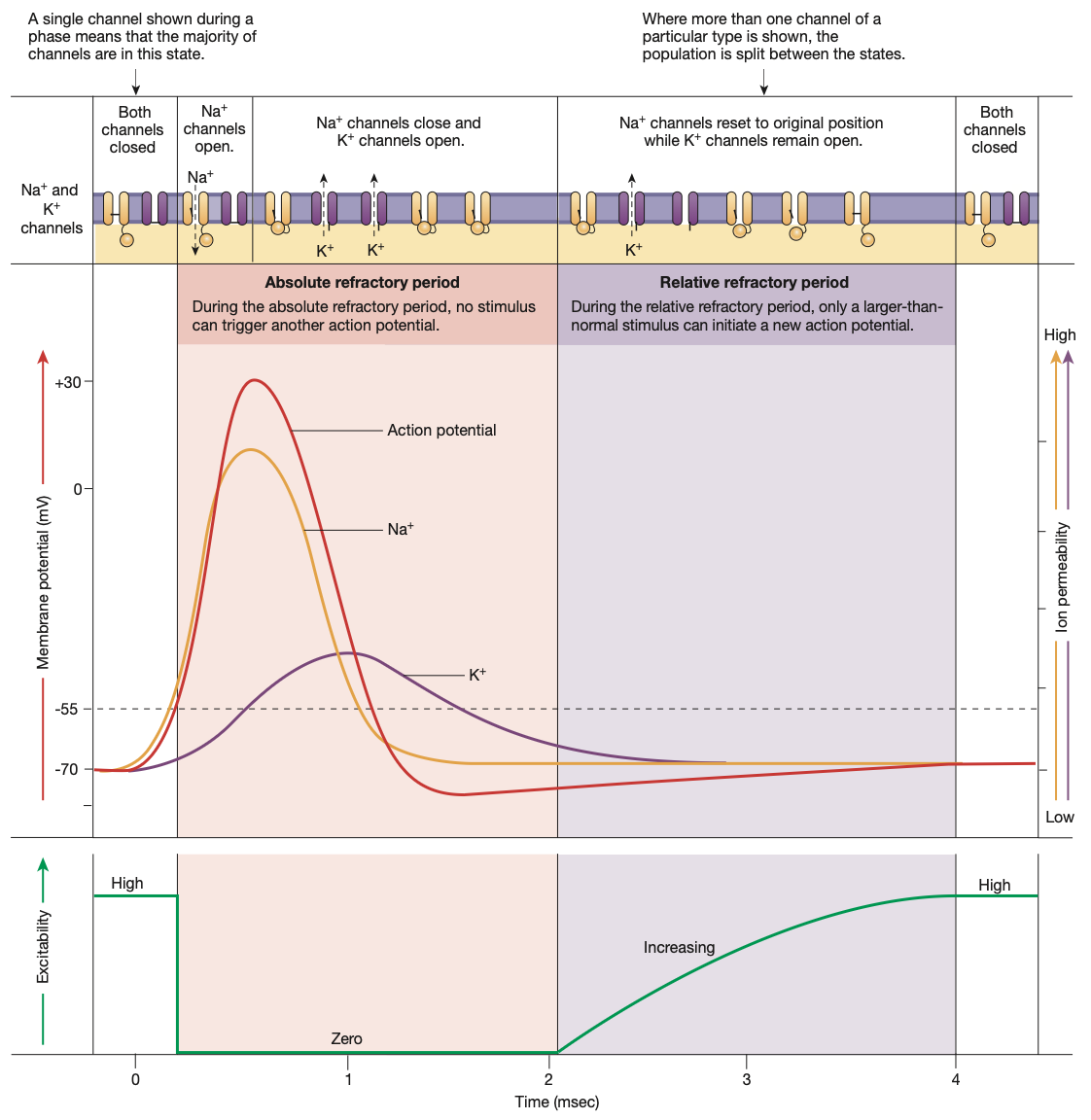
<ol><li><p><strong><mark data-color="green" style="background-color: green; color: inherit;">Absolute refractory period</mark></strong></p></li></ol><p>Time taken from the start of an action potential, until after depolarisation phase of action potential where voltage-gated Na+ channels to transition from <strong>inactivated</strong> (open gate, closed ball), to <strong>closed but activated</strong> (closed gate, open ball, state found at resting membrane potential).</p><ul><li><p>Absolutely no action potential can occur during this 1-2 millisecond phase</p></li></ul><p></p><ol start="2"><li><p><strong><mark data-color="green" style="background-color: green; color: inherit;">Relative refractory period</mark></strong></p></li></ol><p>Some voltage-gated Na+ channels have returned to their closed, but activated positions.</p><p>Voltage gated K+ channels are still open.</p><p>Due to the membrane potential still being hyperpolarised, the threshold potential is further away than usual (however it is still -55mv). </p><ul><li><p>Thus, an oddly strong graded-potential will be required to trigger an action potential.</p></li></ul><p></p>
12
New cards

Why action potentials move in one direction? Conduction of Action Potentials

  1. Action potentials are triggered by voltage-gated Na+ ion channels opening

  2. Voltage-gated ion channels are triggered by disturbances in the surrounding cell membrane potential. (change comes from the rushing in of Na+ from said gates opening)

  3. Hence, when an action potential begins in the axon hillock, the depolarisation travels down the axon due to neighbouring voltage-gated Na+ channels.

  4. Much like a ripple on a lake

  5. However, the ripple (action potential) does not travel backwards due to the previous section of the axon being in the refractory stages.

  6. Hence, the axon potential shoots down the axon, towards the axon terminal.

In skeletal muscle cells/fibres, action potentials are recieved and propagated along the sarcolemma a true ‘ripple’ fashion.
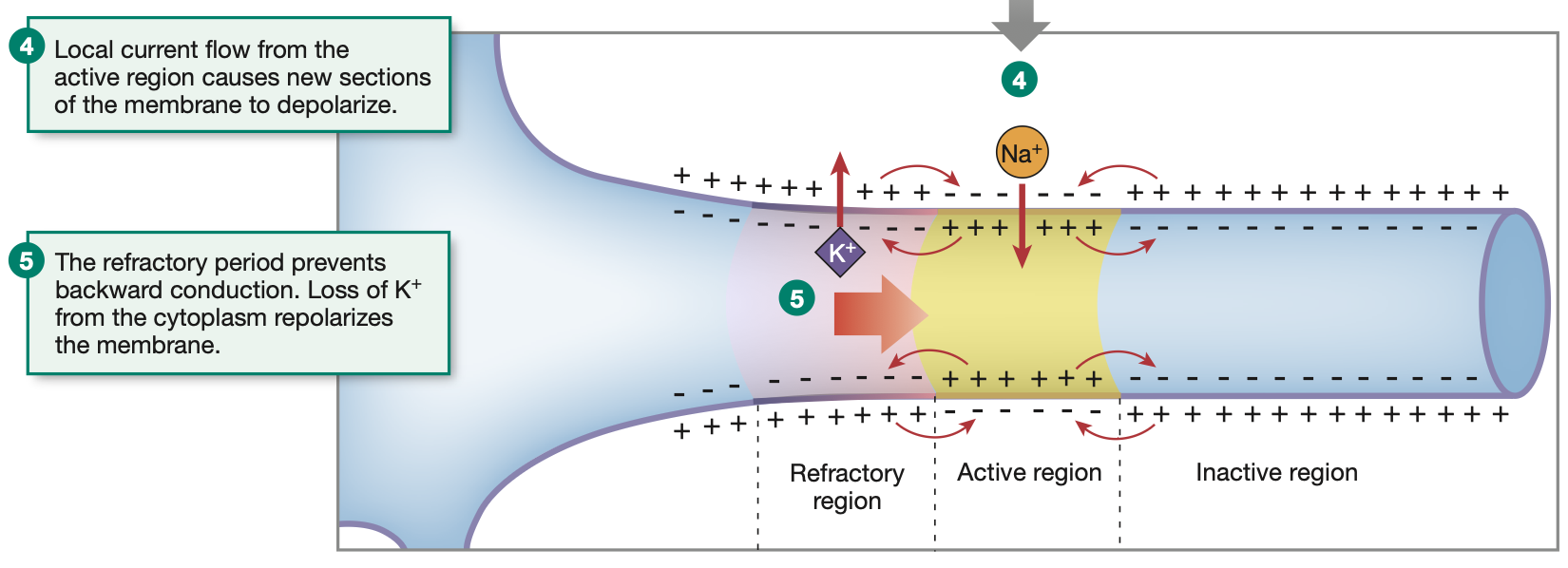
<ol><li><p>Action potentials are triggered by voltage-gated Na+ ion channels opening</p></li><li><p>Voltage-gated ion channels are triggered by disturbances in the surrounding cell membrane potential. (change comes from the rushing in of Na+ from said gates opening)</p></li><li><p>Hence, when an action potential begins in the axon hillock, the <strong>depolarisation travels down the axon</strong> due to <strong>neighbouring voltage-gated Na+ channels</strong>.</p></li><li><p>Much like a <strong><mark data-color="blue" style="background-color: blue; color: inherit;">ripple</mark></strong> on a lake</p></li><li><p>However, the ripple (action potential) does not travel backwards due to the previous section of the axon being in the <strong>refractory stages</strong>.</p></li><li><p>Hence, the axon potential shoots down the axon, towards the axon terminal.</p></li></ol><p></p><p>In skeletal muscle cells/fibres, action potentials are recieved and propagated along the sarcolemma a true ‘<strong><mark data-color="blue" style="background-color: blue; color: inherit;">ripple</mark></strong>’ fashion.</p>
13
New cards

Saltatory conduction: Axon potentials

  • In unmyelinated axons, opening of voltage-gated Na+ channels along the entire axon takes time, especially in long neurons

Process of Saltatory conduction:

  1. Depolarisation occurs at the trigger zone/axon hillock

  2. Initial batch of voltage-gated Na+ channels open, letting Na+ rush into the cell.

  3. Eventually, the depolarising neuron membrane stops, as a myelin sheath is reached (sometimes Schwann cell)

  4. In myelinated axons, voltage-gated Na+ channels along the axon can only be found along the nodes of Ranvier (refer to diagram)

  5. Hence, the inner steep Na+ gradient (from previously opened voltage-gated Na+ channels is able to rush past myelin sheath segments inside the neuron without risk of Na+ leaking out from leaky channels. (i.e no current leak)

  6. Hence, myelin sheaths allow the axon potential to “skip” along nodes of Ranvier, while also preventing leaks of Na+ ions from leaky channels.

  • More myelin sheath, the faster an action potential, the less likelihood of an action potential dissipating

Lack of a myelin sheath can hinder action potentials greatly, as found in ailments such as multiple sclerosis (degradation of myelin sheath).
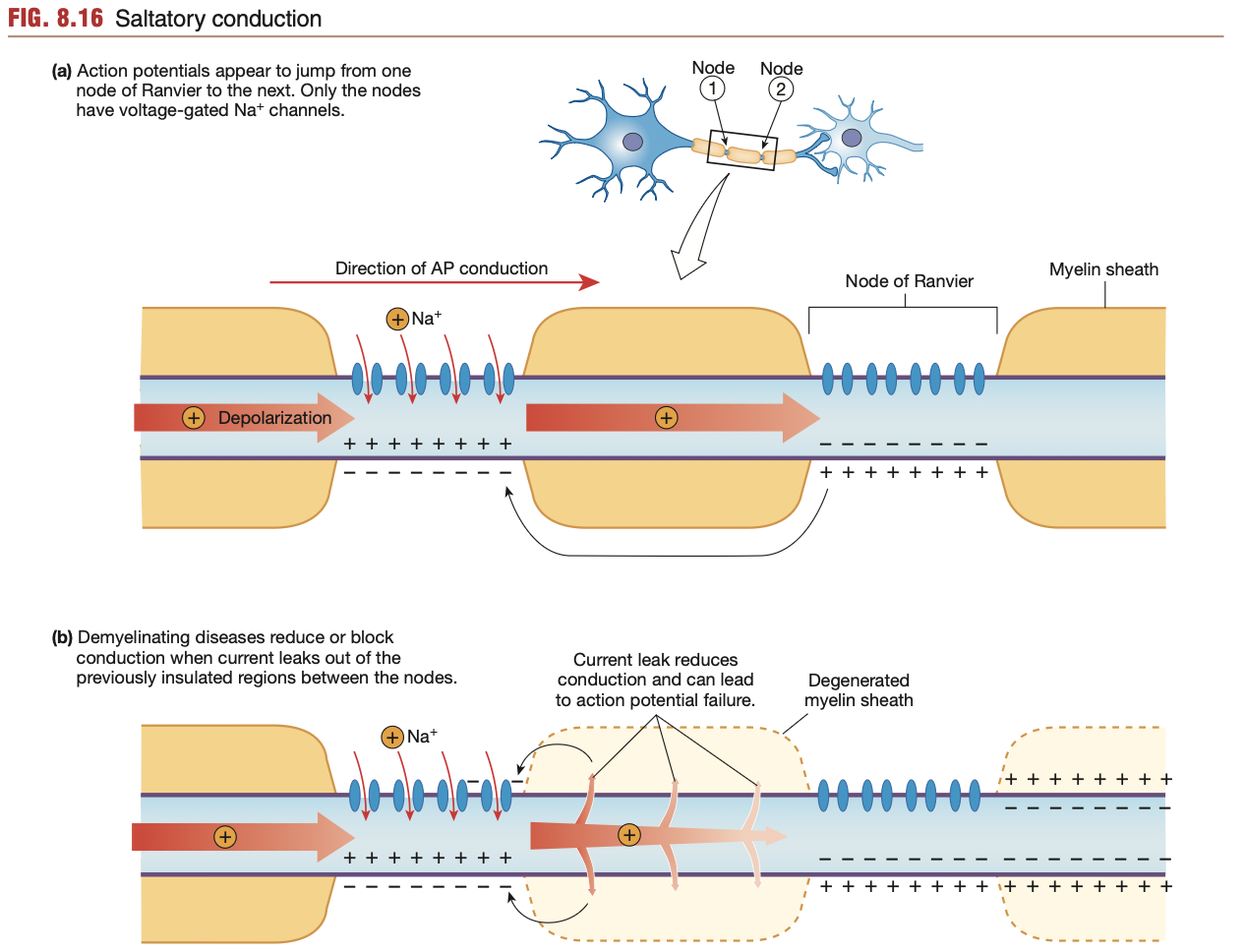
<ul><li><p>In unmyelinated axons, opening of voltage-gated Na+ channels along the entire axon takes time, especially in long neurons</p></li></ul><p>Process of <strong><mark data-color="yellow" style="background-color: yellow; color: inherit;">Saltatory conduction</mark>:</strong></p><ol><li><p>Depolarisation occurs at the trigger zone/axon hillock</p></li><li><p>Initial batch of voltage-gated Na+ channels open, letting Na+ rush into the cell.</p></li><li><p>Eventually, the depolarising neuron membrane stops, as a myelin sheath is reached (sometimes Schwann cell)  </p></li><li><p>In myelinated axons, voltage-gated Na+ channels along the axon can only be found along the <strong><mark data-color="red" style="background-color: red; color: inherit;">nodes of Ranvier</mark></strong> (refer to diagram)</p></li><li><p>Hence, the inner steep Na+ gradient (from previously opened voltage-gated Na+ channels is able to rush past myelin sheath segments inside the neuron without risk of Na+ leaking out from leaky channels. (i.e <strong>no current leak</strong>)</p></li><li><p>Hence, myelin sheaths allow the axon potential to “skip” along nodes of Ranvier, while also preventing leaks of Na+ ions from leaky channels.</p></li></ol><ul><li><p><mark data-color="green" style="background-color: green; color: inherit;">More myelin sheath, the faster an action potential, the less likelihood of an action potential dissipating</mark></p></li></ul><p></p><p>Lack of a myelin sheath can hinder action potentials greatly, as found in ailments such as <strong>multiple sclerosis</strong> (degradation of myelin sheath).</p>