Microbiology Unit Two Test
 Call Kai
 Learn
Learn Practice Test
 Spaced Repetition
 Match
Match Flashcards
 Knowt Play
1/13

Earn XP
Description and Tags
Chapter 6: Cards 1-5, Chapter 9: Cards 6-8, Chapter 10: Cards
Name | Mastery | Learn | Test | Matching | Spaced | Call with Kai |
|---|
No analytics yet
Send a link to your students to track their progress
14 Terms
Essential Nutrient Requirements:
Essential nutrients
Inorganic vs. organic nutrient
Any substance that cannot be formed by an organism and must be supplied in diet (a growth factor). Macronutrients have a role in cell structure and metabolism; they are required in large quantities (C, H, O). Micronutrients have a role in enzyme function and maintenance of protein structure; they are required in small quantities (trace elements like Zinc).
Essential nutrients for microbes (CHONPS):
Carbon (needed for proteins, carbohydrates, lipids, nucleic acids)
Hydrogen (water, salts, gases)
Oxygen (needed for proteins, carbohydrates, lipids, nucleic acids)
Nitrogen (key component of amino acids→proteins)
Phosphate (nucleic acid, ATP)
Sulfur (vitamins)
Major elements → H, O, N, C (CHON) are MOST abundant.
Organic nutrients contain C and H and are usually the product of living things. Inorganic nutrients contain a combination of atoms other than C and H.
Growth Conditions Classification:
Psychrophile
Mesophile
Thermophile
Halophile
Acidophile
Neutrophile
Facultative anaerobe
Obligate aerobe
Obligate anaerobe
Aerotolerant
Capnophile
Psychrophile- Grow at low temperatures (0 °C- 20 °C) w/ a temp. optimum (most rapid growth) of 0 °C–15 °C (below 15 °C). These organisms grow best at fridge temperature and are rarely pathogenic.
Ex- Can be found in deep oceans, snow algae
Mesophile- Grow at intermediate temperatures (10C-50C) w/ a temp. optimum of 20C-40C. Most human pathogens grow optimally between 30 °C and 40 °C (body temp is 37 °C). Majority of medically significant microorganisms.
Ex- inhabit animals/plants, tropical regions, Listeria monocytogenes
Thermophile- Grows optimally at a temperature of 45C or higher. Have a range of growth of 45 °C- 80 °C. Most eukaryotic forms cannot survive above 60C.
Extreme thermophiles grow between 80C-121C
Ex- can be found in hot springs, Thermus aquaticus
Halophile- Require high salt concentration to grow.
Ex-Halobacterium (grow optimally in solutions of 25% NaCl but require at least 9% for growth)
Acidophile- Organisms that grow in highly acidic, low pH environments.
Ex-Thermoplasma (pH of 1 or 2)
Neutrophile- Organisms that live or grow in habitats between pH 6 and 8 (because strong acids and bases can be highly damaging to enzymes and other cellular substances). Acidic is below 7 and alkaline/basic is above 7.
Ex- E.coli
Facultative anaerobe- Organisms that can grow with or without oxygen, but prefer oxygen for better growth and energy efficiency.
Ex-staphylococci, many gram-negative intestinal bacteria
Obligate aerobe- An organism that cannot grow without oxygen.
Ex- Humans, the majority of fungi, and Mycobacterium tuberculosis
Obligate anaerobe- An organism that cannot survive or grow in the presence of oxygen.
Ex- Clostridium tetani, oral bacteria, intestinal bacteria
Aerotolerant- Organisms that do not use oxygen, but are not harmed if it is present. They can grow to a limited extent in its presence.
Ex- certain lactobacilli and streptococci
Capnophile- Organisms that grow best at a higher CO2 tension than is normally present in the atmosphere.
Ex- Neisseria
Energy and Carbon Source Terms:
Photoautotroph
Photoheterotroph
Chemoautotroph
Chemoheterotroph
Photoautotroph- carbon source (inorganic carbon dioxide;CO2), energy source (sunlight), example-algae, plants
Photoheterotroph- carbon source (organic compounds), energy source (sunlight), example- purple and green photosynthetic bacteria
Chemoautotroph-
Type 1: Chemoorganic autotrophs; carbon source (Inorganic compound CO2), energy source (organic compounds), example- methanotrophs
Type 2: Chemolithoautotrophs; carbon source (Inorganic compound CO2), energy source (Inorganic Compounds (minerals)), example- Thiobacillus, “rock eating” bacteria
Chemoheterotroph- carbon source (Organic Compounds), energy source (Metabolic conversion of the nutrients from other organisms (organic)), example- saprobes (feed on dead organisms) ex-fungi, decomposers, parasites (nutrients from cells/tissues from living host)
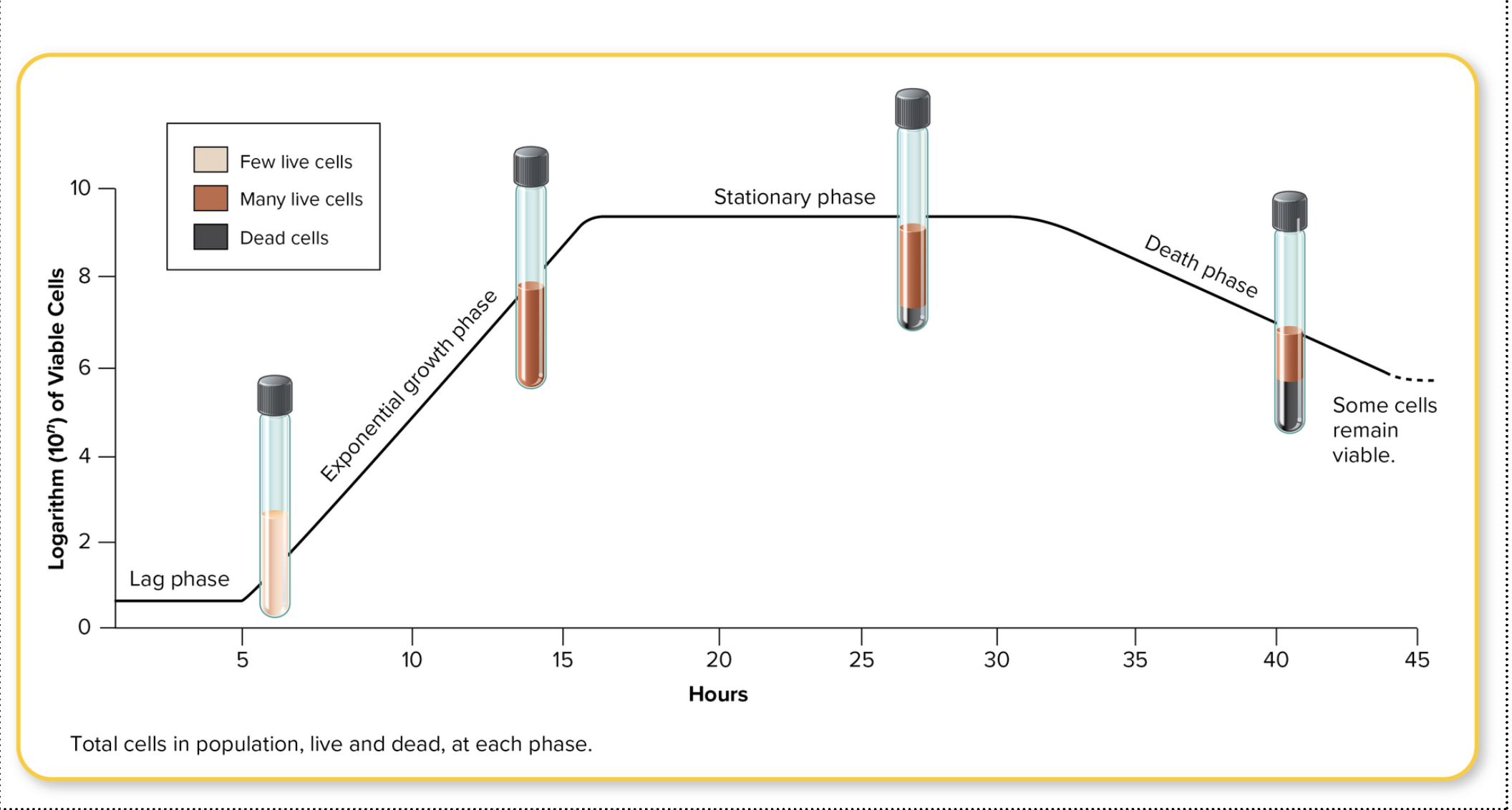
Growth Curve Phases:
Lag Phase
Exponential/Log Phase
Stationary Phase
Death Phase
Viable nonculturable state (VNC)
Is the system of batch culturing open or closed?
Lag — adjusting, no division yet. Flat period on graph b/c newly inoculated cells require a period of adjustment and synthesis; the population of cells is so sparse or dilute that the sample misses them.
Exponential/Log — rapid growth; EASIEST to kill with antibiotics. Maximum rate of cell division, where the curve increases dramatically. This phase continues as long as cells have adequate nutrients and the environment is favorable. Actively growing cells are more vulnerable to growth inhibition and destruction by antibiotics which cause conditions that disrupt cell metabolism and binary fission.
Stationary — growth = death rate. A period where the rates of cell birth and death are more or less equal. The division rate (growth rate) is slowing down due to depleted nutrients and oxygen. This makes it easier for cell death to catch up with the rate of new cell formation.
Death — more cells die than grow. End of cell growth due to lack of nutrients, depletion of environment, and accumulation of wastes. Occurs slower than the exponential growth phase.
The viable nonculturable state (VNC)- many cells in a culture in the death phase stay alive but are dormant so they will not grow on culture medium and are missed in colony counts.
The system of batch culturing is closed- nutrients and space are limited and there is no mechanism for the removal of waste products.
Lab Concepts:
Viable plate count
Microaerophile
Staph. epidermidis
Each colony= 1 original cell
A method of quantifying (live, reproducing) microorganisms- samples are serially diluted, plated on nutrient agar, and incubated so each living cell grows into a visible colony.
Growth with 3-5% of oxygen
Grows in 10% salt and 37°C → halophile + mesophile + facultative anaerobe
Physical Methods of Microbial Control:
Autoclave
Incineration
Radiation (ionizing)
Non-ionizing UV
Filtration
Key resistance hierarchy: most→ least
Autoclave- A sterilization chamber that uses steam under pressure to sterilize materials. The most common temperature/pressure combination is 121°C and 15 psi.
Type of moist heat (coagulation and denaturing of proteins-microbicidal effect) ^requires lower temp. and shorter exposure than dry heat
Effective for heat-resistant materials like glassware, cloth, and metallic instruments, but not for sterilizing substances that repel moisture (oils,wax) or those harmed by it (powders).
Incineration- A flame is the most rigorous of all heat treatments; direct exposure ignites and reduces microbes and other substances to ashes and gas. Can sterilize.
Type of dry heat (dehydrates the cell, removing water necessary for metabolic rxns, denatures proteins, requires higher temp)
Limited to metals and heat-resistant glass materials; bunsen burners, inoculating loops, and carcasses
Radiation (ionizing)- Gamma rays (most penetrating) & X-rays; highly effective alternative for sterilizing materials that are sensitive to heat or chemicals. Penetrates liquids and most solids. Can sterilize.
Used on medical instruments (plastics mostly), tissues (bone, skin), drugs/vaccines
Non-ionizing UV- UV radiation (wavelength of 100-400nm, most lethal from 240-280nm w/ peak at 260); Has a lower energy state, so it’s not as penetrating as ionizing radiation. It passes readily through air, slightly through liquids, and poorly through solids, so the object being disinfected must be directly exposed for full effect.
Directed at disinfection rather than sterilization. Examples include germicidal lamps (cut down concentration of airborne molecules as much as 99%) used in hospital rooms, UV treatment system for disinfecting water
UV radiation introduces lethal thymine dimers into microbial dna so they cannot be correctly replicated or transcribed.
Filtration- Mechanical method; Removes microbes from air and liquids, by straining air/liquid through a filter with openings large enough for the fluid or air to pass through but too small for the microorganisms to pass.
Microbiological filters include thin membranes of cellulose acetate, polycarbonate, and a variety of plastic material (nylon). Charcoal can be used.
Pore sizes can be controlled to permit true sterilization by trapping viruses or large proteins
Used to prepare liquids that cannot withstand heat such as serum, blood products, vaccines
High-efficiency particulate air (H E P A) filters are used in hospital rooms and sterile rooms to remove airborne contaminants (trap anything larger than 10 nanometers).
Air decontamination and liquid sterilization
The most resistant are endospores, and the least resistant are vegetative cells
The goal of sterilization is the destruction of endospores b/c any process that kills endospores will invariably kill all less-resistant microbial forms. Prions are a special case where they are not destroyed by the procedures we discuss-discard as biohazard.
Chemical Control:
Alcohol (70%)-
Iodine/Betadine-
Chlorhexidine-
Glutaraldehyde-
Heavy Metals
Detergents
Does freezing microbes kill them?
Is sanitization the same as sterilization?
Alcohol (70%)- Target most bacteria, viruses, and fungi. Concentrations of 50% and higher dissolve membrane lipids, disrupt cell surface tension, and compromise membrane integrity.
70% most effective because proteins require water in order for denaturation to occur- higher concentrations of alcohol have less water, so they are less effective.
Germicidal, nonirritating, and inexpensive. Routinely used as skin degerming agents (70-95% solutions)
Limitations-Rate of evaporation decreases effectiveness and inhalation of vapors can affect the nervous system.
Iodine- Is a halogen; can kill endospores (slowly) and all other microbes. Penetrates cells of microorganisms where it interferes with a variety of metabolic functions (interferes with the hydrogen and disulfide bonding of proteins). Can sterilize!
2% iodine and 2.4% sodium iodide (aqueous iodine) used as topical antiseptic while 5% iodine and 10% potassium iodide are used as a disinfectant for plastic and rubber instruments, cutting blades.
Limitations-can be extremely irritating to the skin and is toxic when absorbed
Chlorhexidine- Target most bacteria, viruses, and fungi. Targets bacterial
membranes, where selective permeability is lost; bacterial cell walls;
and proteins, resulting in denaturation
Mildnesses, low toxicity, and rapid action make it a popular choice of agents. Used in scrubs, prepping skin for surgery, mucous membrane irrigant.
limitations-Effects on viruses and fungi are variable
Glutaraldehyde- A type of aldehyde; kill endospores and all other microbes. Can irreversibly disrupt the activity of enzymes and other proteins within the cell. Can sterilize!
Kills rapidly and is broad-spectrum; used to sterilize respiratory equipment, scopes, kidney dialysis machines, dental instruments.
Limitations- it is somewhat unstable, especially with increased pH and temperature (Orthophalaldehyde is safer and just as effective but more expensive)
Heavy metals- Target some bacteria, viruses, and fungi. Mercury, silver, and other metals exert microbial effects by binding onto functional groups of proteins and inactivating them.
Organic mercury tinctures are fairly effective antiseptics, organic mercurials serve as preservatives, and silver nitrate solutions are used for topical germicides and ointments.
Limitations-microbes can develop resistance to metals, not effective against endospores, can be toxic if inhaled or absorbed, may cause allergic rxns in susceptible individuals.
Detergents do not work well against Pseudomonas & Mycobacterium, and Bacillus (have endospores) and clostridium. Effective against viruses, algae, fungi, and gram positive bacteria.
Freezing = bacteriostatic, NOT killing. Elevated temperatures (exceeding max growth temp)=microbicidal (kill microbes)
Sanitization ≠ sterilization
Restaurants → sanitization (sanitization is also called decontamination- cleansing technique that mechanically removes microorganisms and debris to reduce contamination to safe levels: soaps, detergents,commerical dishwashers)
Bactericidal
Bacteriostatic
Asepsis
Sterilization
Disinfection
Bactericidal- An agent that kills bacteria; a chemical that destroys bacteria except for those in the endospore stage.
Bacteriostatic- Any process or agent that inhibits bacterial growth; prevent the growth of bacteria on tissues or objects in the environment.
Asepsis- A condition free of viable pathogenic microorganisms; any practice that prevents entry of infectious agents into sterile tissues and therefore prevents infection.
Aseptic techniques used in healthcare range from sterile methods that exclude all microbes to antisepsis.
Note- Antisepsis: reduces the number of microbes on the human skin. It is a form of decontamination but on living tissue. It uses chemical agents called antiseptics on tissue, wounds, and incisions to destroy or inhibit pathogens. Involves scrubbing the skin (mechanical friction) or immersing it in chemicals (or both).
Examples of agents: alcohol, surgical hand scrubs
Sterilization- Process that destroys or removes all viable microorganisms (including viruses)
Reserved for inanimate objects, such as surgical instruments
Examples of agents: heat (autoclave), sterilants (chemical agents capable of destroying endospores)
Disinfection- Physical process or a chemical agent to destroy vegetative pathogens but not bacterial endospores. It removes harmful products of microorganisms (toxins) from material.
Normally used on inanimate objects (concentration required to be effective is harmful to human tissue)
Examples of agents: bleach, iodine, heat (boiling)
Note- sterilization and disinfection are processes and agents used in the process are bactericidal and bacteriostatic.
Drug Targets:
Cell wall (6)
Protein Synthesis (8)
DNA/RNA synthesis (4)
Cell membrane (2)
Folic Acid synthesis (2)
Cell wall- Block synthesis and repair: Beta lactams-penicillins, cephalosporins (Ceftriaxone), carbapenems, vancomycin, bacitracin, and isoniazid
Protein Synthesis- Ribosomes; Site of action (50s subunit)- azithromycin (macrolides), synercid, and pleuromutilins
Site of action (30s subunit)- Aminoglycosides, streptomycin, tetracyclines, glycylcyclines
Site of action (both 30s and 50s)- blocks initiation of protein synthesis- linezolid (oxazolidinones)
DNA/RNA synthesis- Inhibit replication and transcription, inhibit gyrase-unwinding enzymes (quinolones, fluoroquinolones ), and inhibit RNA polymerase (rifampin, ansamycins)
Cell membrane- Cause loss of selective permeability: polymixins (B), daptomycin
Folic Acid synthesis- Block pathways and inhibit metabolism: sulfonamides (sulfa drugs) and trimethoprim
Antibiotic Concepts:
selective toxicity
Antibiotics
Antiviral drugs
Therapeutic Index
Antifungal drugs
Broad and Narrow Spectrum
Selective toxicity easier for bacteria, harder for protozoa/helminths. They are eukaryotes so they share similar cellular machinery with human cells (such as cytoplasmic membrane) so it is harder to target them without harming the host<-Property of an antimicrobial agent to be highly toxic against its target microbe without simultaneously damaging host tissues.
Antibiotics = naturally produced by microbes (bacteria, fungi). <-substances produced by the natural metabolic processes of some microorganisms (to reduce competition for nutrients and space in their habitat) that can inhibit or destroy other microorganisms; generally the term is used for drugs targeting bacteria and not other types of microbes. Greatest number of antibiotics are derived from bacteria genera Streptomyces and Bacillus and molds in genera Penicillium and Cephalosporium.
Antiviral drugs CANNOT target folic acid synthesis — viruses don’t use it.
Therapeutic Index → higher number = safer drug. It describes the ratio of the dose of the drug that is toxic to humans compared to its minimum effective dose. The smaller the number the greater potential for toxic drug rxn.
Antifungal drugs = azoles (examples of azoles= ketoconazole) they interfere with sterol synthesis in fungi.
The 4 main drug groups for fungi= macrolide polyene antibiotics, the azoles, the echinocandins, and allylamines.
Broad spectrum- Drugs that affect a wide variety of microorganisms (least selective). Narrow-spectrum- Drugs that are selective and limited in their effects (target specific group)
Resistance develops from…
Drug resistance
Misuse of antibiotics
Animal agriculture antibiotics
Stopping treatment early
✘ Well-managed multi-drug therapy does NOT contribute
Drug resistance- an adaptive response in which microorganisms begin to tolerate an amount of drug that would ordinarily be inhibitory (do so due to genetic versatility (spontaneous mutations or horizontal gene transfer from another species) and general adaptability).
Classify S. mutans & E. coli by oxygen use
Both S. mutans and E.coli are facultatively anaerobic bacteria. The term facultative suggests these organisms are capable of growing under differing sets of conditions, in this case, the presence or absence of oxygen.
These bacterium do not require oxygen for metabolism but use it when it is present (oxygen is not obligatory for growth).
E. coli grows faster and generates higher ATP yields with oxygen, while S. mutans are not harmed by oxygen and rely on fermentation for energy whether or not it is present (ferments dietary sugars into lactic acid).
While oxygen is not toxic to S. mutans, high amounts of it can impair its ability to form biofilms.
Why antibiotics don’t work on viruses
Antibiotics don’t work on viruses because they are designed to target specific structures or metabolic processes unique to bacteria (like cell walls), which viruses do not have since they rely on the host cell for the vast majority of their metabolic functions and lack cellular structures.
Instead, antiviral drugs are used, which target specific points in the infectious cycle of viruses (barring penetration of the virus into the host cell, blocking the transcription and translation of viral molecules, and preventing the maturation of viral particles.
Tube oxygen classification chart
We are able to differentiate the oxygen requirements of cultured microbes using tubes of fluid thioglycollate medium. The location of growth indicates the oxygen requirements of the microbes, where the oxygen concentration is the highest at the top of the tube and lowest at the bottom.
Aerobes- Top of the tube; can use gaseous oxygen in their metabolism and possess the enzymes needed to process toxic oxygen products.
An organism that cannot grow without oxygen is an obligate aerobe.
Ex: Most fungi, protozoa, many bacteria (Mycobacterium tuberculosis)
Microaerophiles- Narrow band just below the top; are harmed by normal atmospheric concentrations of oxygen but require a small amount of it in metabolism
Ex: organisms that live in soil or water or mammalian hosts, not directly exposed to the atmosphere (Helicobacteri pylori)
Facultative anaerobes- Bacteria grow throughout the tube but usually top dense because this growth often goes more quickly in some facultative anaerobes; do not require oxygen for metabolism but use it when it is present. Can also grow anaerobically.
Ex: many gram-negative intestinal bacteria, staphylococci
Anaerobes- Growth at the bottom; lack the metabolic enzyme systems for using oxygen in respiration. Obligate anaerobes also lack the enzymes for processing toxic oxygen and die in its presence.
Ex: Many oral bacteria, intestinal bacteria
Aerotolerant anaerobes- Grow evenly throughout; do not utilize oxygen but can survive and grow to a limited extent in its presence. They are not harmed by oxygen, mainly because they possess alternate mechanisms for breaking down peroxides and superoxide.
Ex: certain lactobacilli and streptococci