LECTURE 1 INTRODUCTION-SOUND-PATH-RECEIVER
 Call Kai
 Learn
Learn Practice Test
 Spaced Repetition
 Match
Match Flashcards
 Knowt Play
1/21

There's no tags or description
Looks like no tags are added yet.
Name | Mastery | Learn | Test | Matching | Spaced | Call with Kai |
|---|
No analytics yet
Send a link to your students to track their progress
22 Terms
ARCHITECTURAL ACOUSTICS
technology of designing spaces, structures, and mechanical systems to meet hearing needs.
With proper design, “wanted” sounds can be heard properly and “unwanted” sounds or ‘’noise”, can be attenuated to the point where it does not cause annoyance.
A branch of acoustics that deals with providing rooms and buildings with good conditions for listening to speech and music, it plays an important role in the planning and construction of auditoriums, churches, halls libraries and music halls.
1. Source
2. Transmission Path
3. Receiver
Basic elements in an acoustical situation
30 dB
will not cause damage
85 dB
higher than this level is the beginning of hearing damage (esp. After 8 hrs of exposure)
88 dB
such as lawn mower, city traffic (damage in 4 hrs)
91 dB
such as hairdryer, garbage disposal (damage in 2 hrs)
94 dB
such as electric drill (damage in 1 hr)
97 dB
such as motorcycle (damage in 30 mins)
100 dB
such as mp3 player, snowmobile (damage in 15 mins)
115 dB
such as leaf blower, stadium football game (damage in 30 seconds)
120 dB
such as rock concert, ambulance siren (damage in 8 secs)
125 dB
such as fire alarm, firecracker
140 dB
such as jet engine at takeoff, gunshot (damage in immediate hearing)
THEATER OF EPIDAURUS
Considered as an architectural marvel.
The _________________ through its production and presentation of drama, plays and recitals therefore became an important contributor to the progress of Greek arts.
Acoustics of the _______________ are so good you can hear a pin drop from the back seats.
Spectators capacity: 11,750-14,700
Measurements:
CAVEA: 119 mts
ORCHESTRA: 24.65 mts
HEIGHT: approx. 59 mts
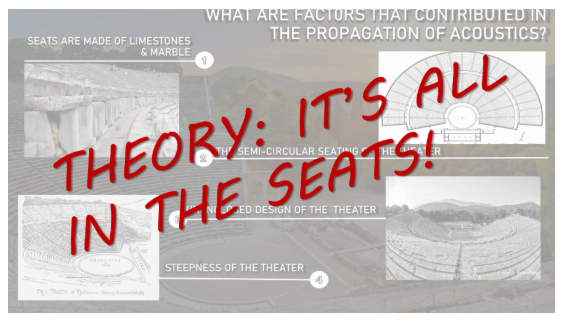
SEATS ARE MADE OF LIMESTONES & MARBLE
THE SEMI-CIRCULAR SEATING OF THE THEATER
UNENCLOSED DESIGN OF THE THEATER
STEEPNESS OF THE THEATER
WHAT ARE THE FACTORS THAT CONTRIBUTED IN THE PROPAGATION OF ACOUSTICS?
REVERBERATION
_____________ is the persistence of sound after the cause of sound has stopped - a result of repeated reflections.
FOCUSING
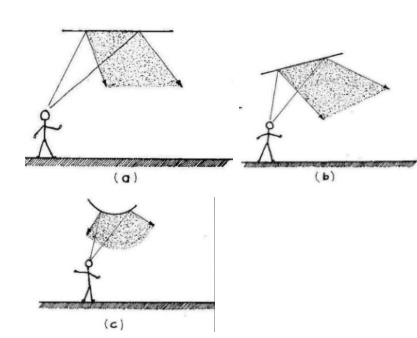
Concave domes, vaults, or walls will focus reflected sound into certain-areas of rooms. This has several disadvantages. For example, it will deprive some listeners of useful sound reflection and cause hot spots at other audience positions.
REFLECTIONS
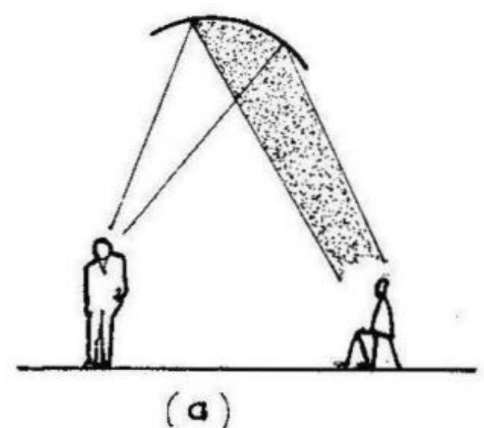
These occur when sound hits a surface that is neither
predominantly absorptive nor sound transparent at the specific frequency. Non-absorptive surfaces that are large, as compared to the wavelength at a given frequency, reflect sounds.
EXAMPLE:
3-inches wide pickets in a fence reflect frequencies with
wavelengths that are less than three in (4500 Hz and higher) . If the fence is 50% open, it reflects about 50% of the high- frequency energy. However, it does not significantly affect the lower frequencies. These lower frequencies (longer wavelengths) simply diffract around the obstruction.
SPECULAR REFLECTION
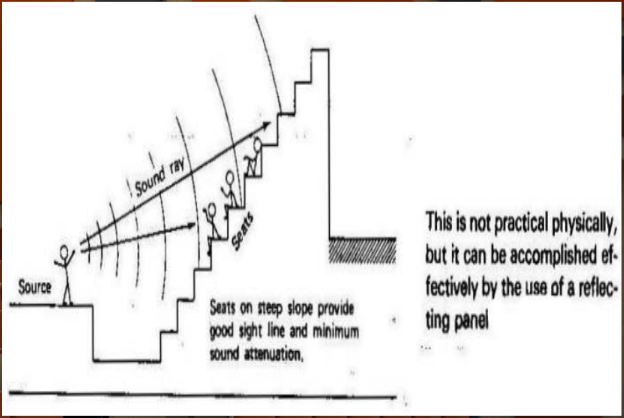
______________ occurs when sound reflects off a hard polished surface. This characteristics can be used to good advantage to create an effective image source. In ancient Greek and roman theaters, seats were arranged on a steep, conical surface around the performer. The virtue of the arrangement in the fig. (a) below is that the sound power travels to each location, with minimal attenuation.
RAY DIAGRAM
_______________ is a design procedure for analyzing reflected sound distribution throughout a hall, using the first reflection only.
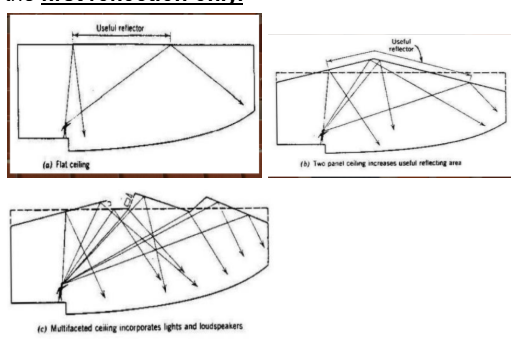
ECHOES
A clear _____ is caused when reflected sound at sufficient intensity reaches a listener approximately 70 msec or more after hears the direct sound. _______ even if not distinctly discernable are undesirable in rooms. They are annoying and make speech less intelligible the relative annoyance is dependent on the time delay, and loudness relative to the direct sound which, in turn, are dependent on the size, position, shape, and absorption of the reflecting surface.
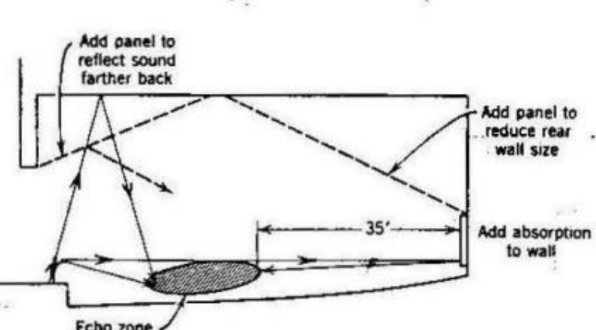
DIFFUSION
This is the converse of focusing and occurs primarily when sound is reflected from convex surfaces. A degree of ________ is also provided by flat horizontal inclined reflectors as shown.