PART 1: Historical English phonology
 Call Kai
 Learn
Learn Practice Test
 Spaced Repetition
 Match
Match Flashcards
 Knowt Play
1/5

There's no tags or description
Looks like no tags are added yet.
Name | Mastery | Learn | Test | Matching | Spaced | Call with Kai |
|---|
No analytics yet
Send a link to your students to track their progress
6 Terms
OLD-ENGLISH (500bc-1150ac)
The Old English vowel system was very symmetrical
All vowels and diphthongs could be long or short.
Old English consonants could also be long (doubled) or short
The voiced fricatives were allophones of their voiceless counterparts in complementary distribution: short (undoubled) fricatives in medial positions were voiced →they didn’t distinguish meaning
The grapheme <g> indicated either the phoneme /j/, (before [e,i]; e.g. gear), or the phoneme /g/ with its two allophones [g] (god) or [G] (fugol) (in intervocalic position)
/h/ was pronounced [h] at the beginning of a syllable (hætt), and [x] after a back vowel (dohtor) / [C] after a front vowel (niht)
/r/ was probably a trill and pronounced in all positions.
From old English to Middle English
Short vowels were lengthened before the lengthening groups -mb, -nd, -ld, and -rd e.g., climban, wind, cild
This change did not take place if the lengthening group was followed by a third consonant, e.g., children
Syllable structure:
Also towards Middle English, the syllable structure in stressed syllables was regularized:
In open syllables, the vowel became a long vowel e.g. cepan ‘keep’
In closed syllables, the vowel became a short vowel e.g. cepte ‘kept’
In the antepenultimate syllable, the vowel was also shortened (this is an exception to the first rule!) e.g., divinity
MIDDLE ENGLISH (1150-1500)
Since early Middle English, unstressed vowels were weakened to schwa /ə/
loss of inflectional endings.
Middle English is the period when English shifted most noticeably from a synthetic to an analytic language, and word order was fixed to SVO
From Middle English to Early modern English
Loss of /x/
The phoneme /x/ was lost
As a consequence, the preceding vowel was lengthened (compensatory lengthening)
As this lengthened vowel then regularly underwent the Great Vowel Shift (GVS), /x/ must have been lost before the fifteenth century e.g., night, knight
In some Middle English dialects, /x/ became /f/ instead. Some words that came into Modern English through these dialects today still have /f/: e.g., laugh, draught
The Great Vowel shift
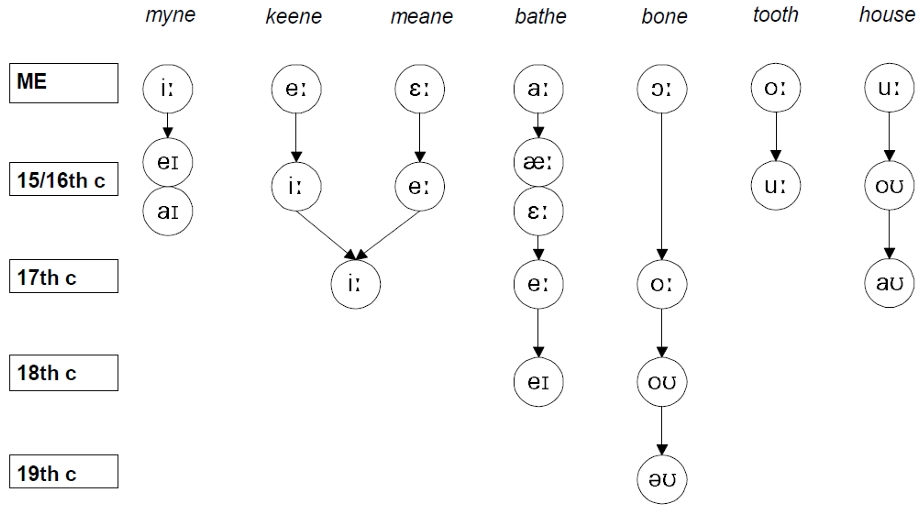
EARLY MODERN ENGLISH (1500-1660)
Vowel changes
Short /ʊ/ changed to /ʌ/.e.g. but, butter, cup. However, this change did not take place in all words e.g. pull, put, wolf, bull
Middle English /ɛː/ was shortened to /e/ in some words e.g. breath, bread, sweat, spread
Middle English /oː/ was shortened to /ʊ/.
Depending on whether this shortening took place early, the resulting /ʊ/ underwent the regular further change to /ʌ/ (blood, flood, see above) or not (look, foot).
Consonant changes
/k/ and /g/ were lost before nasals at the beginning of words e.g. gnat, knight
/b/ and /g/ were lost after nasals at the end of words, e.g., climbe
/wr/ was simplified to /r/
From Early Modern English to Modern English
Vowel changes:
In British English (RP), short /æ/ was lengthened to /æː/, long /æː/ was later changed to /ɑː/ in some environments:
before voiceless fricatives e.g. path, half, laugh, after, castle, bath
before /n/+/s,t/ e.g. aunt, dance, plant
In RP, vowels following /w/ were rounded; this affected /a/ in particular, e.g., swan, watch
Consonant changes:
Postvocalic /r/ was lost in British English (RP), causing one of the following changes in the preceding vowel:
the vowel is lengthened e.g. arm, bark, card, horse, storm
or: the vowel is changed in quality / diphthongized e.g. here, poor
postvocalic /l/ was lost before consonants in some words, e.g., palm, calm