PSYC 332 Final Exam -Lectures
0.0(0)
Studied by 7 people Call Kai
 Learn
Learn Practice Test
 Spaced Repetition
 Match
Match Flashcards
 Knowt Play
Card Sorting
1/148

Earn XP
Description and Tags
Last updated 3:28 AM on 12/19/22
Name | Mastery | Learn | Test | Matching | Spaced | Call with Kai | Chat |
|---|
No analytics yet
Send a link to your students to track their progress
149 Terms
1
New cards
Who is Greta Thunberg? What does she have?
She is a political figure. (spoken at the UN) Asperger & Anorexia since 12 years old which stunted her growth. (her Asperger’s comes through as she is very focused on numbers)
\
\-she says that Aspergers has been a gift to her because it allows her to be laser-focused, speak the truth and not worry about the consequences-
\
\-she says that Aspergers has been a gift to her because it allows her to be laser-focused, speak the truth and not worry about the consequences-
2
New cards
Greta on the Big 5 and Big 3
* High on Extraversion, low on Neuroticism, can’t say for Openness to experience, Can be high on Agreeableness
* Great is high on Power motivation
\
\-she is not submissive, she is intense, passionate, blaming, accusatory-
\
* Great is high on Power motivation
\
\-she is not submissive, she is intense, passionate, blaming, accusatory-
\
3
New cards
How is ASD characterized in the DSM-5
the deficit in social communication and interaction restricted, repetitive, and stereotypical behaviours. → heterogenous condition with development deficits in social, cognition, motor, & language.
\
\-ASD is 90% heritabile-
\
\-ASD is 90% heritabile-
4
New cards
What are the 5 aspects of Diagnosis for ASD
* persistent deficit in social communication and interaction
* restricted, repetitive patterns of behaviour, interest and activities
* symptoms must be present in early developmental period
* symptoms cause clinically significant impairment in social and occupational functioning
* these disturbances are not better explained by intellectual disability or developmental delay
* restricted, repetitive patterns of behaviour, interest and activities
* symptoms must be present in early developmental period
* symptoms cause clinically significant impairment in social and occupational functioning
* these disturbances are not better explained by intellectual disability or developmental delay
5
New cards
Example: prof. friend HS memorized all the train maps and times of passing, knows a lot about trains with a persistent compulsive aspect. What does his friend suffer from?
ASD
6
New cards
What does it mean to be on the autism spectrum? (3 levels)
Level 3- requiring very substantial support (severe deficit in verbal and non-verbal communication, minimal social response to others; extreme difficulty in coping or repetitive behaviours markedly interfere with functioning in all aspects of life)
\
Level 2- requiring substantial support (difficulty coping with change or other restricted and repetitive behaviours cause interference in functioning, limited social interactions; apparent even with help)
\
Level 1- require support (noticeable impairments without support and inflexible behaviour causing interference with daily functioning)
\
Level 2- requiring substantial support (difficulty coping with change or other restricted and repetitive behaviours cause interference in functioning, limited social interactions; apparent even with help)
\
Level 1- require support (noticeable impairments without support and inflexible behaviour causing interference with daily functioning)
7
New cards
What are other difficulties someone with ASD may face?
Depression, OCD, Anorexia Nervosa, Elective Mutism → Greta:at 12 she developed these in addition to aspergers-
\
**This is common for people with ASD or Aspergers**
\
**This is common for people with ASD or Aspergers**
8
New cards
Indicators for ASD?
* looking at peoples mouth when you have a conversation
* not being able to get sarcasm/humour
* knowing a lot about a random topic that interests them (overboard)
* liking things a certain way and getting upset when people try to interfere in their routines
* convo. doesn’t flow easily
* not being able to get sarcasm/humour
* knowing a lot about a random topic that interests them (overboard)
* liking things a certain way and getting upset when people try to interfere in their routines
* convo. doesn’t flow easily
9
New cards
Autism and the Big 5
* high in ASD is associated with being low in E, high on N, low on C
* people with ASD more common to experience issues with depression and self-consciousness
* in terms of E, they are low on wanting to be with people (gregariousness)
\
*-females with ASD have a harder time during adolescence, bcs it is harder for them to figure out the social hierarchy-*
\
*-12 year old who is on the more social end of the big 5 is very likely to be no longer diagnosed with Aspergers later in life (because they don’t have as much difficulty making friends and being social)-*
\
* people with ASD more common to experience issues with depression and self-consciousness
* in terms of E, they are low on wanting to be with people (gregariousness)
\
*-females with ASD have a harder time during adolescence, bcs it is harder for them to figure out the social hierarchy-*
\
*-12 year old who is on the more social end of the big 5 is very likely to be no longer diagnosed with Aspergers later in life (because they don’t have as much difficulty making friends and being social)-*
\
10
New cards
Meta-analysis: Kotov et al. 2010
* all studies compared a diagnosed patient group with controls
* almost all studies were cross-sectional
* life time prevalence rates (depressive disorders: 17%, anxiety disorders: 29%, substance use disorders: 35%)
\
conclusion:
**depression and anxiety disorders** individuals were low on C,E and high on N
**Substance use** individuals were low on A and E was not associated
* almost all studies were cross-sectional
* life time prevalence rates (depressive disorders: 17%, anxiety disorders: 29%, substance use disorders: 35%)
\
conclusion:
**depression and anxiety disorders** individuals were low on C,E and high on N
**Substance use** individuals were low on A and E was not associated
11
New cards
What is Aspergers?
* A form of ASD
* it differs from ASD because the symptoms are milder and there is an absence of language delays
* it differs from ASD because the symptoms are milder and there is an absence of language delays
12
New cards
What are the 3 levels of personality?
Level 1- Dispositional traits (actor)
Level 2- Goals and Values (agent)
Level 3- Life Narrative/Story (author)
Level 2- Goals and Values (agent)
Level 3- Life Narrative/Story (author)
13
New cards
Ordinary People video (kid forced in therapy)
* agitated, trouble sleeping, trouble with friends and with school
* therapist is natural, creates a relationship making him want to come back, doesn’t force the kid, asks him why are you here?, what do you want to get out of this?
* therapist is natural, creates a relationship making him want to come back, doesn’t force the kid, asks him why are you here?, what do you want to get out of this?
14
New cards
What are the personal qualities needed to be an effective clinician?
* motives: intimacy (build a relationship with client) and power (impact their life/want to change ppl/help ppl)
* traits: agreeableness(empathy/caring, help to build trusting alliance) and extraversion (social vitality aspect, like to spend time with people)--neuroticism doesn’t play a roll
* values: helping people in distress
* skills: empathy, decoding emotional expressions, listening skills
* traits: agreeableness(empathy/caring, help to build trusting alliance) and extraversion (social vitality aspect, like to spend time with people)--neuroticism doesn’t play a roll
* values: helping people in distress
* skills: empathy, decoding emotional expressions, listening skills
15
New cards
Schwartz theory of basic values
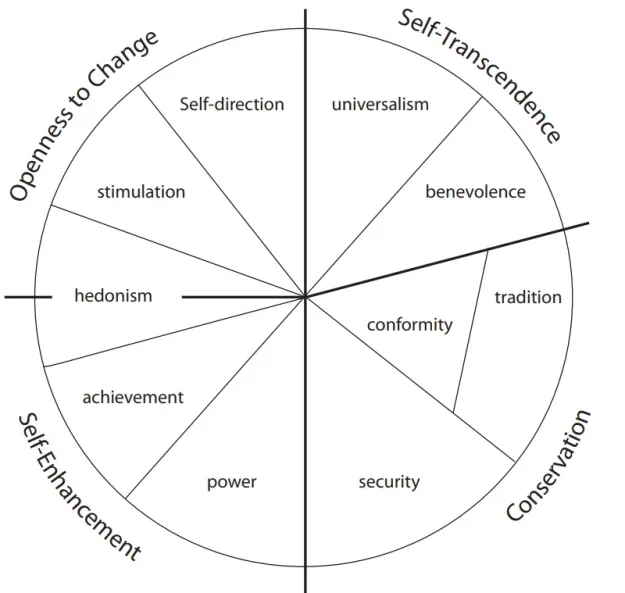
* According to Schwartz, individual values are responses to three universal requirements of human existence; needs of people as biological organisms, agreement in social actions, survival and well-being of groups
* 10 fundamental values
* 4 sections (openness to change, self-transcendence, self-enhancement, conservation)
* some contradict each other
* 10 fundamental values
* 4 sections (openness to change, self-transcendence, self-enhancement, conservation)
* some contradict each other
16
New cards
What is the interpersonal perception task?
Videotape consisting of 30 scenes. Each scene is paired with a multiple-choice question about the interaction depicted in the scene. All scenes contain full-channel sequences of unscripted behaviour and employ an objective criterion of accurate judgment.
17
New cards
Reading the mind in eye test
This test includes 36 photographs of male and female eyes depicting emotional states. For each photograph, participants are asked to choose the emotional state that best describes the eyes, choosing between one of four possible emotions
18
New cards
Thematic Apperception Test (TAT) had a name change. What is the new name for the test?
Picture–story exercises (PSE)
19
New cards
What is the Picture–story exercises (PSE)?
This test consists of an individual being shown multiple ambiguous images and having that individual tell an imaginative story in response to the picture cues → a clinician then codes for motives
20
New cards
A TAT story …. what does this code for?
\
“They were young and in love. Hours would they sit together, taking in the shining beauty of the snow and ice, talking softly. They exchanged understanding glances, and planned for a future together. Yet the air was full of the tensions of war, so they retreated into their world, where no one could come, where they could dream and plan, feel safe and protected, and hope."
\
“They were young and in love. Hours would they sit together, taking in the shining beauty of the snow and ice, talking softly. They exchanged understanding glances, and planned for a future together. Yet the air was full of the tensions of war, so they retreated into their world, where no one could come, where they could dream and plan, feel safe and protected, and hope."
this can be coded for intimacy (about a 6)
21
New cards
A TAT story …. what does this code for?
\
“The man is an agent of the notorious secret police, and the woman is a member of a revolutionary group. She originally joined after her mother (a famous leader) was framed by the government and imprisoned. Now she wants to carry on the campaign. The police have been checking up on her. The agent is eagerly waiting for the chance to plant a listening device on her.”
\
“The man is an agent of the notorious secret police, and the woman is a member of a revolutionary group. She originally joined after her mother (a famous leader) was framed by the government and imprisoned. Now she wants to carry on the campaign. The police have been checking up on her. The agent is eagerly waiting for the chance to plant a listening device on her.”
this can be coded for power (big things going on, wanting to have an influence/impact on people)
22
New cards
Validity Evidence: Activities
nAch – moderate challenge, personal responsibility , extensive feedback
\
nPow – exerting influence and being noticed
\
nInt – Conversing with people in warm, reciprocal manner.
\
nPow – exerting influence and being noticed
\
nInt – Conversing with people in warm, reciprocal manner.
23
New cards
Big 3 and occupational preferences
* nAch → small business owner, research scientists, sales people
* nPow → manager, clergy, leader of a community, teacher therapist, journalist, wanting to be a lawyer or doctor (however, the work of the job is more achievement motivated)
* nInt → counsellor, mediator 12
* nPow → manager, clergy, leader of a community, teacher therapist, journalist, wanting to be a lawyer or doctor (however, the work of the job is more achievement motivated)
* nInt → counsellor, mediator 12
24
New cards
How strongly do the implicit motives relate to other personality measures?
* self reports don’t often correlate, especially for achievement
* self-reports do correlate when asked ‘list 10 things you want?” → because clinicians can code these implicit wants and interpret motives
* self-reports do correlate when asked ‘list 10 things you want?” → because clinicians can code these implicit wants and interpret motives
25
New cards
How do motives relate to which career would suit you?
it allows you to find what fits your goals
26
New cards
what are the personal Qualities Needed to Be an Effective Scientific Researcher?
* motives: achievement motivated
* traits: conscientiousness, introversion (data people)
* values: importance of advance in knowledge
* skills: divergent thinking, identifying patterns
* traits: conscientiousness, introversion (data people)
* values: importance of advance in knowledge
* skills: divergent thinking, identifying patterns
27
New cards
Why did professor Koestner not become a clinician?
* he did not get the same satisfaction as others
* Wrong traits and motive profiles
* teaching and researcher are better options because they fit better with his trait of introversion and achievement motivates
* Wrong traits and motive profiles
* teaching and researcher are better options because they fit better with his trait of introversion and achievement motivates
28
New cards
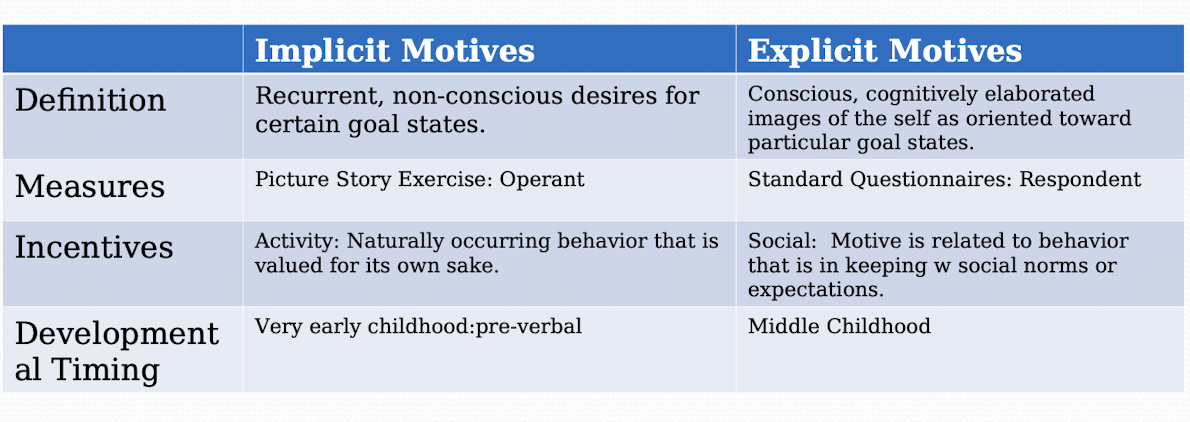
outcomes associated with 2 types of motives, mcadams 2008
29
New cards
Achievement Motive and Sports Participation: Gropel et al., 2016
* 3 studies assessed implicit and self-report achievement motivation
* assessed daily level of sports participation
* results: implicit nAch., self-reports nAch., match of implicit and self-reports
* sports are generally achievement based
* found implicit motive predict how much you practice that sport over time
* assessed daily level of sports participation
* results: implicit nAch., self-reports nAch., match of implicit and self-reports
* sports are generally achievement based
* found implicit motive predict how much you practice that sport over time
30
New cards
What motive are these individuals strives high on?
\
“make my mother proud of me”
“help my friends”
“I would like to brighten up the relationship with my girlfriend. I want to share more activities with her and start being more sensitive to her needs again.”
\
“make my mother proud of me”
“help my friends”
“I would like to brighten up the relationship with my girlfriend. I want to share more activities with her and start being more sensitive to her needs again.”
this individual is… strivings of subject high in intimacy motivation
31
New cards
What motive are these individuals strives high on?
\
“force friendships into greater deep intimacy than other is willing or ready for”
“I am the head of a tutorial in theoretical physics and try to do my best to motivate my students.”
“I try to convince my parents that my academic major is the right thing for me.”
\
“force friendships into greater deep intimacy than other is willing or ready for”
“I am the head of a tutorial in theoretical physics and try to do my best to motivate my students.”
“I try to convince my parents that my academic major is the right thing for me.”
\n this individual is… strivings of subject high in power and agency motivation
32
New cards
Brunstein Results: correlations with average daily well-being
* when making progress on goals (life moving along): feel great and positive, correlated with wellbeing → however the progress must be on our correct motives
* when not making progress correlated negatively with wellbeing
* our everyday emotions/satisfaction is determined by if the progress we are making is on our right motives
* when not making progress correlated negatively with wellbeing
* our everyday emotions/satisfaction is determined by if the progress we are making is on our right motives
33
New cards
Is power motivation maladaptive?
power motivation can be looked at as wonderful or dangerous/socially destructive
\
—> both, it has to do with other characteristics that can moderate or mitigate it
—> having self-control, activity inhibition will guide the power motive so it is more helpful/useful
\
—> both, it has to do with other characteristics that can moderate or mitigate it
—> having self-control, activity inhibition will guide the power motive so it is more helpful/useful
34
New cards
what is achievement?
a recurrent preference for experiences of doing well and being successful.
35
New cards
what is power motivation?
a recurrent preference for experiences of having impact on others.
36
New cards
what is intimacy? and how does affiliation differ?
a recurrent preference for experiences of warm, close, and communicative interactions with others.
\
Affiliation differs because it has a fear aspect, scared to lose relationship/connection.
\
Affiliation differs because it has a fear aspect, scared to lose relationship/connection.
37
New cards
What are the 3 natural incentives?
1. mastery; feel goos when do things well (achievement)
2. impact; power, natural to all but some are more drawn to having an impact
3. connection; sense of being understood & understanding someone (intimacy)
38
New cards
Positive and Negative correlates of Power?
Positive:
* membership in voluntary organizations
* Efforts to make community contributions
* Effective leadership
* Acquisition of prestige symbols
Negative:
* aggression
* Exploitative interpersonal relations
* profligate sexuality
* profligate drinking
* divorce (related to infidelity and selfish behaviours)
* membership in voluntary organizations
* Efforts to make community contributions
* Effective leadership
* Acquisition of prestige symbols
Negative:
* aggression
* Exploitative interpersonal relations
* profligate sexuality
* profligate drinking
* divorce (related to infidelity and selfish behaviours)
39
New cards
Moderators of power motivation
Gender:
→men with a lot of responsibility training no longer showed maladaptive side of power, they showed socialized version
→ no findings of why ppl have +/- power motivation; however, there was correlation with men having problems with power motivation
→agressice, lack of control, impulsive behaviour, selfish behaviour (psychological factors to why lack of control with power)
\
Social class:
→men from lower-class families tend to show more of uncontrolled power motivation
\
Activity inhibition:
→self-control, limit setting, self-regulations, stop&think, inhibit natural way of thinking
→men with a lot of responsibility training no longer showed maladaptive side of power, they showed socialized version
→ no findings of why ppl have +/- power motivation; however, there was correlation with men having problems with power motivation
→agressice, lack of control, impulsive behaviour, selfish behaviour (psychological factors to why lack of control with power)
\
Social class:
→men from lower-class families tend to show more of uncontrolled power motivation
\
Activity inhibition:
→self-control, limit setting, self-regulations, stop&think, inhibit natural way of thinking
40
New cards
predicting managerial success: the leadership motive profile
* high power
* low affiliation
* high activity inhibition
\
→leadership motive profile: high power motivated, care about that kind of incentive, but also low in afflictive motivation (worry about if there will like you or not)
→if you are going to be a good leader you can’t care what people think of you., low affiliative motive allows you to delegate, suggest and lead
* low affiliation
* high activity inhibition
\
→leadership motive profile: high power motivated, care about that kind of incentive, but also low in afflictive motivation (worry about if there will like you or not)
→if you are going to be a good leader you can’t care what people think of you., low affiliative motive allows you to delegate, suggest and lead
41
New cards
Micheal from the office motive profile as a manager
extremely high on affiliative motivation: needs to be liked, needs ti be praised, needs to think everyone admired him (ppl dont like him)
—> high on achievement (good car sales men)
—> low activity inhibition (no ability to inhibit, says and does inappropriate things, doesnt think abut consequences
—> no affiliative or inhibition component so his power motivation isn’t used in a socially helpful way
—> high on achievement (good car sales men)
—> low activity inhibition (no ability to inhibit, says and does inappropriate things, doesnt think abut consequences
—> no affiliative or inhibition component so his power motivation isn’t used in a socially helpful way
42
New cards
research done with men:
* US navy and AT&T (manager you can move up level by level)
* collected stories, coded 3 leadership motives, identified 25% of the managers in both these organizations were high on power, low on affiliation and high on activity inhibition
* ppl with this profile were the ones that moved up in leadership roles through the years (ex: became caption, admiral, commander, VP, etc…)
* US navy and AT&T (manager you can move up level by level)
* collected stories, coded 3 leadership motives, identified 25% of the managers in both these organizations were high on power, low on affiliation and high on activity inhibition
* ppl with this profile were the ones that moved up in leadership roles through the years (ex: became caption, admiral, commander, VP, etc…)
43
New cards
Political psychology (David winter): found way to show you can predict which politicians will be successful in their careers.
* he found a way of coding speeches (if you have enough content you can determine where ppl were on power, affiliation, and activity inhibition.
* he found a strong positive correlation to more success as a president when high power and low affiliation
* he found a strong positive correlation to more success as a president when high power and low affiliation
44
New cards
Winter’s brief scoring definitions of power imagery
* Strong vigorous actions that have impact on others: force, attempts to convince or persuade, unsolicited help, attempts to monitor or control.
* Concern for reputation or prestige.
* Actions that directly arouse a strong positive or negative emotional state in others.
* Concern for reputation or prestige.
* Actions that directly arouse a strong positive or negative emotional state in others.
45
New cards
Motive Scoring of Obama Speeches
* High power
* low affiliative
* Moderate achievement
* high inibition
—> when code Obama speeches can see that compared to everyone running against he has the right profile (why he won)
* low affiliative
* Moderate achievement
* high inibition
—> when code Obama speeches can see that compared to everyone running against he has the right profile (why he won)
46
New cards
Do Obama’s Traits support his motives?
* concerns that Obama was to introverted
* suggest being introverted instead of extroverted could inhibit the power motivation
* suggest being introverted instead of extroverted could inhibit the power motivation
47
New cards
An Integration?
* The channeling hypothesis:
* “Motives involve wishes desires or goals (often implicit or nonconscious), whereas traits channel or direct the ways in which motives are expressed in particular actions throughout the life course.”
* “Motives involve wishes desires or goals (often implicit or nonconscious), whereas traits channel or direct the ways in which motives are expressed in particular actions throughout the life course.”
48
New cards
Longitudinal Study of Radcliffe Women, Winter 1998
* as hypothesized: level of extraversion had an impact
* Un-conflicted desire for impact leads to an impact career and valuing the relational aspects of work as instrumental to this goal
* Un-conflicted desire for impact leads to an impact career and valuing the relational aspects of work as instrumental to this goal
49
New cards
Power X extravert/introvert
* Extrovert: higher the power motive, the more of an impact career they had
* Introvert: the power motive wasn’t expressed clearly (weather high or low didn’t make much difference)
* Introvert: the power motive wasn’t expressed clearly (weather high or low didn’t make much difference)
50
New cards
Would this person be a successful president? Trump vs. Obama
\*\* we had two leaders high on power, Obama had socialized/adaptive form and Trump had the unsocialized/uncontrolled/narcissistic form of power motivation\*\*
\
Trump: does not have the motive profile to be successful president
* high power motive; talks abt how great and powerful he is
* high achievement; standards of excellence , how bad US is and how good it would be if he ran it
* high affiliation; cares about what ppl think of him (like Micheal Scott)
\*\* problem: say things ppl like, if group of racists he will be racist, and he can’t stop himself
* no activity inhibition; no capacity to not say things, not do things
* trump does not have the socialized power motivation —> other research by winter’s suggests that this can lead to problems (corruption, divisiveness in country)
\
Obama: has the motive profile to be successful president
* does have leadership motive profile, which suggests he will be a good leader
* after left things were in not so good shape
* hypothesis: even tho good profile, his low levels go extroversion might have limited his impact in some way
\
Trump: does not have the motive profile to be successful president
* high power motive; talks abt how great and powerful he is
* high achievement; standards of excellence , how bad US is and how good it would be if he ran it
* high affiliation; cares about what ppl think of him (like Micheal Scott)
\*\* problem: say things ppl like, if group of racists he will be racist, and he can’t stop himself
* no activity inhibition; no capacity to not say things, not do things
* trump does not have the socialized power motivation —> other research by winter’s suggests that this can lead to problems (corruption, divisiveness in country)
\
Obama: has the motive profile to be successful president
* does have leadership motive profile, which suggests he will be a good leader
* after left things were in not so good shape
* hypothesis: even tho good profile, his low levels go extroversion might have limited his impact in some way
51
New cards
Does Volodymyr Zelenskyy have the leadership motive profile?
Translator started crying because of how zelensky was portraying the situation so emotionally
* they should stay and fight, cellphone and broadcasted we should fight
* US army try to remove him but he said no we need the resources to fight
* gave speech, won support of countires
\
—> zelensky has motive profile, and moral courage/rising to the moment (smthg act him that inspires ppl)
* they should stay and fight, cellphone and broadcasted we should fight
* US army try to remove him but he said no we need the resources to fight
* gave speech, won support of countires
\
—> zelensky has motive profile, and moral courage/rising to the moment (smthg act him that inspires ppl)
52
New cards
How do motives interact with traits?
power motive sometimes may not be expressed if someone has very low extraversion
53
New cards
Erikson’s Psychosocial Stages
1\. Trust → 1st year of life.
2\. Autonomy → age 2
3\. Initiative → age 4-5
4\. Industry →childhood to mid-adolescence. (are we good?, skillful?, moral sense?)
5\. Identity →late adolescence/young adulthood (open to possibilities, who am i?, what will i do?, what will i be?)
6\. Intimacy →young adulthood (finding friends & partner)
7\. Generativity →midlife
8\. Integrity →old age
2\. Autonomy → age 2
3\. Initiative → age 4-5
4\. Industry →childhood to mid-adolescence. (are we good?, skillful?, moral sense?)
5\. Identity →late adolescence/young adulthood (open to possibilities, who am i?, what will i do?, what will i be?)
6\. Intimacy →young adulthood (finding friends & partner)
7\. Generativity →midlife
8\. Integrity →old age
54
New cards
McAdams on Identity
“Identity is mainly about exploring and ultimately committing to specific life goals and values for the long haul. It is about choosing what sort of career goals to pursue, and deciding the most important values in your life, now that you are on the brink of becoming an adult.”
55
New cards
James Marcia Research Approach
Identity formation consists of:
1\. exploration – genuinely looking at and experimenting with alternative beliefs and directions.
2\. commitment – choosing to pursue certain roles and outlooks that define how you see yourself fitting into adult world.
1\. exploration – genuinely looking at and experimenting with alternative beliefs and directions.
2\. commitment – choosing to pursue certain roles and outlooks that define how you see yourself fitting into adult world.
56
New cards
Two crucial areas:
* Occupational Goals
* Personal Ideology (Political beliefs, Religious beliefs) → doesn’t matter your choice as long as you explore first)
* Identity Status interview
* Personal Ideology (Political beliefs, Religious beliefs) → doesn’t matter your choice as long as you explore first)
* Identity Status interview
57
New cards
Identity Status Categories
1. identity diffusion: don’t know → alienated and isolated; distant from parents.
2. foreclosure: commitment without exploration (ex: choose smthg because your parents want it for u) → goal-directed, very close to family, choose similar friends.
3. moratorium: exploring with no commitment identity → preoccupied and struggling; marked ambivalence toward parents. (higher on N)
4. achievement: both explore and commitment →trust themselves; able to explain their choices, view parents in a balanced way.
\
**diffusion & foreclosure: don’t handle stress well and have problems with intimacy*
58
New cards
Intimacy Status Categories
* Isolate – lacks enduring personal relationships (no depth/no commitment)
* Stereotyped – Rels lack depth
* Pre-Intimate – Friends but not commitment
* Intimate – Commitment and mutuality/depth
* Stereotyped – Rels lack depth
* Pre-Intimate – Friends but not commitment
* Intimate – Commitment and mutuality/depth
59
New cards
From Identity to Intimacy
“It is only after a reasonable sense of identity has been established that real intimacy with another person is possible.”
\
example: The Amazing Spiderman d ate scene
\
example: The Amazing Spiderman d ate scene
60
New cards
Self-esteem study Marcia 1977
* Self-esteem measured before and after doing concept formation task.
* “Test relates to intelligence and success in school.”
* “You have solved the 5 of the 7 problems better (or worse) than national norms”
* “Test relates to intelligence and success in school.”
* “You have solved the 5 of the 7 problems better (or worse) than national norms”
61
New cards
Change over one year, Adams et al 1982
148 students assessed Freshman & Sophomore year
→ push people to move towards achievement and exploration
→ push people to move towards achievement and exploration
62
New cards
prof. story about Identity Crisis Anecdote
* got scholarship to NYC but didn’t go because dad sick
* went to Columbia instead (hated it and worked at macy’s)
* all his friends want to help him change
→ throw away broadway and switch to rock-n-roll (alex)
→ go shopping to change clothes (margret)
→ 2 things: 1 not legal and karate -learn to be more assertive- (john) -- after 3 classes prof. quit
* his mom thought he was part of moonies (cult) instead just karate
* if mom thinks ur part of a cult you need to work on identity
* prof. ended up going away for uni.
* went to Columbia instead (hated it and worked at macy’s)
* all his friends want to help him change
→ throw away broadway and switch to rock-n-roll (alex)
→ go shopping to change clothes (margret)
→ 2 things: 1 not legal and karate -learn to be more assertive- (john) -- after 3 classes prof. quit
* his mom thought he was part of moonies (cult) instead just karate
* if mom thinks ur part of a cult you need to work on identity
* prof. ended up going away for uni.
63
New cards
What is generativity?
An adult’s concern for and commitment to the well being of youth and future generations, as evidenced by teaching, mentoring and other activities aimed at passing a positive legacy to the next generation.
64
New cards
What is Fidelity? part of identity stage
Faithfulness to a person, cause, or belief, demonstrated by continuing loyalty and support.
65
New cards
Challenges of the generativity stage
To engage effectively in multiple social spheres;To extend oneself to others;To provide leadership and guidance;To support the next generation so they develop trust, autonomy, initiative, industry and identity
'Win Win' movie example:
Paul,→ why taking on more, Just had heart attack? → Erikson = we do more of this in midlife
↳tryingto help high- school kids .
↳ trys to help assistant coaches
↳ takes in Kid↳ struggle of midlife & trying to take care of alot of people
↳ anti-hero
Alex → Resseling being the outlet he can control
'Win Win' movie example:
Paul,→ why taking on more, Just had heart attack? → Erikson = we do more of this in midlife
↳tryingto help high- school kids .
↳ trys to help assistant coaches
↳ takes in Kid↳ struggle of midlife & trying to take care of alot of people
↳ anti-hero
Alex → Resseling being the outlet he can control
66
New cards
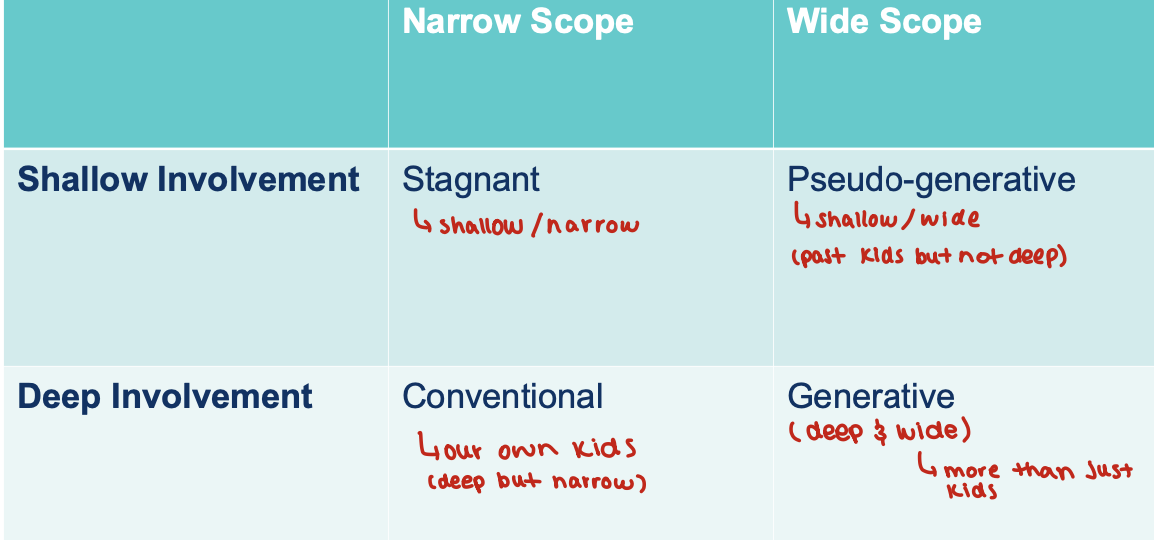
(Interview studies) Bradley & Marcia (1998) Category Model
* Main task is to establish and guide the next generation through one’s acts of care.
Semi-structured interview to assess:
1\.Level of deep involvement or concern for the growth of others.
2\. An individual’s inclusivity or scope of care-giving concern.→ Erikson doesn't give as much focus to self benefits↳ benefits younger gen. past ur children
Semi-structured interview to assess:
1\.Level of deep involvement or concern for the growth of others.
2\. An individual’s inclusivity or scope of care-giving concern.→ Erikson doesn't give as much focus to self benefits↳ benefits younger gen. past ur children
67
New cards
Generativity Statueses
68
New cards
McAdams Model of Generativity
Three Components:
* Generative Concerns (Values) →do you care about this?
* Generative Acts;→ everyday actions: tutor, younger siblings, volunteer, community work
* Generative Strivings →personal goals or community generativity
\
\*\*\*measurement of generativity: combining scores on all 3 and getting a mean\*\*\*
NOTE: parents are not necessarily more generative than an aunt: that gives alot to nieces, nephews & other kids can be more generative.
* Generative Concerns (Values) →do you care about this?
* Generative Acts;→ everyday actions: tutor, younger siblings, volunteer, community work
* Generative Strivings →personal goals or community generativity
\
\*\*\*measurement of generativity: combining scores on all 3 and getting a mean\*\*\*
NOTE: parents are not necessarily more generative than an aunt: that gives alot to nieces, nephews & other kids can be more generative.
69
New cards
Developmental Evidence (generativity by life stage)
* 40,50, 60 year olds: normal distributions
* midlifes generally do more, but can find young person that does more than the average midlifer. " outliers "
* Generally an age thing ex: profs. brother starts c team for his son bcs regected from A&B team once nephew(brothers son) made A team, profs. brother stopped coaching. →therefore, it was about son not community
* midlifes generally do more, but can find young person that does more than the average midlifer. " outliers "
* Generally an age thing ex: profs. brother starts c team for his son bcs regected from A&B team once nephew(brothers son) made A team, profs. brother stopped coaching. →therefore, it was about son not community
70
New cards
Generativity strivings and well being over time, Lekes et al. 2015
* midlife adults generativity is positive related to improving along years (well being payoff)
* for young adults identity success = positive health impact
* Prospective prediction of well being is related to success of your age related strives
* for young adults identity success = positive health impact
* Prospective prediction of well being is related to success of your age related strives
71
New cards
McAdams recent conclusion redevelopment of generativity (2013)
“Erikson was broadly correct in supposing that midlife is a prime time for the expression of generativity. However, it is probably claiming too much to assert that generativity is neatly situated within a discrete midlife stage. “
72
New cards
Generativity and Social Activities, Hart et al. 2001
* Extensive network of friends;
* Social support in community;
* Greater satisfaction with social relationships
* Greater involvement in church activities.↳within black community
* Social support in community;
* Greater satisfaction with social relationships
* Greater involvement in church activities.↳within black community
73
New cards
Research on Individual Differences in Generativity: Parenting
* unrelated to being a parent → but the way you parent is
* More involved in schooling (homework, PT association, attendance at school plays and dances, knowledge of academic and social aspects of school)→ volunteer generally not just when kid is involved.
* Effective parenting style (authoritative parenting is associated with more generative)
* More involved in schooling (homework, PT association, attendance at school plays and dances, knowledge of academic and social aspects of school)→ volunteer generally not just when kid is involved.
* Effective parenting style (authoritative parenting is associated with more generative)
74
New cards
Generative Parents and Their College Age Children, Peterson 2006
* Higher scores on A & C → throughout uni years if you have generative parents
* Greater positive emotions in daily life
* Greater involvement in politics and religion.
↳ parents more generative, make more progress with belief (identity status = explore & commit) access generativity of parents during adolescents link between parents success in midlife, our struggle through uni (young adulthood)
* Greater positive emotions in daily life
* Greater involvement in politics and religion.
↳ parents more generative, make more progress with belief (identity status = explore & commit) access generativity of parents during adolescents link between parents success in midlife, our struggle through uni (young adulthood)
75
New cards
Prospective Study of generativity: Peterson & Duncan, 2007
* Generativity assessed in 100 50
* year old women followed up 10 years later.
* Satisfaction with life (General, Marital, Maternal)
* Successful aging (Less concern about aging, Identity certainty)
* Positive Personality Development (Increased A&O, decreased N)
* Generativity helps you & your children (increase A & O, decrease N)
* year old women followed up 10 years later.
* Satisfaction with life (General, Marital, Maternal)
* Successful aging (Less concern about aging, Identity certainty)
* Positive Personality Development (Increased A&O, decreased N)
* Generativity helps you & your children (increase A & O, decrease N)
76
New cards
Generativity in Midlife and Successful Aging: Gruenwald et al 2012
* Study of Midlife in the US: assessed geerativity
* 2000 participants in 60’s followed 10 years later.
* 1⁄4 died; 1⁄4 reduced activities of daily living;
* Control for T1 health status and demographic factors
\
Results: Significantly greater risk (doubles) of disability and death even after controlling for health and demographic factors.
“Adults in their 60’s who feel more generative are factors. less likely to show increases in physical disability or to die as they age into their 70’s. “
\*Replications of study in Japan and France.
\*more generative you are at 60 less likely you to die (next 10 years)&less likely to get a disability
* 2000 participants in 60’s followed 10 years later.
* 1⁄4 died; 1⁄4 reduced activities of daily living;
* Control for T1 health status and demographic factors
\
Results: Significantly greater risk (doubles) of disability and death even after controlling for health and demographic factors.
“Adults in their 60’s who feel more generative are factors. less likely to show increases in physical disability or to die as they age into their 70’s. “
\*Replications of study in Japan and France.
\*more generative you are at 60 less likely you to die (next 10 years)&less likely to get a disability
77
New cards
Relations to Big 5 (Shaver 2006)
* Meta-analysis of a dozen studies plus two new studies with best measures.
* Secure: Low N, High E (esp SD), High A
↳ function well
* Anxious: Very High N (dependant)
* Avoidant: Low E, Low A
\
\
Key Point: Moderate empirical overlap, but \*\*\*\* attachment styles predict relational outcomes better than Big 5 traits. \n
* Secure: Low N, High E (esp SD), High A
↳ function well
* Anxious: Very High N (dependant)
* Avoidant: Low E, Low A
\
\
Key Point: Moderate empirical overlap, but \*\*\*\* attachment styles predict relational outcomes better than Big 5 traits. \n
78
New cards
The grand theory of John Bowlby
* “A complex, instinctually guided behavioral system that has functioned throughout human evolution to protect infants from predators.”
* Secondary Proposition: emotional regulation
→ in order to cope with fear, anxiety, distress
→ evidence that secure attachment allows us to regulate & mitigate those kinds of emotions
* Secondary Proposition: emotional regulation
→ in order to cope with fear, anxiety, distress
→ evidence that secure attachment allows us to regulate & mitigate those kinds of emotions
79
New cards
Attachment in development
Normative patterns
↳ Biological preparedness for mothers to respond to the attachment behaviour
\
Failure to attach?
↳Result of a serious developmental disorder
↳ very rare ; less than 1% Of the cases
↳ Biological preparedness for mothers to respond to the attachment behaviour
\
Failure to attach?
↳Result of a serious developmental disorder
↳ very rare ; less than 1% Of the cases
80
New cards
Internal working models
* Secure – trust, exploration, base (developing working model)
* Insecure- intrust, anxiety, pessimism
\
→ 9-12 month transition \n → Bowlby suggest actually healthy & adaptive that human infants are programmed to be scared of strangers.
\
Video:
* African babies more independent (secure attachment; child calms when mom returns)
* other child insecure cries when parent leaves attached to parents leg
* Insecure- intrust, anxiety, pessimism
\
→ 9-12 month transition \n → Bowlby suggest actually healthy & adaptive that human infants are programmed to be scared of strangers.
\
Video:
* African babies more independent (secure attachment; child calms when mom returns)
* other child insecure cries when parent leaves attached to parents leg
81
New cards
How to assess infant attachment?
* Strange Situation for 12-18 mth old
* reaction to stranger & returning mom
* Secure – 65%
* Insecure (Avoidant 20%, Anxious-Ambivalent 15%)
→ this is similar to adults relationship attachment
* reaction to stranger & returning mom
* Secure – 65%
* Insecure (Avoidant 20%, Anxious-Ambivalent 15%)
→ this is similar to adults relationship attachment
82
New cards
D babies
* rare but associated with worst development attachments
* disorganized pattern
* parental environment: neglect or abuse
* not a lot of predictability in caretaking of child
* stability of attachment pattern is about .3 to .4
* disorganized pattern
* parental environment: neglect or abuse
* not a lot of predictability in caretaking of child
* stability of attachment pattern is about .3 to .4
83
New cards
Where do the differences in attachment styles come from?
there is a clear link btw these parenting aspects and the likelihood of a secure attachment style
* Consistent
* Sensitive
* Responsive
* Attentive
* Not Interfering or controlling
\
Key study by Ainsworth 1984:
* specific mothering behaviours that were associated with better child attachment at @9-12 moths
All impact secure attachment
* 3 moths always respond to crying → don’t respond when older
* moms express more affection
* hormonious feeding sessions
* Consistent
* Sensitive
* Responsive
* Attentive
* Not Interfering or controlling
\
Key study by Ainsworth 1984:
* specific mothering behaviours that were associated with better child attachment at @9-12 moths
All impact secure attachment
* 3 moths always respond to crying → don’t respond when older
* moms express more affection
* hormonious feeding sessions
84
New cards
What Developmental Outcomes Are Associated with Security of Attachment?
* exploration → more free to expore
* task mastery → react better if something goes wrong
* emotional adaptation → more positive
* social adaptation
\
Example with prof. Kid rlly scared Of dogs:
* She goes to dog but always goes back to check in with Prof.(dad)
* attachment process \n ↳ explore, distress, checking in
* daughter more anxious than other kids but securely attached
↳ confident enough to explore, learn , interact with dog
* task mastery → react better if something goes wrong
* emotional adaptation → more positive
* social adaptation
\
Example with prof. Kid rlly scared Of dogs:
* She goes to dog but always goes back to check in with Prof.(dad)
* attachment process \n ↳ explore, distress, checking in
* daughter more anxious than other kids but securely attached
↳ confident enough to explore, learn , interact with dog
85
New cards
Social Functioning at age 5, Srouffe 1985
findings: kids secure at 15 months, more likely to show competence in social relationships at age 5
86
New cards
Simpson et al.,2007 (prospectice longitudinal)
* Infant attachment;
* Peer competence in teacher reports grades 1,2,3
* Age 16 interview about security in closest friendships
* Age 23 assessment
* Emotional Tone of relationship;
* Observation during conflict resolution;
* Observation during collaborative task.
* all dependent measures were observed & reported (no self reports)
\
Results: As hypothesized, infant attachment at 18 months or 15 months was associated with peer competence in 1st, 2nd, 3rd grade. 1st, 2nd, 3rd grade peer adjustment associated with secure best friend at age 16. secure bestfriend at age 16 associated with secure romantic attachment at age 23.
\
Conclusion: “Our experiences in adult relationships appear to be tied in significant and meaningful ways to experiences rooted in earlier relationships and stages of development.
* Peer competence in teacher reports grades 1,2,3
* Age 16 interview about security in closest friendships
* Age 23 assessment
* Emotional Tone of relationship;
* Observation during conflict resolution;
* Observation during collaborative task.
* all dependent measures were observed & reported (no self reports)
\
Results: As hypothesized, infant attachment at 18 months or 15 months was associated with peer competence in 1st, 2nd, 3rd grade. 1st, 2nd, 3rd grade peer adjustment associated with secure best friend at age 16. secure bestfriend at age 16 associated with secure romantic attachment at age 23.
\
Conclusion: “Our experiences in adult relationships appear to be tied in significant and meaningful ways to experiences rooted in earlier relationships and stages of development.
87
New cards
Love actually, movie ending example
* end positive at airport
* seeing attachment behaviour
* all 64 scenes ppl are securely attached
* only seeing best outcomes don't see avoident or anxious attachment styles →Which isn’t realistic
* seeing attachment behaviour
* all 64 scenes ppl are securely attached
* only seeing best outcomes don't see avoident or anxious attachment styles →Which isn’t realistic
88
New cards
Stability of attachment
* 65% of adults categorize as secure
* if secure as infant 75% chance to remain secure as adult
* if secure as child more likely to parent own child to be secure as well
* if secure as infant 75% chance to remain secure as adult
* if secure as child more likely to parent own child to be secure as well
89
New cards
What are the two types of autonomy?
* reactive
* reflective
* reflective
90
New cards
what is ARC theory? (3 basic psyc. needs to consider in everyday life)
* autonomy
* relativeness
* competence
* relativeness
* competence
91
New cards
prof. race track story
* met first gf
* made rlly good guy friends
* John : love race trace , Catholic, both love sports,
loved race track bcs u use data to choose horses. Studied stats and predict which horse would win.
* prof. lost 8 first bets
* first time he bet same like john he won
* prof. refused to bet on same horse as friend, when he was an expert.
* self-reliant, independant, self-determination → not autonomy
* made rlly good guy friends
* John : love race trace , Catholic, both love sports,
loved race track bcs u use data to choose horses. Studied stats and predict which horse would win.
* prof. lost 8 first bets
* first time he bet same like john he won
* prof. refused to bet on same horse as friend, when he was an expert.
* self-reliant, independant, self-determination → not autonomy
92
New cards
**Deci & Ryan 2012 definition of Autonomy:**
“Autonomy means to behave with a sense of volition, willingness, and congruence, thus acting according to one’s true feelings.”
93
New cards
**The General Causality Orientation Scales.**
**The three orientations:**
* autonomous behaviours: initiated and regulated volitionally based on an awareness of one’s needs and integrated goals
* controlled behaviours: initiated and regulated by controls in the environment such as reward structures or internally controlling imperatives indicating how one “should” or “must” behave.
* impersonal behaviours: are those whose initiation and regulation are received to be beyond intentional control. → external locus of control (helpless)
* autonomous behaviours: initiated and regulated volitionally based on an awareness of one’s needs and integrated goals
* controlled behaviours: initiated and regulated by controls in the environment such as reward structures or internally controlling imperatives indicating how one “should” or “must” behave.
* impersonal behaviours: are those whose initiation and regulation are received to be beyond intentional control. → external locus of control (helpless)
94
New cards
**Henry Murray (1938) Definition of Autonomy**
"To resist influence or coercion; to defy an authority or to seek freedom in a new place. To strive for independence"
\
* resistance to hypnotism
* a strong dislike of work environments that encourage supportiveness and teamwork.
* a lack of persistence in pursuing goals.
\
reactive: dropout of counselling (don’t like to hear what others have to say)
\
* resistance to hypnotism
* a strong dislike of work environments that encourage supportiveness and teamwork.
* a lack of persistence in pursuing goals.
\
reactive: dropout of counselling (don’t like to hear what others have to say)
95
New cards
**Koestner & Losier** ***(1996)***
Study 1: Examined Relations Among Two Forms of Autonomy in University men and women.
\
* men more likely reactive autonomy
* women more reflective autonomy
* correlations with big 5
→reactive autonomy (high social dominance, very low on A)
→ reflective autonomy no correlations
* me(reactive) vs. we(reflective)
\
Study 3: Measured Two forms of Autonomy and Quality of Social Interactions Over 1 Week
* reflective enjoy peer interaction more
* reactive interactions with authority is unpleasent
\
* men more likely reactive autonomy
* women more reflective autonomy
* correlations with big 5
→reactive autonomy (high social dominance, very low on A)
→ reflective autonomy no correlations
* me(reactive) vs. we(reflective)
\
Study 3: Measured Two forms of Autonomy and Quality of Social Interactions Over 1 Week
* reflective enjoy peer interaction more
* reactive interactions with authority is unpleasent
96
New cards
**Hodgins et al(1997)**
* College students record interactions with peers and with parents over 3 weeks.
* Rochester Interaction Record, an event-contingent sampling procedure was used.
* Conclusion: Reflective Autonomy neither negates nor conflicts with the human need for relatedness. Rather, it allows for more open and honest interpersonal experience.
* Rochester Interaction Record, an event-contingent sampling procedure was used.
* Conclusion: Reflective Autonomy neither negates nor conflicts with the human need for relatedness. Rather, it allows for more open and honest interpersonal experience.
97
New cards
**Koestner et al 1998 -- Race Track Study**
* University students recruited to do a prediction task that involves data interpretation.
* The task was learning how to bet on horse races. Measured two forms of autonomy. → more exciting when puts $
* Taught the basics of horse-race handicapping.
* Given $ and could make more with good bets or lose it.
* 3 races that they actually watched and then had time to prepare for next.
* 3 Experimental conditions
→control: use what you learned
→ expert advice: handicapping sheet (non-credible: experts shown to actually lose more than they win; credible: experts shown to win more than they lose)
* Dependent variables
→Reliance on experts in making selections.
→Reports of interest and enjoyment
* reflective individuals followed experts picks (trusted credible experts advice)
* reactive individuals had a tendency to bet with un-credible experts, wouldn’t follow credible (lower enjoyment with credible, maybe felt threaten)
\
***This applies to everyday life as well reflective individuals typically make more educated decisions, they include others input, then they make the final decision and if they choose to take it or not is based on their true autonomy (important thing is they accept all credible info and use it to make an informed decision)***
* The task was learning how to bet on horse races. Measured two forms of autonomy. → more exciting when puts $
* Taught the basics of horse-race handicapping.
* Given $ and could make more with good bets or lose it.
* 3 races that they actually watched and then had time to prepare for next.
* 3 Experimental conditions
→control: use what you learned
→ expert advice: handicapping sheet (non-credible: experts shown to actually lose more than they win; credible: experts shown to win more than they lose)
* Dependent variables
→Reliance on experts in making selections.
→Reports of interest and enjoyment
* reflective individuals followed experts picks (trusted credible experts advice)
* reactive individuals had a tendency to bet with un-credible experts, wouldn’t follow credible (lower enjoyment with credible, maybe felt threaten)
\
***This applies to everyday life as well reflective individuals typically make more educated decisions, they include others input, then they make the final decision and if they choose to take it or not is based on their true autonomy (important thing is they accept all credible info and use it to make an informed decision)***
98
New cards
**Leger Surveys re Vaccination**
* US Study with 600 White and Black participants Fall 2021 – southern states.
* Quebec 3-wave 2022 study of 600 → longnitudal study
* Quebecers including half racialized minorities.
* Results:
→Reflective autonomy: Reliance on expert sources
in making vaccine decisions (health professionals and more respected sources of info); Autonomous motivation to \n get vaccinated; Higher rates of vaccination. (WE AUTONOMY)
→Reactive autonomy: Mistrust and rejection of expert sources in making vaccine decisions (do their own research and rely on social media); controlled motivation to get vaccinated; lower rates of vaccination (ME AUTONOMY)
* Quebec 3-wave 2022 study of 600 → longnitudal study
* Quebecers including half racialized minorities.
* Results:
→Reflective autonomy: Reliance on expert sources
in making vaccine decisions (health professionals and more respected sources of info); Autonomous motivation to \n get vaccinated; Higher rates of vaccination. (WE AUTONOMY)
→Reactive autonomy: Mistrust and rejection of expert sources in making vaccine decisions (do their own research and rely on social media); controlled motivation to get vaccinated; lower rates of vaccination (ME AUTONOMY)
99
New cards
Narrative Identity
The internalized and evolving story of the self that the person consciously and unconsciously constructs to bind together the many different aspects of the self.
100
New cards
The basics of a story (5 yr old knows this)
* Stories are set in a particular time and place, and involve characters who act on their beliefs and desires over time.
* Stories expected to have a beginning, middle, and end. **--> Event agent must work towards**
* **Stories should evoke suspense and curiosity, otherwise they will be dismissed as boring.**
* Stories expected to have a beginning, middle, and end. **--> Event agent must work towards**
* **Stories should evoke suspense and curiosity, otherwise they will be dismissed as boring.**