Ch. 12 Cell Cycle
 Call Kai
 Learn
Learn Practice Test
 Spaced Repetition
 Match
Match Flashcards
 Knowt Play
1/59

There's no tags or description
Looks like no tags are added yet.
Name | Mastery | Learn | Test | Matching | Spaced | Call with Kai |
|---|
No analytics yet
Send a link to your students to track their progress
60 Terms
What are the 3 key roles of cell division?
Reproduction
Growth and Development
Tissue Renewal
Genome
A cell’s DNA or genetic information
What is the difference between a prokaryotes and eukaryotes genome?
Prokaryotes: single long circular DNA molecule (chromosome)
Eukaryotes: number of DNA molecules (chromosomes)
What is a somatic cell?
Any cell in a organism besides the gametes
What are gametes?
Egg and sperm
How many chromosomes are found in a mature human sperm?
23 (n): one set of 23 chromosomes
Does bigger species size = more chromosomes?
No, bigger size doesn’t = more chromosomes
True or False: Every species has a defined number of chromosomes
True
Chromosomes are made of chromatin. What is chromatin?
A complex of DNA and associated protein molecules
Chromatin is a complex of DNA and associated protein molecules. What is the function of the DNA and associated proteins?
In eukaryotes, the DNA is a single linear molecule containing several hundred to a few thousand genes.
The associated proteins function to maintain the structure of chromosomes and to help control gene activity.
Centromere
Region where 2 sister chromatids are tightly attached
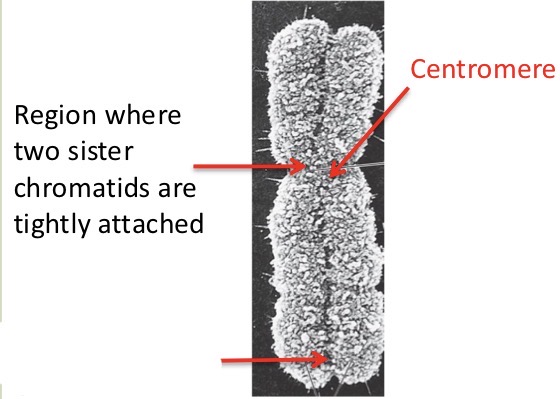
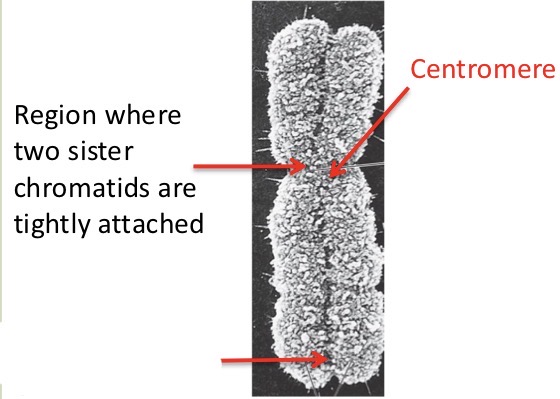
Sister chromatids are attached by what?
Cohesions
True or False: Sister chromatids are considered “one” chromosome when attached
True
Mitosis occurs in what and produces what?
Occurs in somatic cells (2n to 2n). Produces two daughter cells that are genetically identical.
Meiosis in occurs in what and produces what?
Occurs in germ cells (2n to 1n). Produces 4 daughter cells that are genetically different.
Cytokinesis
Division of the cytoplasm
What are the phases of the cell cycle?
M phase, G1 Phase, S Phase and G2 Phase
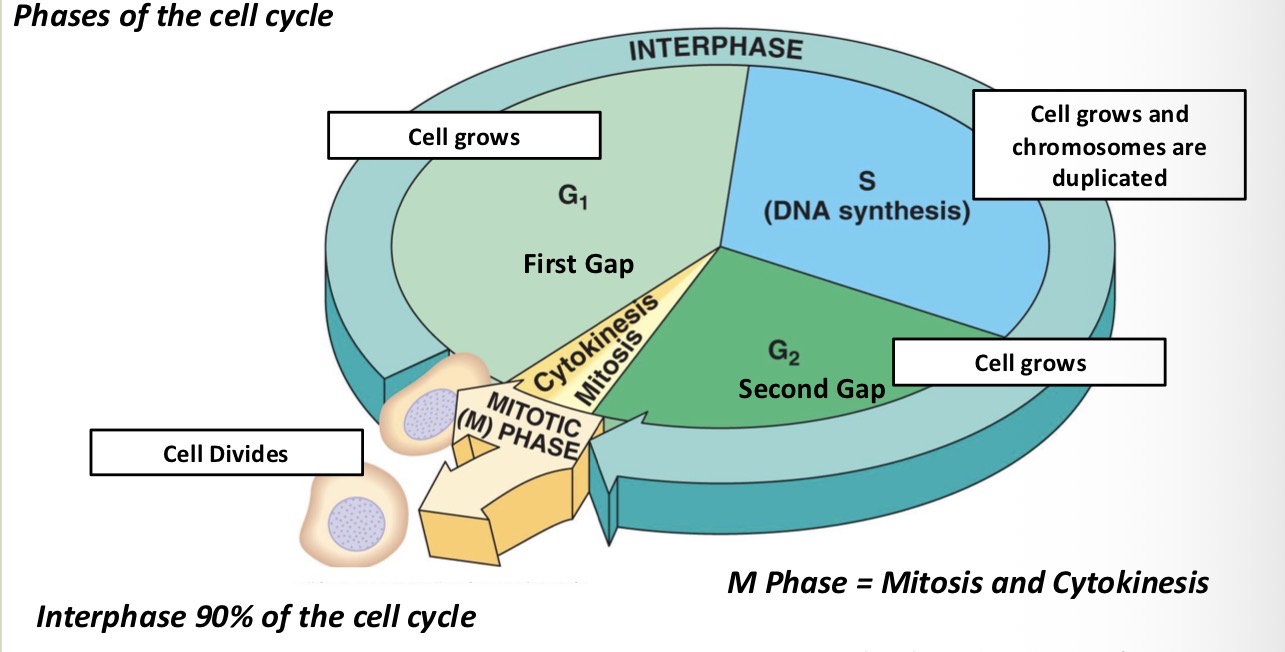
What happens in M Phase?
Mitosis and cytokinesis. The cell divides.
What happens in the G1 phase (a.k.a first gap)?
Cell grows
What happens in the S phase?
DNA synthesis. Cell grows and chromosomes are duplicated.
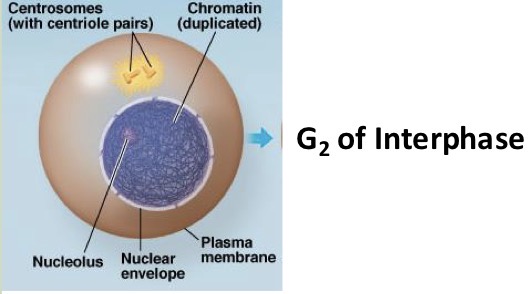
What happens in the G2 phase (a.k.a. 2nd gap)?
Cell grows
Mitosis is broken down into 5 stages. What are they?
Prophase
Prometaphase
Metaphase
Anaphase
Telophase
What is the difference between mitosis and cytokinesis?
Mitosis is the division of the nucleus, and cytokinesis is the division of the cytoplasm
Centrosome
Microtubule organizing center. Duplicate during interphase (S phase) in animals cells and move apart during mitosis (prophase and prometaphase)
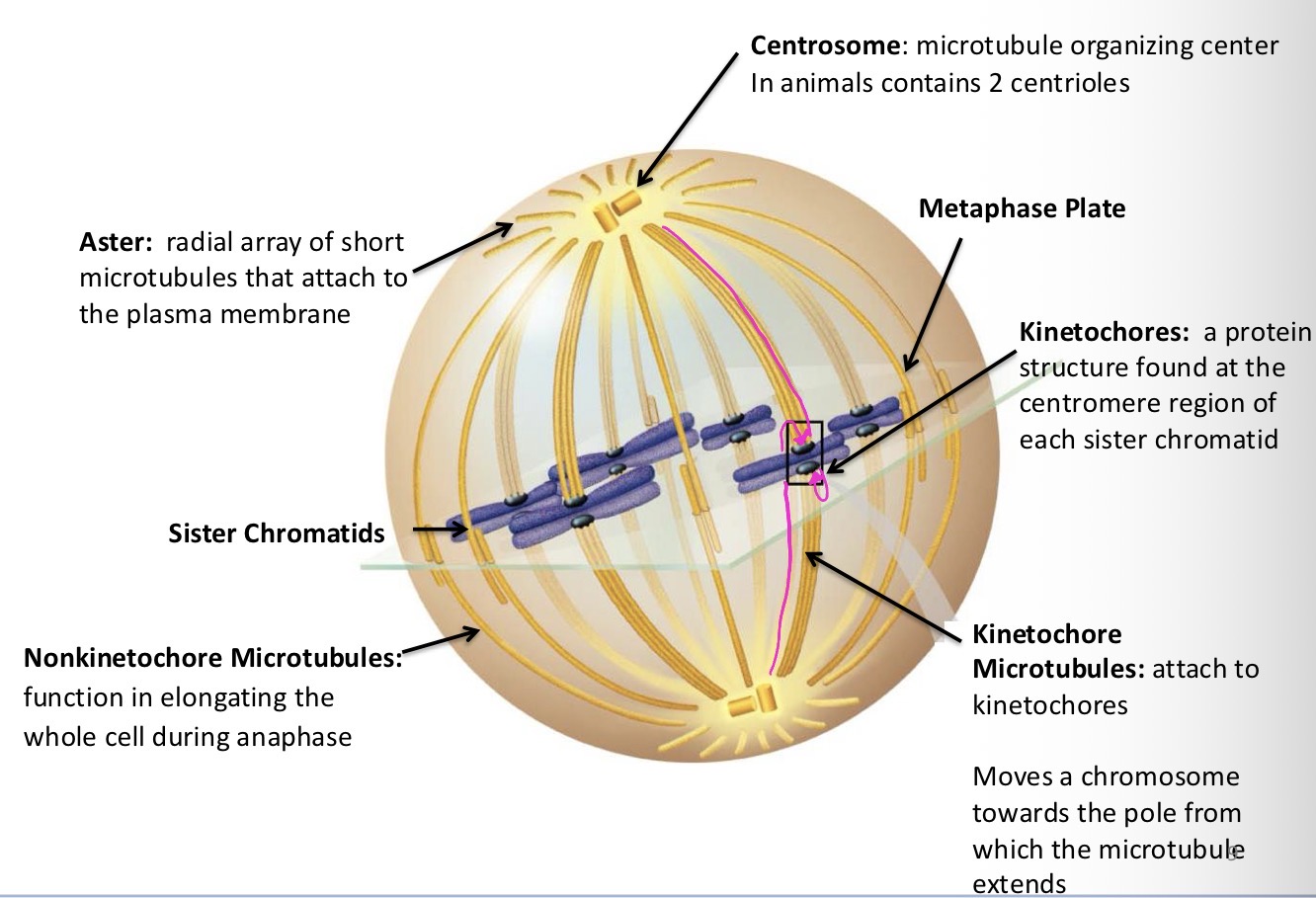
Kinetochores
A protein structure at the centromere region of each sister chromatid
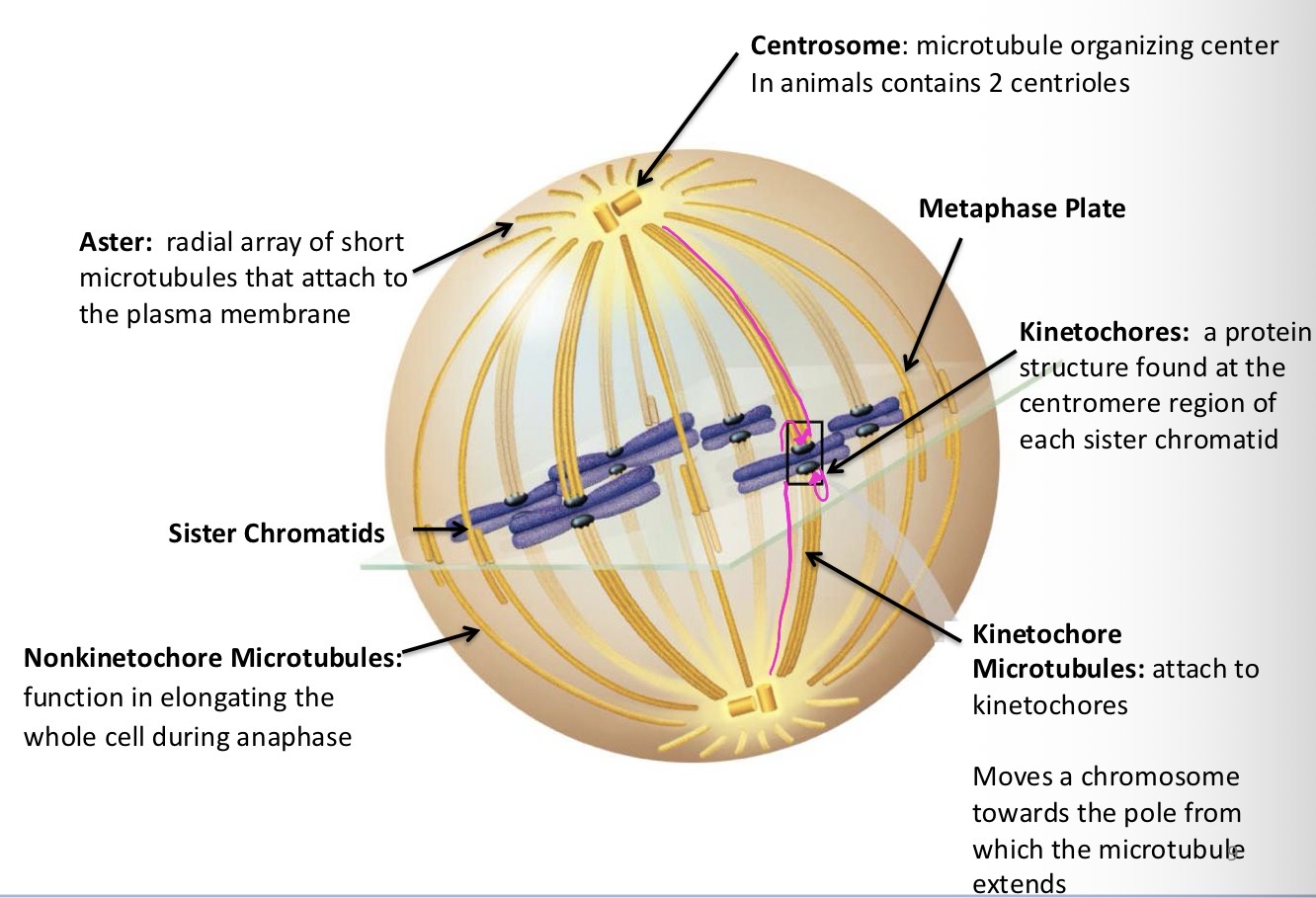
Kinetochore Microtubules
Attach to kinetochores. Moves a chromosome towards the pole from which the microtubule extends
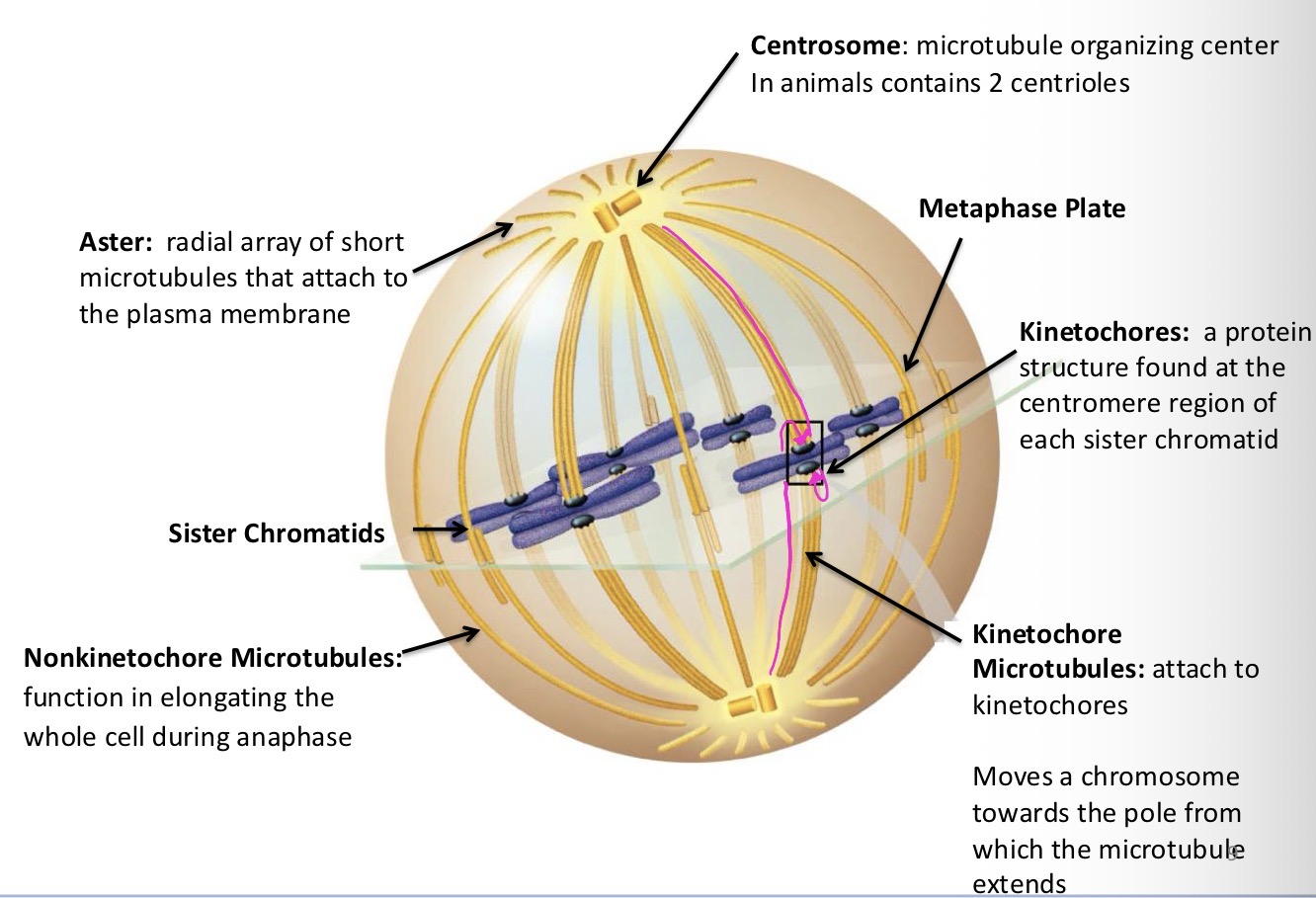
Aster
Radial array of short microtubules that attach to the plasma membrane
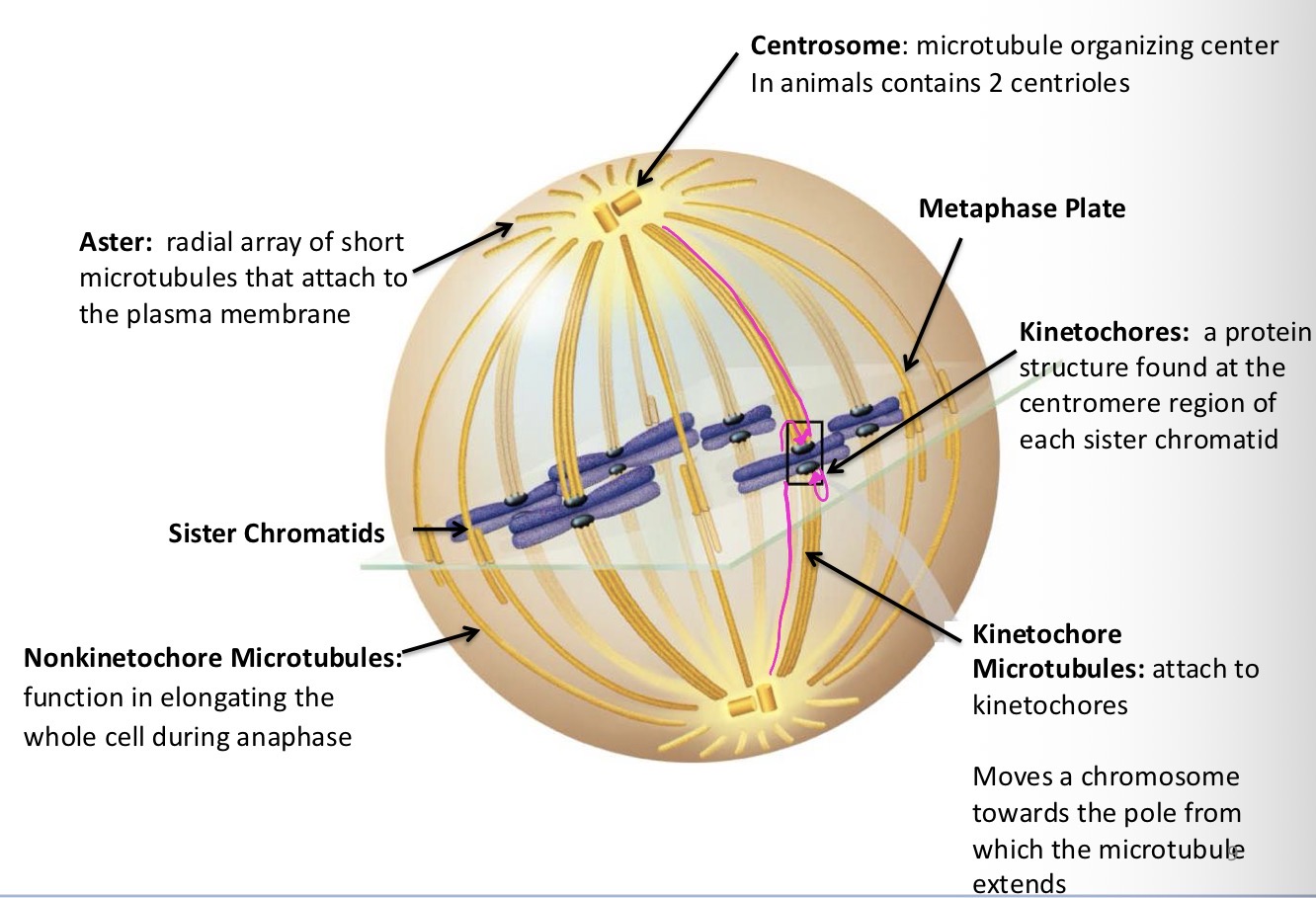
Nonkinetochore microtubules
Function in elongating the whole cell during anaphase
Mitotic spindle is composed of what?
Centrosomes
Spindle microtubules (kinetochore and nonkinetichore microtubules)
Asters
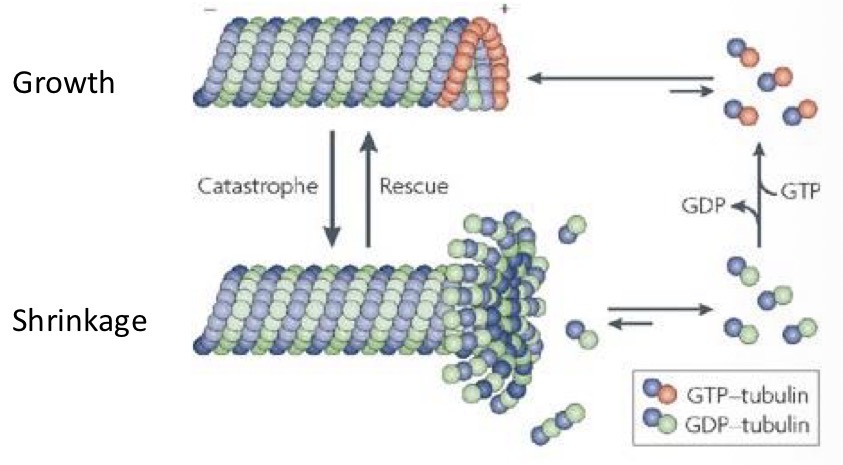
Spindle microtubules
Elongate by adding subunits of tubular and shorten by losing subunits of tubulin
Each centrosome contains how many centrioles?
2
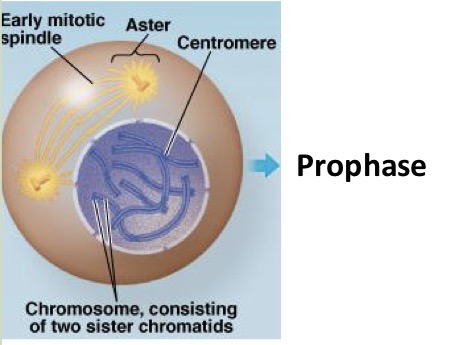
What happens in prophase?
chromatin fibers condense
Mitotic spindle begins to form
Centrosomes begin to move away from each other
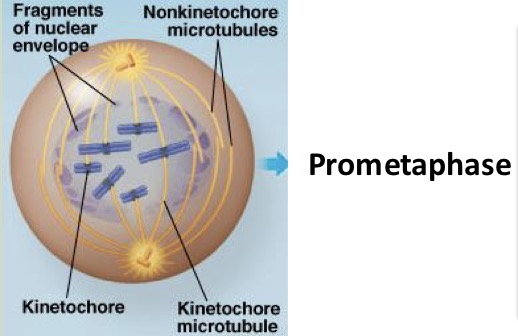
What happens in prometaphase?
nuclear envelope fragments
Microtubules invade the nuclear area
A kinetchore microtubule attaches to each sister chromatid
Nonkinetochore microtubules interact with those of the opposite spindle
What is the longest stage in mitosis?
Metaphase. Lasts for 20 minutes.
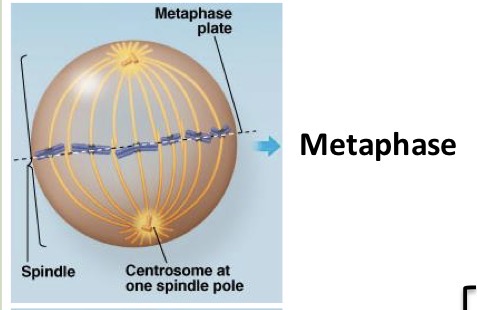
What happens in metaphase?
Chromosomes align on the metaphase plate
Kinetochore microtubules are attached to the kinetochore on each sister chromatid
What is the shortest stage in mitosis?
Anaphase. It lasts just a few minutes.
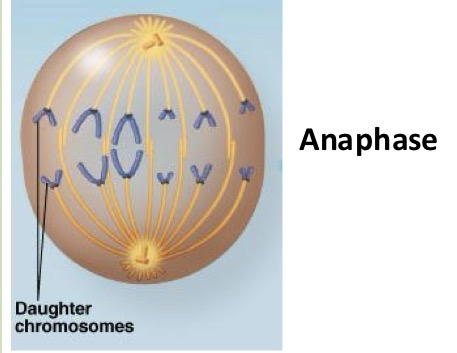
What happens in anaphase?
cohesions proteins are cleaved by the enzyme, separase, and the sister chromatids separate as kinetochore microtubules shorten
Once separated, each chromatid becomes a full-fledged chromsome
Cells elongate as the Nonkinetochore microtubules lengthen
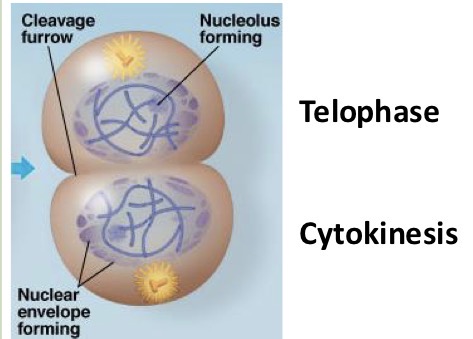
What happens in telophase?
nuclear envelope forms
Mitosis - divisor of one nuclear into 2 nuclei is complete
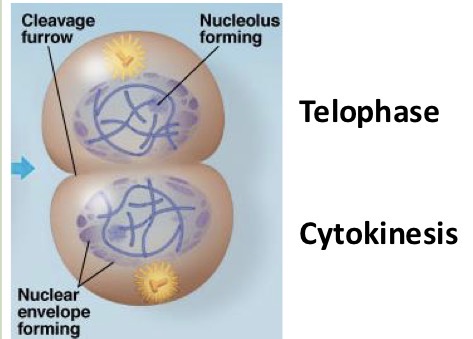
What happens in cytokinesis?
division of cytoplasm is usually well underway by late telophase
Daughter cells appear shortly after the end of mitosis
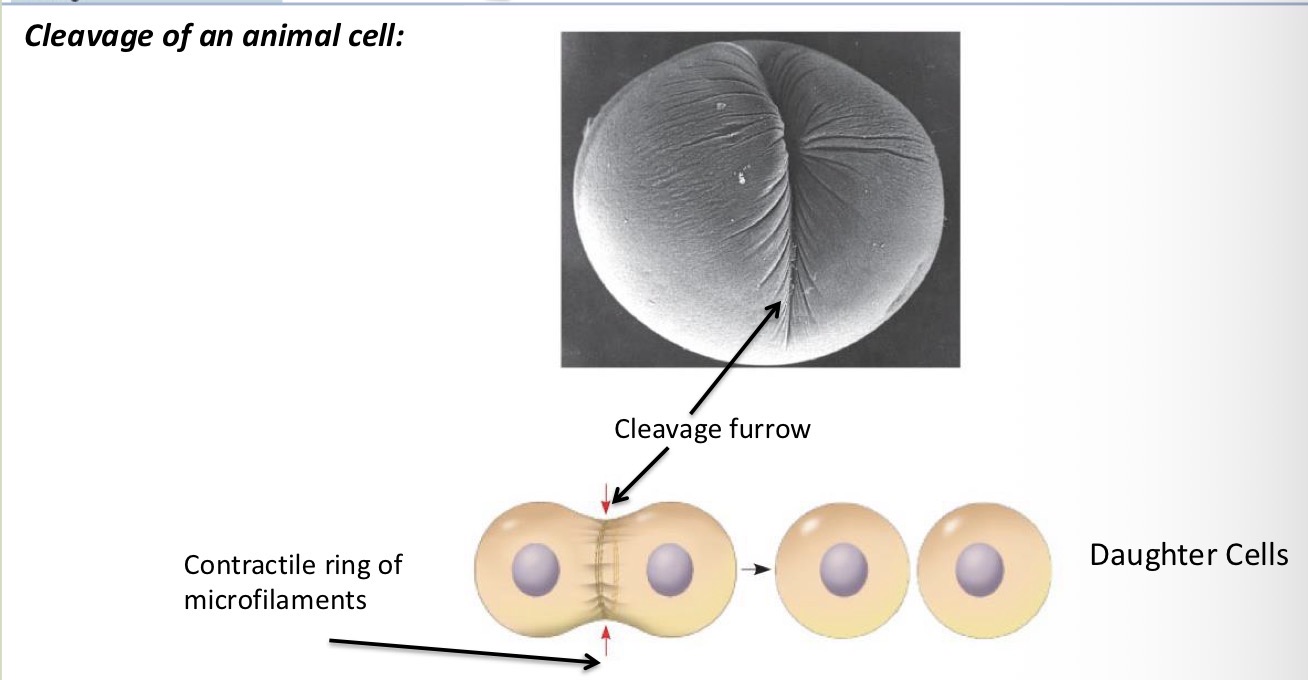
How does cleavage of an animal cell occur?
Actin microfilaments interact with myosin molecules causing the ring to contract. Cleavage furrow depends until the parent cell is pinched in 2. Generate 2 completely separate cells (daughter cells). Each daughter cell has its own nucleus and a share of cytoskeleton, organelles, and other subcellular structures.
Eukaryotic Cell Cycle
Timing and rate of cell division in plants and animals is crucial to normal growth, development and maintenance
How often do skin cells divide?
Frequently
How often do liver cells divide?
Only when a need arises (ex. To repair a wound)
How often do muscle and nerve cells divide?
Never
How often do cancer cells divide?
Uncontrollably
What controls the cell cycle?
Cell cycle control system
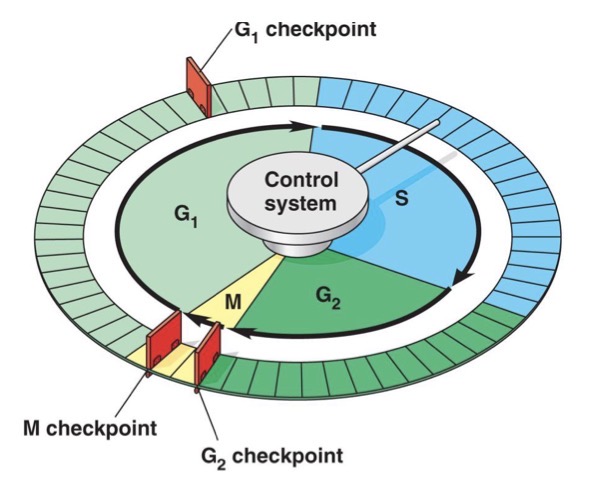
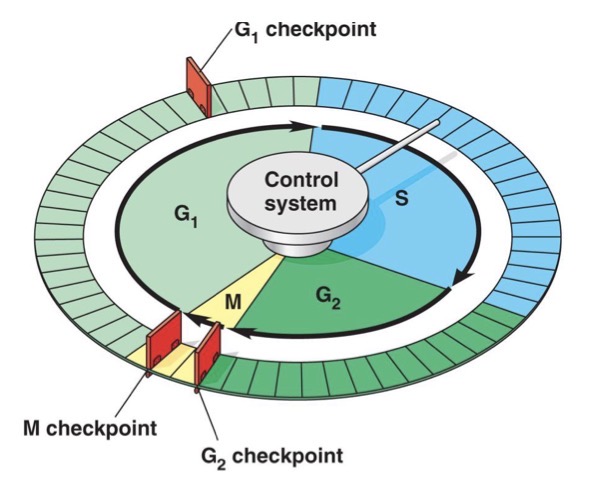
Cell cycle control system
Cyclically operating set of molecules in the cell that triggers and coordinates events in the cell cycle
How does the control system proceed?
On its own. It’s driven by a built-in clock. It’s like an automatic washing machine.
Checkpoint in cell cycle control system
A cell cycle control point where “stop” and “go” signals can regulate the cycle
What question does the G1 checkpoint have?
Is DNA damaged?
What question does the G2 checkpoint have?
Is all DNA replicated?
What question does the M checkpoint have?
Are all chromosomes attached to the spindle?
What is the most important checkpoint?
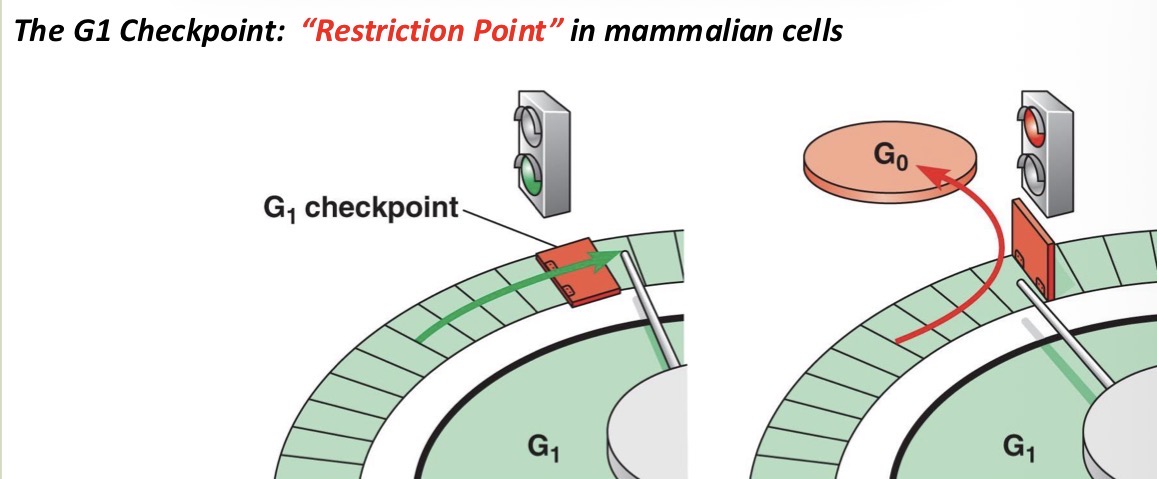
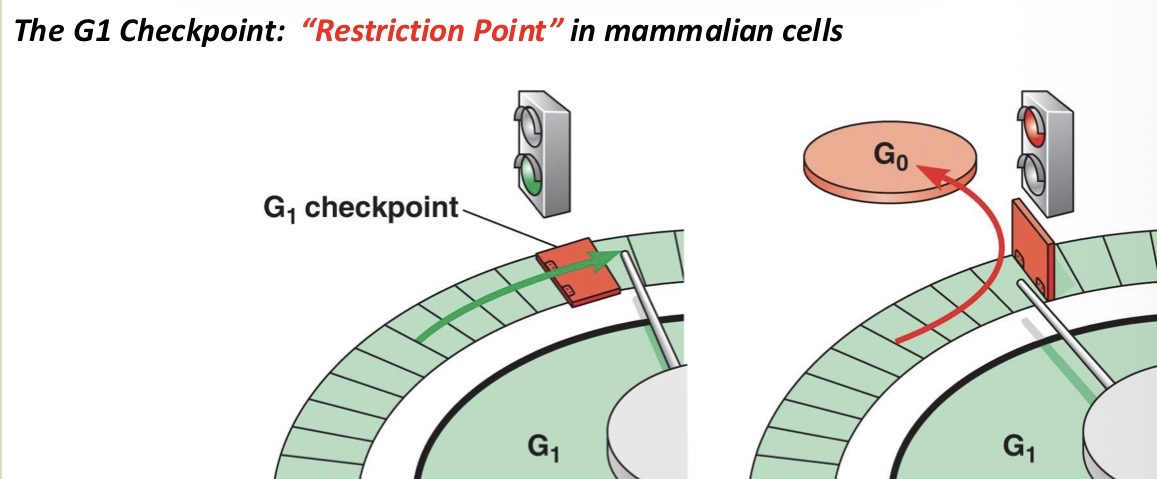
The G1 checkpoint
If a cell receives the go-ahead signal at the G1 checkpoint, what will happen?
It will enter G1, S, G2, M, and divide
If a cell does not receive the go-ahead signal, what will happen?
It will exit the cell cycle and switch to a non-dividing state called G0 phase
What phase are most cells in the human body in?
G0
Anaphase will not begin until all chromsomes are what?
Are properly attached to the spindle at the metaphase plate
The regulatory protein complex protein is only activated when?
When all the chromsomes are properly attached to the spindle
Separase
An enzyme that cleaves cohesions and allows the sister chromatids to separate
Why is the M checkpoint so important?
T makes sure that cells do not end up with missing or extra chromsomes