8.7 General Second-Order Circuits
 Call Kai
 Learn
Learn Practice Test
 Spaced Repetition
 Match
Match Flashcards
 Knowt Play
1/3

There's no tags or description
Looks like no tags are added yet.
Name | Mastery | Learn | Test | Matching | Spaced | Call with Kai |
|---|
No analytics yet
Send a link to your students to track their progress
4 Terms
General Second-Order Circuits
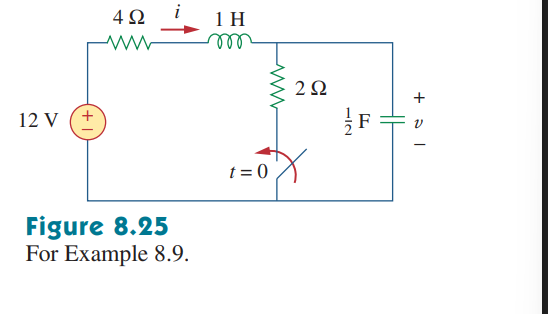
If an RLC circuit cannot be reduced into either a series or parallel RLC circuit (for example, not being able to find a simple, singular, equivalent resistance), then a slightly different methodology has to be taken.
Notice how the circuit in the picture cannot be simplified with its resistors into a series or parallel RLC circuit?
General Algorithm
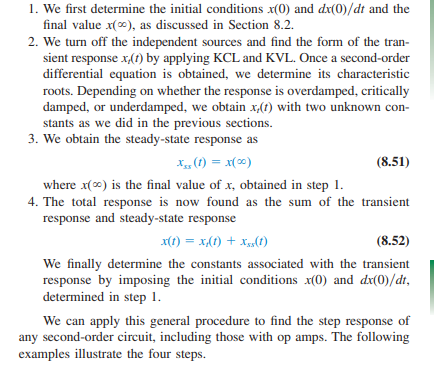
Determine the initial conditions for either the voltage/current function, the initial conditions for their respective derivatives, and the final behavior of the voltage/current function.
Turn off the independent sources in order to determine the transient response (natural response) of the RLC circuit by utilizing KCL and KVL. From there, determine the characteristic roots and its dampness (overdamped, critically damped, or underdamped) — then obtain its response function as always.
The steady-state response is simply the the final behavior of the voltage or current as t → infinity.
The TOTAL response is nothing more than the sum of the transient response and the steady-state response.
Remember, use the initial conditions v(0)/I(0) or (dv(0)/dt)/(dI(0)/dt) to figure out the coefficients for the total response function.
Filler
filler
filler
filler