Capacitors
 Call Kai
 Learn
Learn Practice Test
 Spaced Repetition
 Match
Match Flashcards
 Knowt Play
1/31

There's no tags or description
Looks like no tags are added yet.
Name | Mastery | Learn | Test | Matching | Spaced | Call with Kai |
|---|
No analytics yet
Send a link to your students to track their progress
32 Terms
Capacitor
Consists of 2 metal plates which are seperated by an insulating layer (known as a dielectric)
It stores charge by building up a surplus of electrons on one plate and a deficit on the other
What can a dielectric (insulating layers) be made of?
Air
Plastic
Paper
How do capacitors store charge?
When a capacitor is uncharged it contains equal amounts of electrons on both plates
When a capacitor is connected to a battery some of those electrons are moved from one plate to another
The electrons will be attracted to the positive terminal of the battery and then repelled by the negative terminal
The capacitor is now charged
Rules of a capacitor
Can only be charged by a DC supply
The capacitor cannot be charged to a higher voltage then the power supply
Capacitors vs batteries
Stores energy as electrical potential energy (due to electrons being pushed together) - battery = chemical energy
Capacitors store very small amounts of charge which can be released very quickly as a high current
Application of capacitors
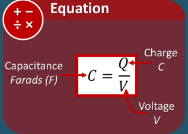
Capacitance
The amount of charged stored per unit potential difference
Capacitance graph
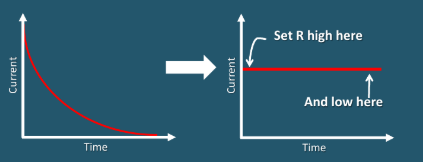
This assumes that current stays constant which is not true

Why does current not stay constant when charging a capacitor?
There aren’t fixed spaces on a capacitor for electrons
Instead as you pack the electrons closer together the force of repulsion between them increases
Evenutally the force of repulsion is equal to the EMF (electromotive force) for the battery and so the current stops
How to keep current constant when charging a capacitor
Use a variable resistor
Set the resistance high to slow the flow of electrons in and gradually reduce
How is energy stored in a capacitor
Capacitor energy is stored as electrical potential energy
It’s achieved by forcing electrons closer together on one plate
The more electrons that squeeze onto the plate, the smaller the distance between them, so these electrons will try to space out equally
This increases the force between them (Coulomb’s law)
Which takes energy to push the electrons onto the plate - the moment the power supply is taken away, they will burst back out
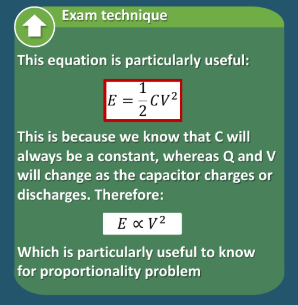
Relationship between energy stored and potential difference (voltage)
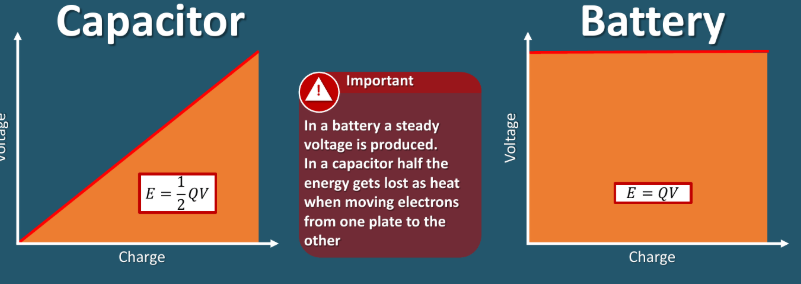
How does the energy stored in a capcitor compare to the energy stored in a battery
Batteries produce a steady voltage
In a capacitor half the energy gets lost as heat when moving electrons from one plate to the other
Dielectric
The insulating layer between the two metal plates
It prevents electrons from jumping from one plate to another
Between the two parallel plates, a uniform electric field is generated
Relationship between permittivity and charge to generate an electric field
Greater permittivity requices greater charge
Directly proportional
Permittivity
How hard it is to generate an electric field in a material
Relative permittivity (Dielectric Constant)
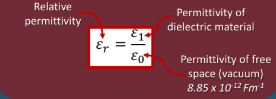
The ratio of the permittivity of a material compared to the permittivity of free space (a vacuum)
Different dielectrics have different relative permittivity’s
Breakdown voltage
Refers to how strong the electrical field needs to be to allow electrons to ‘punch’ through the dielectric
Polar Molecules
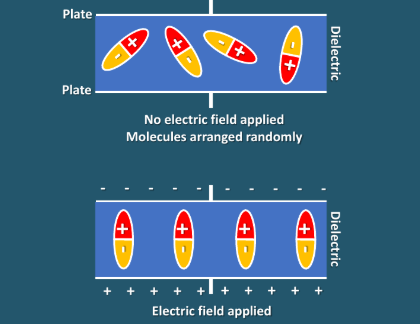
Permittivity can be explained by the motion of polar molecules inside a dielectric
Polar molecules have a positive and negative end
As the capacitor charges, one plate becomes positive and the other negative
The positive ends will be attracted to the negative plate, and the negative ends to the positive plate
Molecules are aligned anti-parallel to the field
This means the charges on the field and molecules are the opposite way round
How relative permittivity affects capacitance
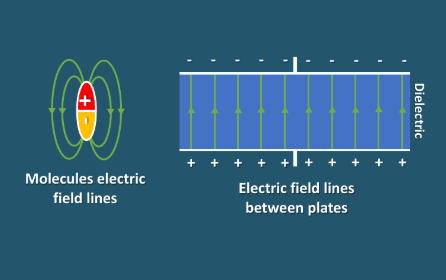
Each polar molecule has its own electric field
In this alignment, it opposes the field between the plates
Permittivity (larger) is directly proportional to the opposing field (larger) - thereby creating a weaker overall electric field
This makes it easier to continue transferring electrons from one plate to the other
Therefore reducing the potential difference (Joules per coulomb) needed to transfer a given charge (electrons)
So capacitance increases
Three factors that affect capcitance
Area overlap (More area = More space to store electrons, C ∝ A)
Permittivity of dielectric (Higher permittivity = makes it easier to transfer electrons C ∝ ε1 [ε0 x εr])
Distance between plates (When distance is small the force between the plates is greater, allowing you hold more electrons in place, C ∝ 1/d
![<ul><li><p>Area overlap (More area = More space to store electrons, C <span style="font-size: medium;">∝ </span>A)</p></li><li><p>Permittivity of dielectric (Higher permittivity = makes it easier to transfer electrons C <span style="font-size: medium;">∝ </span><span>ε1 [ε0 x εr]</span>)</p></li><li><p>Distance between plates (When distance is small the force between the plates is greater, allowing you hold more electrons in place, C <span style="font-size: medium;">∝ </span>1/d</p></li></ul><p></p>](https://assets.knowt.com/user-attachments/16eac6e0-29c5-4eda-825e-f10dacba690a.png)
Capacitors in parallel
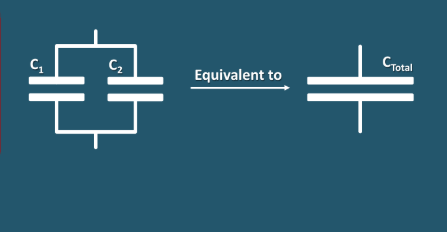
When capacitors are placed in parallel you are increasing the area that electrons can be stored on
Effectively creating one larger capacitor
Which leads to an increase in capcitance, as C ∝ A
C total = C1 + C2 + …
Capacitors in series
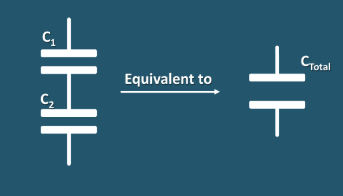
When capacitors are placed in series you are effectively increasing the distance between the plates
Which leads to a decrease in capacitance as C ∝ 1/d
1/C total = 1/C1 + 1/C2 + …
Capacitor charging graphs
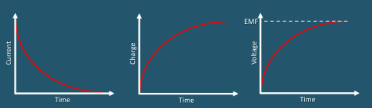
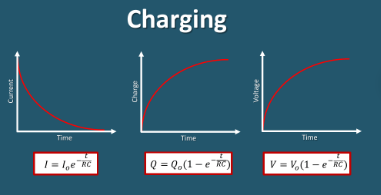
Current flowing into an uncharged capacitor starts off high and then falls exponentially
The charge will build up quickly on an uncharged capacitor while current is high and then build up slower as current slows
The voltage will do the same as charge as tjeu are dorectly proportional. It cannot go above the emf of the battery
How the voltage across the resistor varies in a charging circuit
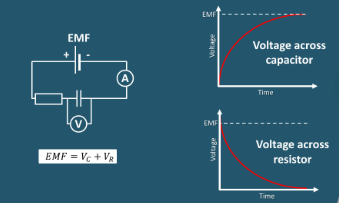
In a charging circuit, the capacitor and resistor will share the voltage produced by the battery
But as the voltage across the capacitor increases, the resistor will get a decreasing share
Until eventually the capacitor has a voltage to the emf, and the resistor will get none
Analogy for a discharging capacitor
Use of coulomb’s law
When a capacitor is charged, the electrons are close together
Coulombs tells us that the smaller the distance the greater the force
As the capacitor discharges and electrons leave the plate, the distance between them increases, which reduces the force

Capacitor discharging graphs
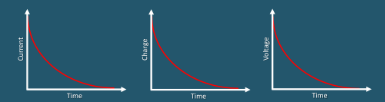
Initial current from a charged capacitor will start high and then reduce exponentially over time
The charge reduce quickly when current it high and then reduce more slowly as the current slows
The voltage will do the same as charge as they are directly proportional
How voltage across the resistor varies in a discharging circuit
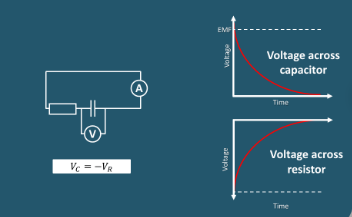
In a discharging circuit the capacitor is the only power supply
The resistor is the only other component
So whatever voltage the capacitor is producing gets completely used by the resistor
The voltage on both will be the same magnitude
The reason why the voltage across the resistor is labelled as a negative is because it is flowing the opposite way to when the circuit was charging
Exponential decay equation for capacitors
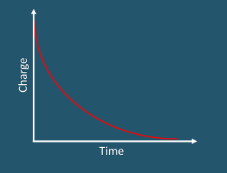
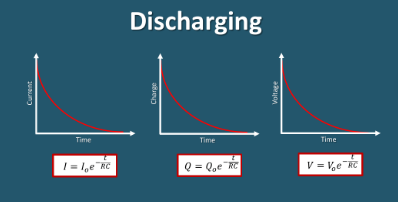
The graph is an exponential decay. This means we can predict the charge left at any point in time
It also follows the half-life rule - this means the charge always takes the same amount of time to halve
Discharging equations
Charging equations
The current graph is exponential decay whilst the others aren’t
What happens when a capacitor discharges into another capacitor
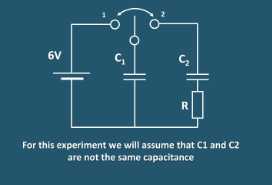
Following the circuit diagram:
When the switch is at position 1, then capacitor C1 is charged by the battery:
This will cause capacitor C1 to become fully charged and have a voltage of the emf
This will happen almost instantly as the wires are the only thing providing resistance
C2 will not charge as it is part of a broken circuit
When connected to position 2 then the fully charged C1 discharges into C2, charging it,
C1 is now the only power cupply, it will discharge into C2, and charge it up
Eventually C1’s and C2’s voltage will become the same
The current will then stop flowing
Remember that C1 and C2 are not the same capacitance, so the charge won’t be equal