KIN 211 Final UBC Cartes | Quizlet
 Call Kai
 Learn
Learn Practice Test
 Spaced Repetition
 Match
Match Flashcards
 Knowt Play
1/101

There's no tags or description
Looks like no tags are added yet.
Name | Mastery | Learn | Test | Matching | Spaced | Call with Kai |
|---|
No analytics yet
Send a link to your students to track their progress
102 Terms
What is the law of practice?
more practice is better for learning
the more you practice, the more you improve, the more you learn
What is deliberate practice?
purposeful practice to improve performance
1. activities designed to improve the current level of performance
2. requires effort/concentration
3. not inherently enjoyable
4. planned by knowledgeable coach/instructor
What are the predictions of deliberate practice?
1. in experts, deliberate practice with activities increase in a "monotonic" fashion with age and experience
2. performance can be predicted from hours accumulated in deliberate practice activities
these predictions are supported by collected data (by 18, elite players devoted 50% of their time playing soccer to purposeful/deliberate practice activities (team + individual practice) compared to 25% for sub-elites
What is massed practice?
-practice periods run close together, with little or no rest between periods
-time spent practising is typically higher than rest
what is Distributed (spaced) practice?
-practice periods run with longer intervals of rest between periods
-time spent practising is typically the same or less than rest
As practice becomes more ___________ performance ___________, why?
distributed
improves
fatigue
Massed groups do _________ throughout training and show ____________ retention after 9 months
worst
poorest
there are trade offs between practice efficiency (total practice duration) and effectiveness
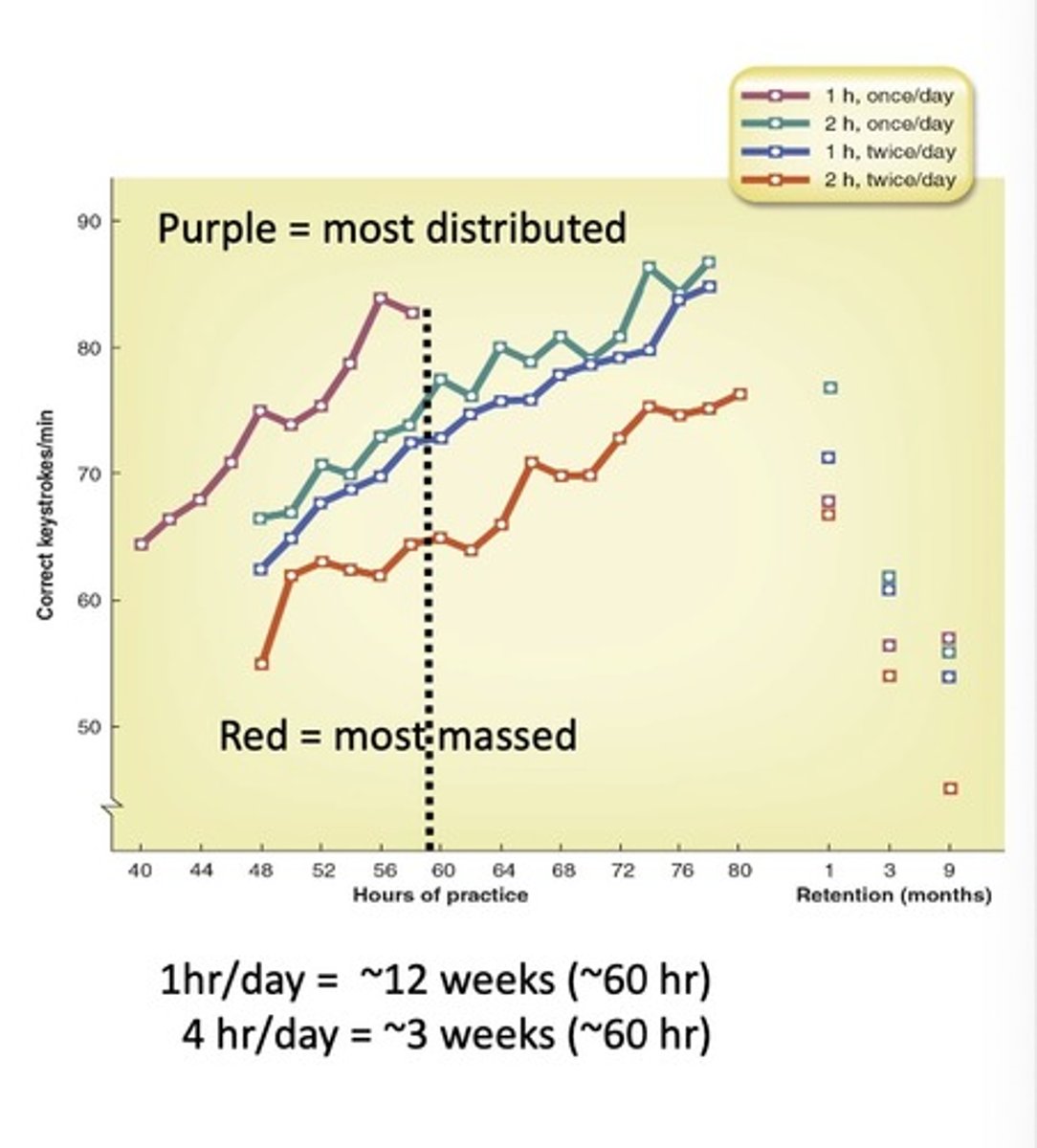
What are the hypotheses for why massed practice might impair learning compared to distributed?
Fatigue hypothesis
Cognitive-effort hypothesis
Memory consolidation hypothesis
What is a schema?
rule, concept, a relationship
generalized motor program underlies this theory
What is constant practice?
-only one variation of the criterion task is practiced
-criterion task is practiced under identical environmental conditions
What is variable practice?
-multiple variations of the criterion task are practiced
-variability achieved by practicing criterion task:
-under different environmental conditions
-at different speeds, distances, etc
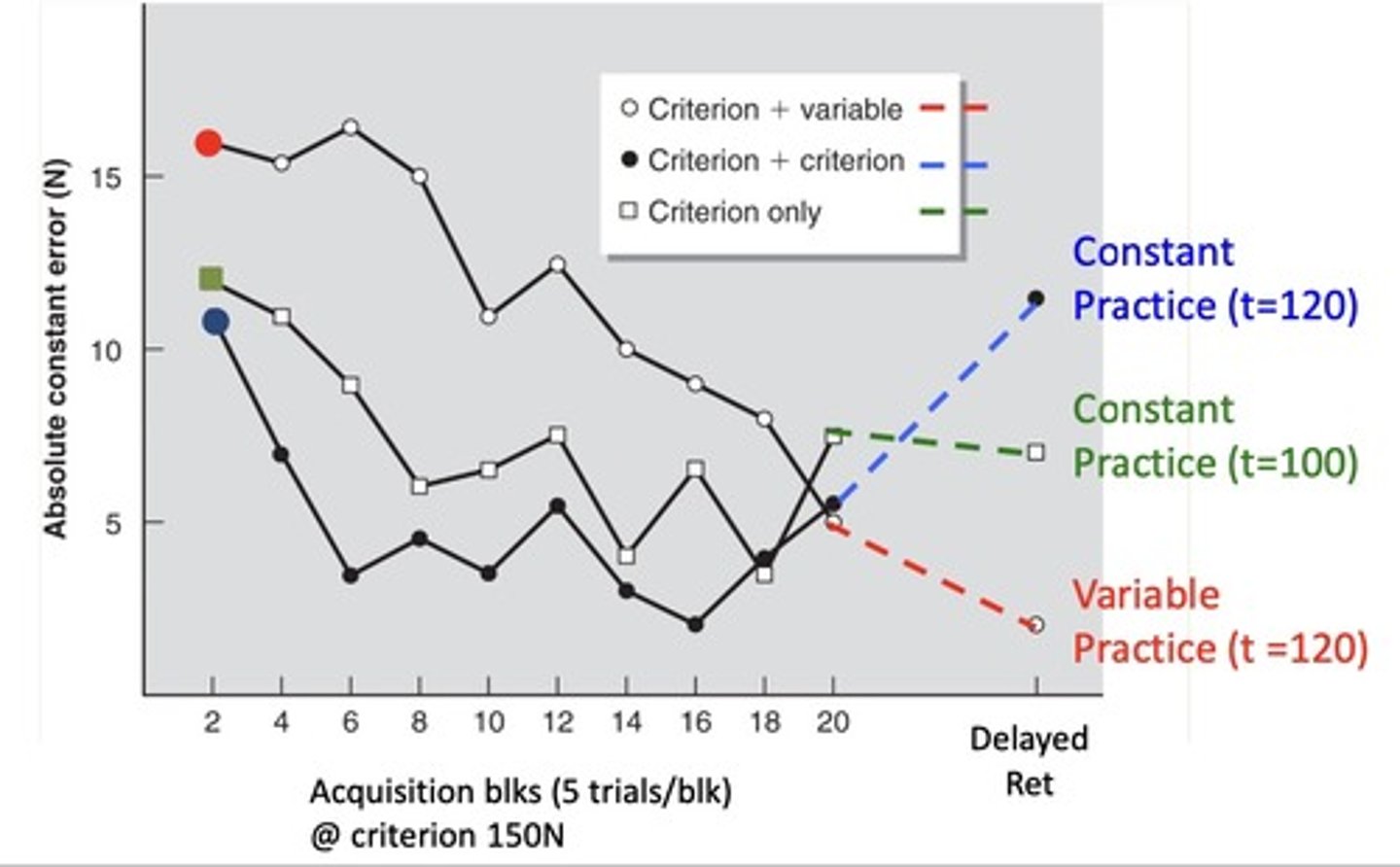
variability of practice leads to better transfer to __________________
unpractised tasks/skills
What were the conclusions from the variable practice study?
initially, the variable practice group had the worst performance, at the end of the acquisition trails all groups performed the same, however, for delayed retention the variable practice group performed the best
After a GMP is selected and movement is completed, what 4 types of information are stored in STM?
1. Initial conditions of the movement
2. Parameters that were assigned to the movement (eg. amplitude/absolute force of movement time)
3. Outcome feedback about the movement
4. Sensory consequences of the movement
These enable two schemas (rules) to be formed. Recall & recognition schemas
What is recall schema?
relation between parameters and movement outcome
after each movement, info discarded from STM leaving only a rule
rule is strengthened with more (varied) data (parameters, outcomes, & initial conditions)
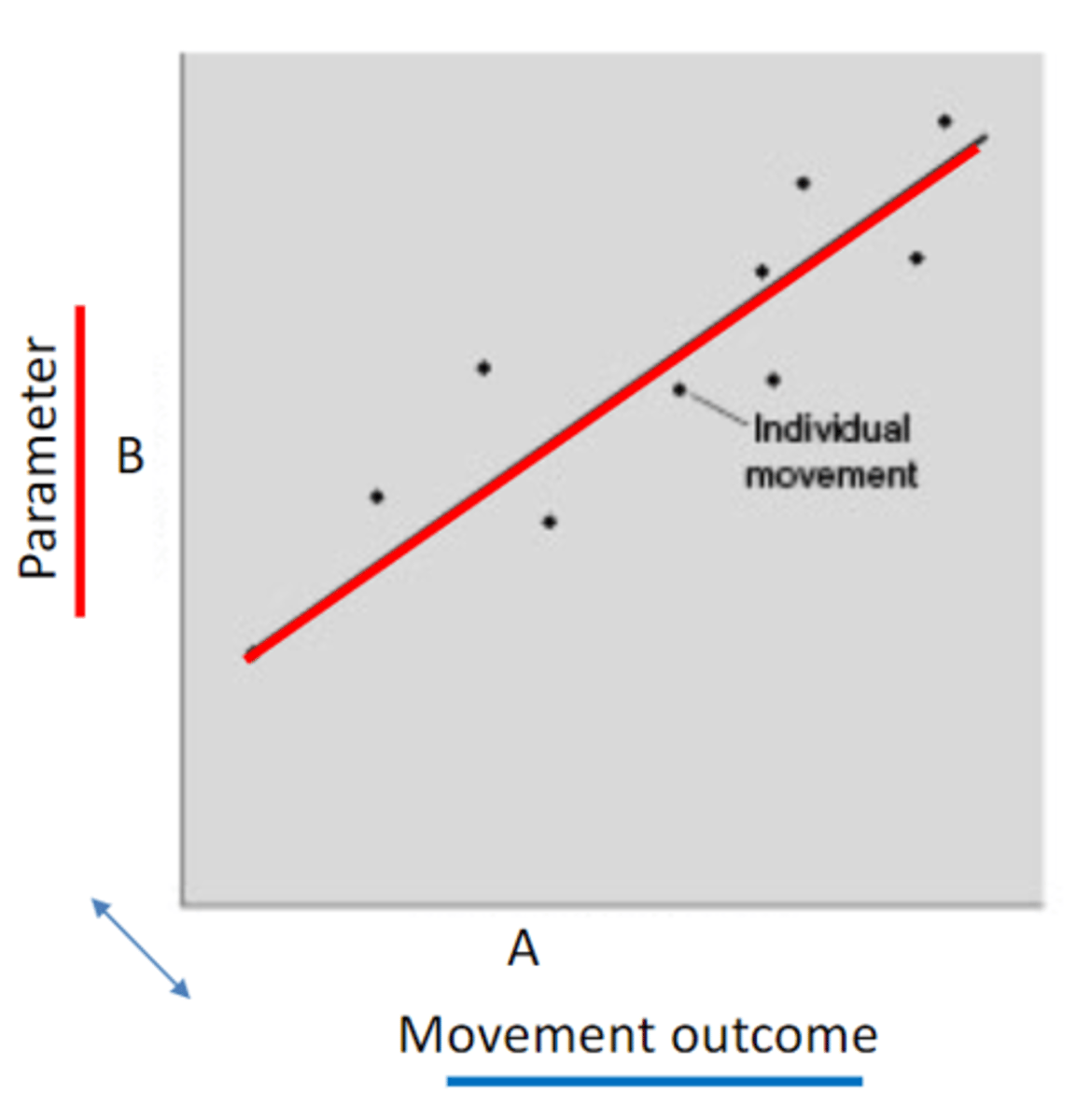
if movement outcome A is required and initial conditions 2 - detected, ___________ is selected
parameter B
What is recognition schema?
relation between sensory consequences & movement outcomes
after each movement, info discarded from STM leaving only a rule
plays important role in movement evaluation
more important for control of slower movements
variability of practice will enhance _________ & estimation of ____________________________
schemas
new parameters & sensory consequences
practicing a variety of movements with same GMP (different parameters, initial conditions) will form
strong schemas
production of new movement requires application of
schemas
extensive parameter exploration results in
less uncertainty and error, due to more accurate estimations of parameters & sensory consequences
there is evidence that success at shooting free-throw type shots scales with distance, why?
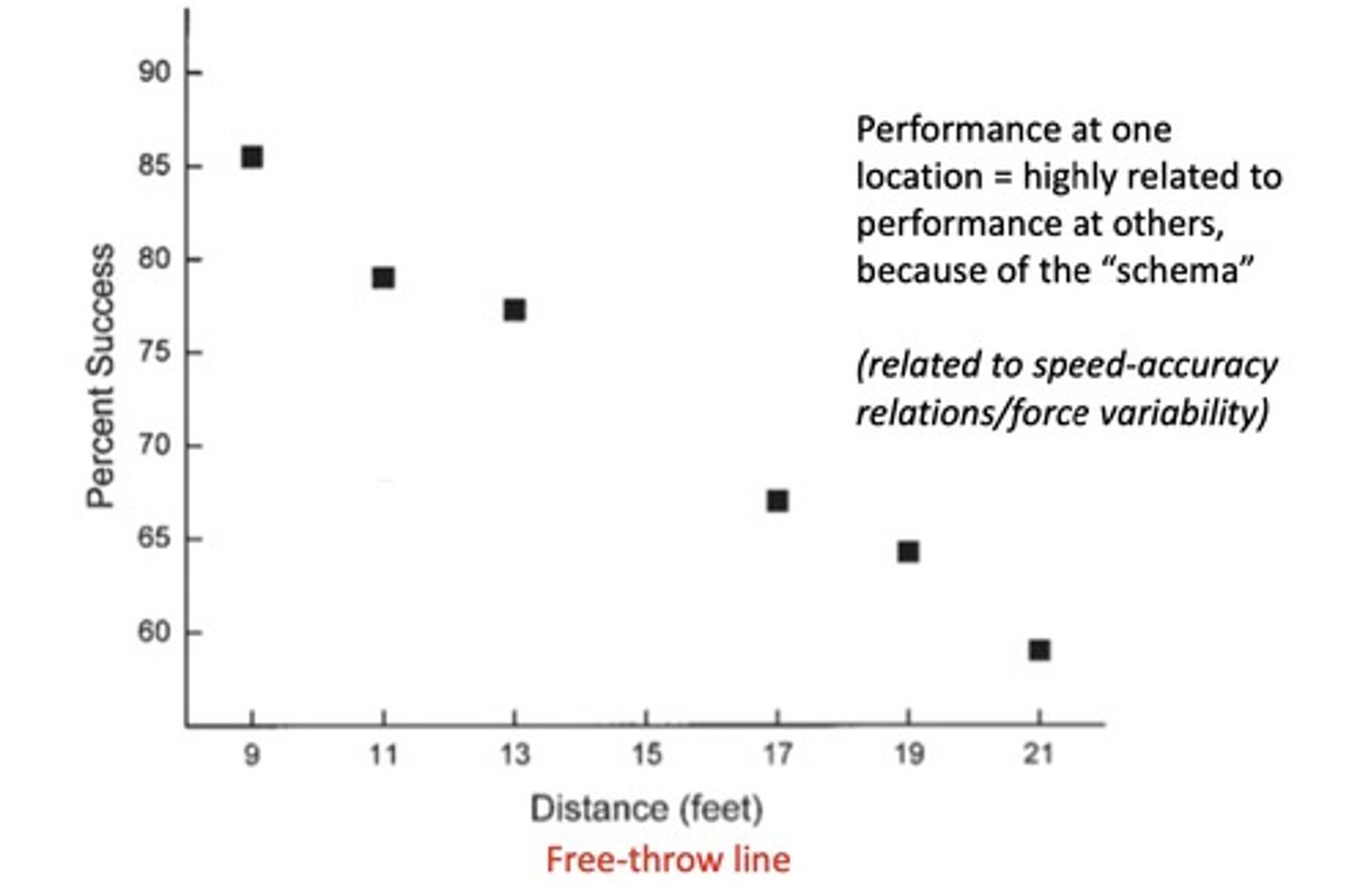
constant practice of one parameter variation can lead to ______________
especial skill (good for that skill, but doesn't generalize well to different outcomes
variability of practice seems to be best after some ___________________ because ___________
initial constant practice
promotes stability and acquisition of invariant/relative features)
what theory helps to explain why variable practice of different distances facilitates retention and transfer?
schema theory
What is blocked practice?
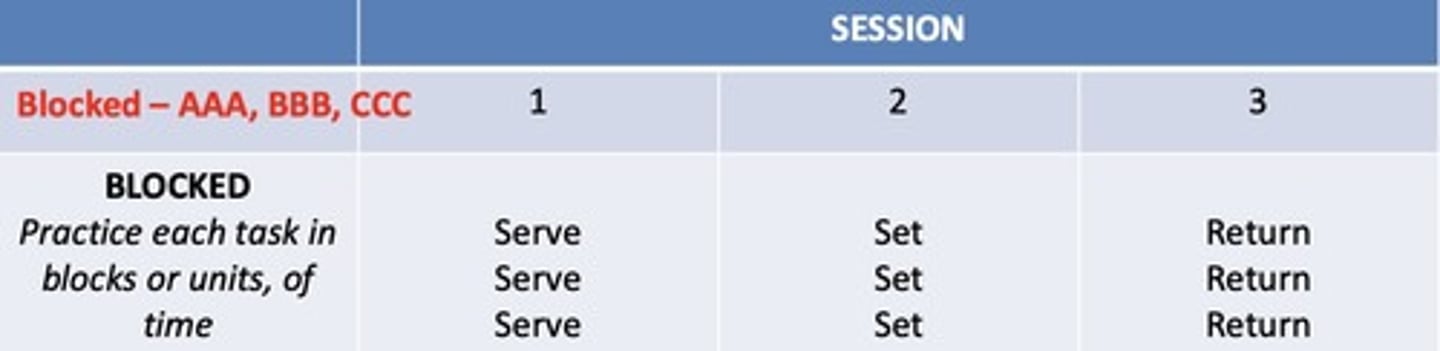
What is serial practice?
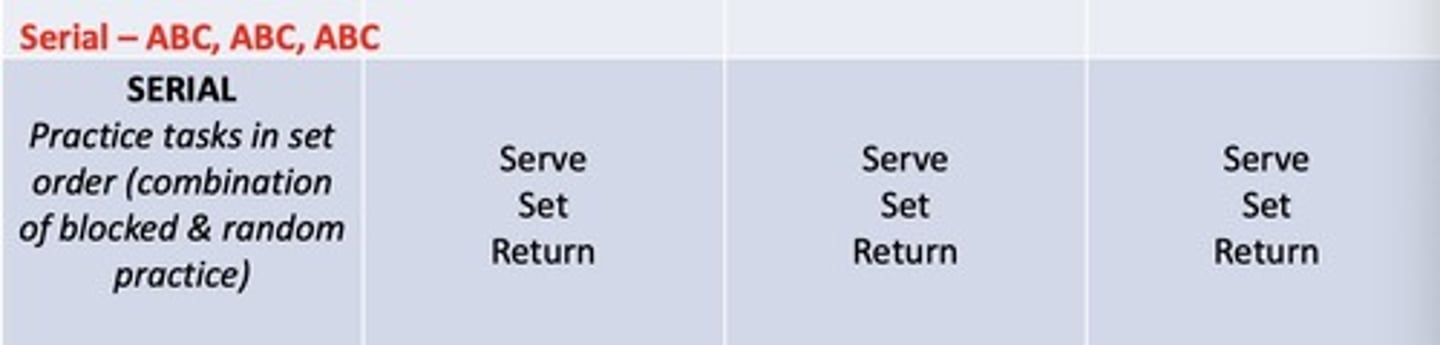
What is random practice?

which method of practice is the hardest and has the highest amount of contextual interference? why?
random (no predictability and low/no repetition)
which practice method is the easiest and has the lowest amount of contextual interference? why?
blocked (predictability and repetition (drill-type practice)
which practice method has medium difficulty and CI? why?
serial (predictability, but not repetition)
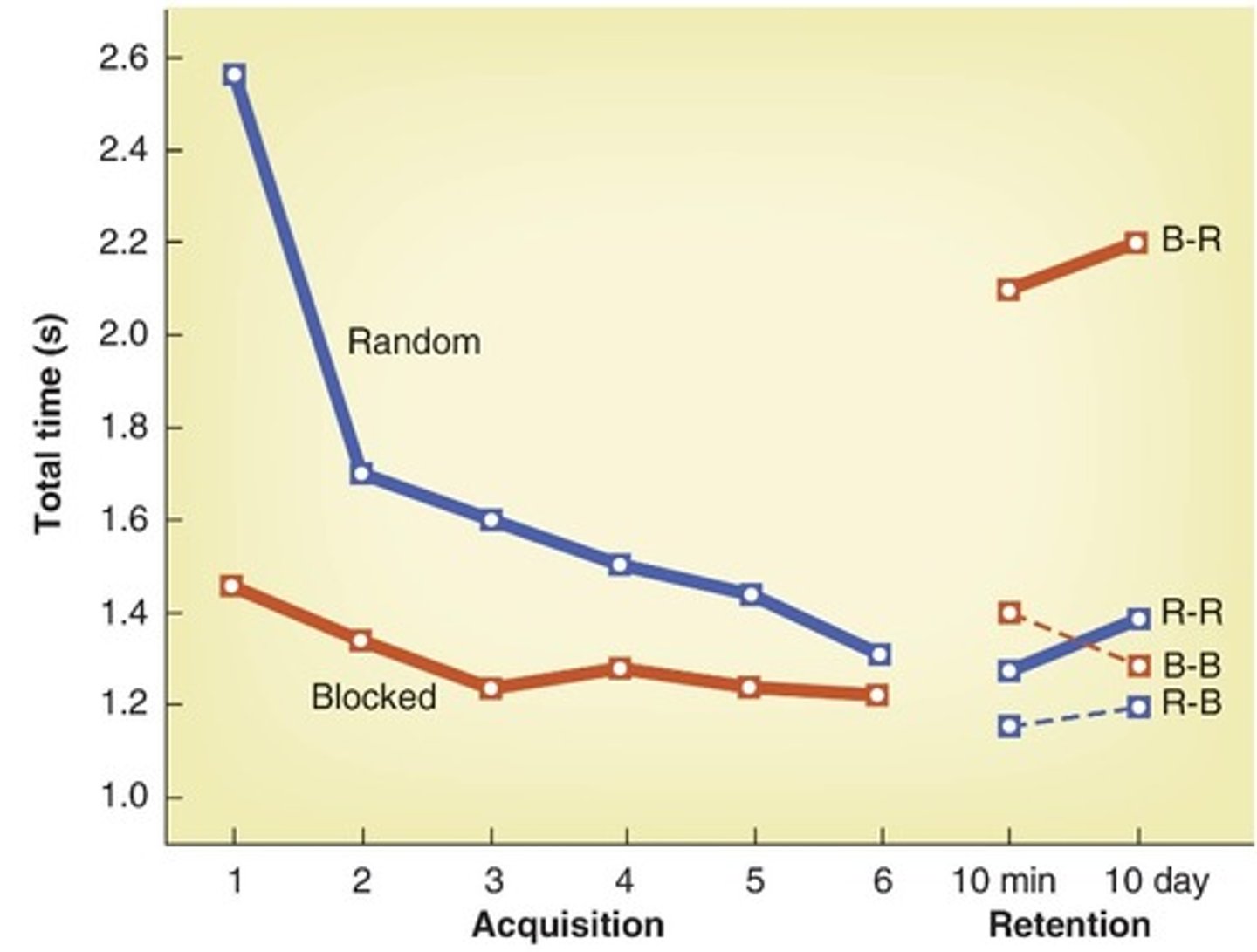
what are the results of this contextual interference study?
blocked schedules (low CI) = good during practice
random schedules (high CI) aided learning
What is the first hypothesis for these CI effects?
Elaboration hypothesis
-random practice = increased distinctiveness of movements in memory
-variation allows learner to appreciate unique features & contrast/elaborate
More distinctive -> more durable/better memory -> more easily retrieved
What is the second hypothesis for these CI effects?
Forgetting & Reconstruction Hypothesis
-random practice (task switching) leads to need of regenerate solution/motor program, aids memory
Skill A -> Skill B
-learner 'forgets' aspects of skill A (ex. free throw) while figuring out Skill B (ex. layup)
Skill B -> Skill A
-learner needs to reconstruct/plan solution for Skill A again
for blocked practice: solution/motor program is always in working memory, so no forgetting/reconstruction
Additional considerations regarding CI: What are hybrid schedules?
-when there is a mix of blocked and random practice
-can sometimes be better than high CI schedules for difficult skills and beginner/novices (early in practice)
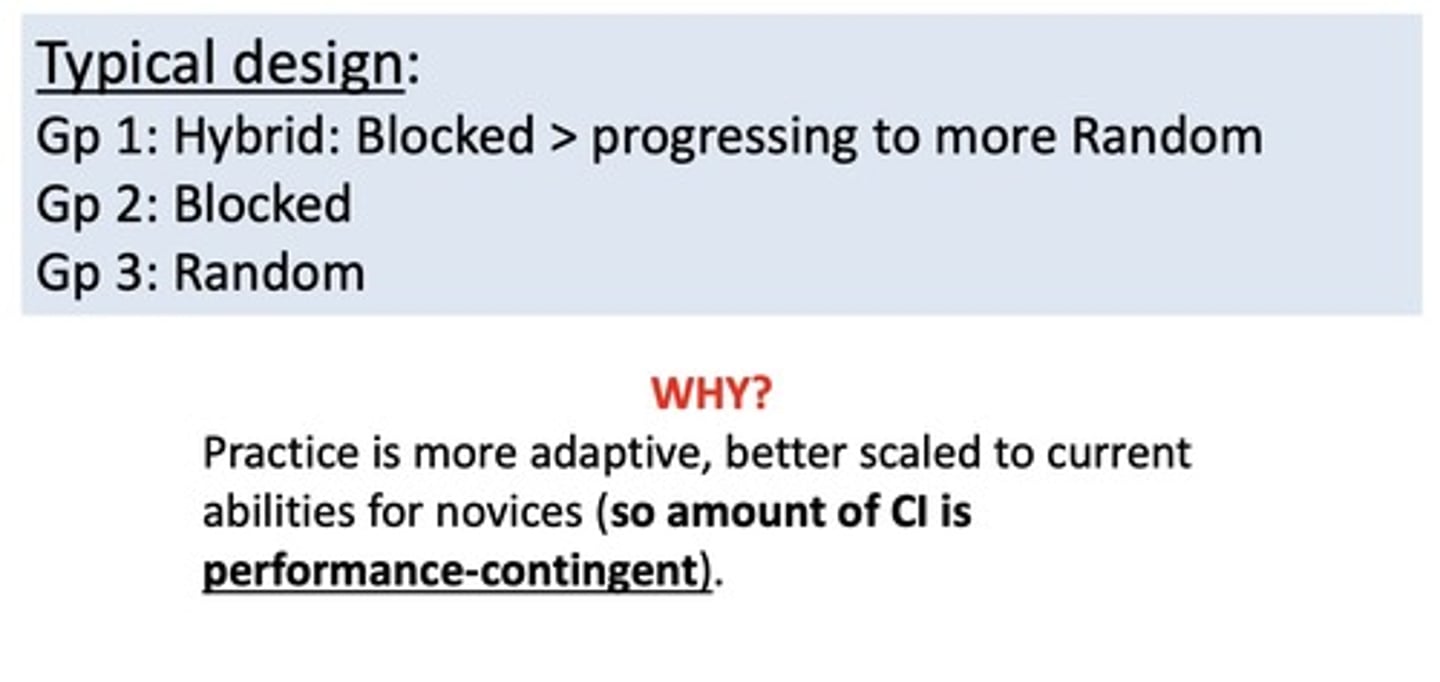
Additional considerations regarding CI: What is self-control of practice?
when individuals choose how to practice in the moment...can sometimes be better than high CI practice
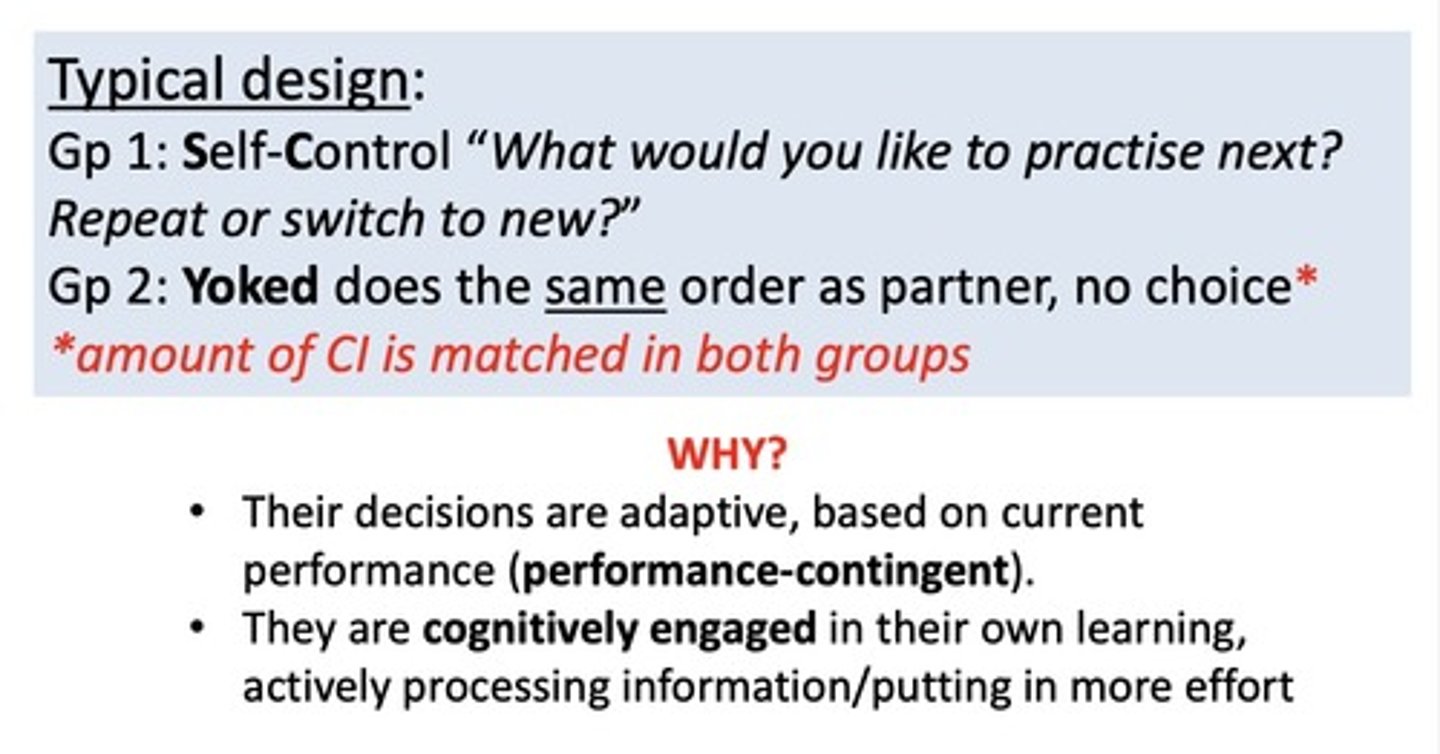
What is performance-contigency?
-on lower error trials (doing relatively well), people choose to switch
-on higher error trials (doing relatively poorly), people choose to repeat
-no participants choose a fully "random" schedule....usually hybrid
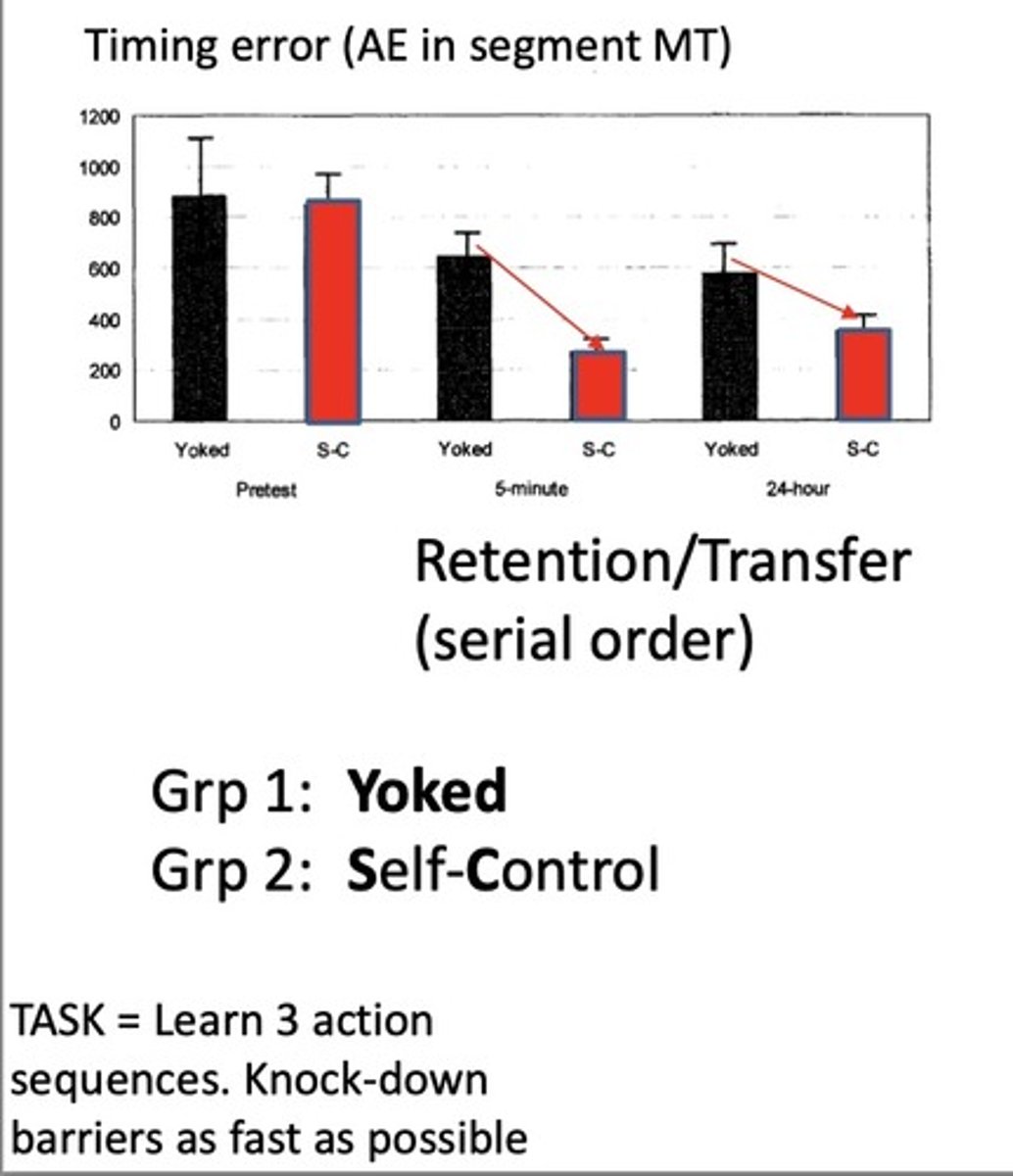
What is whole practice?
practice strategy that involves practicing a skill in its entirety (as a whole)
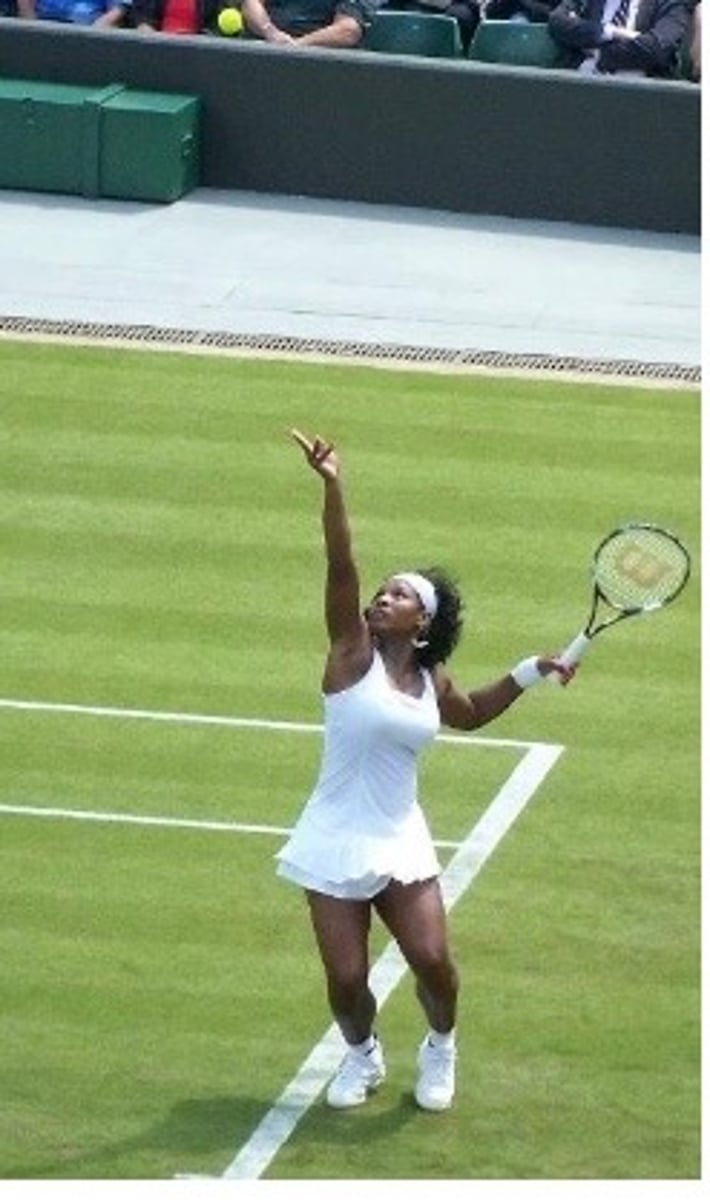
What is part practice?
a practice strategy that involved practicing of a skill broken down into small units
What are the 3 reasons for breaking down whole skills into smaller parts?
1. Efficiency in practice
-learner can spend more time mastering difficult components of "whole task"
gymnast practicing just the dismount off the bars
2. ease of practice
-learner might not yet be capable of completing whole task
novice swimmer learning butterfly practices dolphin kick independent of arm stroke
3. Good technique/prevent injury
-learner has risk of injury without "correct" technique
pitcher in fast pitch makes sure they don't overextend on the follow through
When is part practice best for learning?
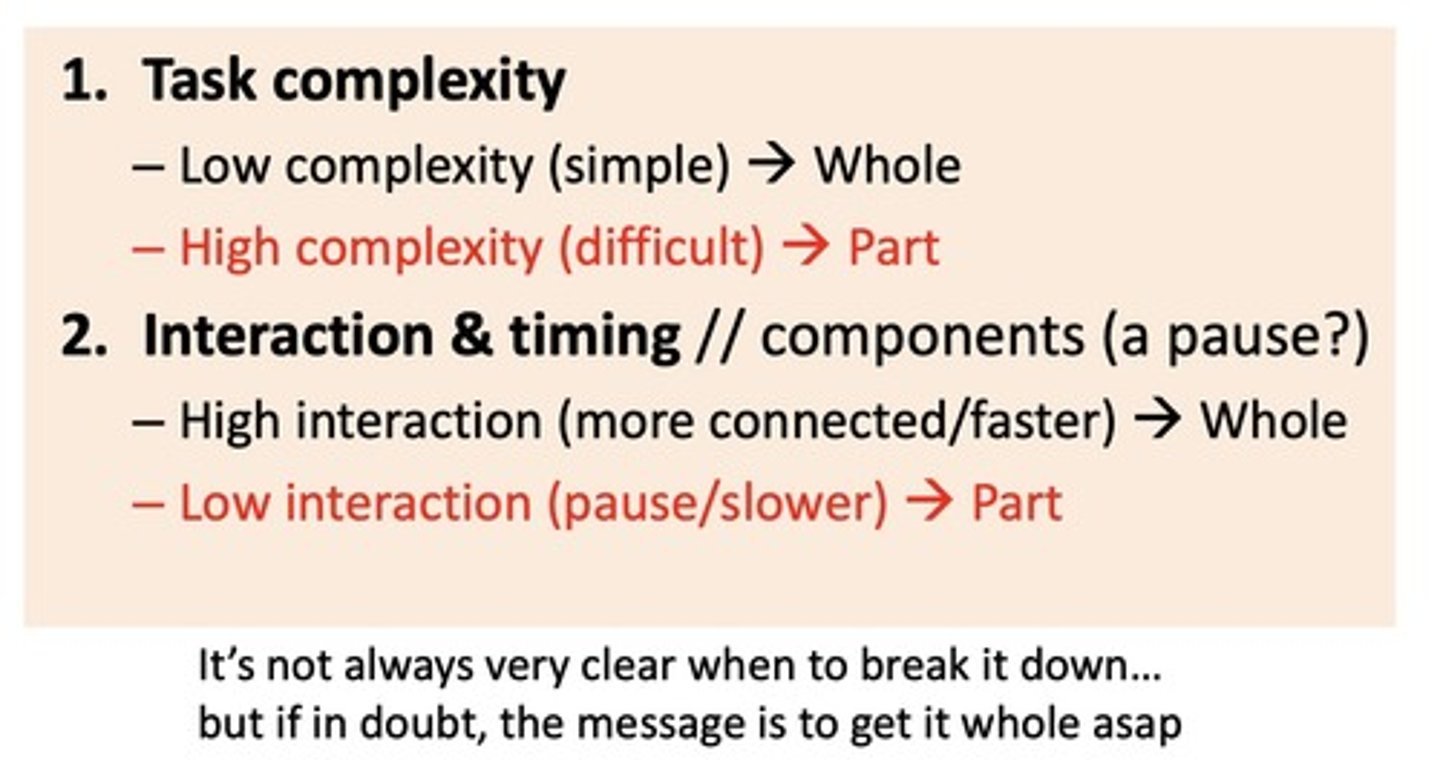
When to do part practice?
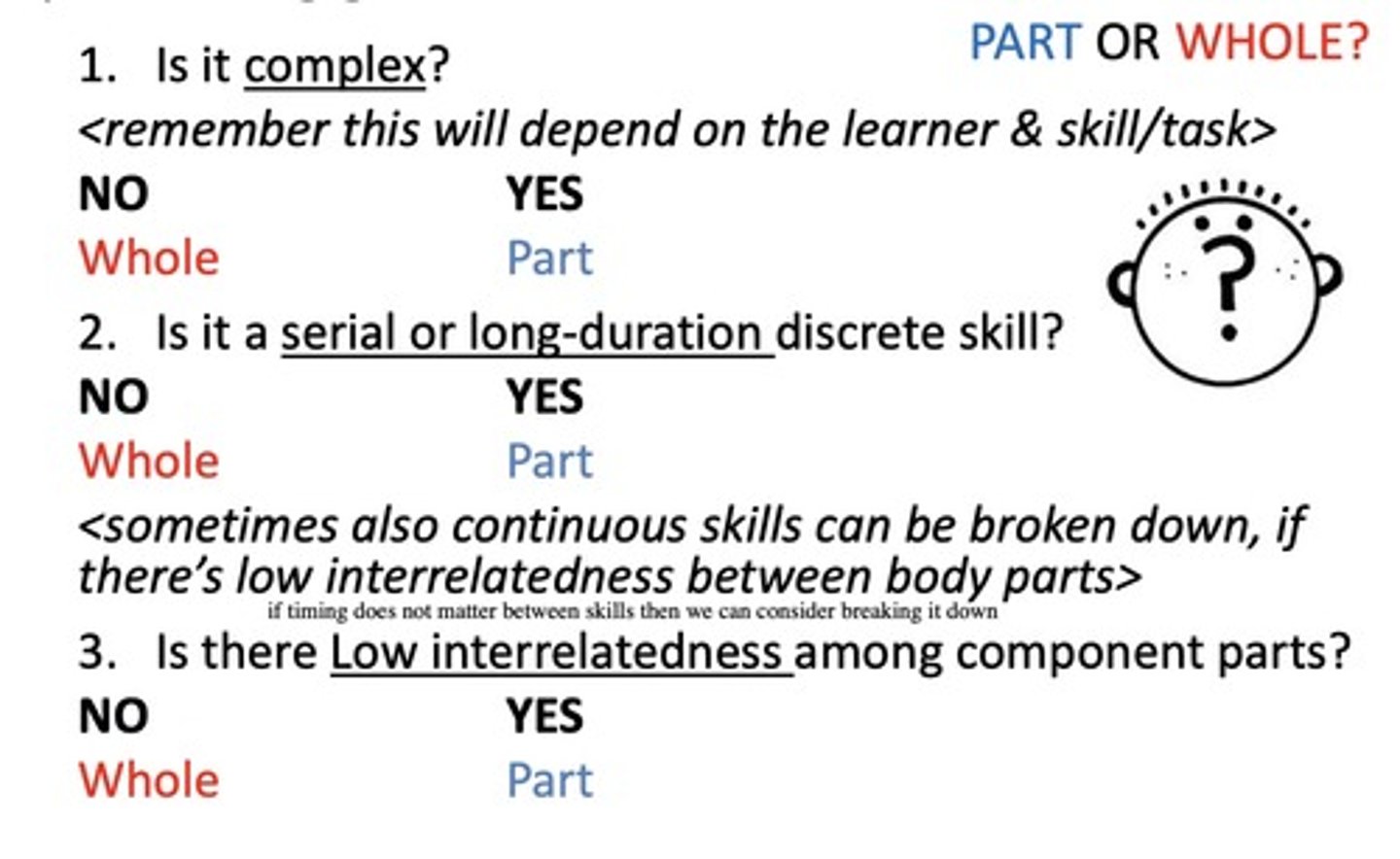
What are the 3 commonly used part practice techniques?
1. Fractionation: one or more parts of a skill are practiced separately (just ball toss, just legs butterfly)
AAAA, BBBB, CCCC, DDDD
2. Segmentation/chaining: one part of a skill is practiced for a time, then second part added etc, until the entire skill is practiced (gymnastic vault)
A, A, AB, AB, ABC, ABC, ABCD
3. Simplification (shaping): complexity of some aspect of the skill is reduced (lower net)
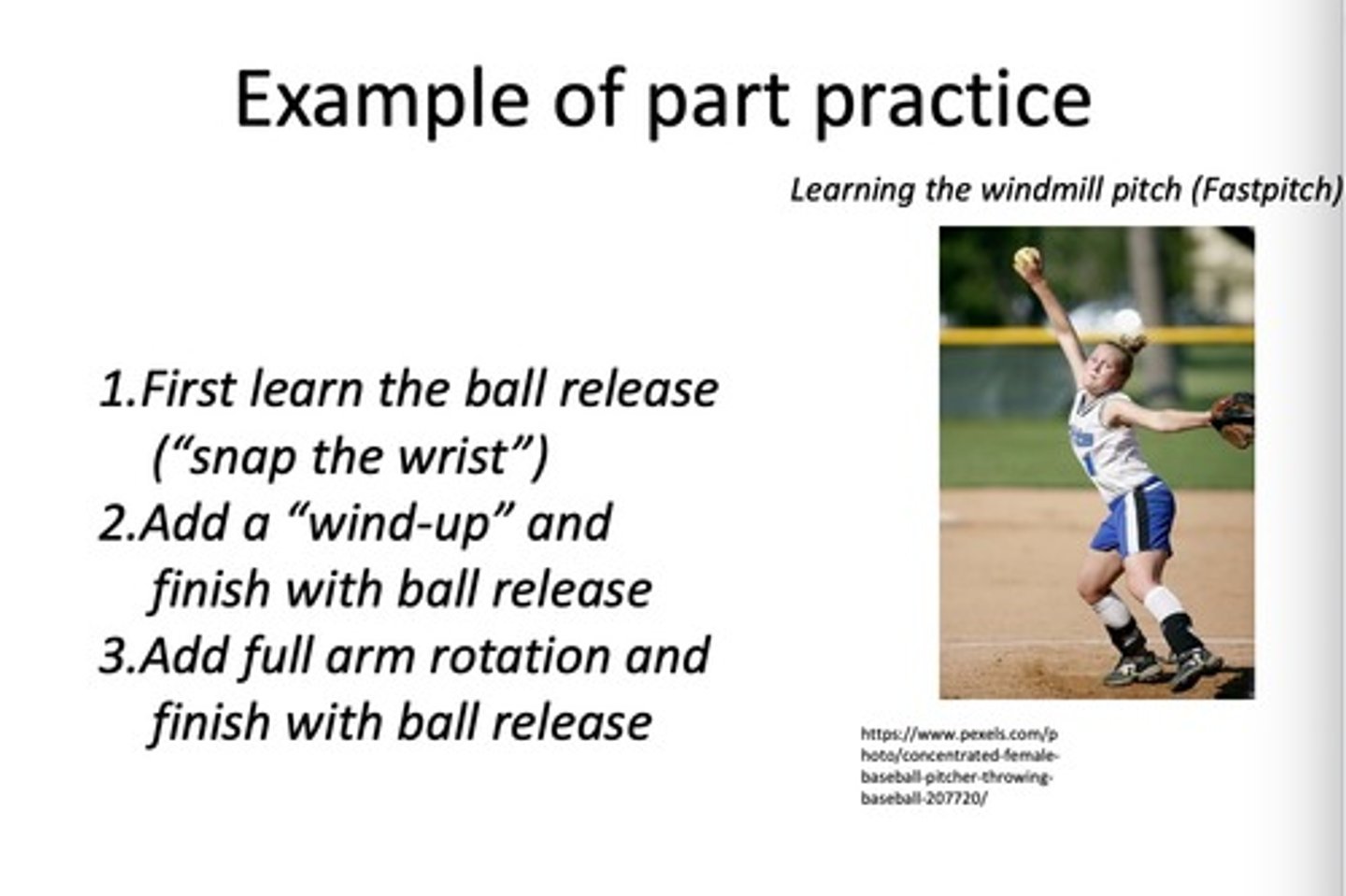
How would you use segmentation practice for fast pitch?
1. First learn the ball release ("snap the wrist")
2. Add a "wind up" and finish with ball release
3. Add full arm rotation and finish with ball release
this is a complex, long, discrete/serial skill. Medium-high interrelatedness between components
What are some examples of simplification?
to reduce difficulty/attentional demands without changing the movement goal:
1. reduce object difficulty (making ball bigger so kid can catch it)
2. reduce speed
3. sequencing skill progressions (t-ball-> pitching machine -> pitcher)
4. simulators and virtual reality (can simplify certain features)
5. physical guidance
What is physical fidelity?
the degree to which surface features of a simulation and criterion task are identical
(does it look like it will in the whole task?)
What is psychological fidelity?
the degree to which behaviours (responses) in a simulator are identical to behaviours required by criterion (test/transfer) task
what is physical guidance? (simplification)
-learning new, unfamiliar skills
-re learning correct movement patterns after injury (re-gaining function in hemiparetic arm)
-assistance can be provided by a coach, therapist, experimenter, device
What is passive guidance?
-learner being moved and is not actively sending motor commands to initiate & execute action
-the guide moves the learner's passive limb thru desired action sequence
What is partial (active-assist) guidance?
-learner is sending motor commands to initiate &/or help execute action
-learner shares effort to complete the action, with the guide/assistive device providing support role
ex. helping young kid with momentum in somer sault
What is no guidance (informational guidance only)?
-learner is sending motor commands to initiate & execute action
-learner completes action without any physical assistance but coach may provide feedback guidance
Why do people use guidance methods for motor skill learning?
1. learner knows the look and feel of correct movement (enhance sensory reference)
2. reduce the risk of injury (for potentially dangerous skills)
3. "errorless practice leads to errorless learning"
what are the results of this guidance study?
guidance group had little error in trial but the worst retention, learned nothing
occasional feedback group did slightly worse in trial and only slightly better in retention than guidance group
post trial feedback group had high practice error but the best retention
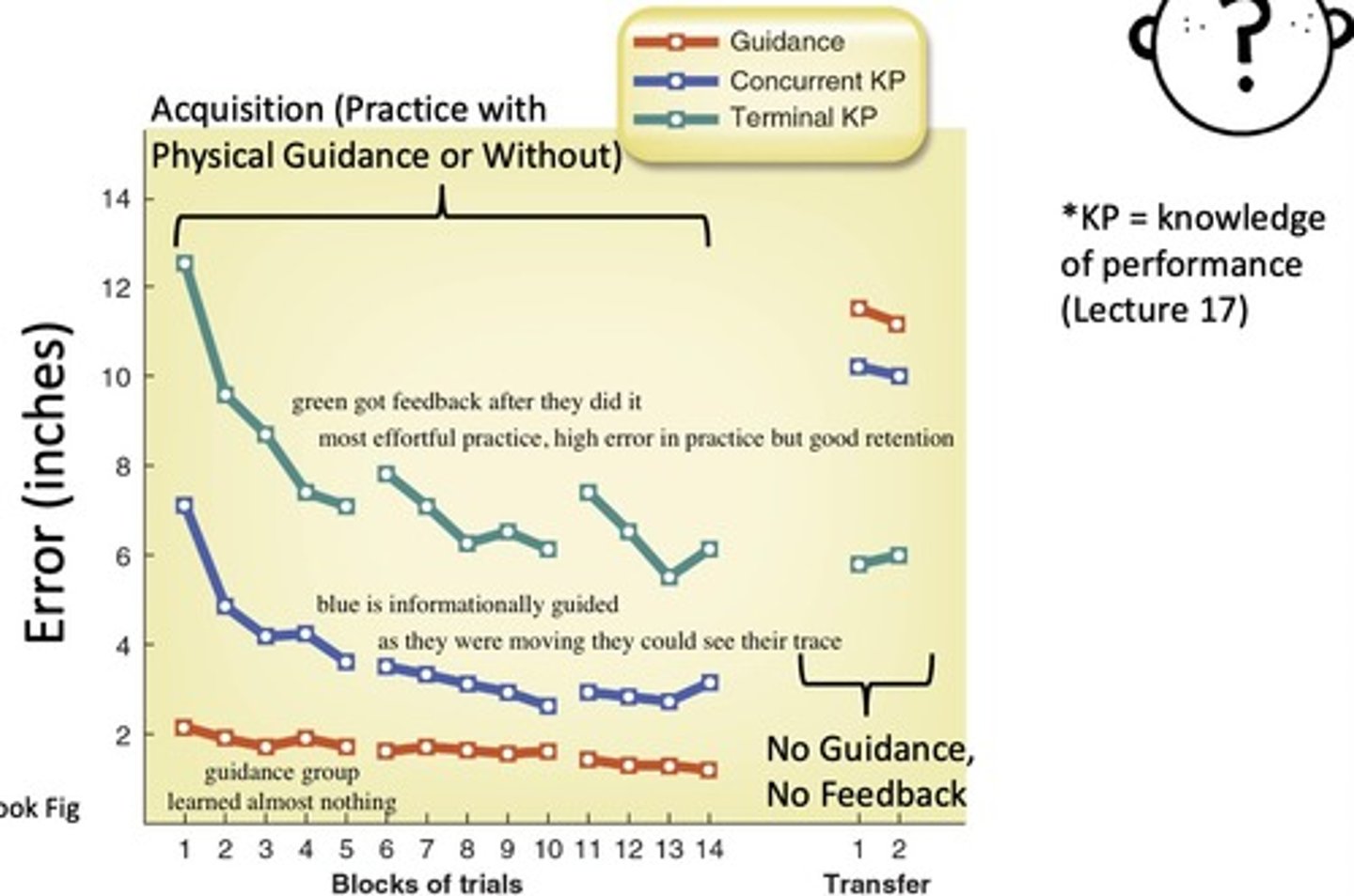
What are 3 reasons passive physical guidance is not the best learning aid?
1. No errors in guided movement - hence no opportunities for error detection and corrections
2. Lack of transfer specificity across practice conditions because practice and test conditions are different (with then without guidance)
3. Learner becomes over-dependent on guidance if it is always available - "Guidance Hypothesis" (guidance acts as a crutch)
What are 4 reasons why people still use physical guidance despite dependency properties?
early in learning: physical guidance can help make "difficult" tasks do-able
1. encourages engagement/prevents discouragement
2. Give some idea of goal movement
3. Frees attention for other task components
4. Safe (prevents large or catastrophic errors)
but should be used sparingly with a faded schedule
What is performance?
a "now" measure of current observable state, reflects training factors: fatigue, motivation, instruction (short term/immediate performance)
What is retention
later performance (next day, week, or end of season). Reflects learning "consolidation" (longer term specific learning - specific skills)
What is transfer?
later performance in new environments, or new skill variations/in competition (longer-term general learning - application)
Why might what see in practice =/= what is being learnt or retained?
-faster gains can indicate learning, but they dont have to. They may indicate that practice is too easy and learning will be compromised
-we need to measure performance across multiple time points, after periods of rest, to get true measures of learning
What is challenge-framework?
Relates to ideas of "Deliberate practice": purposeful practice designed to improve performance
High cognitive effort (reading and planning activities) Learner is an 'active' participant
What is challenge?
1. Individualized: based on the individual, interacting with the task/skill (functional task difficulty)
2. Information-based: can be thought of as amount of novel "info" available (uncertainty)
-situation gives challenge if it requires the learner to get new info, otherwise you don't really have to think bc you already know
3. Dynamic/changing: "optimal" zone promotes long-term learning but it is continually shifting
4. Specific to conditions of transfer/competition
-match to whatever the transfer task is
what is the optimal challenge point/zone for learning?
-when the difficulty of training is not too easy or difficult, the perfect middle so that performance is some error (so that learning is happening)
-overload principle
-random practice is beneficial bc it gets people re-engaged with task
How to increase challenge?
1. variable/random practice conditions (higher cognitive demands)
2. uncertain and unusual conditions
-racquet/ball size, field size # opponents
-switch positions, watch from different angles
3. reward learning, not performance
What is inherent feedback?
intrinsic/response-produced sensory info
-Touch (cutaneous receptors)
-Proprioception (Muscle spindles, GTO's, some cutaneous afferents, vestibular apparatus)
-Vision
-Audition (sound of hitting the ball)
What is augmented feedback?
extrinsic/not naturally occurring
-Knowledge of results (KR) (tells you about the outcome/goal of the action)
-Knowledge of performance (KP) (quality of the action)
What does augmented feed back do?
1. Adds to a performer's naturally occurring intrinsic feedback
2. Provides information about the movement or movement outcome
3. Often from an instructor/external person but can be from video or any device (fitbit HR steps etc)
What are the functions of augmented feedback?
1. Motivational role
-provides a reward function "good job"
2. Attention-directing role
-directs attention (internal/external - or to specific features)
3. Informational role
-primary role
-provides error/accuracy information "too much rotation)
4. Dependency role
-creates dependency/reliance on the info
(guidance hypothesis, acts as crutch)
What are examples of internal and external feedback for the attention-directing function of augmented feedback?
Internal: HR, hip placement on golf swing
External: ball flight projectory or ball itself
What is knowledge of results (KR)?
-Information about the outcome
-Qualitative or quantitative
"Your serve was 3 cm from the line"
"You hit a 260 yard drive"
"You missed"
How successful was the action with respect to the intended environmental-goal?
Aim of this information is to improve the next response (detect), then repeat or change (correct)
Important when learners cannot assess their own errors/performance (target is too far)
What is knowledge of performance (KP)?
-Information about movement quality/form (kinematics)
-not about outcome
"You dropped your shoulder on the serve"
"Keep your arm pointing at the target on the follow through"
-not about the environmental goal success (exception: aesthetically judged events where form is the goal = grey area)
-quality of the movement pattern
What is bio or neurofeedback?
electronic measurement & feedback of an internal biological process
-provides info that cannot be directly perceived
-popular among high level athletes
-biofeedback helps the individual better control of the process
ex. EMG, BP, EEG, HR from fitbit
What are the pros of KP and KR?
-often more information, more precise
-helps to zone in on otherwise unobservable
What are the cons of KP vs KR?
-can be too much information (overload)
-often directs attention internally/to the body (rather than external effects)
-may be too prescriptive (tells the performer what needs changing)/discourages 'active' problem-solving which can lead to better learning
What is absolute frequency?
total number of feedback presentations
what is relative frequency?
% of trials in which feedback given
total number of feedback presentations/total number of movement attempts x 100
what were the results of the feedback study?
feedback 50% of the time is better than 100% because they become reliant on it and thus a decrement in performance
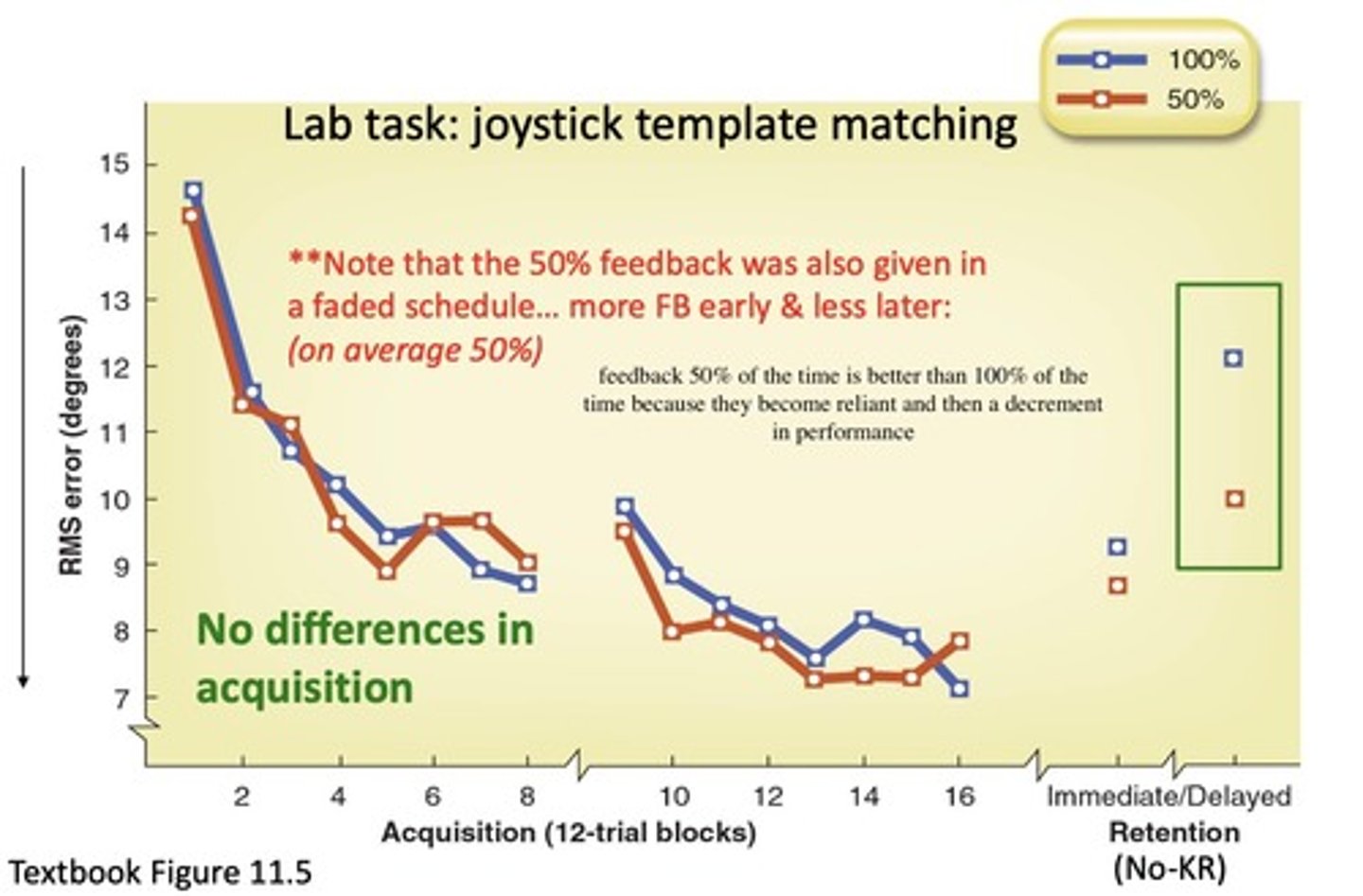
what is the guidance hypothesis?
-learner can become dependent on augmented feedback if it diverts attention away from discovering how to accomplish the task goal in the absence of augmented feedback
-No KR retention test is critical for testing for dependency
What is bandwidth feedback?
-another method to reduce feedback, only give FB when error fall outside criterion
-quantitative (-5cm)
-faded feedback frequency (as performance improves less FB is given)
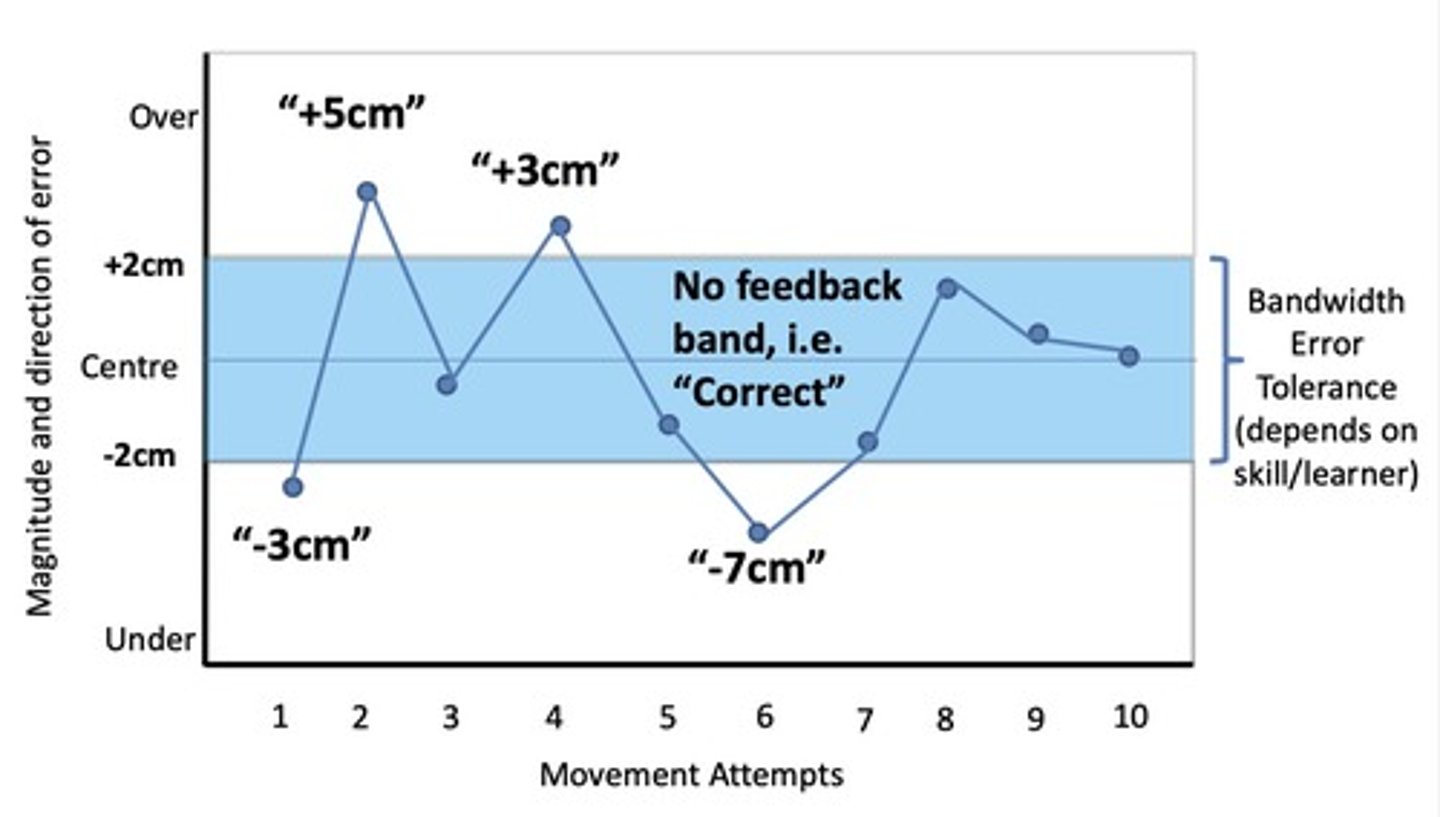
Why is bandwidth feedback more effective than feedback every trial?
1. results in reduced frequency of feedback, preventing dependency (guidance)
2. frequency of being "correct" increases with practice, potentially increase motivation
3. increases consistency by limiting "maladaptive" (unnecessary) corrections
-correcting small errors and changing technique between trials, instead of trying to repeat and stabilize
-especially relevant if ur a novice, where you dont need "sensitivity" (precision) in feedback as no motor proficiency yet
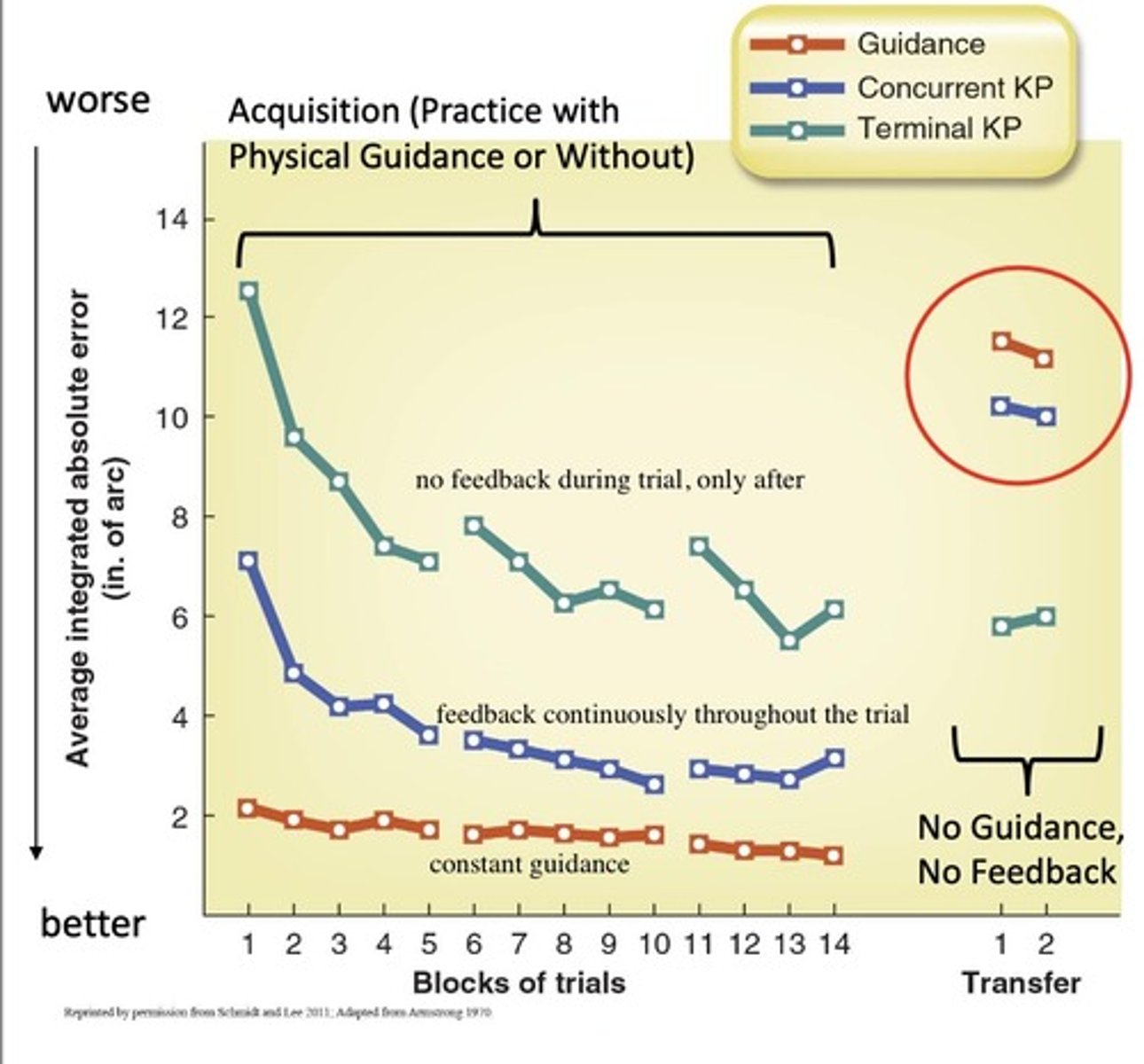
What can be inferred from this feedback study?
-concurrent feedback (during movement) works a lot like physical guidance
-only terminal KP (post movement FB) aided learning
-don't want to make person dependent on FB
What is the feedback delay interval?
-the longer the interval b/w FB, the more enhanced the learning
-longer pre-KR delay interval encourages processing of intrinsic FB, enhancing error detection capabilities
-waiting longer to give FB, allows engagement in processing activities that are good for learning
what are all the various techniques for alleviating effects of FB and "guidance"?
-reduced frequency of feedback
-fading feedback
-bandwidth feedback
-summary feedback
-terminal feedback vs. concurrent
-increased KR delay
-self control of FB
What information is conveyed during a demonstration?
Cognitive-spatial elements of the task:
Perceptual-Motor elements of the task:
What are implicit motor plans?
observed actions that are mapped onto viewer's own motor representation of the action
What is the mirror neuron system?
-action simulation
-the same neurons that fire when you plan and perform an action also fire when observing someone else perform the action
What are the benefits of watching an expert model vs a novice one?
-predict that more skilled, more similar and higher status model would improve learning
-more attention should be focused on the model
-more accurate perceptual blueprint
-assists problem solving of skill (effort)
-more consistent with stage of learner
-alerts to errors and how to correct them
Why should we intersperse demonstrations with blocks of physical practice when teaching new motor skills?
1. more likely to engage learner in active problem-solving
2. provides learner with rest between trials of physical practice
3. could also help activate MNS during observation, encourage simulation
What is visual mental imagery?
"seeing" in the absence of the appropriate immediate sensory input
what is auditory mental imagery?
'hearing' in the absence of the immediate sensory input
what is imagery?
the registration of physically present stimuli
what is functional equivalence?
shared neural substrates underpinning overt (movement) and covert (motor imagery and action observation) processes
what is mental chronometry?
if actual and imagined actions are functionally equivalent, they should have similar timing characteristics
what is aphantasia?
-a complete absence of the "minds eye"
-can be acquired or congenital
-0.9% of people
-may also have inabilities to generate other modalities (kinesthetic and auditory imagery)
is imagery always a conscious process?
explicit imagery is a conscious (instructed) use of imagery
implicit imagery is considered unconscious (uninstructed) use of imagery
what is developmental coordination disorder?
a neurodevelopmental condition characterized by uncoordinated movement patterns
what is the double step reaching task?
requires individuals to adjust movements after the development of a motor plan
What is fatigue hypothesis?
fatigue can impair quality of practice (eg. cause learner to practice incorrect movement patterns)
What is cognitive-effort hypothesis?
trials become repetitious, monotonous or boring; low engagement/concentration/mental effort
what is memory consolidation hypothesis?
periods of rest are not there to help LTM storage process (neurobiochemical). can be related to sleep