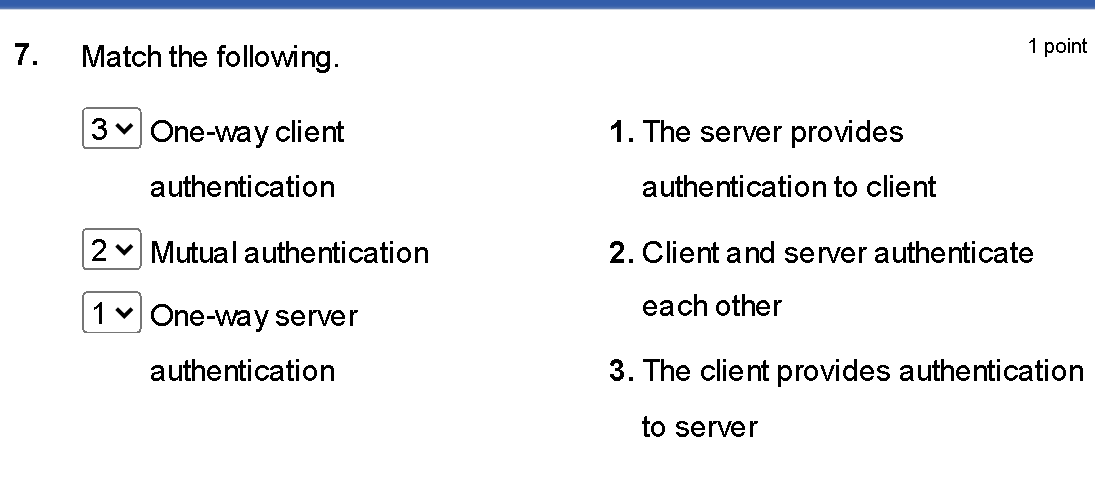
D334 Round 2
 Call Kai
 Learn
Learn Practice Test
 Spaced Repetition
 Match
Match Flashcards
 Knowt Play
1/53

There's no tags or description
Looks like no tags are added yet.
Name | Mastery | Learn | Test | Matching | Spaced | Call with Kai |
|---|
No analytics yet
Send a link to your students to track their progress
54 Terms
A block cipher mode uses an IV so that:
A. The key changes every encryption
B. The same plaintext can produce different ciphertexts
C. The plaintext becomes shorter
D. The encryption becomes asymmetric
✅ Correct!
Why?
An Initialization Vector (IV) is used so that:
The same plaintext encrypted with the same key can produce different ciphertexts.
Without an IV:
HELLO + Key123 = ABC123
HELLO + Key123 = ABC123
With different IVs:
HELLO + Key123 + IV1 = XYZ789
HELLO + Key123 + IV2 = MNO456
This prevents:
Pattern leakage
ECB-style weaknesses
Copy-and-paste attacks
Which block cipher mode uses a counter value that is encrypted and then XOR'd with the plaintext, allowing encryption and decryption operations to be performed in parallel?
A. CBC
B. CFB
C. CTR
D. OFB
✅ Correct!
Why?
The key phrase is:
"counter value that is encrypted and then XOR'd with the plaintext"
That's the textbook definition of CTR (Counter Mode).
How CTR Works
Counter1 → Encrypt → E1
E1 XOR P1 = C1

Counter2 → Encrypt → E2
E2 XOR P2 = C2

Counter3 → Encrypt → E3
E3 XOR P3 = C3
Notice:
The plaintext blocks don't depend on each other.
The ciphertext blocks don't depend on each other.
Each counter value is independent.
OA Memory Hook
CTR = Counter → Encrypt → XOR
If you see:
Counter
Nonce + Counter
Parallel encryption/decryption
Stream cipher behavior
Answer:
✅ CTR
Quick Comparison
Mode | Memory Trigger |
|---|---|
ECB | Same plaintext = same ciphertext |
CBC | Ciphertext chains blocks together |
CFB | Ciphertext becomes next IV |
OFB | Encrypted output becomes next IV |
CTR | Counter is encrypted and XOR'd |
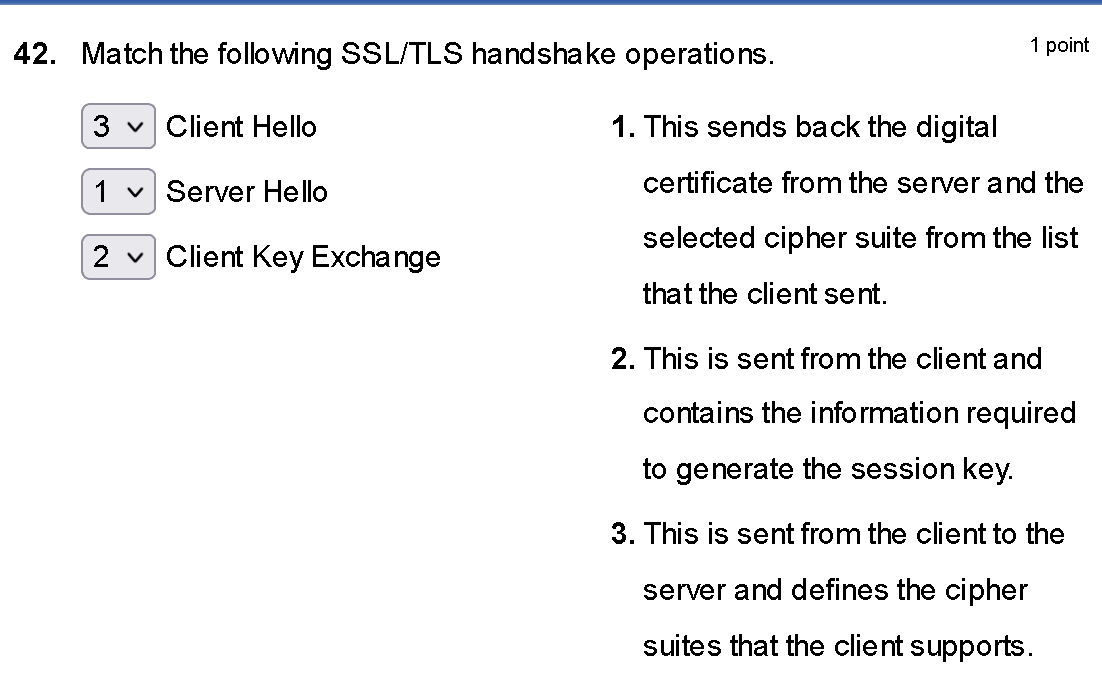
Easy D334 Memory Trick
Think of the handshake as a conversation:
Client Hello
↓
"Here's what I support."

Server Hello
↓
"I pick this cipher suite.
Here's my certificate."

Client Key Exchange
↓
"Here's the information needed
to create the session key."
So:
Client Hello = Supported cipher suites → 3
Server Hello = Certificate + chosen cipher suite → 1
Client Key Exchange = Session key material → 2
Thanks for catching that. On the OA, that matching should be 3, 1, 2, not 2, 1, 3. 👍
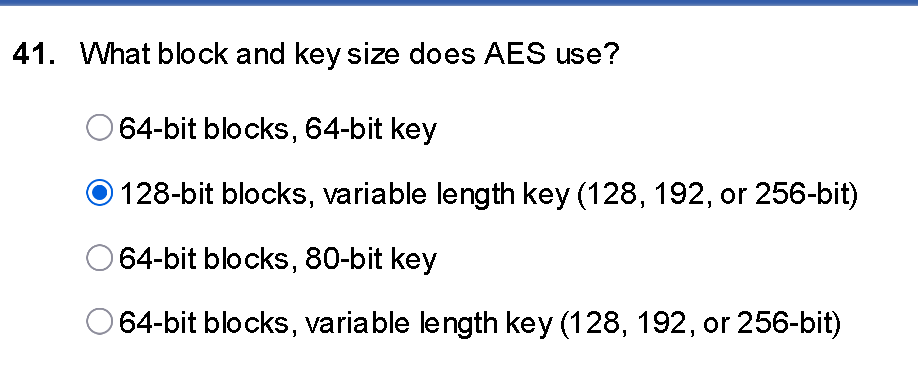
✅ Correct.
The answer is:
128-bit blocks, variable length key (128, 192, or 256-bit)
D334 Memory Trick
AES is easy to memorize:
AES Block Size = Always 128 bits

AES Key Sizes = 128, 192, 256 bits
Notice:
The block size never changes.
Only the key size changes.
OA Cheat Code
If you see:
Algorithm | Block Size | Key Size |
|---|---|---|
AES | 128-bit | 128, 192, 256 |
DES | 64-bit | 56-bit |
3DES | 64-bit | 112 or 168-bit |
Common OA Trap
Many students pick:
64-bit blocks, variable length key (128, 192, 256)
because they remember the AES key sizes but forget the block size.
Remember:
AES = 128-bit block size, always.
I would absolutely commit this to memory for the OA:
AES
Block = 128
Keys = 128, 192, 256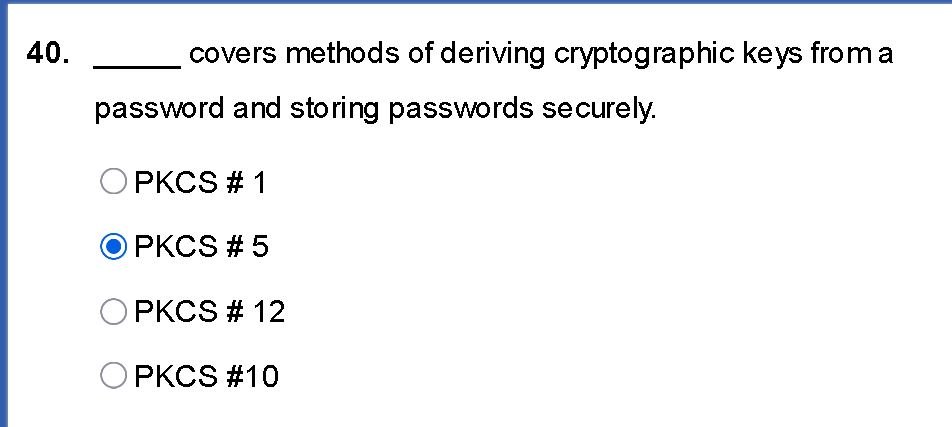
✅ Correct.
The answer is:
PKCS #5
Why?
The key phrase is:
"deriving cryptographic keys from a password"
That's exactly what PKCS #5 covers.
It defines Password-Based Cryptography, including:
Password-based encryption
Key derivation functions
PBKDF2 (very important for D334)
D334 Memory Hook
Think:
PKCS #5 = Passwords
The 5 looks a little like an S:
PKCS #5
   ↓
Passwords
PKCS Cheat Sheet
PKCS | Remember |
|---|---|
PKCS #1 | RSA |
PKCS #5 | Passwords / PBKDF2 |
PKCS #10 | CSR (Certificate Signing Request) |
PKCS #12 | Certificates + Private Keys in one file (.p12/.pfx) |
OA Cheat Code
If you see:
Password-based encryption
Key derivation from passwords
PBKDF2
Answer:
✅ PKCS #5
If you see:
CSR
Answer:
✅ PKCS #10
If you see:
Certificate + private key in one file
Answer:
✅ PKCS #12
Question 40: Your answer is correct. ✅
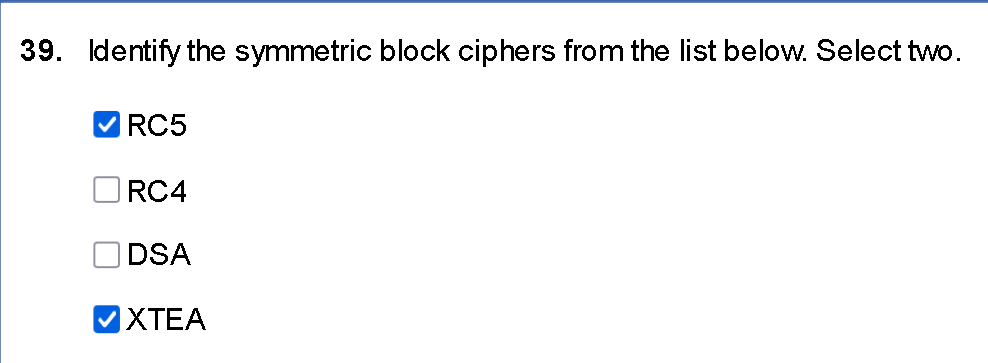
✅ Your answer is correct.
You selected:
☑ RC5
☑ XTEA
Those are both symmetric block ciphers.
Why the others are wrong
❌ RC4
Symmetric, but a stream cipher, not a block cipher.
❌ DSA
Digital Signature Algorithm
Asymmetric signature algorithm
Not a cipher at all
D334 Memory Hook
Think of the RC family:
Algorithm | Type |
|---|---|
RC4 | Stream Cipher |
RC5 | Block Cipher |
RC6 | Block Cipher (AES finalist) |
And:
Algorithm | Type |
|---|---|
TEA | Block Cipher |
XTEA | Block Cipher |
AES | Block Cipher |
DES | Block Cipher |
OA Cheat Code
If you see:
RC4
Immediately think:
✅ Stream Cipher
If you see:
RC5, RC6, XTEA, AES, DES, 3DES
Think:
✅ Block Cipher
Which one is the odd one out?
A. AES
B. XTEA
C. RC4
D. RC5
✅ Correct!
C. RC4 is the odd one out.
Algorithm | Type |
|---|---|
AES | Block Cipher |
XTEA | Block Cipher |
RC5 | Block Cipher |
RC4 | Stream Cipher |
D334 Memory Hook
RC4 = Stream
RC5 = Block
RC6 = Block
This is a very common exam trap because RC4 and RC5 look almost identical by name.
Think:
RC4 "flows" like a stream.
RC5 works on blocks.
You're getting these algorithm classification questions right consistently, which is a good sign because the OA likes to test:
Block vs Stream
Symmetric vs Asymmetric
Cipher vs Hash vs Signature
Which algorithm is primarily used for digital signatures rather than encryption?
A. AES
B. DSA
C. RC5
D. ChaCha20
✅ Correct!
B. DSA (Digital Signature Algorithm)
Why?
DSA is designed for:
✅ Digital Signatures
❌ Encryption
Compare the choices
Algorithm | Purpose |
|---|---|
AES | Symmetric Encryption |
DSA | Digital Signatures |
RC5 | Symmetric Encryption |
ChaCha20 | Stream Cipher Encryption |
D334 Memory Hook
Think:
DSA = Digital Signature AlgorithmThe name literally gives away its purpose.
OA Cheat Code
Need to... | Use |
|---|---|
Encrypt Data | AES, ChaCha20, RC5 |
Create Digital Signatures | DSA |
Encrypt & Sign | RSA (can do both) |
A common exam trap is confusing:
RSA → Encryption and signatures
DSA → Signatures only
Which hashing algorithm produces a 160-bit hash value and is considered cryptographically broken due to collision attacks?
A. SHA-256
B. SHA-512
C. SHA-1
D. SHA-3
✅ Correct!
C. SHA-1
Why?
SHA-1 produces a:
160-bit hash
and is considered cryptographically broken because researchers have demonstrated practical collision attacks.
D334 Memory Hook
MD5   = 128-bit = Broken
SHA-1 = 160-bit = Broken
SHA-256 = 256-bit = Secure
SHA-512 = 512-bit = Secure
OA Cheat Code
If you see:
160-bit hash
Answer:
✅ SHA-1
If you see:
Collision attacks
Broken hashing algorithm
Think:
✅ MD5
✅ SHA-1
Quick Comparison
Hash | Output Size | Status |
|---|---|---|
MD5 | 128-bit | Broken |
SHA-1 | 160-bit | Broken |
SHA-256 | 256-bit | Secure |
SHA-512 | 512-bit | Secure |
Super Important OA Pattern
If the question says:
"Produces a 160-bit digest"
Don't overthink it.
Answer:
✅ SHA-1
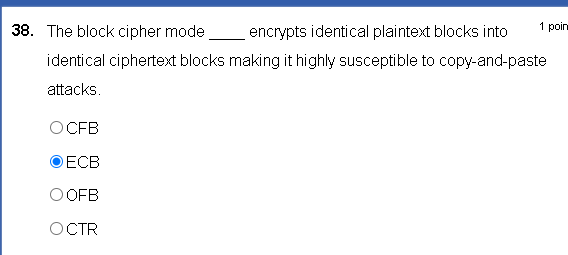
The answer is:
ECB (Electronic Codebook)
Why?
The key phrase is:
"identical plaintext blocks into identical ciphertext blocks"
That is the defining weakness of ECB.
Plaintext Block A → Ciphertext Block X
Plaintext Block A → Ciphertext Block X
Same plaintext + same key = same ciphertext.
What does this cause?
Because patterns remain visible, ECB is vulnerable to:
✅ Pattern leakage
✅ Copy-and-paste attacks
✅ Block replay attacks
Compare to the others
Mode | Identical Plaintext = Identical Ciphertext? |
|---|---|
ECB | ✅ Yes |
CFB | ❌ No |
OFB | ❌ No |
CTR | ❌ No |
D334 Memory Hook
ECB = Exposes Clear Blocks
or
ECB = Every Copy is the same Block
Whenever you see:
Pattern leakage
Same plaintext → same ciphertext
Copy-and-paste attacks
Answer:
✅ ECB
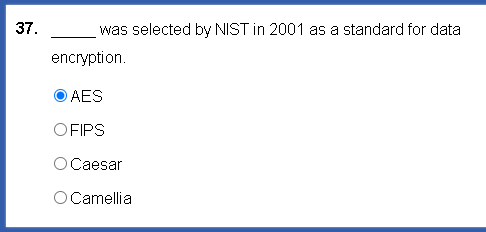
The answer is:
AES (Advanced Encryption Standard)
Why?
The key phrase is:
"selected by NIST in 2001 as a standard for data encryption"
That's exactly what happened.
NIST held a competition to replace DES.
The winning algorithm was Rijndael.
After selection, it became AES.
Officially adopted in 2001.
D334 Memory Hook
2001
↓
NIST selects Rijndael
↓
Becomes AES
Why the others are wrong
❌ FIPS
A publication standard, not an encryption algorithm.
❌ Caesar
Ancient substitution cipher.
❌ Camellia
Modern cipher, but not the NIST-selected AES standard.
OA Cheat Code
When you see:
NIST
2001
Encryption Standard
Answer:
✅ AES
Quick Facts Worth Memorizing
Fact | Remember |
|---|---|
AES adopted | 2001 |
AES block size | 128 bits |
AES key sizes | 128, 192, 256 |
AES replaced | DES |
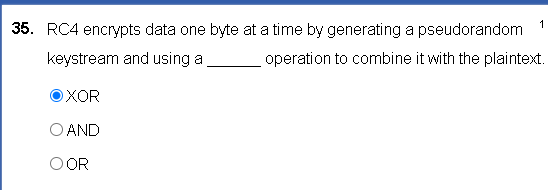
The answer is:
XOR
Why?
RC4 is a stream cipher.
It works like this:
Plaintext
    XOR
Keystream
    =
Ciphertext
D334 Memory Hook
For all stream ciphers (RC4, ChaCha20, OFB, CTR):
Think:
Keystream + XOR
Keystream XOR Plaintext = Ciphertext
OA Cheat Code
If you see:
Stream cipher
RC4
ChaCha20
Keystream generation
Answer:
✅ XOR
Easy Example
Suppose:
Plaintext = 1010
Keystream = 1100
XOR them:
1010
1100
----
0110
Ciphertext:
0110That's the basic idea behind RC4.
One-Liner to Memorize
RC4 generates a pseudorandom keystream and XORs it with the plaintext.
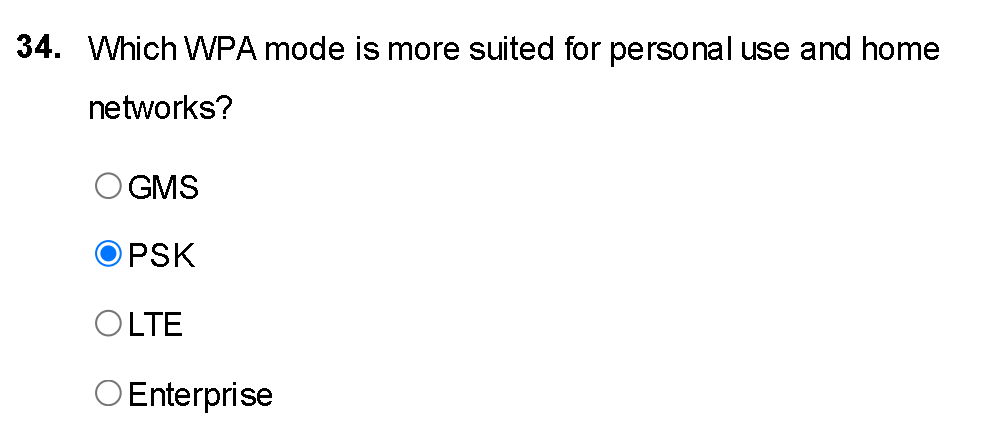
✅ Correct answer: PSK (Pre-Shared Key)
D334 Memory Hook
Think:
Home = PSK
Business = Enterprise
Why?
WPA/WPA2/WPA3 Personal
Uses:
✅ PSK (Pre-Shared Key)
This is your typical home Wi-Fi password:
MyWiFiPassword123Everyone uses the same password.
WPA/WPA2/WPA3 Enterprise
Uses:
✅ RADIUS server
✅ Individual user accounts
✅ 802.1X authentication
Common in:
Businesses
Universities
Hospitals
Government networks
OA Cheat Code
Environment | Mode |
|---|---|
Home / Personal | PSK |
Business / Corporate | Enterprise |
Whenever you see:
Home network
Personal use
Small office
Answer:
✅ PSK
Whenever you see:
RADIUS
802.1X
Corporate authentication
Answer:
✅ Enterprise
So for Question #34:
Correct Answer: PSK ❌➡✅
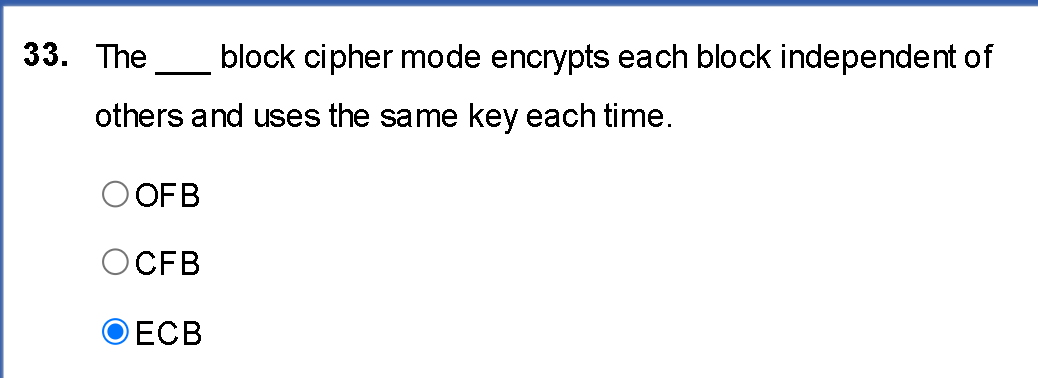
The answer is:
ECB (Electronic Codebook)
Why?
The key phrase is:
"encrypts each block independent of others"
That's the defining characteristic of ECB.
P1 → Encrypt → C1

P2 → Encrypt → C2

P3 → Encrypt → C3
Each block is treated separately.
No:
IV chaining
Ciphertext feedback
Output feedback
Counter values
Compare to the Others
ECB
Each block stands alone.
CBC
Previous ciphertext helps encrypt next block.
CFB
Ciphertext feeds back.
OFB
Encryption output feeds back.
D334 Memory Hook
For ECB, remember:
E = Each block is independent
or
ECB = Encrypts blocks by themselves
OA Cheat Code
If you see:
Independent blocks
Same plaintext → same ciphertext
Pattern leakage
Copy-and-paste attacks
Answer:
✅ ECB
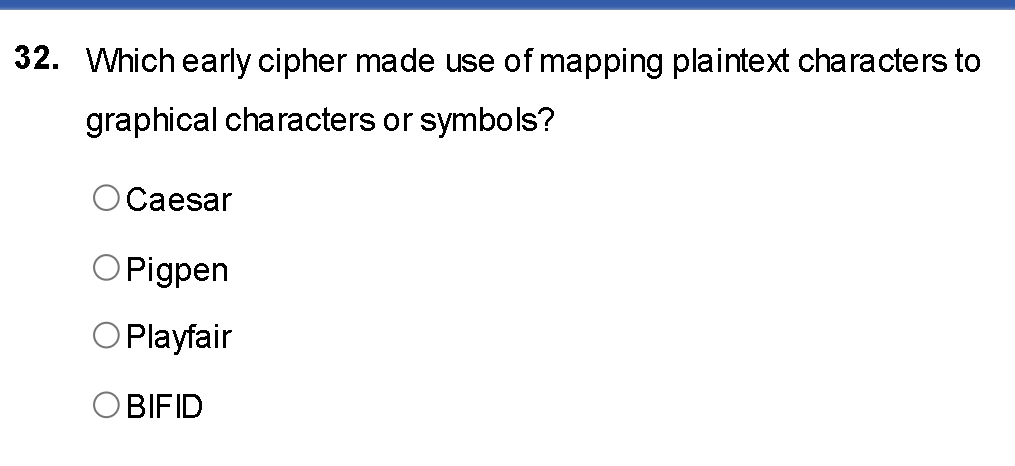
The answer is:
Pigpen Cipher
Why?
The key phrase is:
"mapping plaintext characters to graphical characters or symbols"
That's exactly what the Pigpen cipher does.
Instead of letters:
A B CIt uses symbols based on a grid:
┌ ┬ ┐
├ ┼ ┤
└ ┴ ┘
(and variations with dots).
Why the others are wrong
Caesar → Shifts letters (A→D, B→E, etc.)
Playfair → Encrypts pairs of letters (digraphs)
BIFID → Uses a Polybius square and fractionation
Pigpen → Replaces letters with symbols ✅
D334 Memory Hook
Cipher | Remember |
|---|---|
Caesar | Letter shifting |
Vigenère | Keyword, polyalphabetic |
Playfair | Letter pairs |
4-Square | Four 5×5 matrices |
Pigpen | Symbols instead of letters |
OA Cheat Code
If you see:
Graphical symbols
Secret symbols
Masonic cipher
Answer:
✅ Pigpen
✅ Correct.
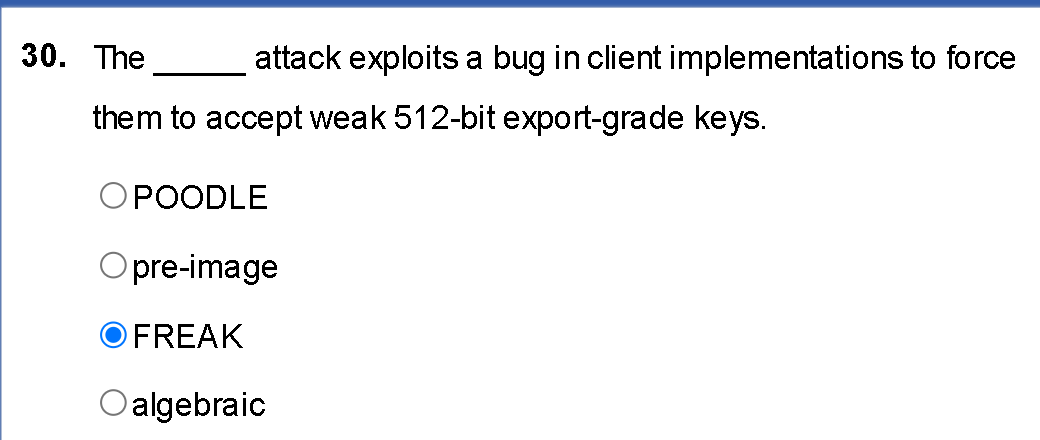
The answer is:
FREAK
Why?
The key phrase is:
"force them to accept weak 512-bit export-grade keys"
That's exactly what the FREAK attack does.
FREAK stands for:
Factoring RSA Export Keys
It exploits old export-grade cryptography restrictions and can downgrade a connection to weak 512-bit RSA keys.
D334 Memory Hook
FREAK
↓
Factoring RSA Export Keys
↓
512-bit export-grade RSA
Compare the Choices
Attack | Remember |
|---|---|
FREAK | Weak 512-bit export RSA keys |
POODLE | SSL 3.0 downgrade attack |
Pre-image | Hash attack |
Algebraic | Cryptanalysis technique |
OA Cheat Code
If you see:
Export-grade encryption
512-bit RSA
Downgrade to weak keys
Answer:
✅ FREAK
✅ Correct.
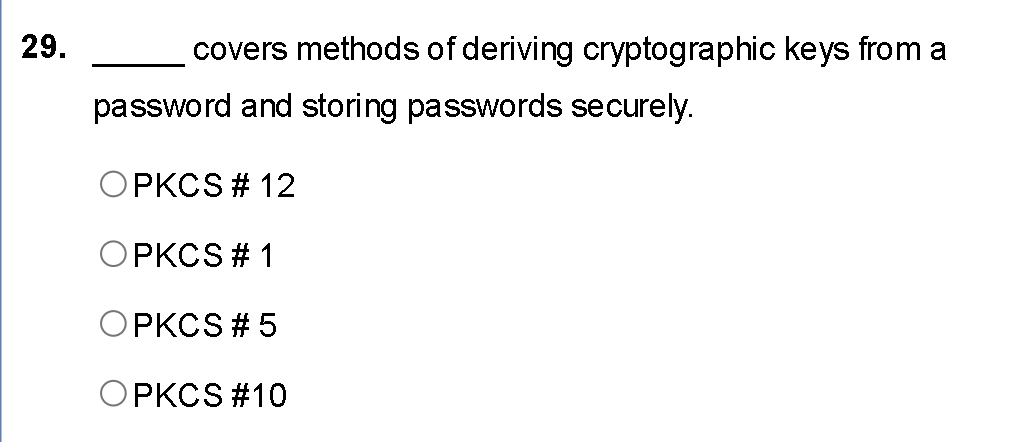
The answer is:
PKCS #5
Why?
The key phrase is:
"deriving cryptographic keys from a password"
PKCS #5 defines Password-Based Cryptography, including:
Password-Based Encryption (PBE)
Password-Based Key Derivation Functions
PBKDF2 (very important for D334)
D334 PKCS Cheat Sheet
PKCS | Remember |
|---|---|
PKCS #1 | RSA |
PKCS #5 | Passwords / PBKDF2 |
PKCS #10 | CSR (Certificate Signing Request) |
PKCS #12 | Certificates + Private Keys (.p12/.pfx) |
Memory Trick
PKCS #5
     ↓
Passwords
     ↓
PBKDF2
When you see:
Password-based encryption
Key derivation from passwords
PBKDF2
Answer:
✅ PKCS #5
✅ Correct.
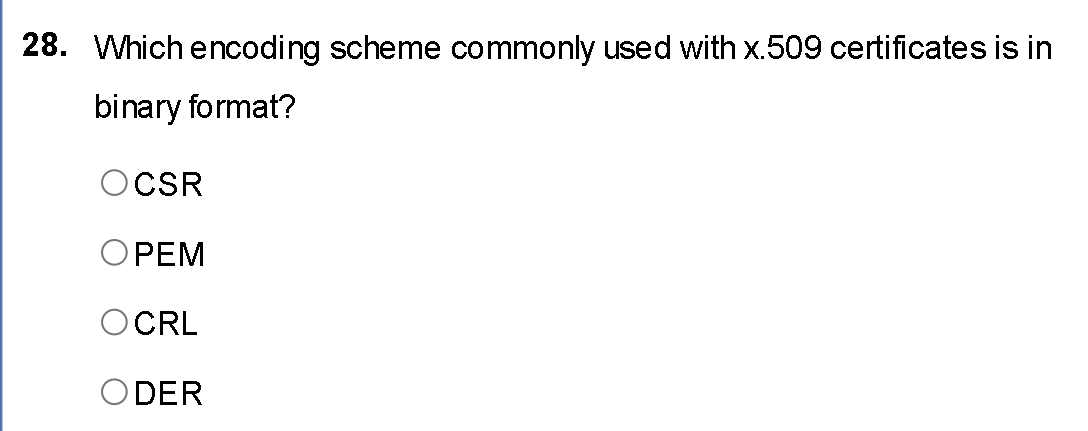
The answer is:
DER (Distinguished Encoding Rules)
Why?
The key phrase is:
"binary format"
That's DER.
DER vs PEM (Very Common OA Question)
Format | Type |
|---|---|
DER | Binary |
PEM | Base64-encoded text |
Memory Trick
Think:
DER = Data Encoded Raw
      ↓
    Binary
and
PEM
↓
Readable text
-----BEGIN CERTIFICATE-----
OA Cheat Code
If you see:
X.509 certificate in binary format
Answer:
✅ DER
If you see:
-----BEGIN CERTIFICATE-----
Answer:
✅ PEM
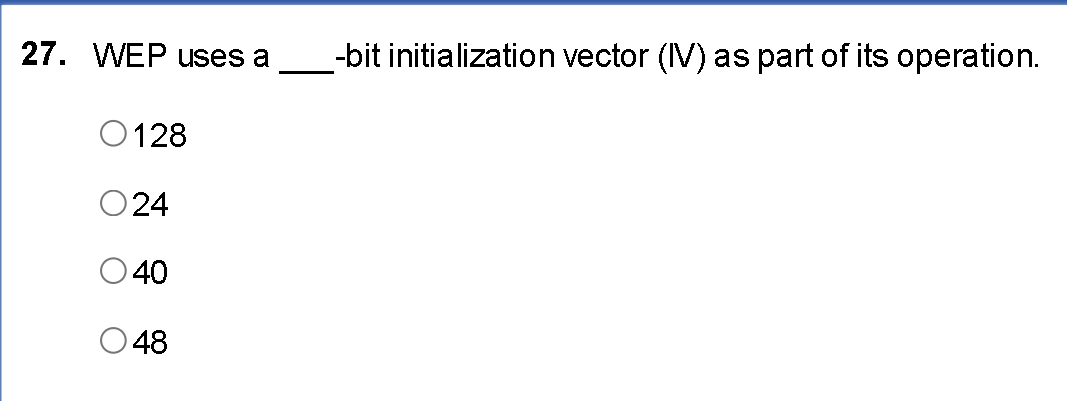
✅ Correct answer: 24 bits
Why?
WEP uses:
RC4 stream cipher
24-bit IV
Combined with either a 40-bit or 104-bit secret key
The 24-bit IV is actually one of WEP's biggest weaknesses because it is so small that IVs repeat frequently.
D334 Memory Hook
WEP = Weak
     ↓
24-bit IV
Or:
WEP
↓
24-bit IV
↓
IV Reuse
↓
Cracked
Common OA Trap
Students often pick 40 bits because they remember:
WEP originally used a 40-bit key.
But the question asks for the:
Initialization Vector (IV)
Answer:
✅ 24 bits
Wireless Cheat Sheet
Standard | IV Size |
|---|---|
WEP | 24-bit IV |
WPA/WPA2 | Uses TKIP/CCMP improvements |
WPA3 | SAE authentication |
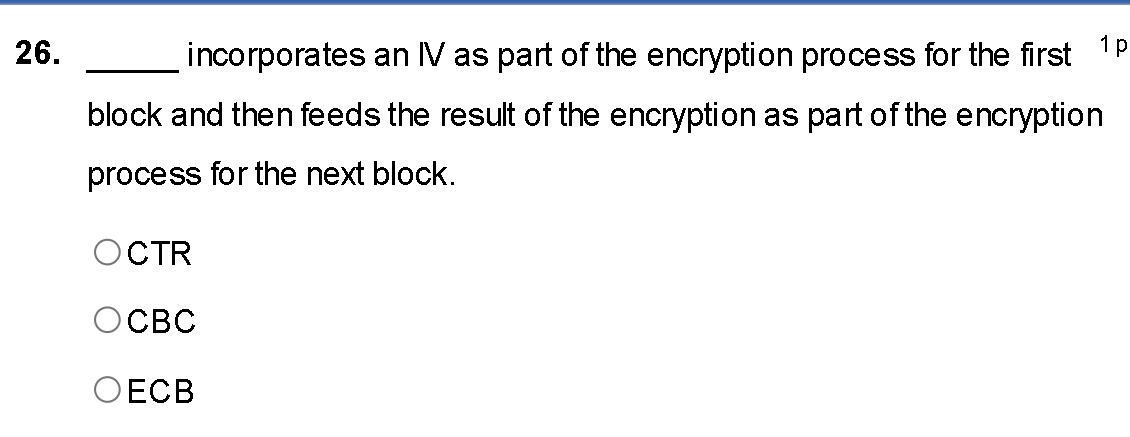
✅ Correct. CBC
The key phrase is:
"incorporates an IV for the first block and then feeds the result of the encryption into the next block."
That's exactly how CBC (Cipher Block Chaining) works.
Visual
Block 1
P1 ⊕ IV
   ↓
 Encrypt
   ↓
  C1
Block 2
P2 ⊕ C1
   ↓
 Encrypt
   ↓
  C2
Block 3
P3 ⊕ C2
   ↓
 Encrypt
   ↓
  C3
D334 Memory Hook
For CBC, memorize:
Ciphertext chains blocks together.
Or even shorter:
CBC = Cipher Block Chaining
The previous ciphertext becomes part of the next encryption operation.
How to distinguish the modes
Mode | Memory Trigger |
|---|---|
ECB | Each block independent |
CBC | Previous ciphertext helps encrypt next block |
CFB | Ciphertext becomes next IV |
OFB | Encrypted output becomes next IV |
CTR | Counter is encrypted and XOR'd |
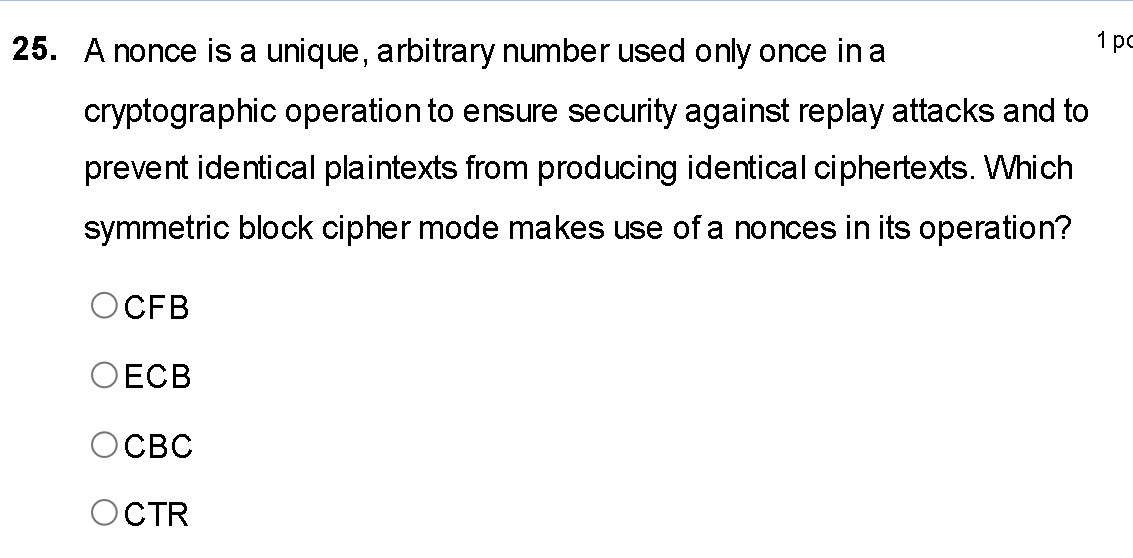
✅ Correct.
The answer is:
CTR (Counter Mode)
Why?
The key phrase is:
"Nonce"
CTR mode typically uses:
Nonce + CounterThen encrypts that value:
Nonce + Counter
        ↓
     Encrypt
        ↓
    Keystream
        ↓
      XOR
        ↓
   Ciphertext
D334 Cheat Code
When you see:
Clue | Answer |
|---|---|
Nonce | CTR |
Counter | CTR |
Parallel encryption | CTR |
Stream cipher behavior | CTR |
Memory Hook
CTR
↓
Counter Mode
↓
Nonce + Counter
Why the others are wrong
ECB → No IV, no nonce.
CBC → Uses an IV.
CFB → Uses an IV.
CTR → Uses a nonce and counter. ✅
This is one of the easiest pattern-recognition questions on the OA:
Nonce = CTR
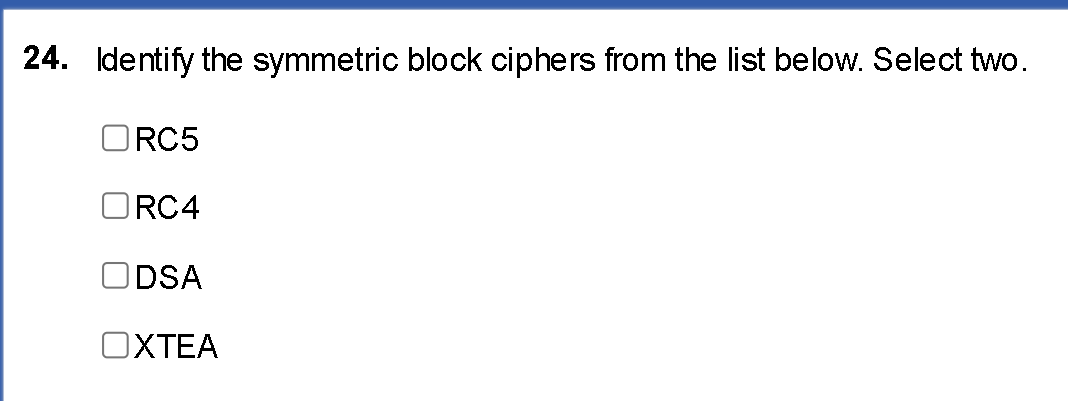
✅ Correct.
The two symmetric block ciphers are:
☑ RC5
☑ XTEA
Why?
Algorithm | Type |
|---|---|
RC5 | Symmetric Block Cipher |
XTEA | Symmetric Block Cipher |
RC4 | Symmetric Stream Cipher |
DSA | Digital Signature Algorithm |
D334 Memory Hook
RC4 = Stream
RC5 = Block
That's one of the most common OA traps.
And:
TEA = Block
XTEA = Block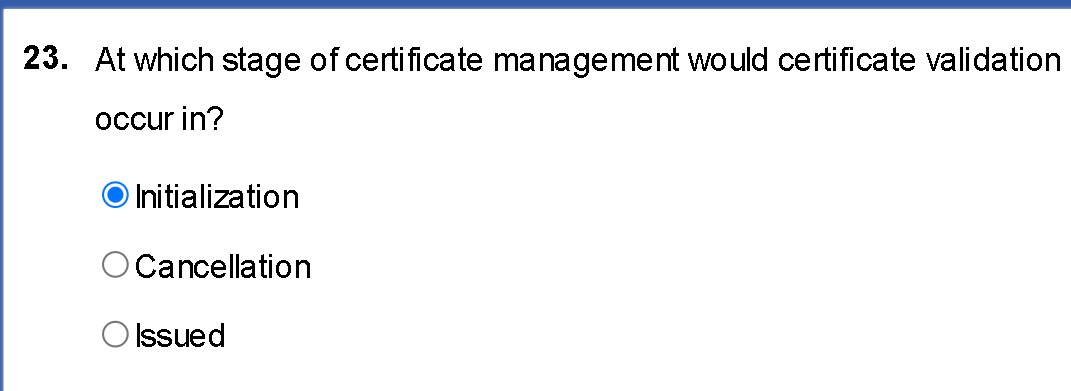
Initialization
Certificate is requested and created.
Identity is verified.
Certificate validation/checking occurs before trust is established.
Issued
The certificate has already been created and distributed.
The validation work has essentially already happened.
Cancellation
Certificate is revoked or terminated.
D334 Exam Pattern
When WGU asks:
"At which stage would certificate validation occur?"
The answer is typically:
✅ Initialization
Because that's the phase where the CA validates identity and the certificate enters the trust chain.
Memory Hook
Initialization = Validate and Create
Issued = Use
Cancellation = Revoke
So I would answer:
✅ Initialization
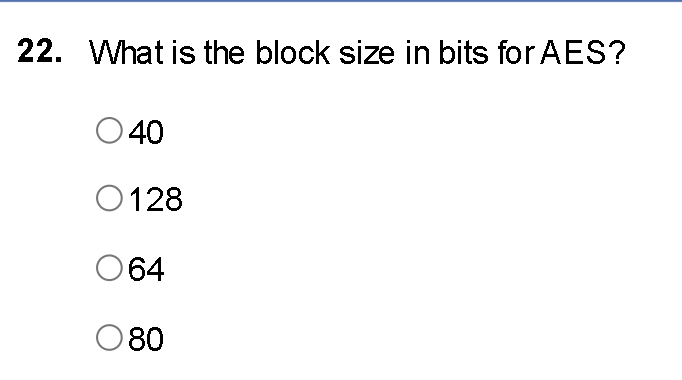
✅ Correct.
The answer is:
128 bits
D334 Memory Hook
This is one of the highest-yield facts on the OA:
AES
Block Size = 128 bits (ALWAYS)

Key Sizes = 128, 192, 256 bits
Common OA Trap
Students often confuse:
Block Size ❌
Key Size ❌
Remember:
AES-128
AES-192
AES-256
Those numbers refer to the key size, not the block size.
The block size remains:
✅ 128 bits
Quick Memory Phrase
"AES always blocks at 128."
No matter whether the key is:
128-bit
192-bit
256-bit
the block size is still:
✅ 128 bits
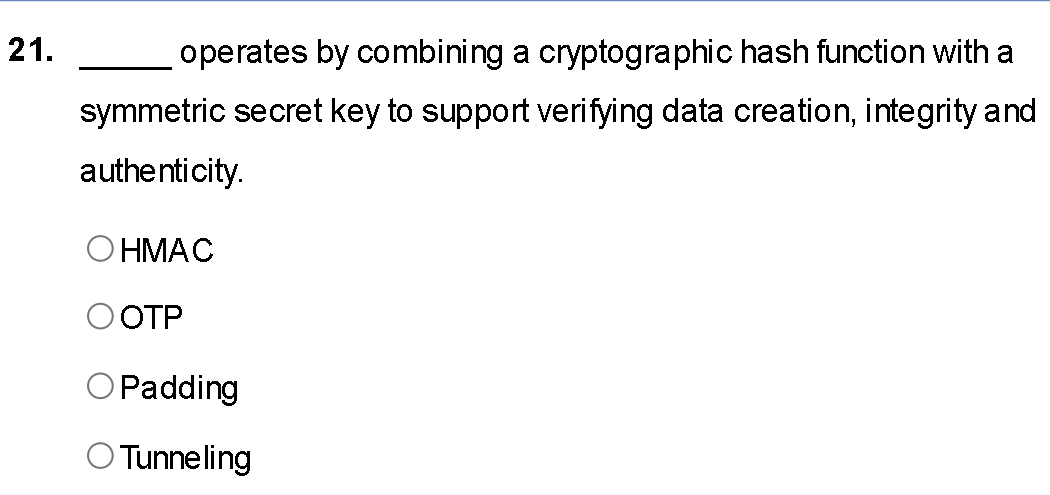
✅ Correct answer: HMAC
The key phrases are:
"cryptographic hash function"
"symmetric secret key"
"integrity and authenticity"
That is the textbook definition of HMAC (Hash-based Message Authentication Code).
D334 Memory Hook
HMAC
=
Hash + Secret Key
What does HMAC provide?
✅ Integrity (message wasn't changed)
✅ Authentication/Authenticity (came from someone who knows the secret key)
❌ Confidentiality (does NOT encrypt data)
Why the others are wrong
OTP → One-Time Pad password/token concept, not hash + key.
Padding → Adds bytes to data before encryption.
Tunneling → Encapsulates traffic (VPNs, IPSec, etc.).
OA Cheat Code
If you see:
Hash + Secret Key
Answer:
✅ HMAC
If you see:
Integrity + Authenticity
Answer:
✅ HMAC
Quick Comparison
Technology | Purpose |
|---|---|
Hash | Integrity |
HMAC | Integrity + Authenticity |
Encryption | Confidentiality |
Digital Signature | Integrity + Authenticity + Nonrepudiation |
🎯 Question #21: HMAC
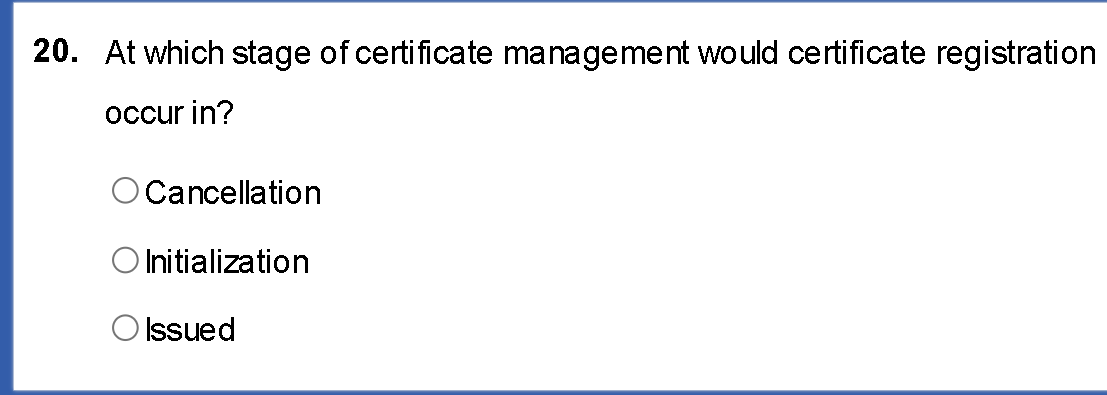
✅ Correct answer: Initialization
Why?
The key word is:
Registration
Certificate registration happens at the beginning of the certificate lifecycle.
Simple Lifecycle
Initialization
↓
Registration
Validation
Key Generation
Certificate Request

Issued
↓
Certificate is Active and Being Used

Cancellation
↓
Revoked / Expired
D334 Memory Hook
Think:
Stage | What Happens |
|---|---|
Initialization | Registration, validation, setup |
Issued | Certificate is active and in use |
Cancellation | Revocation, expiration, termination |
OA Cheat Code
If you see:
Registration
Answer:
✅ Initialization
If you see:
Revocation
Answer:
✅ Cancellation
If you see:
Certificate is being used
Answer:
✅ Issued
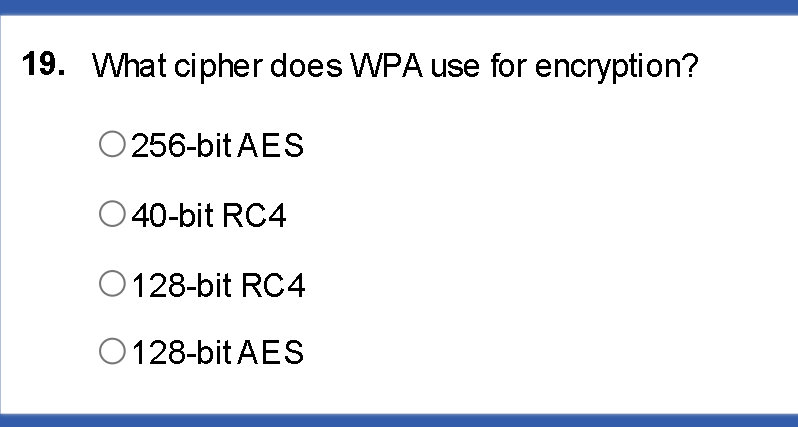
✅ Correct.
The answer is:
128-bit RC4
WPA vs WPA2 Cheat Sheet
Standard | Cipher |
|---|---|
WEP | RC4 |
WPA | RC4 (with TKIP) |
WPA2 | AES (CCMP) |
WPA3 | AES + SAE |
D334 Memory Hook
WEP  → RC4
WPA  → RC4
WPA2 → AES
WPA3 → AES
Common OA Trap
Many students see:
"WPA"
and immediately pick AES because AES is more modern.
But:
WPA = RC4 + TKIP
WPA2 = AES + CCMP
Extra Fact
WPA uses:
RC4
128-bit key
TKIP
So from the choices:
✅ 128-bit RC4
🎯 Question #19: Correct.
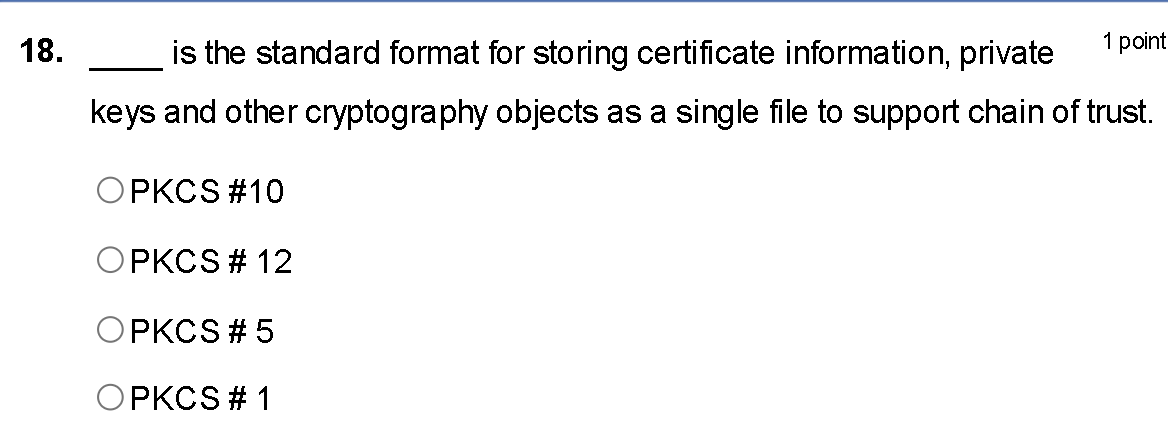
✅ Correct.
The answer is:
PKCS #12
Why?
The key phrases are:
"storing certificate information"
"private keys"
"single file"
"chain of trust"
That's exactly what PKCS #12 was designed for.
D334 Memory Hook
Think:
PKCS #12
=
Everything in one package
It can contain:
Certificates
Private keys
Public keys
Certificate chains
Common file extensions:
.p12
.pfx
PKCS Cheat Sheet (Memorize This)
PKCS | Remember |
|---|---|
PKCS #1 | RSA |
PKCS #5 | Passwords / PBKDF2 |
PKCS #10 | CSR (Certificate Signing Request) |
PKCS #12 | Certificate + Private Key Container |
OA Pattern Recognition
If you see:
CSR
Answer:
✅ PKCS #10
If you see:
Password-derived keys / PBKDF2
Answer:
✅ PKCS #5
If you see:
Certificate + Private Key + Chain of Trust
Answer:
✅ PKCS #12
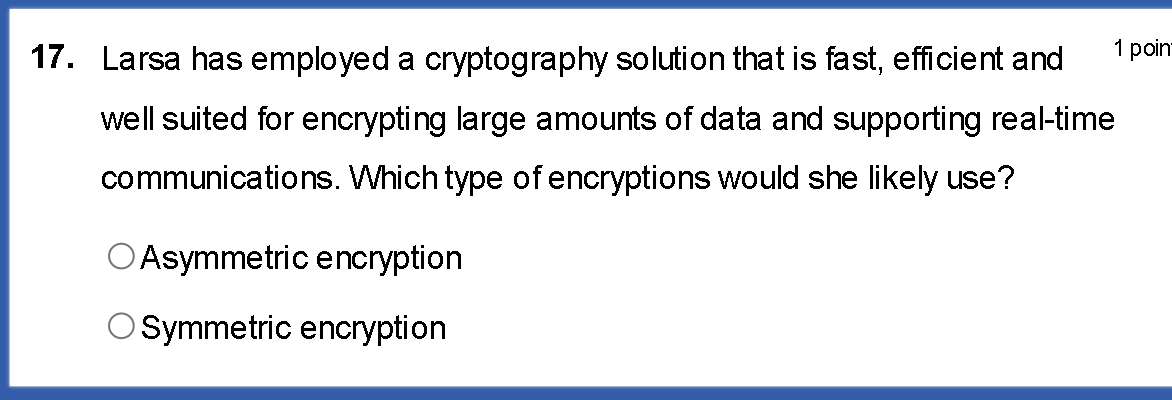
✅ Correct.
The answer is:
Symmetric encryption
Why?
The key phrases are:
"fast"
"efficient"
"large amounts of data"
"real-time communications"
Those are all clues for symmetric encryption.
D334 Cheat Code
Symmetric | Asymmetric |
|---|---|
Fast | Slow |
Efficient | Computationally expensive |
Large amounts of data | Key exchange & signatures |
One shared secret key | Public/private key pair |
Memory Hook
Think:
Symmetric = Speed
Asymmetric = Security Services
Real-World Example
When you visit a website:
Asymmetric encryption (RSA/ECC) is often used to exchange a session key.
Symmetric encryption (AES) is then used for the actual data transfer because it's much faster.
OA Pattern Recognition
If you see:
Fast
Efficient
Bulk data encryption
Real-time communications
Large files
Answer:
✅ Symmetric Encryption
If you see:
Digital signatures
Key exchange
Public/private keys
Nonrepudiation
Answer:
✅ Asymmetric Encryption
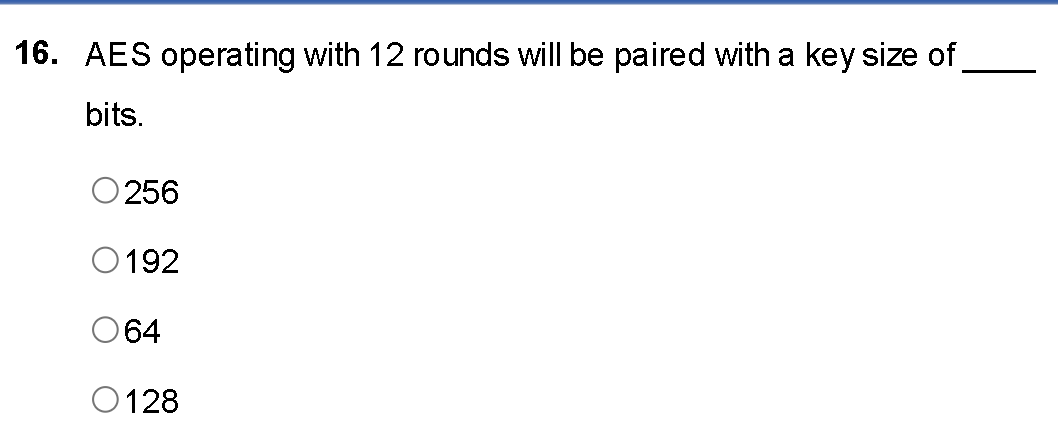
✅ Correct.
The answer is:
192 bits
AES Rounds Cheat Code (Memorize This)
AES Key Size | Rounds |
|---|---|
128-bit | 10 rounds |
192-bit | 12 rounds |
256-bit | 14 rounds |
Memory Trick
Think:
128 → 10
192 → 12
256 → 14
Notice the pattern:
10 → 12 → 14As the key size increases, the number of rounds increases.
OA Pattern Recognition
If you see:
12 rounds
Answer:
✅ 192-bit key
If you see:
14 rounds
Answer:
✅ 256-bit key
If you see:
10 rounds
Answer:
✅ 128-bit key
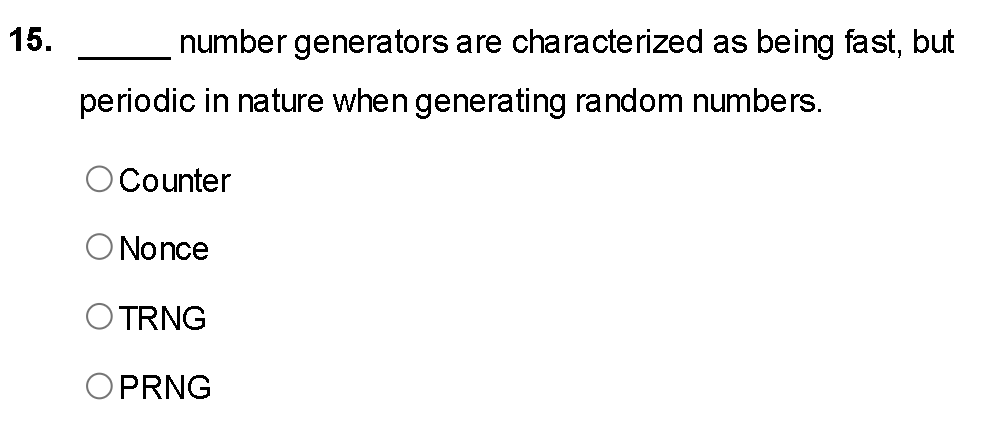
✅ Correct.
The answer is:
PRNG (Pseudo-Random Number Generator)
Why?
The key phrase is:
"fast, but periodic in nature"
That's exactly how a PRNG works.
A PRNG:
Starts with a seed value.
Generates numbers very quickly.
Eventually repeats its sequence (periodic).
Compare PRNG vs TRNG
Type | Characteristics |
|---|---|
PRNG | Fast, deterministic, periodic |
TRNG | Slower, truly random, based on physical phenomena |
D334 Memory Hook
PRNG
↓
Pseudo
↓
Predictable from a seed
↓
Fast
↓
Eventually repeats
TRNG
↓
True Random
↓
Physical source
↓
Slower
↓
Does not follow a predictable sequence
OA Cheat Code
If you see:
Fast
Seed
Periodic
Answer:
✅ PRNG
If you see:
Physical noise
Radioactive decay
Atmospheric noise
Truly random
Answer:
✅ TRNG
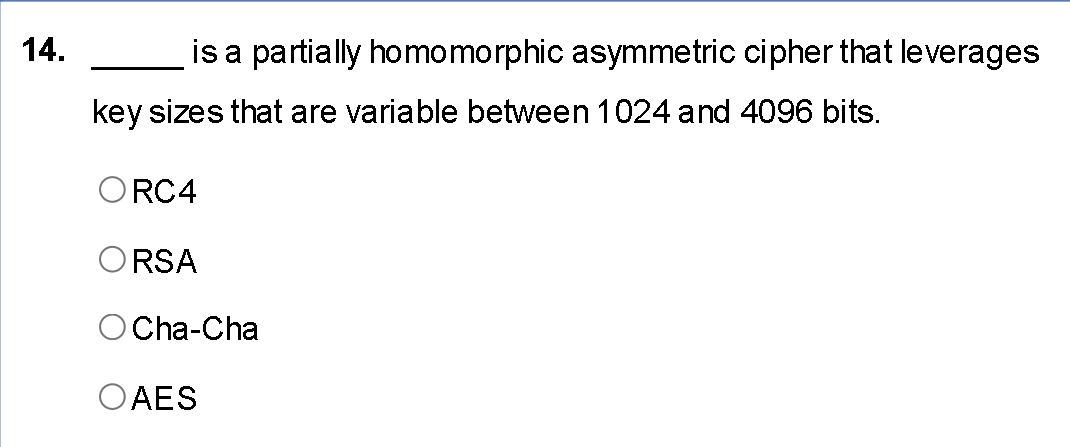
✅ Correct.
The answer is:
RSA
Why?
The key phrases are:
"asymmetric cipher"
"1024 to 4096-bit keys"
"partially homomorphic"
Those are all clues for RSA.
Why the others are wrong
Algorithm | Type |
|---|---|
RC4 | Symmetric Stream Cipher |
AES | Symmetric Block Cipher |
ChaCha | Symmetric Stream Cipher |
RSA | Asymmetric Cipher |
D334 Memory Hook
Think:
RSA
↓
Large Keys
1024
2048
3072
4096
OA Cheat Code
If you see:
1024–4096 bit keys
Answer:
✅ RSA
If you see:
Public key / Private key
Answer:
✅ RSA (or another asymmetric algorithm)
Extra Fact (for recognition)
RSA is often described as partially homomorphic because certain mathematical operations can be performed on ciphertexts and still produce meaningful results after decryption.
For the OA, though, I'd focus on:
RSA
=
Asymmetric
=
1024–4096-bit keys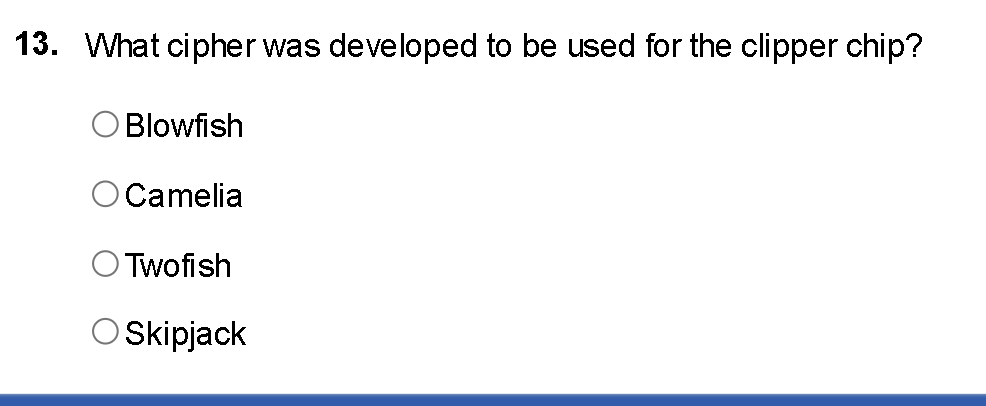
✅ Correct answer: Skipjack
Why?
The key phrase is:
"Clipper Chip"
The Clipper Chip used the:
Skipjack cipher
This was a U.S. government initiative in the 1990s that included key escrow, meaning the government could potentially access encrypted communications.
D334 Memory Hook
Clipper Chip
     ↓
  Skipjack
That's really all you need to memorize.
Why the others are wrong
Cipher | Remember |
|---|---|
Blowfish | Bruce Schneier block cipher |
Twofish | AES finalist |
Camellia | Modern block cipher similar to AES |
Skipjack | Clipper Chip cipher |
OA Cheat Code
If you see:
Clipper Chip
Answer:
✅ Skipjack
If you see:
Key Escrow + 1990s government encryption project
Answer:
✅ Skipjack
✅ Correct.
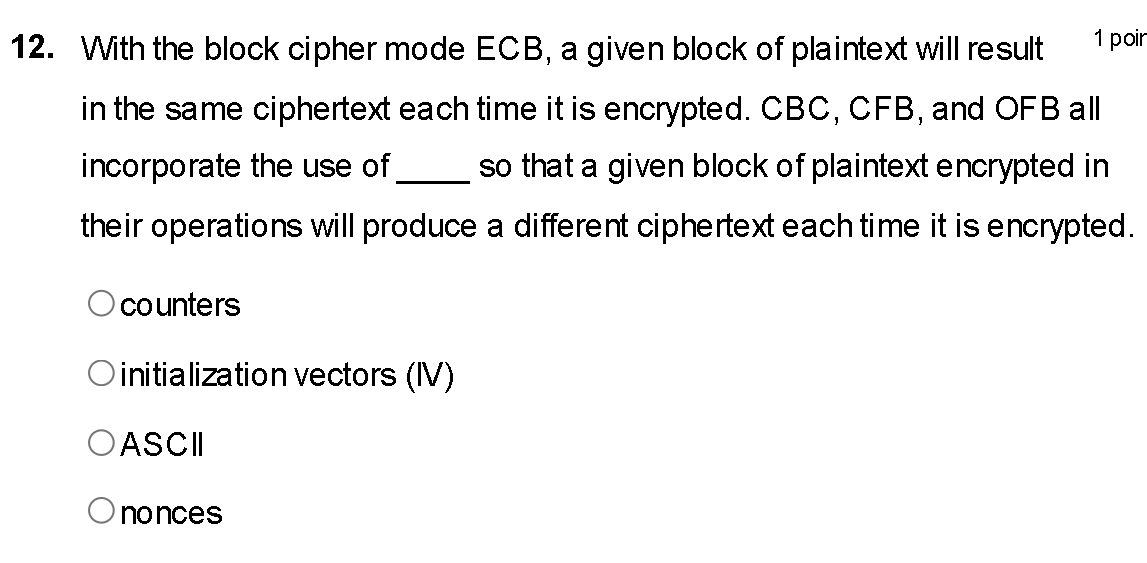
The answer is:
Initialization Vectors (IVs)
Why?
The key phrase is:
"same plaintext will produce a different ciphertext each time"
That's exactly what an IV is designed to accomplish.
ECB vs CBC/CFB/OFB
ECB
HELLO
↓
Encrypt
↓
ABC123

HELLO
↓
Encrypt
↓
ABC123
Same plaintext → Same ciphertext ❌
CBC, CFB, OFB
HELLO + IV1
↓
Encrypt
↓
XYZ789

HELLO + IV2
↓
Encrypt
↓
LMN456
Same plaintext → Different ciphertext ✅
D334 Memory Hook
When you see:
Same plaintext, different ciphertext
Think:
✅ IV
When you see:
CBC, CFB, OFB
Think:
✅ Uses an IV
One Important Distinction
For the OA:
CBC, CFB, OFB → Think IV
CTR → Think Nonce + Counter
That's why the answer is IV, not nonce.
✅ Correct.
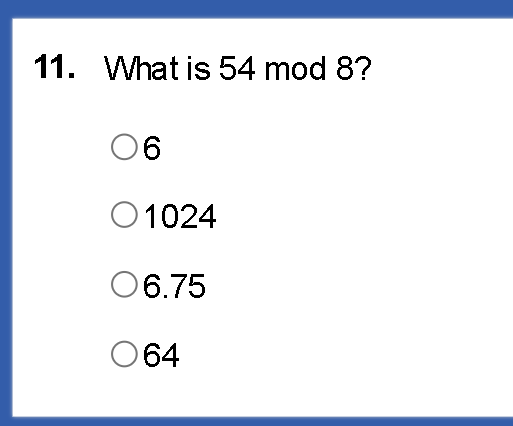
The answer is:
6
Why?
Modulus (mod) means:
What's the remainder after division?
So:
54 ÷ 8 = 6 remainder 6Because:
8 × 6 = 48
54 - 48 = 6
Therefore:
54 mod 8 = 6
D334 Memory Trick
For any mod question:
Divide.
Ignore the quotient.
Keep the remainder.
Example:
17 mod 517 ÷ 5 = 3 remainder 2Answer:
17 mod 5 = 2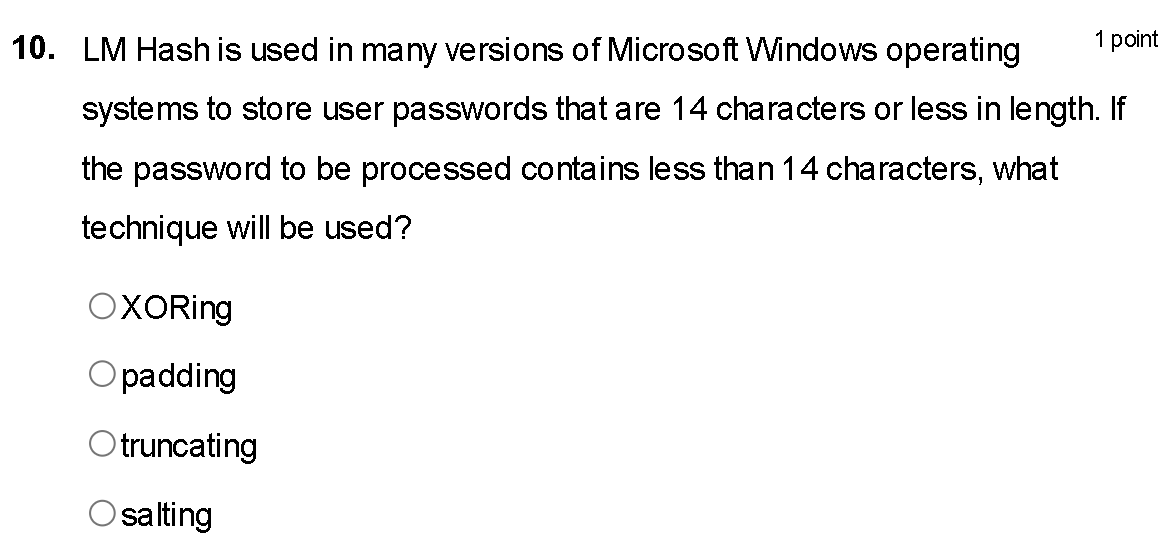
✅ Correct answer: Padding
Why?
The question says:
"If the password contains less than 14 characters"
LM Hash expects a 14-character password.
If the password is shorter than 14 characters, Windows:
Pads it with null characters (NULL bytes)
to make it exactly 14 characters long before processing.
D334 Memory Hook
Think:
Too short?
↓
Pad it

Too long?
↓
Truncate it
Example
Password:
DOGLM Hash internally does something like:
DOG___________(adding padding until it reaches 14 characters)
OA Cheat Code
Situation | Technique |
|---|---|
Password shorter than required length | Padding |
Password longer than allowed length | Truncation |
✅ Correct.
The answer is:
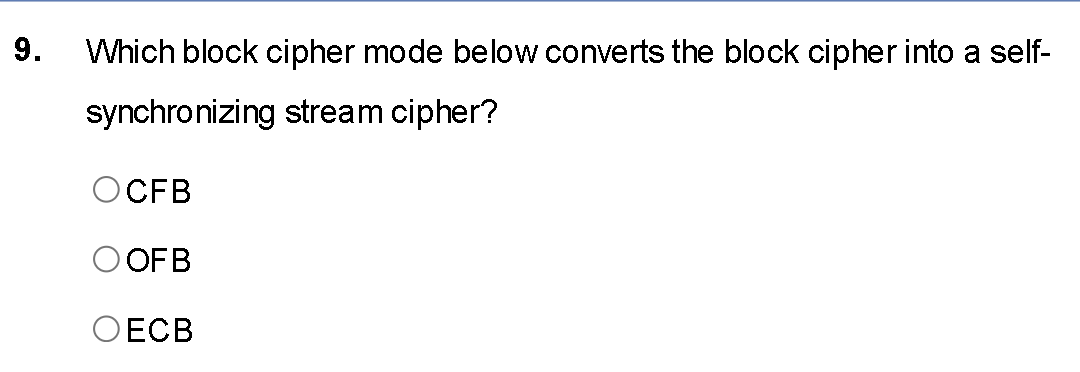
CFB (Cipher Feedback)
Why?
The key phrase is:
"self-synchronizing stream cipher"
That's the textbook description of CFB.
D334 Memory Hooks
Mode | Remember |
|---|---|
CFB | Self-synchronizing stream cipher |
OFB | Synchronous stream cipher |
ECB | Independent blocks |
The Easy Way to Remember
CFB
Cipher Feedback
↓
Ciphertext feeds back
↓
Self-synchronizing
OFB
Output Feedback
↓
Encryption output feeds back
↓
Synchronous stream cipher
OA Cheat Code
If you see:
Self-synchronizing stream cipher
Answer:
✅ CFB
If you see:
Converts a block cipher into a stream cipher
Encrypted IV becomes the next IV
Answer:
✅ OFB
✅ Correct.
The answer is:
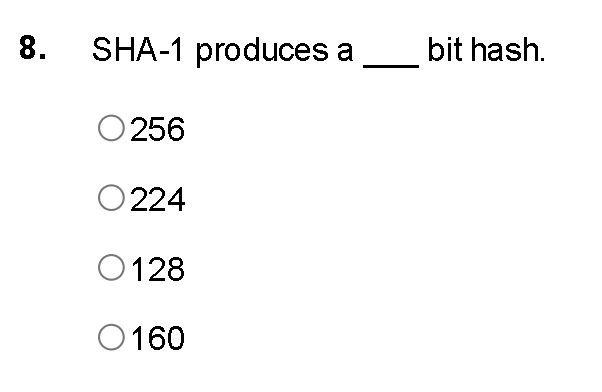
160 bits
D334 Hash Size Cheat Sheet
Hash Algorithm | Output Size |
|---|---|
MD5 | 128-bit |
SHA-1 | 160-bit |
SHA-224 | 224-bit |
SHA-256 | 256-bit |
SHA-384 | 384-bit |
SHA-512 | 512-bit |
Memory Hook
MD5    = 128
SHA-1  = 160
SHA-256 = 256
SHA-512 = 512
OA Cheat Code
If you see:
160-bit hash
Answer:
✅ SHA-1
If you see:
Broken due to collision attacks
Answer:
✅ SHA-1 (or MD5 depending on choices)
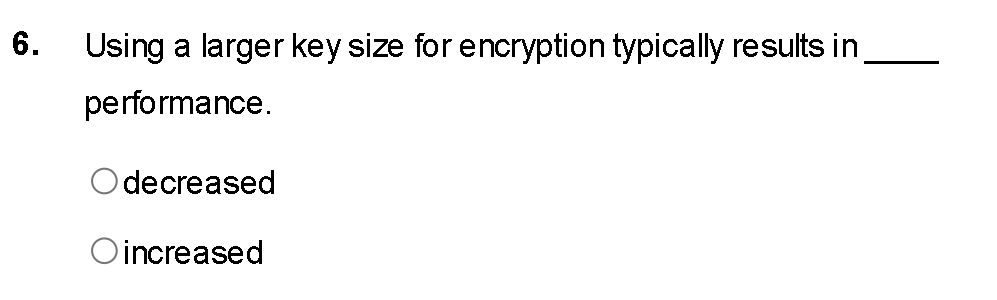
✅ Correct answer: Decreased
Why?
Larger keys provide:
✅ More security
But they also require:
❌ More processing power
❌ More computation time
Therefore:
Performance decreases as key size increases.
Easy Example
AES-128 → Faster
AES-192 → Slower
AES-256 → Slowest
More security, but more work for the computer.
D334 Memory Hook
Bigger Key
↓
More Security
↓
More Processing
↓
Lower Performance
OA Cheat Code
If you see:
Larger key size
and the question asks about:
Performance
Answer:
✅ Decreased
If the question asks about:
Security
Answer:
✅ Increased
Quick Contrast
Larger Key Size | Effect |
|---|---|
Security | ⬆ Increased |
Performance | ⬇ Decreased |
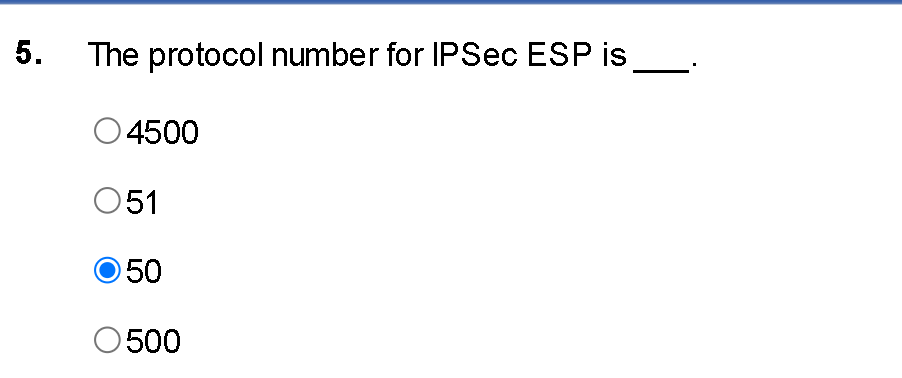
✅ Correct answer: 50
This is one of those annoying IPSec memorization questions.
IPSec Cheat Sheet
Item | Number |
|---|---|
ESP | 50 |
AH | 51 |
IKE | UDP 500 |
NAT-T | UDP 4500 |
Memory Trick
ESP = 50
AH  = 51
Think:
ESP goes first = 50
AH comes after = 51
Why 500 looked tempting
Because:
UDP 500 = IKEIKE is used to negotiate IPSec tunnels.
But the question asks:
Protocol number for IPSec ESP
Not the port number for IKE.
OA Cheat Code
If you see:
ESP
Answer:
✅ 50
If you see:
AH
Answer:
✅ 51
If you see:
IKE
Answer:
✅ UDP 500
If you see:
NAT Traversal (NAT-T)
Answer:
✅ UDP 4500
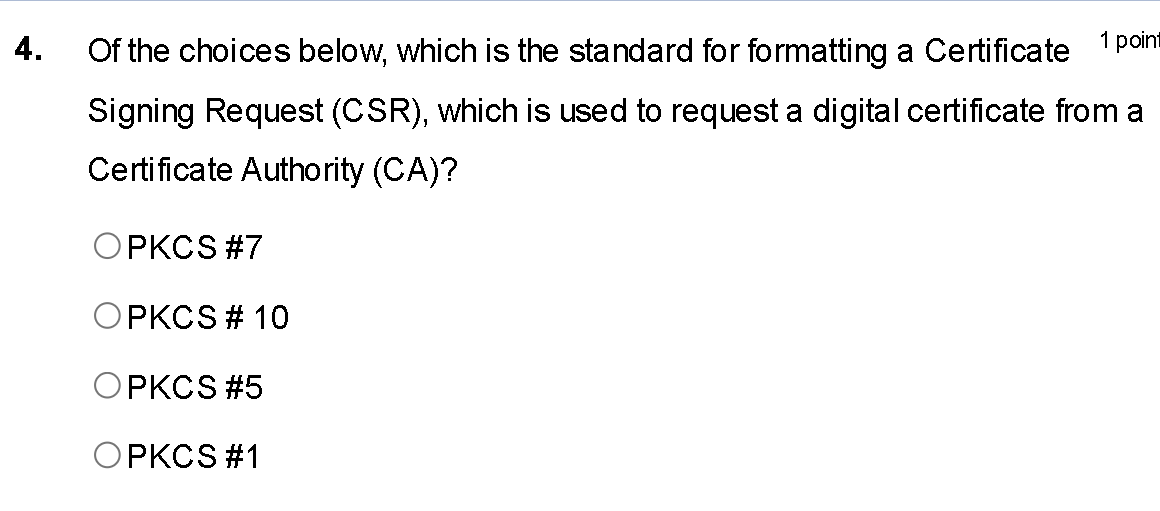
✅ Correct.
You answered:
B = PKCS #10
And that is the correct answer.
Why?
The key phrase is:
Certificate Signing Request (CSR)
A CSR uses the standard:
✅ PKCS #10
D334 PKCS Cheat Sheet
PKCS | Remember |
|---|---|
PKCS #1 | RSA |
PKCS #5 | Passwords / PBKDF2 |
PKCS #10 | CSR (Certificate Signing Request) |
PKCS #12 | Certificate + Private Key Container (.p12/.pfx) |
Memory Trick
PKCS #10
     ↓
Certificate
Signing
Request
Or:
Need a certificate?
↓
Submit a CSR
↓
PKCS #10
OA Cheat Code
If you see:
CSR
Answer:
✅ PKCS #10
If you see:
Certificate + Private Key + Chain of Trust
Answer:
✅ PKCS #12
If you see:
Password-derived keys / PBKDF2
Answer:
✅ PKCS #5
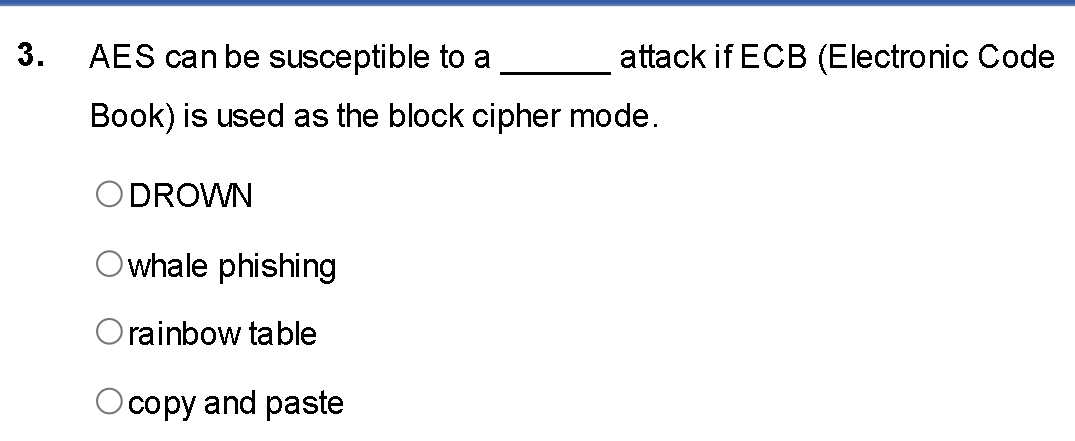
✅ Correct.
The answer is:
Copy and Paste Attack
Why?
The key phrase is:
ECB (Electronic Codebook)
ECB encrypts identical plaintext blocks into identical ciphertext blocks.
That allows an attacker to:
Copy ciphertext blocks
Move them around
Paste them elsewhere
without needing to decrypt them.
D334 Memory Hook
ECB
↓
Same plaintext
↓
Same ciphertext
↓
Copy & Paste Attack
OA Cheat Code
If you see:
ECB
Think:
✅ Pattern leakage
✅ Identical plaintext = identical ciphertext
✅ Copy-and-paste attacks
Why the others are wrong
❌ DROWN
SSL/TLS attack.
❌ Whale phishing
Social engineering attack.
❌ Rainbow table
Password hash attack.
❌ Copy and paste
ECB weakness. ✅
Super Important OA Association
ECB ↔ Copy-and-Paste Attack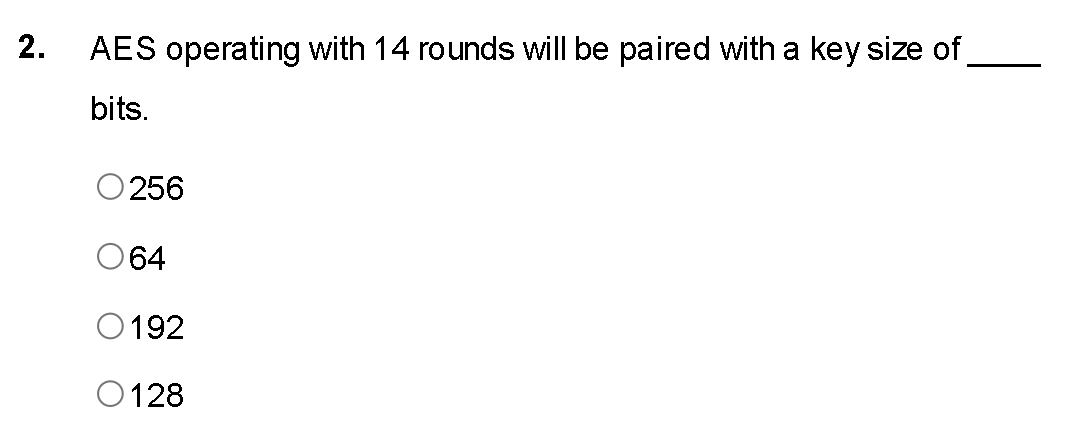
✅ Correct.
The answer is:
256 bits
AES Rounds Cheat Sheet (Must Memorize)
Key Size | Rounds |
|---|---|
128-bit | 10 |
192-bit | 12 |
256-bit | 14 |
Memory Trick
128 → 10
192 → 12
256 → 14
Just remember:
10 → 12 → 14As the key size increases, the rounds increase.
OA Cheat Code
If you see:
10 rounds
Answer:
✅ AES-128
If you see:
12 rounds
Answer:
✅ AES-192
If you see:
14 rounds
Answer:
✅ AES-256
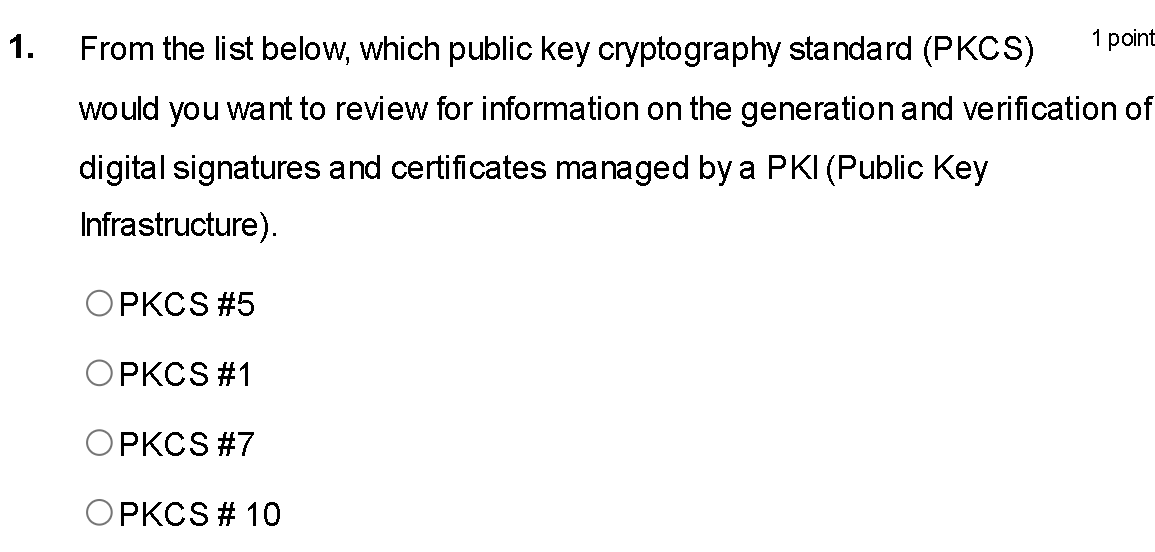
✅ Correct.
The answer is:
PKCS #1
Why?
The key phrases are:
digital signatures
generation and verification
PKI
PKCS #1 defines the RSA Cryptography Standard, including:
RSA encryption
RSA digital signatures
Signature generation
Signature verification
D334 PKCS Cheat Sheet
PKCS | Remember |
|---|---|
PKCS #1 | RSA, digital signatures |
PKCS #5 | Passwords, PBKDF2 |
PKCS #7 | Cryptographic message syntax (CMS) |
PKCS #10 | CSR (Certificate Signing Request) |
PKCS #12 | Certificates + Private Keys (.p12/.pfx) |
Memory Trick
PKCS #1
↓
RSA
↓
Digital Signatures
OA Cheat Code
If you see:
RSA
Digital signatures
Signature verification
Answer:
✅ PKCS #1
If you see:
CSR
Answer:
✅ PKCS #10
If you see:
Password-derived keys / PBKDF2
Answer:
✅ PKCS #5
If you see:
Certificate + Private Key Container
Answer:
✅ PKCS #12
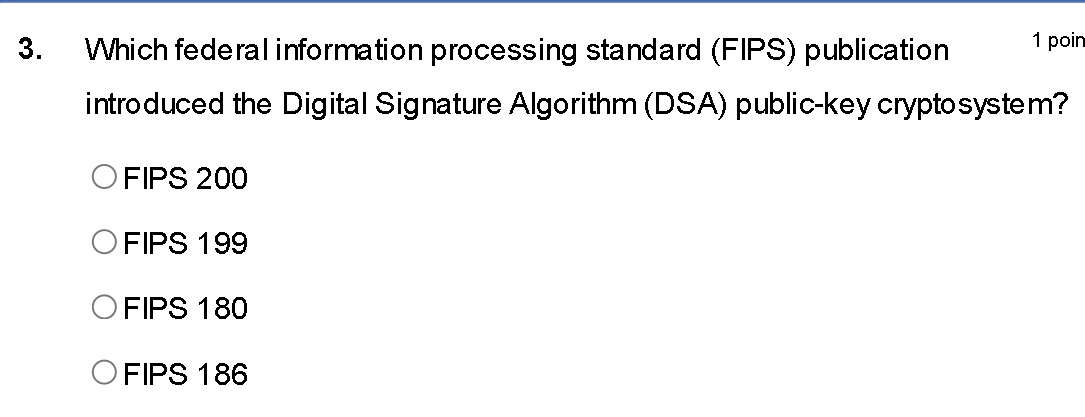
✅ Correct answer: FIPS 186
This is one of the annoying memorization questions.
D334 Memory Hook
DSA
↓
Digital Signature Algorithm
↓
FIPS 186
Why the confusion?
FIPS 186 = Digital Signature Standard (DSS) → Introduced DSA
FIPS 199 = Standards for Security Categorization of Federal Information and Information Systems
OA Cheat Code
If you see:
DSA
or
Digital Signature Standard (DSS)
Answer:
✅ FIPS 186
Quick Memory Table
FIPS | Remember |
|---|---|
FIPS 186 | DSA / DSS |
FIPS 197 | AES |
FIPS 180 | Secure Hash Standard (SHA family) |
FIPS 199 | Security Categorization |
🎯 Question #3: Correct answer = FIPS 186
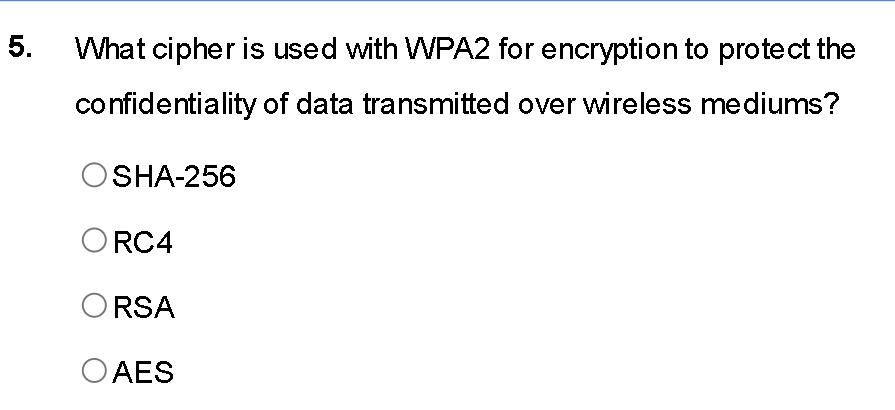
✅ Correct.
The answer is:
AES
Wireless Security Cheat Sheet
Standard | Encryption |
|---|---|
WEP | RC4 |
WPA | RC4 + TKIP |
WPA2 | AES + CCMP |
WPA3 | AES + SAE |
Memory Trick
WEP  → RC4
WPA  → RC4
WPA2 → AES
WPA3 → AES
Why the others are wrong
❌ SHA-256
Hashing algorithm, not wireless encryption.
❌ RC4
Used by WEP and WPA, not WPA2.
❌ RSA
Asymmetric algorithm for key exchange/signatures.
✅ AES
Encryption algorithm used by WPA2.
OA Cheat Code
If you see:
WPA2
Answer:
✅ AES
If you see:
WEP
Answer:
✅ RC4
If you see:
WPA
Answer:
✅ RC4/TKIP
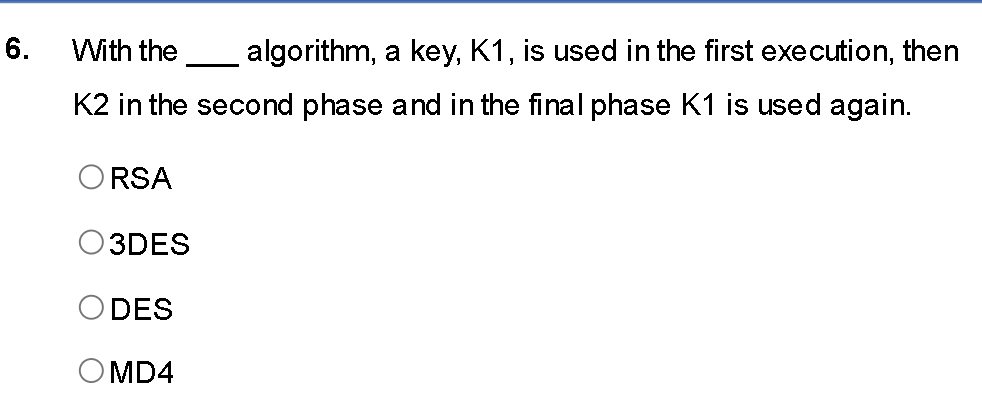
✅ Correct answer: 3DES
The clue is:
K1 → K2 → K1
That is the classic 2-key 3DES pattern.
Memory Trick
3DES
↓
DES three times

Encrypt with K1
Decrypt with K2
Encrypt with K1
Often written as:
E(K1) → D(K2) → E(K1)
D334 Cheat Sheet
Algorithm | Remember |
|---|---|
DES | One 56-bit key |
3DES | K1 → K2 → K1 |
AES | Modern replacement for DES/3DES |
RSA | Asymmetric |
MD4 | Hashing algorithm |
OA Pattern Recognition
If you see:
K1, K2, K1
Answer:
✅ 3DES
If you see:
Triple encryption of DES
Answer:
✅ 3DES
Bonus Fact
There are two common versions:
2-Key 3DES
K1 → K2 → K13-Key 3DES
K1 → K2 → K3For the OA, when they mention:
K1, K2, then K1 again
They're specifically describing:
✅ 3DES