Microbiology Flashcards for Chapter 15
 Call Kai
 Learn
Learn Practice Test
 Spaced Repetition
 Match
Match Flashcards
 Knowt Play
1/60

There's no tags or description
Looks like no tags are added yet.
Name | Mastery | Learn | Test | Matching | Spaced | Call with Kai |
|---|
No analytics yet
Send a link to your students to track their progress
61 Terms
cyto-
cell Example: cytopenia: reduction in the number of blood cells
hepat-
of the liver Example: hepatitis: inflammation of the liver
-pathy
disease Example: neuropathy: a disease affecting nerves
-emia
of the blood Example: bactermia: presence of bacteria in blood
-itis
inflammation Example: colitis: inflammation of the colon
-lysis
destruction Example: hemolysis: destruction of red blood cells
-oma
tumor Example: lymphoma: cancer of the lymphatic system
-osis
diseased or abnormal condition Example: leukocytosis: abnormally high number of white blood cells
-derma
of the skin Example: keratoderma: a thickening of the skin
infectious disease
any disease caused by the direct effect of a pathogen
communicable
capable of being spread from person to person through direct or indirect mechanisms
noncommunicable
not spread from one person to another
contagious
•easily spread from one person to another •The degree of contagious depends on how the pathogen is transmitted
iatrogenic disease
disease contracted as a result of a medical procedure
nosocomial disease
•diseases acquired in a hospital setting
zoonotic disease
disease transmitted from an animal to a human
noninfectious disease
disease not caused by a pathogen
pathogenicity
The ability of a microbial agent to cause disease is called pathogenicity
virulence
the degree to which an organism is pathogenic is called virulence.
primary pathogen
A primary pathogen can cause disease in a host regardless of the host’s resident microbiota or immune system
opportunisitic pathogen
An opportunistic pathogen, by contrast, can only cause disease in situations that compromise the host’s defenses, such as the body’s protective barriers, immune system, or normal microbiota.
mycotoxins
Many fungi produce exotoxins and are called mycotoxins
protozoan pathogens
Protozoan pathogens are unicellular eukaryotic parasites that have virulence factors and pathogenic mechanisms analogous to prokaryotic and viral pathogens, including adhesins, toxins, antigenic variation, and the ability to survive inside phagocytic vesicles.
helminths
Helminths, or parasitic worms, are multicellular eukaryotic parasites that depend heavily on virulence factors that allow them to gain entry to host tissues.
disease
A disease is any condition in which the normal structure or functions of the body are damaged or impaired
infection
An infection is the successful colonization of a host by a microorganism
signs (of disease)
The signs of disease are objective and measurable, and can be directly observed by a clinician.
symptoms (of disease)
Unlike signs, symptoms of disease are subjective. Symptoms are felt or experienced by the patient, but they cannot be clinically confirmed or objectively measured.
asymptomatic/subclinical
some diseases may be asymptomatic or subclinical, meaning they do not present any noticeable signs or symptoms.
incubation period
The incubation period occurs in an acute disease after the initial entry of the pathogen into the host (patient). It is during this time the pathogen begins multiplying in the host.
prodromal period
The prodromal period occurs after the incubation period. During this phase, the pathogen continues to multiply and the host begins to experience general signs and symptoms of illness, which typically result from activation of the immune system, such as fever, pain, soreness, swelling, or inflammation. Usually, such signs and symptoms are too general to indicate a particular disease.
period of illness
Following the prodromal period is the period of illness, during which the signs and symptoms of disease are most obvious and severe.
period of decline
The period of illness is followed by the period of decline, during which the number of pathogen particles begins to decrease, and the signs and symptoms of illness begin to decline.
secondary infections
during the decline period, patients may become susceptible to developing secondary infections because their immune systems have been weakened by the primary infection.
period of convalescence
The final period is known as the period of convalescence.
During this stage, the patient generally returns to normal functions, although some diseases may inflict permanent damage that the body cannot fully repair.
acute disease
For an acute disease, pathologic changes occur over a relatively short time (e.g., hours, days, or a few weeks) and involve a rapid onset of disease conditions
chronic disease
For a chronic disease, pathologic changes can occur over longer time spans (e.g., months, years, or a lifetime).
latent disease
In latent diseases, as opposed to chronic infections, the causal pathogen goes dormant for extended periods of time with no active replication.
exposure/contact
An encounter with a potential pathogen is known as exposure or contact.
portal of entry
An
anatomic site through which pathogens can pass into host tissue is called a portal of entry. These are locations where the host cells are in direct contact with the external environment.
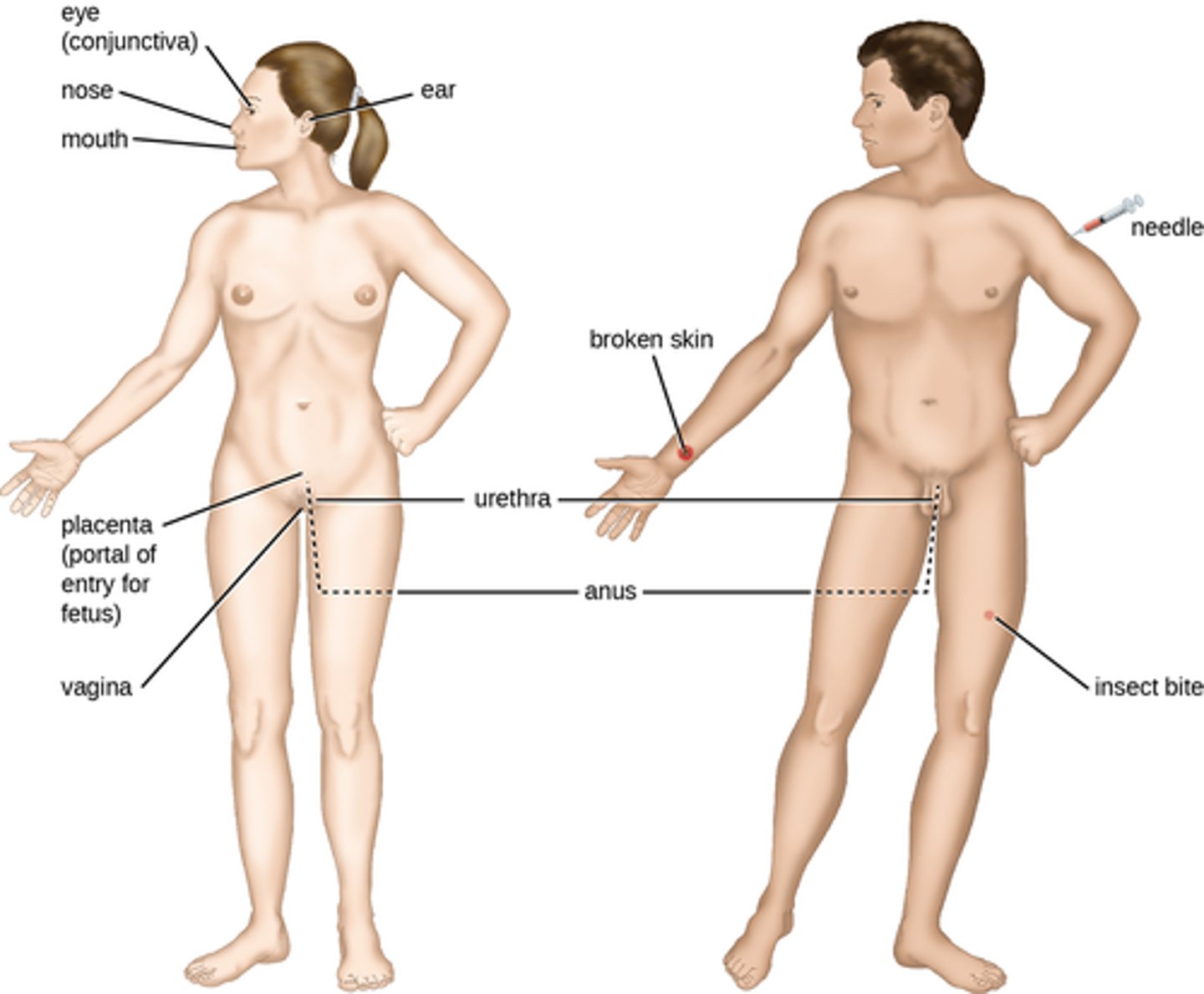
parenteral route
Pathogens can also enter through a breach in the protective barriers of the skin and mucous membranes. Pathogens that enter the body in this way are said to enter by the parenteral route
adhesion
Following the initial exposure, the pathogen adheres at the portal of entry. The term adhesion refers to the capability of pathogenic microbes to attach to the cells of the body using adhesion factors, and different pathogens use various mechanisms to adhere to the cells of host tissues.
adhesins
Molecules (either proteins or carbohydrates) called adhesins are found on the surface of certain pathogens and bind to specific receptors (glycoproteins) on host cells.
biofilm
A biofilm is a community of bacteria that produce a
glycocalyx, known as extrapolymeric substance (EPS), that allows the biofilm to attach to a surface.
invasion
Once adhesion is successful, invasion can proceed. Invasion involves the dissemination of a pathogen throughout local tissues or the body.
local infection
local infection is confined to a small area of the body, typically near the portal of entry.
focal infection
In a focal infection, a localized pathogen, or the toxins it produces, can spread to a secondary location.
systemic infection
When an infection becomes disseminated throughout the body, we call it a systemic infection.
primary infection
a primary infection, the initial infection caused by one pathogen
secondary infection
Sometimes a primary infection, the initial infection caused by one pathogen, can lead to a secondary infection by another pathogen.
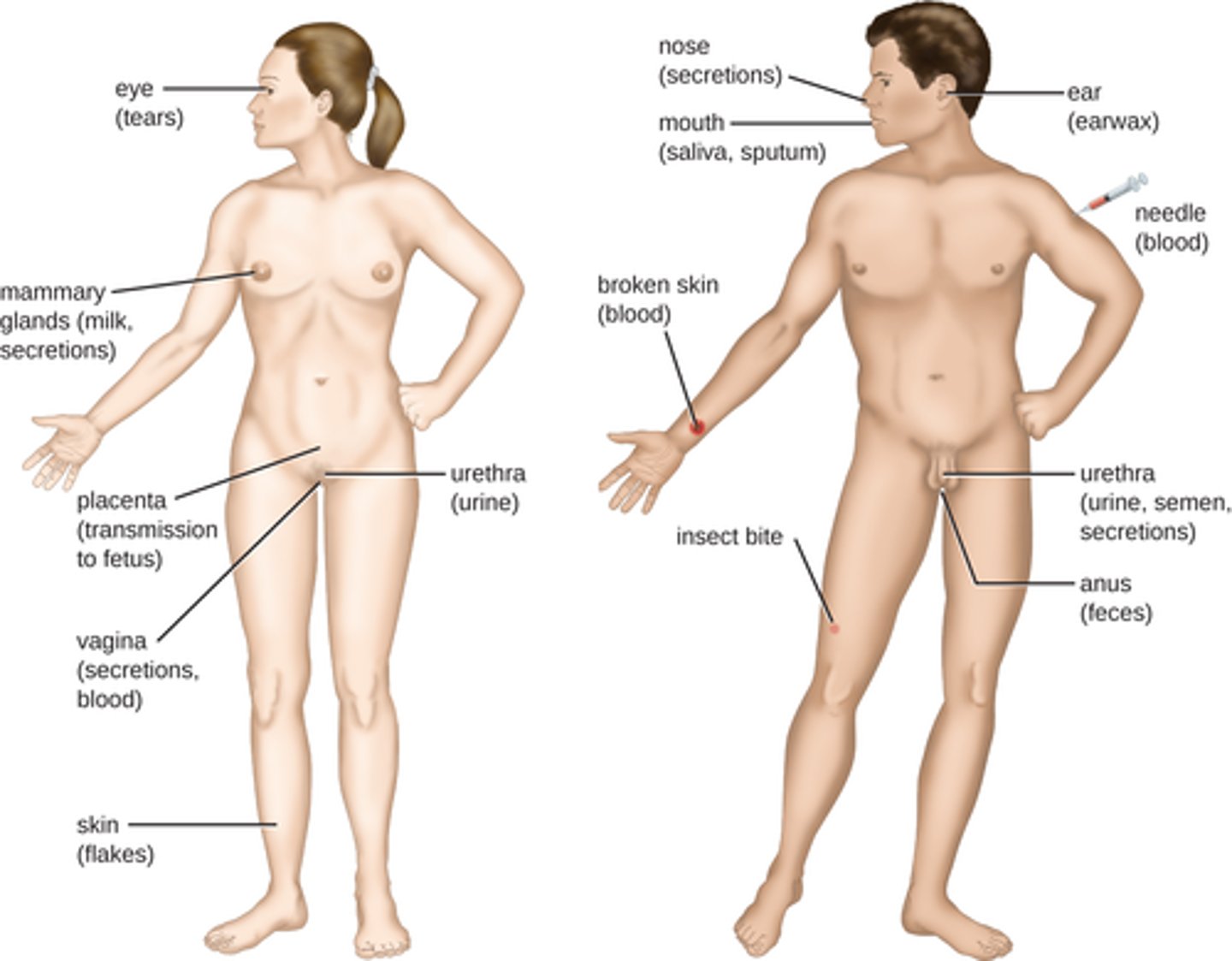
portal of exit
For a pathogen to persist, it must put itself in a position to be transmitted to a new host, leaving the infected host through a portal of exit (Figure 15.9). As with portals of entry, many pathogens are adapted to use a particular portal of exit. Similar to portals of entry, the most common portals of exit include the skin and the respiratory, urogenital, and gastrointestinal tracts.
virulence factors
virulence factors are produced by individual pathogens, which determine the extent and severity of disease they may cause. A pathogen's virulence factors are encoded by genes
viremia
When viruses are found in the blood, it is called viremia.
toxemia
The term toxemia describes the condition when toxins are found in the blood
septicemia
If bacteria are both present and multiplying in the blood, this condition is called septicemia.Patients with septicemia are described as septic.
shock
shock is a life-threatening decrease in blood pressure (systolic pressure <90 mm Hg) that prevents cells and organs from receiving enough oxygen and nutrients
exoenzymes
Some pathogens produce extracellular enzymes, or exoenzymes, that enable them to invade host cells and deeper tissues
toxins
certain pathogens are able to produce toxins, biological poisons that assist in their ability to invade and cause damage to tissues
toxigenicity
The ability of a pathogen to produce toxins to cause damage to host cells is called toxigenicity.
endotoxin
The lipopolysaccharide (LPS) found on the outer membrane of gram-negative bacteria is called endotoxin. During infection and disease, gramnegative bacterial pathogens release endotoxin either when the cell dies, resulting in the disintegration of the membrane, or when the bacterium undergoes binary fission. Exotoxins stimulate a general systemic inflammatory response when released.
exotoxin
Exotoxins are protein molecules that are produced by a wide variety of living pathogenic bacteria. exotoxins are much more specific in their action and the cells they interact with. Each exotoxin targets specific receptors on specific cells and damages those cells through unique molecular mechanisms.