Herpetology Lecture (Exam 1)
 Call Kai
 Learn
Learn Practice Test
 Spaced Repetition
 Match
Match Flashcards
 Knowt Play
1/350

There's no tags or description
Looks like no tags are added yet.
Name | Mastery | Learn | Test | Matching | Spaced | Call with Kai |
|---|
No analytics yet
Send a link to your students to track their progress
351 Terms
What does the term 'herpien' mean?
To creep, from which the term 'herptiles' is derived.
What is the significance of the term 'polyphyletic group' in Herpetology?
It refers to a group that does not include all descendants from a common ancestor, as is the case with amphibians and reptiles.
What is taxonomy?
The naming of organisms or groups of similar organisms.
Who organized all life into a hierarchical classification?
Linnaeus, in his catalog Systema Naturae.
What does the Linnaean system imply about taxonomic categories?
They provide information about similarity among organisms.
What is a key limitation of taxonomy in reflecting evolutionary history?
It does not accurately reflect the sequence of divergence events.
What is a superclass in Linnaean classification?
A taxonomic rank above class and below phylum, such as Tetrapods.
Name three classes of extant tetrapods.
Amphibia, Reptilia, Mammalia.
What are the orders of extant amphibians?
Anura, Caudata, Gymnophiona.
What are the orders of extant reptiles?
Testudines, Crocodylia, Rhynchocephalia, Squamata.
How many species of amphibians are there?
9,010 species.
How many species of reptiles are there?
12,586 species.
What is the estimated divergence time between amphibians and amniotes?
Approximately 350 million years ago.
What significant evolutionary change occurred in tetrapods around 360 million years ago?
The first tetrapods appeared.
What adaptations allowed early tetrapods to move onto land?
Evolved limb-like fins and more robust limbs for support.
What did the air bladder evolve into in tetrapods?
Lungs.
What are the fishy traits of Tiktaalik?
Scales, fins, and gills.
What are the salamandery traits of Tiktaalik?
Neck separating shoulder bones from skull, flat head, robust fin skeleton, and lungs.
What group of tetrapods are amphibians derived from?
Temnospondyls.
What evolutionary change occurred in Lissamphibians?
The evolution of metamorphosis.
What is a key feature of amphibian eggs compared to fish eggs?
Amphibian eggs have an extra jelly layer for protection against desiccation and pathogens.
What is the oldest known salamander fossil?
Triassurus sixtelae, found in Kyrgyzstan, dating back 230 million years.
What drove the evolution of frog morphology?
Adaptations to jumping.
What is the significance of the Chinle Frog?
It is an early frog dating back to approximately 216 million years ago.
What does the term 'tetrapody' refer to?
The condition of having four limbs.
What is the evolutionary significance of the vertebral column in tetrapods?
It became sturdier to support movement onto land.
What adaptations occurred in the skin of early tetrapods?
Increased keratinization for desiccation resistance.
What are Amniotes?
Amniotes are a clade that includes mammals and reptiles.
What two major groups are classified under Amniotes?
Sauropsida and Synapsida.
What is the significance of the term Sauropsida?
It refers to a group that includes all reptiles and birds, but some extinct Sauropsids are not considered reptiles.
Give an example of an extinct Sauropsid that is not classified as a reptile.
Petrolacosaurus, an extinct Sauropsid from ~310 MYA.
What are the two extra layers found in an Amniotic egg?
The Chorion and the Amnion.
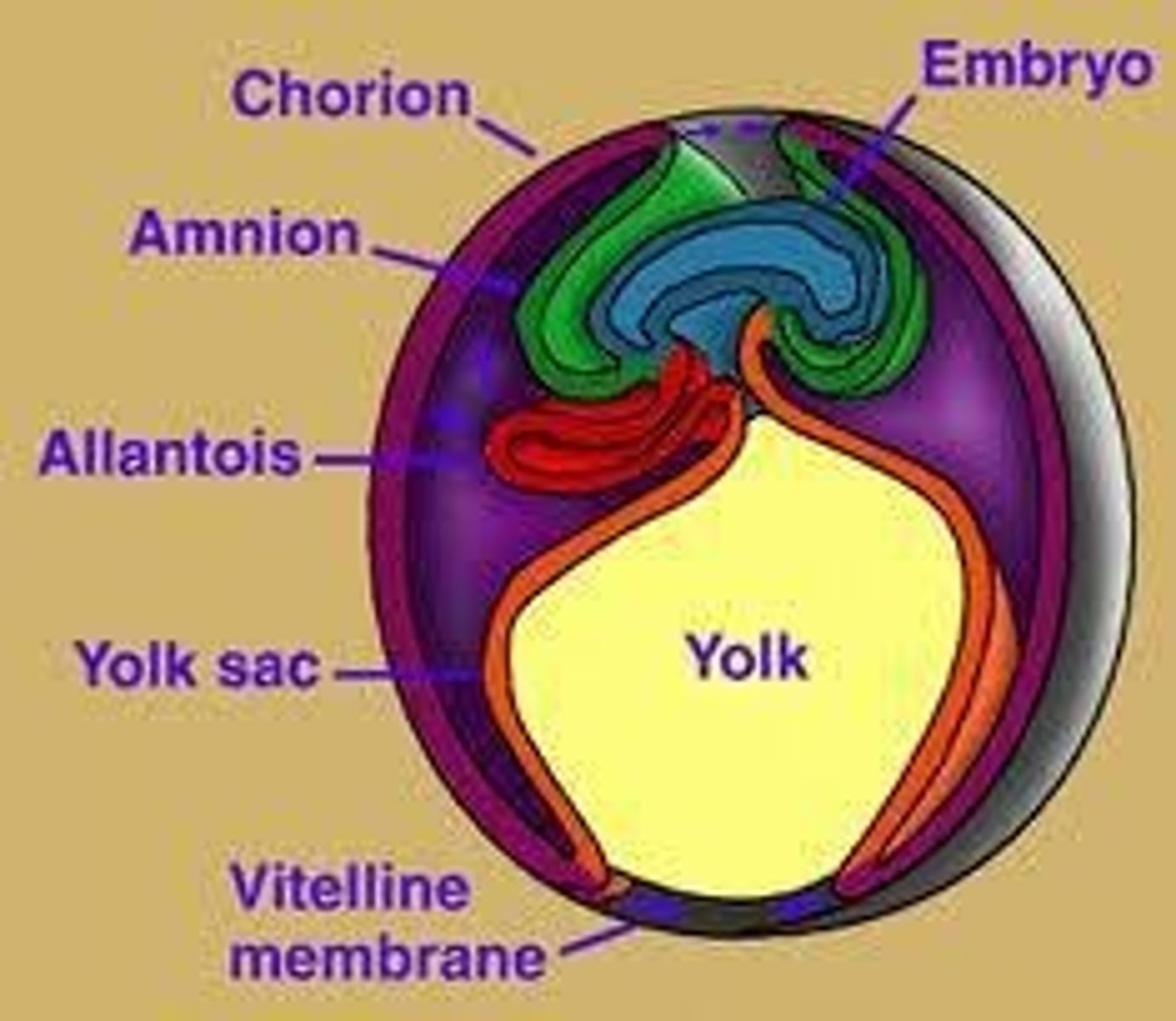
What is the function of the Amniotic egg's layers?
They are essentially water impermeable but gas permeable, reducing dependence on water.
What major evolutionary advantage did Amniotic eggs provide?
They allowed the common ancestor of mammals and reptiles to colonize land.
What are the two types of skull openings found in Synapsids and Sauropsids?
Synapsids have one opening (fenestra) behind the eye, while Sauropsids can have anapsid or diapsid skulls.
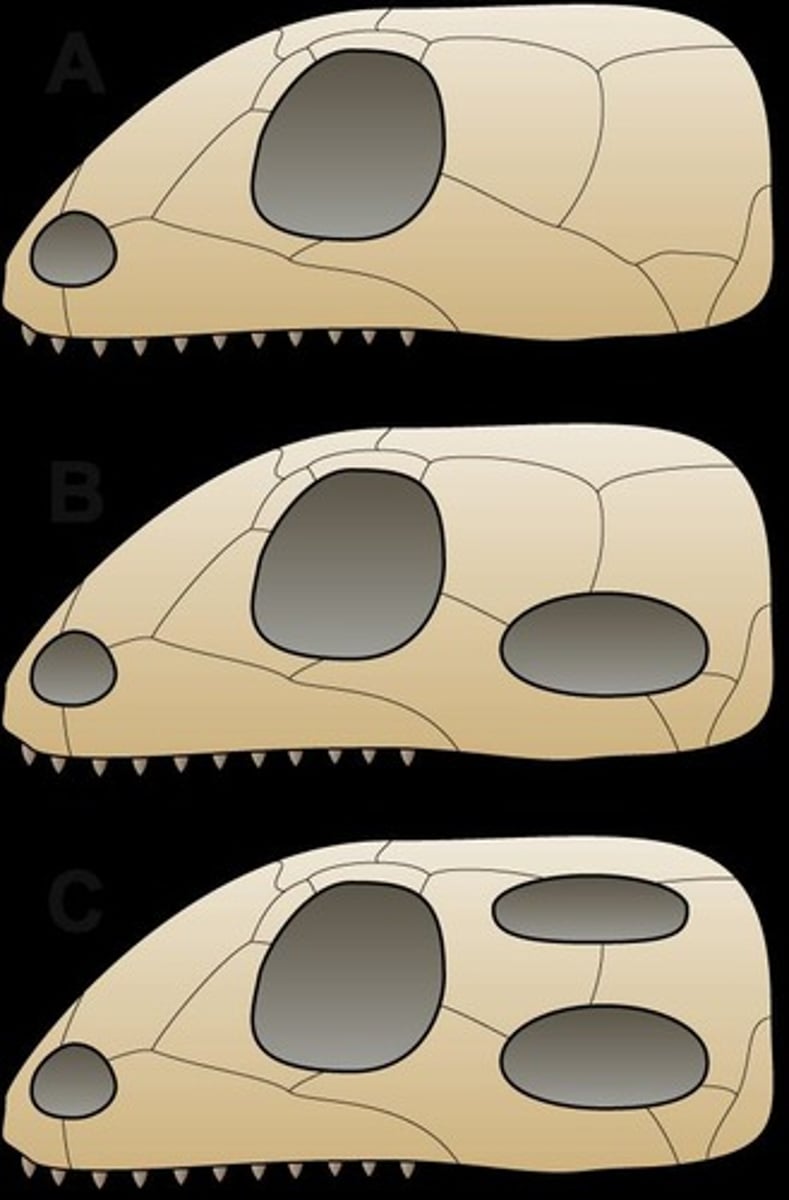
What distinguishes diapsid skulls from anapsid skulls?
Diapsid skulls provide more room for muscle expansion and attachment.
What are the two main lineages of reptiles that emerged after the Permian/Triassic extinction?
Sauropsida and Synapsida.
What is the oldest true reptile according to some paleontologists?
Hylonomus lyelli, which lived ~330 MYA.
What group of reptiles were dominant during the Mesozoic era?
Reptiles, including dinosaurs and ichthyosaurs.
What are the four lineages of feathered dinosaurs that survived the Cretaceous/Paleogene extinction?
Palaeognathae, Answeriformes, Galliformes, and Neoaves.
What is the significance of the Eorhynchochelys sinensis?
It is a turtle ancestor that did not yet have an external bony shell.
What is the oldest known squamate fossil?
Megachirella, which dates back to ~240 MYA.
What is the only extant Rynchocephalian?
The Tuatara.
What is the definition of an amphibian?
Amphibians are vertebrates that undergo a dual life, typically involving both aquatic and terrestrial stages.
What are the three orders of amphibians?
Gymnophiona, Anura, and Caudata.
How many species of amphibians are currently recognized?
9,014 species.
What are the defining physical characteristics of Caudata (salamanders)?
Usually have four limbs, well-developed tails, and costal grooves (except Salamandridae).
Where are the centers of diversity for salamanders located?
Eastern U.S. and Neotropics.
What is the primary distribution of salamanders?
Primarily Laurasian (Europe, Asia, North America) with secondary invasion of the Neotropics and North Africa.
What are the defining characteristics of Anura (frogs and toads)?
Four robust limbs, compact body, no tail in adults, elongated hind limbs, and fused caudal vertebrae into a urostyle.
What is the primary distribution of frogs?
Absent from Antarctica, parts of the Sahara Desert, Arabian Desert, Tibetan Plateau, Greenland, and far north.
What are the defining characteristics of Gymnophiona (caecilians)?
Limbless, elongated, annulated bodies, generally fossorial, with reduced eyes covered by skin or bone.
What is the significance of the opercular apparatus in amphibians?
It aids in hearing seismic sounds by transmitting waves from the ground through the forelimb skeleton.
What is the ancestral condition of teeth in amphibians?
Pedicellate teeth, with a tubular base filled with replacement teeth.
What is metamorphosis in amphibians?
A developmental process that is ancestral but lost in some lineages.
How do amphibians primarily intake water?
Through the skin (cutaneous drinking) and food.
What adaptations do terrestrial amphibians have for water conservation?
Highly concentrated urine and a bladder that serves as a water storage organ.
What is the role of the pelvic patch in anurans?
Aids in water absorption.
What is the significance of the 'cocoon' behavior in some amphibians?
It helps prevent water loss during long dry seasons by burying themselves in mud.
What is the metabolic consequence of ectothermy in amphibians?
Body temperature strongly influences movement and performance, with critical temperature limits (CTmin and CTmax).
What is the difference in conversion efficiency of food to body mass between ectotherms and endotherms?
Ectotherms have a conversion efficiency that is 25 times higher than endotherms.
What is the smallest terrestrial vertebrate known?
Paedophryne amanuensis, measuring ~8 mm SVL.
What are the consequences of indeterminate growth in amphibians?
They can continue to grow throughout their lives, unlike many other vertebrates.
What is the significance of the dual occipital condyles in amphibians?
They provide a wider range of nodding/tilting motion for the skull.
How do amphibians lose water?
Through evaporation from skin, respiration, and excretion.
What is the role of skin in amphibian gas exchange?
Moist skin facilitates gas exchange.
What is the impact of body size on metabolic rates in ectotherms?
Tiny endotherms have high metabolic rates, while ectotherms can evolve smaller minimum sizes.
What is the estimated time frame for many family-level divergences among amphibians?
Approximately 150-200 million years ago.
What do aquatic amphibians excrete?
Ammonia
Why is ammonia excretion metabolically cheap for aquatic amphibians?
Because it is easy to produce but highly toxic.
What do most terrestrial amphibians excrete?
Urea
What is a key advantage of urea over ammonia?
Urea is non-toxic and saves water.
What is the cost of converting ammonia to urea in terms of energy?
It costs 2 ATP per molecule of urea.
What is a significant challenge amphibians face in the food web?
The majority do not reach sexual maturity and are often preyed upon.
What is the main cause of mortality in amphibians?
Predation.
How do amphibians escape predators?
They may drop or lose their tails and use various escape methods at different life stages.
What are granular glands in amphibians?
They are the technical name for poison glands.
What is the purpose of poison glands in amphibians?
To deter predators with poisonous or noxious secretions.
What is the function of mucous glands in amphibians?
To secrete clear, slimy mucus that maintains a moist film over the skin.
Which amphibian has venomous spines on its head?
Corythomantis greeningi.
What is aposematic coloration?
Bright colors that warn predators of toxicity.
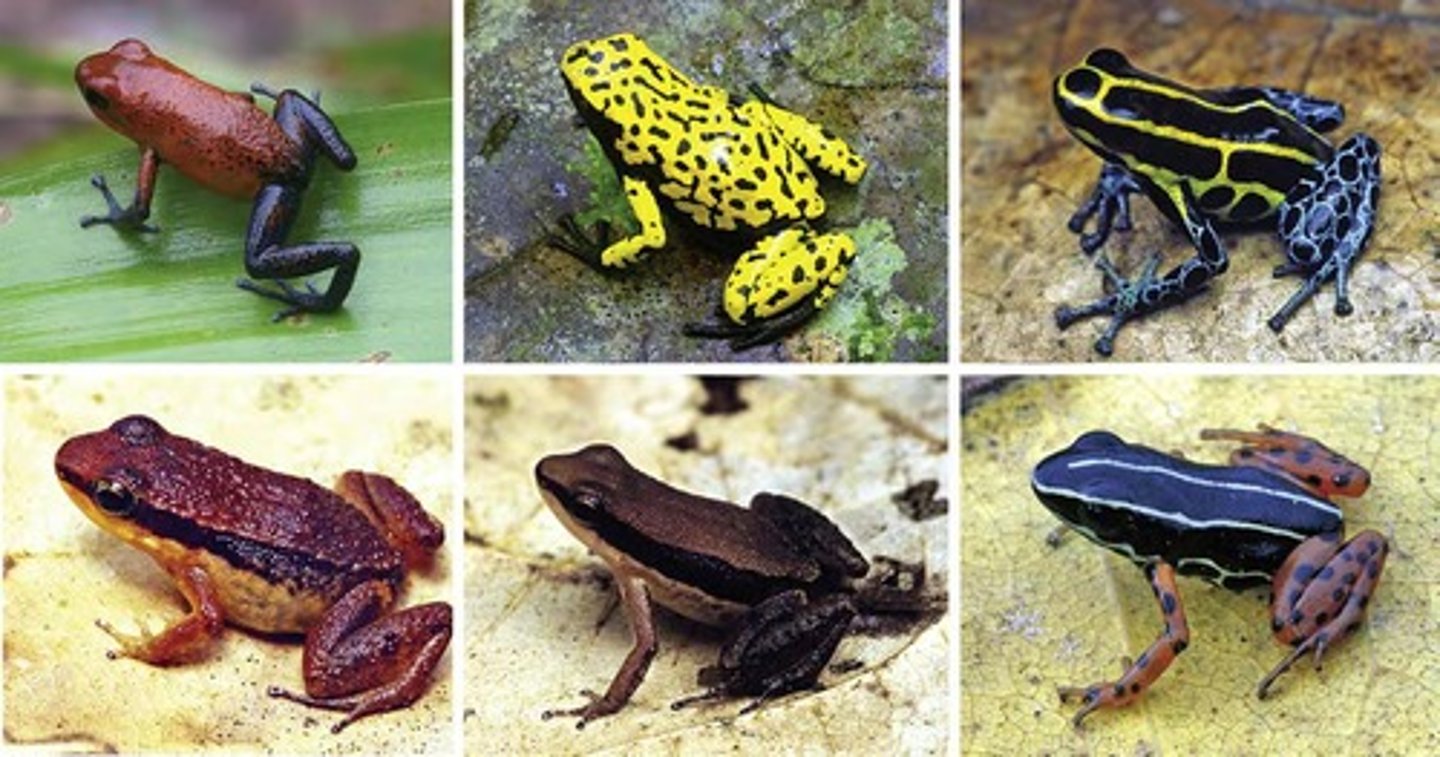
What is Batesian mimicry?
Non-toxic species mimic toxic species.
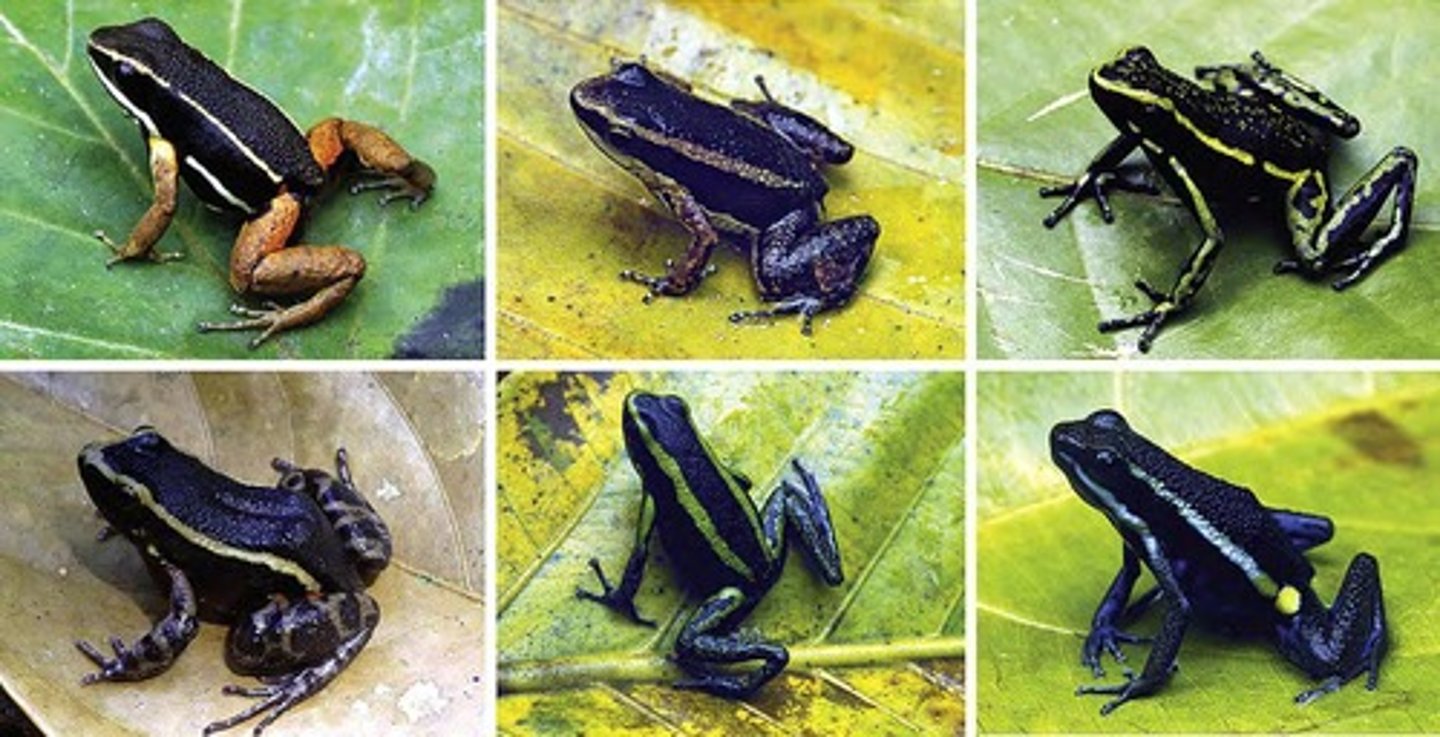
What is Mullerian mimicry?
Toxic species mimic other toxic species.
What is the Unken reflex?
A defensive posture where the amphibian makes itself look too big to eat.
What are chromatophores?
Skin cells in amphibians that contain pigments and can change skin color.
What types of pigments do melanophores contain?
Black, grays, browns, and dark reds.
What is ecdysis in amphibians?
The process of shedding skin.
What is unique about the lunglessness in some amphibians?
It has evolved multiple times within salamanders and other species.
How do amphibians perform gas exchange?
Through their highly permeable skin, facilitated by capillaries.
What is the primary reason amphibians cannot grow very large?
Limited gas exchange through their skin and potential for massive water loss.
What is the gas exchange process in amphibians?
Oxygen intake is represented by orange and CO2 emission by green.
What type of sex determination do amphibians have?
Genetic sex determination.
What are the two types of heterogamety found in amphibians?
XY/XX in males and ZZ/ZW in females.
How many families and species are there in the Order Caudata?
10 families and 829 species.
Which family of salamanders has the highest number of species?
Plethodontidae with 26 genera and 519 species.
What is a unique feature of the Sirenidae family?
They have external fertilization and are paedomorphic, retaining larval traits throughout life.
What is the primary characteristic of the suborder Cryptobranchoidea?
They have external fertilization and unfused angular and prearticular bones in their lower jaws.
What is the significance of the spermatophore in salamander reproduction?
It allows internal fertilization without an intromittent organ.
How do male salamanders transfer pheromones to females during courtship?
Through tactile communication, visual signaling, and chemical signaling via pheromones.
What is the role of the spermatheca in female salamanders?
It sequesters sperm and provides nutrients to maintain it until fertilization.