3. Choice under uncertainty
 Call Kai
 Learn
Learn Practice Test
 Spaced Repetition
 Match
Match Flashcards
 Knowt Play
1/53

There's no tags or description
Looks like no tags are added yet.
Name | Mastery | Learn | Test | Matching | Spaced | Call with Kai |
|---|
No analytics yet
Send a link to your students to track their progress
54 Terms
What is uncertainty?
opposite of certainty
consequences depend on a probability, rather than happening for sure
before knowing the realisation of a random variable
with uncertainty there is risk(known probabilities) and ambiguity(unknown probabilities)
What is prospect?
list of consequences with associated probabilities
p = (p1: x1;….; ps : xs)
What are consequences?
finite set of consequences C = {x1, x2, …., xs}
S is the number of something in the world
What is probabilities?

What does p>q mean?
prospect p strictly preferred to prospect q
What is p ≥ q mean? funky version of signs
p is weakly preferred to q
What does p ~ q mean
indifference between p and q
indifference does not mean that you don’t have a preference
p ~ q means that both p ≥ q and q ≥ p - funky version
How do we find out the expected value

What is the St Petersburg paradox?
A game where you flip a coin repeatedly until you get heads
you will earn £2n, where n is the flip number at which I got heads
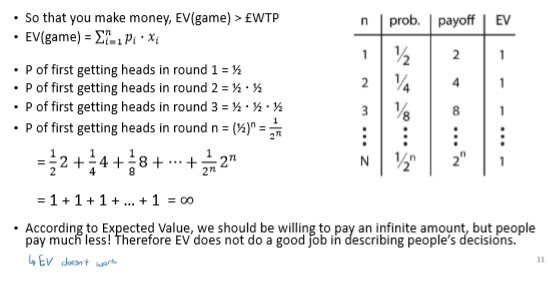
What does EV assume?
people base their decisions only on how much money they could receive but
receiving £100 does not feel the same if you earn £1,000 per month than if you earn £10,000 oer month
Choices may depend on factors other than economic profit
solution transkate £ into utilities
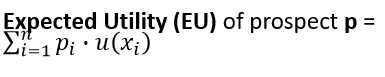
What is the expected utility of prospect p (EU)?
What are the 3 attitudes towards risk?
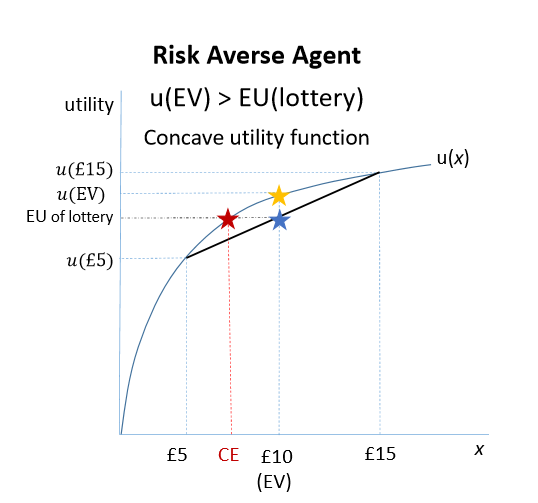
risk averse - hating
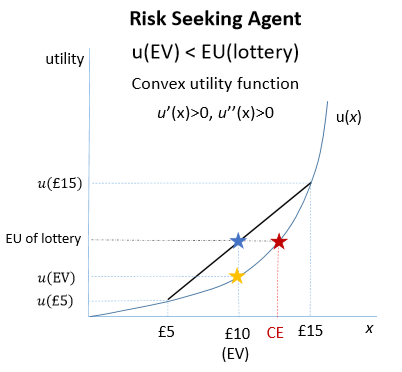
risk seeking - loving
risk neutral
What does attitude towards risk depend on
how the utility of the exoected value of the lottery compares to the expected utility of the lottery
What is certainty Equivalent (CE)?
amount which if recieved with certainty, gives the same utility as the EU of the lottery
What does a utility curve look like for a risk seeking agent?
What does the utility function look like for a risk averse agent?
What is Risk premium (RP)
difference between the expected value and the certainty equivalent
extra amount of x the agent is giving up in order to avoid risk
The extra amount that the agent would receieve from playing the lottery instead of receiving the CE
What is the equation for Risk Premium?
RP = expected value - certainty equivalent
What is the recap of attitdes to risk?
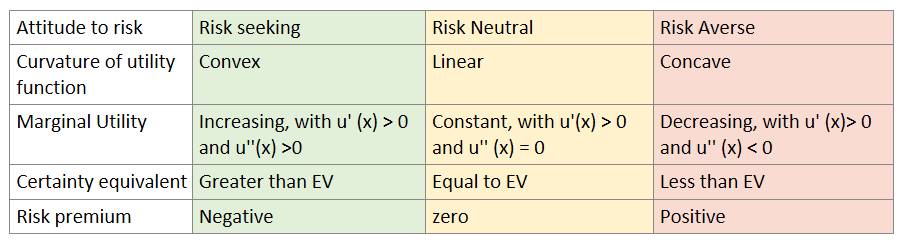
What are the 2 ways to quantify how risk averse someone is?
all else equal - lower certainty equivalent → more risk adverse
all else equal, the higher the risk premium → more risk averse
What is a risk premium?
money people are willing to leave on the table to avoid risk when making choices under uncertainty.
How does utility function show us about how risk averse someone is?
The more concave the function, the more risk averse
Why does using the 2nd derivative of a function?
no because the behaviour of an agent would be the same so the r measured risk aversion should also be the same
different atitudes to risk =/ same behaviour
What is the Arrow-Pratt measure of (absolute) risk aversion?
How risk adverse someone is
remove the effect of linear changes
ppl who behave the same get the same things
degree pf rosl aversion is now invariant to positive linear transformations of the utility function
tells us how the amount of money invested in risky assets would change as the investor’s level of wealth changes
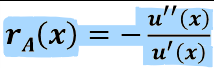
What happens in Arrow-Pratt if there is decreasing absolute risk aversion?
ra(x) is a strictly decreasing function (ra’(x) <0)
As x increases, agent is less risk averse and takes more risks
What happens in Arrow-Pratt if there is constant absolute risk aversion?
ra(x) does not vary with x (ra’(x) =0)
As x increases, agent is a risk averse and takes some risk
What happens in Arrow-Pratt if there is increasing absolute risk aversion?
ra(x) is a strictly increasing function (ra’(x)>0)
As x increases, agent is more risk averse and takes less risks
What is the Arrow-Pratt measure of relative risk aversion?
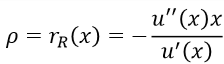
What happens if there is a decreasing relative risk aversion?
proportion of wealth invested in a risky asset increases when wealth increases
What happens if there is constant relative risk aversion?
proportion of wealth invested in a risky asset does not depend on changes in wealth
What happens if there is increasing relative risk aversion?
proportion of wealth invested in a risky asset decreases when wealth increases
What are the 5 methods considered when testing attitudes to risk in a lab?
ballon Analogue risk task (BART
Questionnaires
Gneezy and Potters method
Eckel and Grossman method
Multiple price list (MPL) method
What are ways we categorise method ?
complexity
revealed vs self-reported preference
What are complex methods?
Complex methods - estimate parameters of a utility function using functional form assumptions
What are simple methods?
Simple methods just aim to score individuals in terms of how willing they are to take risks without parameterising the utility function
What are revealed preferences?
Revealed preferences measures infers participants’ risk preferences from their (incentivised) choices
What is self-reported preference?
methods use participants’ stated attitudes about their risk preferences
What is the Ballon Analogue Risk Task (BART(?
inflate a “balloon” Each pump raises the reward earned, but if the balloon pops then you lose it all
function governs probability of popping: starts low and increases until certainty after T pumps. T is not known to participants
Balloon will pop for sure after T pumps
Participants learn through experience then decide when to stop
Earlier stopping point implies greater risk aversion
What is the mathematical side of when the balloon will pop?
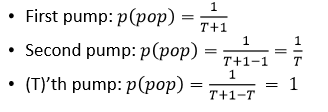
What are the pros of Balloon Analogue Risk TAsk( BART)
Easy to understand: simple + realistic
shown to correlate with reported real world risky behaviour
What are the cons of Balloon Analogue Risk Task (BART)?
Risk preferences may not transfer across domains
computer and multiple trials required - cannot be easily embedded into surveys or used in the field without access to computers
What is the general for questionnaires?
Rate your willingness to take risks in general - on a 10 point scale, 1 = completely unwilling and 10 = completely willing -
assumes a stable domain-general preference - not realistic
What is domain specific (DOSPERT)
40-item scale with 8 items each in the domains of recreational, health, social, and ethical risks and four items in the domains of gambling and investment
Each item is a 5-point scale on how likley the person is to engage in a particular behaviour
Interpret total or average score to reveal willingness to take risks within and across domains
What are the pros of questionaires?
simple
domain-specific - if preferred
easily understood
What are the cons of questionnaires?
Unincentivised - possibility of gratuitously expressed risk preferences