Assumptions
 Call Kai
 Learn
Learn Practice Test
 Spaced Repetition
 Match
Match Flashcards
 Knowt Play
1/15

There's no tags or description
Looks like no tags are added yet.
Name | Mastery | Learn | Test | Matching | Spaced | Call with Kai |
|---|
No analytics yet
Send a link to your students to track their progress
16 Terms
What are the 3 behaviourist approaches?
Humans are born like a blank slate
Behaviour is learned through conditioning
Humans and animals learn in similar ways
What is meant by tabula rasa?
Blank slate- behaviourists argue newborns born completely neutral except with basic responses- crying, pain, hunger etc. nothing is innate
Is the assumption nature or nurture?
Nurture all behaviour comes from the environment
No room for biology or anything innate
Is this assumption deterministic or free will?
Environmental determinism
All we are is because of our environment. Personalities & behaviour determined by our environment
Also means people don’t have free will
What is classical conditioning?
Learning through association
How does classical conditioning work?
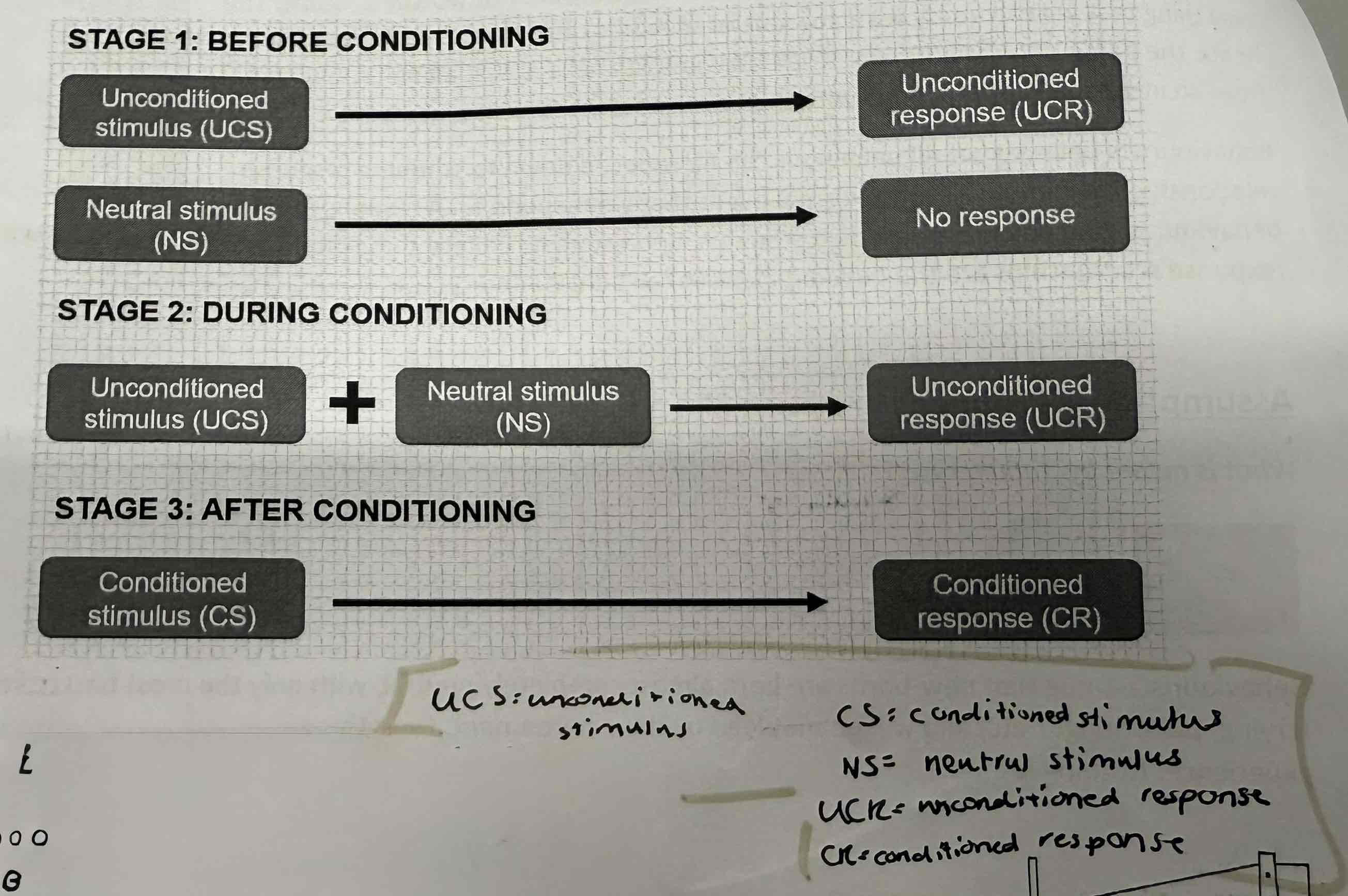
What is evidence of classical conditioning?
Pavlov’s dogs, found dogs salivated when they saw food so decided to condition them into believing when a bell rings that food is coming and, they began salivating just when they heard the bell without even seeing the food
What is operant conditioning?
Learning through conditioning more voluntary than the learning seen in classical conditioning- people behave in a particular way and are rewarded for it, they will repeat it. If punished for behaviour will stop doing it.
What is positive reinforcement?
A reward or pleasant consequence that increases the likelihood that a behaviour or action will be repeated
What is negative reinforcement?
When an unpleasant experience is removed after a behaviour or action has been made. This increases the likelihood of that behaviour being repeated
What is punishment?
A stimulus that weakens behaviour because it is unpleasant and we try and avoid it
What do behaviourists believe in learning?
There’s no differences in the way an animal and the way a human learns, both are products of their environment and for both of them all behaviour is determined by stimulus-response relationships
A consequence of this assumption is we can intestate the affect of conditions on animals then apply the results to humans can generalise from animals to humans
What is as example of projecting research from animals onto humans?
Classical conditioning- aversion therapy
Another example- skinners rats
rat learns to associate a specific behavior (like pressing a lever) with a consequence, such as receiving a food pellet for a desired action (positive reinforcement) or escaping an electric shock for an unwanted one (negative reinforcement)
Positive reinforcement: hungry rat is placed in a Skinner box. It moves around until it accidentally presses a lever, which triggers a food dispenser to drop a food pellet. The rat learns that pressing the lever leads to a reward and starts to repeat the action intentionally
Negative Reinforcement: The experiment is altered to include an unpleasant stimulus, such as an electric shock from the floor of the box. The rat learns to press the lever to turn off the shock, which is a form of negative reinforcement because the rat is removing an unpleasant stimulus
Punishment: In another variation, the rat receives an electric shock every time it presses the lever. This punishment results in a decrease in lever-pressing behavior, as the rat learns that the action leads to an undesirable consequence
What is a token economy
A particular firm of behaviour modification programme in which the main vehicle is reinforcement is some sort of ‘token’
Incentive good behaviour
Where are token economies used?
Institutions - in the mentally handicapped, adolescences, chronic mentally ill people
Schools
At home