Babphics Bart Bone
 Call Kai
 Learn
Learn Practice Test
 Spaced Repetition
 Match
Match Flashcards
 Knowt Play
1/46

Earn XP
Description and Tags
| 14-24: advanced shading stuff | 30-32: mesh and widgets (?) (arcball, mover) | 33-36: bezier curves | 42-45: bezier patches | 55-61: alternative to parametric surfaces
Name | Mastery | Learn | Test | Matching | Spaced | Call with Kai |
|---|
No analytics yet
Send a link to your students to track their progress
47 Terms
how was rob cook influential
shade trees, cook-torrance lighting model (the pots made of different things)
what does distributed ray-tracing support? (5)
gloss, translucency, penumbra, depth of field, motion blur
what is ray-tracing? what does it NOT have and why is it an issue?
sending out rays through each pixel and seeing what is hit
no pixel-to-pixel coherence, meaning each pixel’s color is completely in isolation from neighbors, unlike rasterization which does interpolation. this is why it is much slower than rasterization!
what is distributed ray tracing
instead of sending out 1 ray per pixel, scatter them around the pixel
(like imagine shooting a point with a sniper rifle vs a shotgun (distributed)
distributed not just spatially, but in time (e.g. evaluate the rays at different times over 1/24th of a second) and more
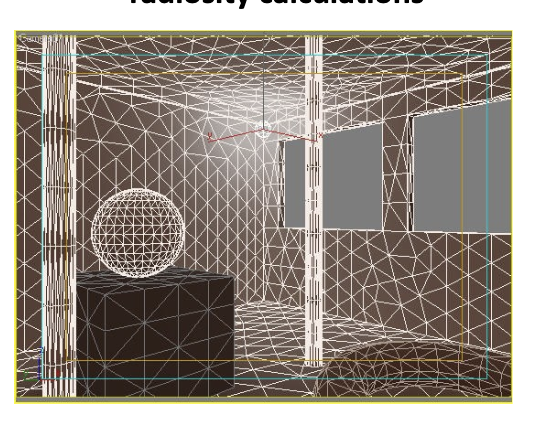
what is radiosity?
a global illumination method, where you have light radiate out from the source.
global illumination explanation: the idea that surfaces collect light from more than just a direct light source like the sun or a lightbulb, but from other surfaces reflecting light as well, such as walls, floors, clothes etc., so some surfaces will collect more light than others and thus be lighter
why is rendering equation good
mathematically defines how light bounces off surfaces to simulate global illumination, increases realism!
who came up with the rendering equation
james kajiya
curved shadows on curved surfaces: what is it, who came up with it, how does it work?
shadow mapping: if a point can ‘see’ the light sources, it is lit. if it can’t, it’s in shadow
by lance williams
uses z-buffer: creates a shadow map that records closest possible surface light can hit. later, if u check z buffer and a pixel’s distance is smaller than the stored value in shadow map, it is lit and vice versa.
basically they used to struggle with shadows on curved stuff it required lots of math, now using shadow mapping and the z values, curved surface and flat work exactly the same since it looks up a single pixel value at a time
does 3d texture increase realism? T/F
true
does subsurface scattering increase realism? T/F
true
general idea of how CAT/MRI/PET scans work? what is the 3d grid made of? what company made like some computer or whatever for this purpose?
they go slice by slice, stacked to make a 3d grid made of VOXELS (volume element)
semi-transparency decided based on densities (e.g. air is clear, bone is high density should be mostly opaque)
ray traced from camera to each pixel through the 3d grid
pixar
arcball code info
when the arcball goes down (mouse down/you click), you have a starting quaternion. when you drag, you get a new quaternion and its multipled by start quaternion to get the new orientation.
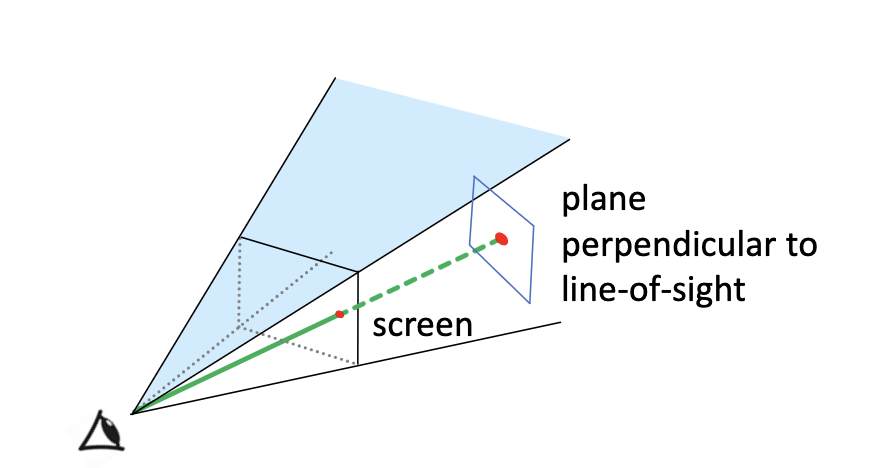
mover
if you pick a point, you move it in a plane that is perpendicular to the line of sight. the plane updates with your line of sight, ensuring it is always perpendicular and always at the same depth.
the further red point is the actual point, the closer one is the point being represented on the screen. the plane will always be at the depth of the further red point
name of bezier curve making process
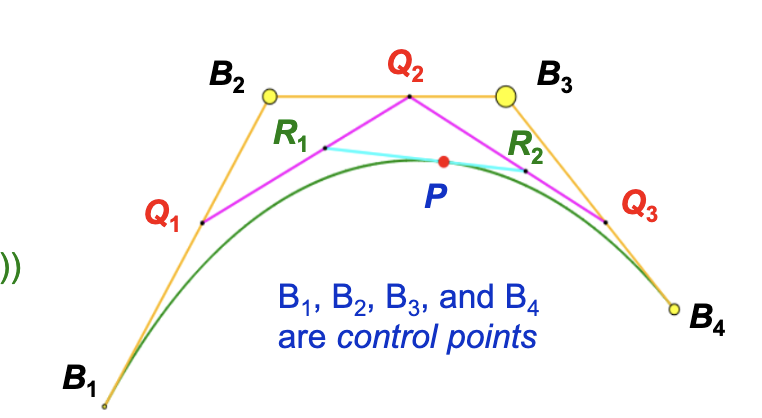
de casteljau construction of bezier curve
how to actually make bezier curve?
how many control points?
what is the parameter?
what is the range of the parameter?
how to find p?
what is s?
start with 4 control points,
t, where you are on the curve
0 to 1, t0 to t1 sweeps out the parametric curve
e.g. for p where t = 2/3, go 2/3 along each segment between the control points to get 3 points. connect those 3 points. then go 2/3 along each of those created segments to get 2 points. connect the two points to make one segment. go once more 2/3 along that segment to get the final point p. p is where on the curve you will be when parameter t = 2/3
s = 1-t, simplifies the equations significantly
what is a bezier curve with 4 control points called?
a parametric cubic polynomial curve
one with 3 control points would be called a parametric quadratic polynomial curve
what are the bezier basis functions? what properties do they have (2)?
they are the coefficients for each of the control points in the equation, made up of s and t
they form a partition of unity, meaning for any value of t the 4 functions sum up to one.
the entire curve is contained within the convex hull of the control points (if you stretched a rubber band around the 4 points, curve would always fit within the rubber band)
what is the difference between the B1 and B4 points and the B2 and B3 points?
the bezier curve interpolates (goes through) 1 and 4, but only approximates 2 and 3
does the bezier curve have lots of nice properties
yes
how to ensure continuity between two piecewise bezier curve? what this continuity called
7 points total since they share middle point, middle point (4th) must be halfway between the 3rd and 5th points. c1 continuity
if it not midway, u connected to curve but they dont have c1 continuity
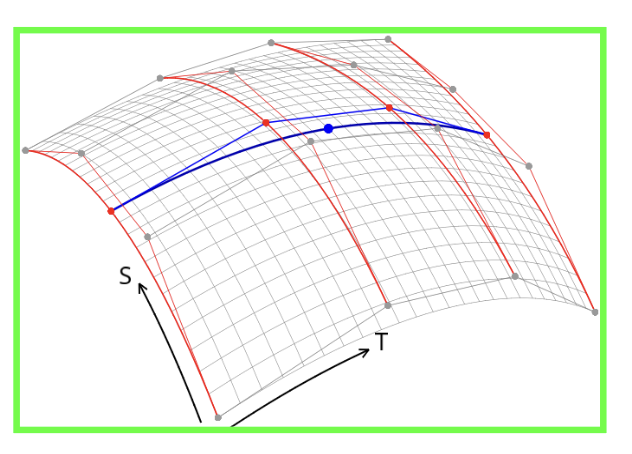
how to make bezier patch?
how many control points
what are the two curve called and what are they made of
how do you find an arbitrary point (u, v) in the patch?
refer to image for #3
16
t curve made of s-points, s-curve made of t-points
to find e.g. a point (u, v) go up each of the s curves (red lines) until you get the point where s = u. Using these four points (red points), create the t-curve. Find where t = v and yay you have the point you want
given a point u, v with parameters s, t on a bezier patch, how can you find the surface normal? (N(s,t) = ?)
how exact is this answer?
find the tangents of the s curve and the t curve and cross product them together
it is super precise!! it is accurate!! NOT an approximation!!
what key concept does the utah teapot demonstrate??
bezier curves/patches!! can see the control mesh is all straight lines, but turns into a curved shape!
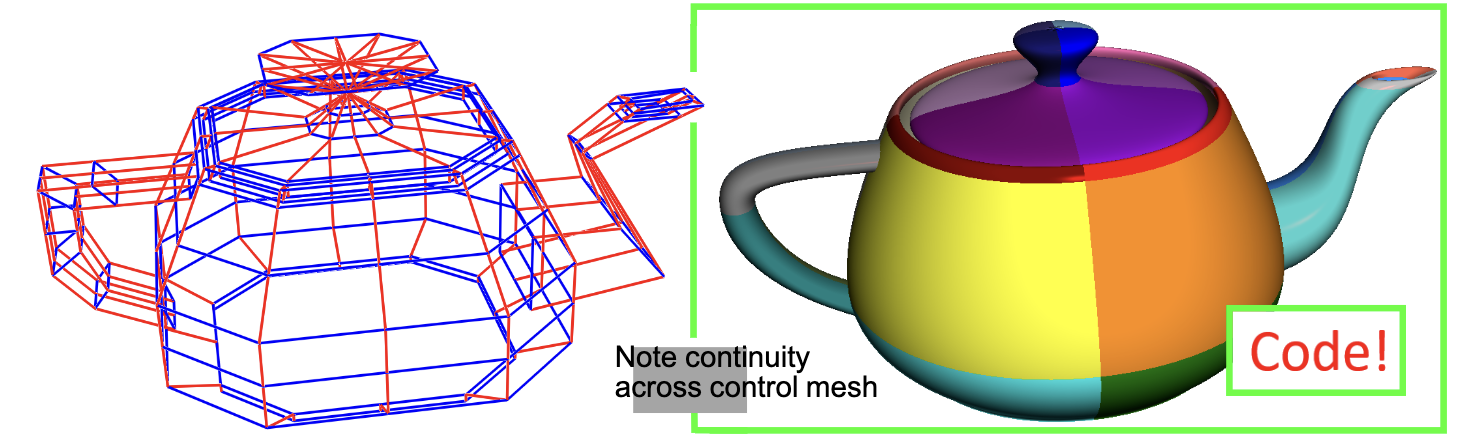
how to split a bezier patch? what happens to the control points?
subdivided into two sub-patches along s-direction (top to bottom down the middle), then split those two patches in the t-direction (left to right horizontally). the result is 1 patch has been split into 4 subpatches
old control points thrown out, new control points have to be calculated
continuity in bezier patches?
same as for curves:
bezier patch boundaries lined up → c0 continuity, position only
tangents/slope line up, control points before and after boundary form a stright line with the boundary points → c1 continuity
alternatives to parametric surfaces (3)
subdivision surfaces, implicit surfaces, particle systems
subdivision surfaces def +
who came up with them? (2)
how do they work? (3 steps)
what do the surfaces become?
blend via recursive smoothing of a polygonal mesh
ed catmull, jim clark (silicon graphics guy)
e.g. for a rectangle defined by 4 points:
add midpoints on each edge
move each point halfway toward its cw neighbor
repeat
surfaces become more smooth with each iteration
implicit surfaces def +
compare to what?
how are they different?
what is the implicit equation for a circle/ what does it mean?
blend via summation of primitives
parametric, where you have a single alpha and p = cos alpha, sin alpha
parametric: give me parameters, i give you the point
implicit: give me a test so i can check if a point is on it{p } : px^2 + py^2 − 1 = 0 → set of all p that fit this equation, exact same circle as parametric
if = 0, on circle. positive = outside circle, negative = inside circle
use of implicit surfaces
allows you to blend!! see blinn’s blobbies, merging two sphere together. way easier than trying to do it parametrically
blue slime blob bob
in implicit surfaces, how do you know where there is an intersection?
if one point is positive and another is negative, you know there MUST be a boundary there somewhere, need to find where it equals 0, repeatedly subdivide and keep testing until you get 0
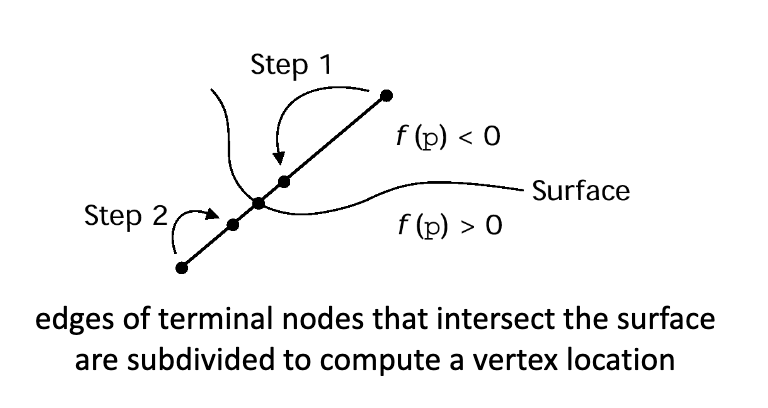
particle systems def
individual points acting independently, individually displayed
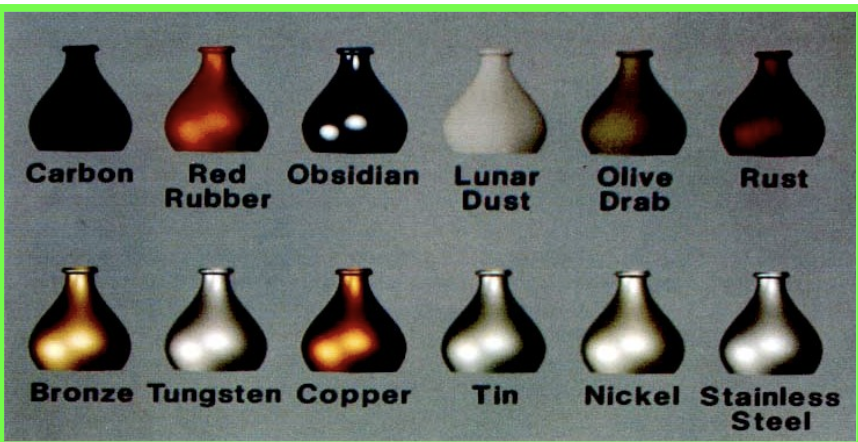
what does this image demonstrate?
cook torrance model
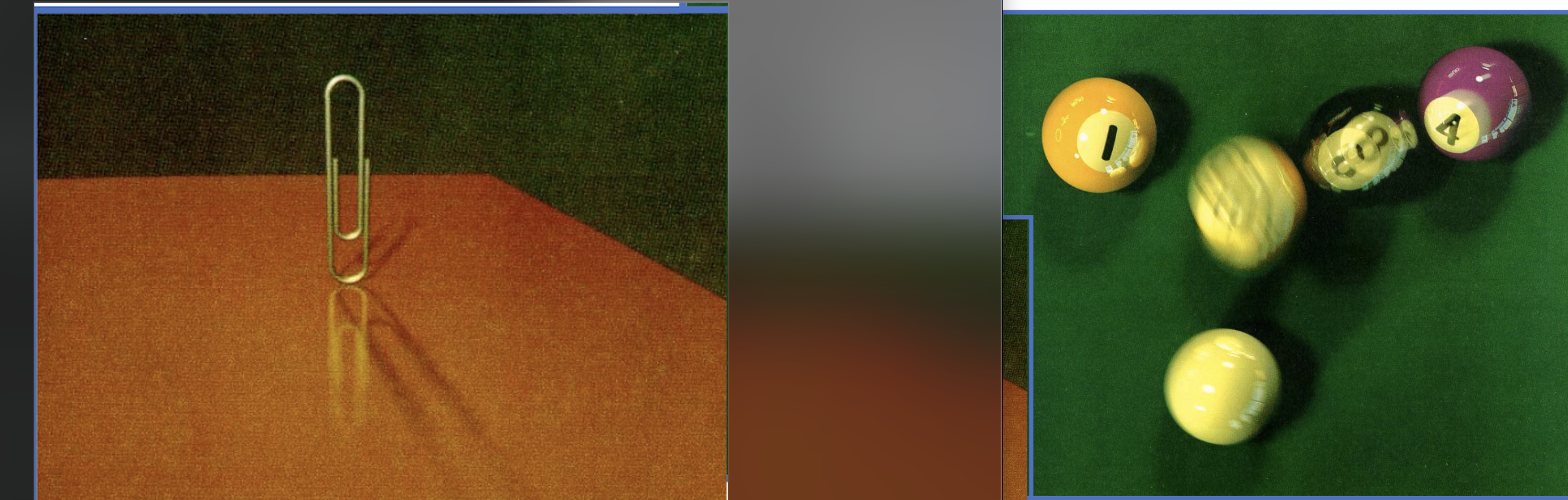
what do these images demonstrate?
distributed ray tracing
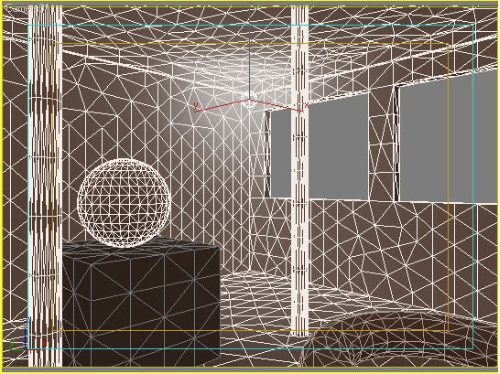
what does this image demonstrate?
radiosity
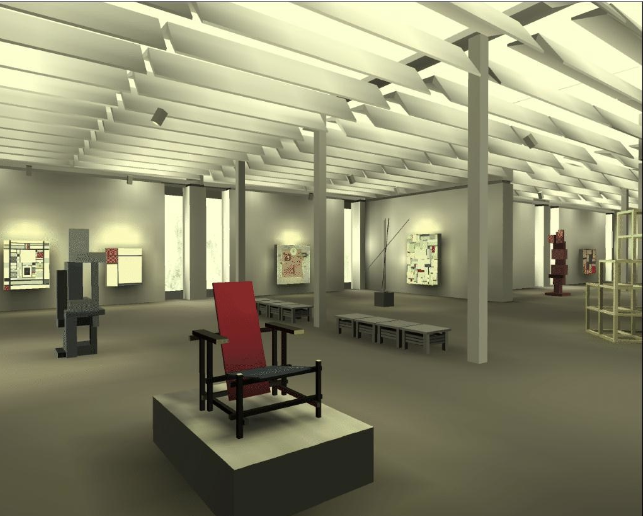
what does this image demonstrate?
radiosity
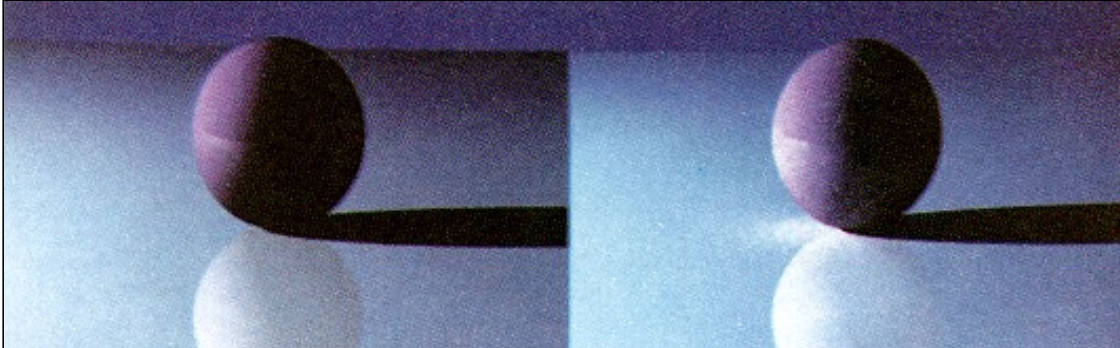
what is the difference between these two images? one is ___ and one is from __
ray-traced on left, rendering equation on right
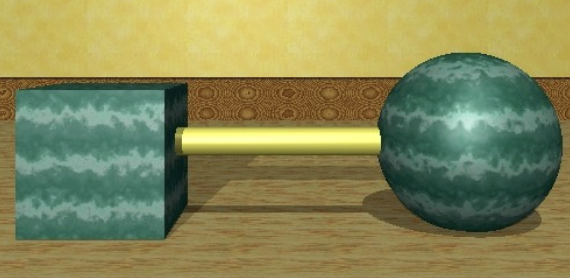
what does this image demonstrate?
3d textures
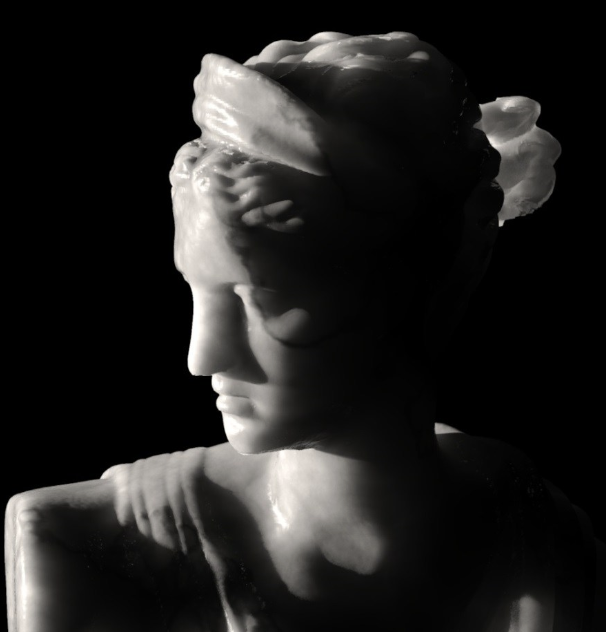
what does this image demonstrate?
subsurface scattering
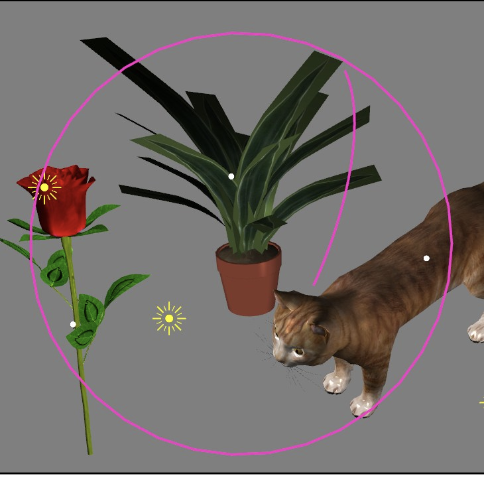
arcball
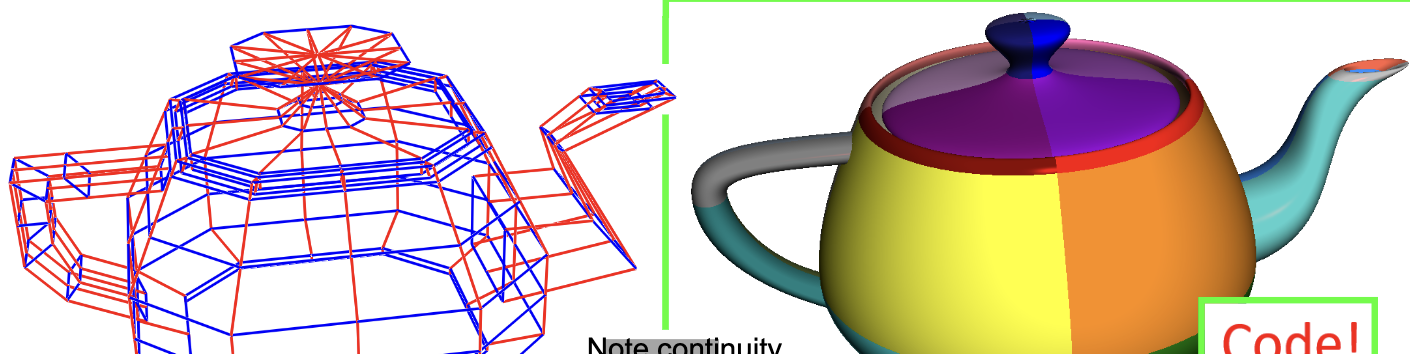
bezier patches
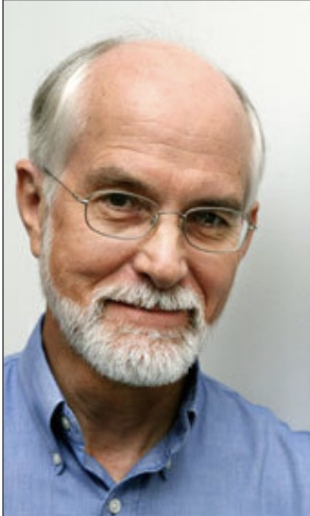
what this guys name and nationality (lol)
martin newell, british
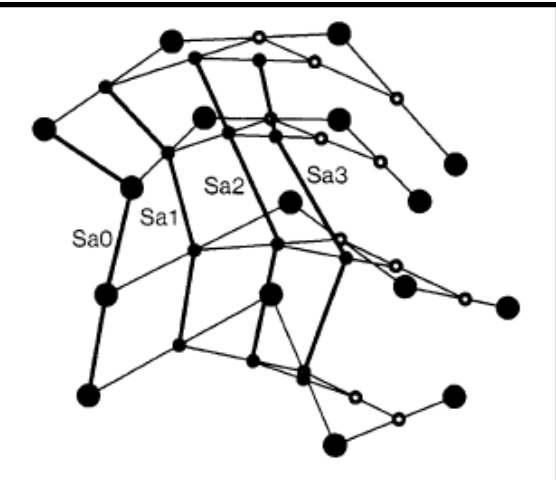
patch splitting
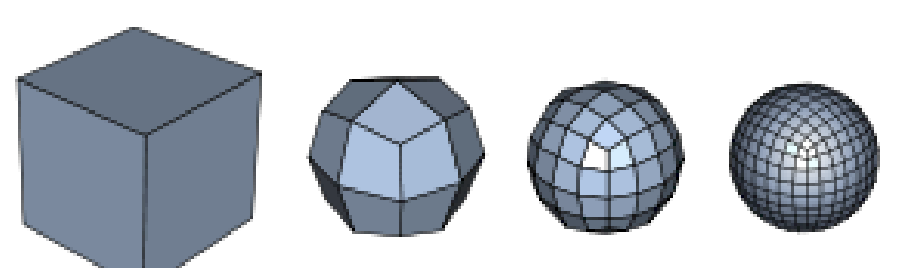
what does this show
clark catmull subdivision surfaces
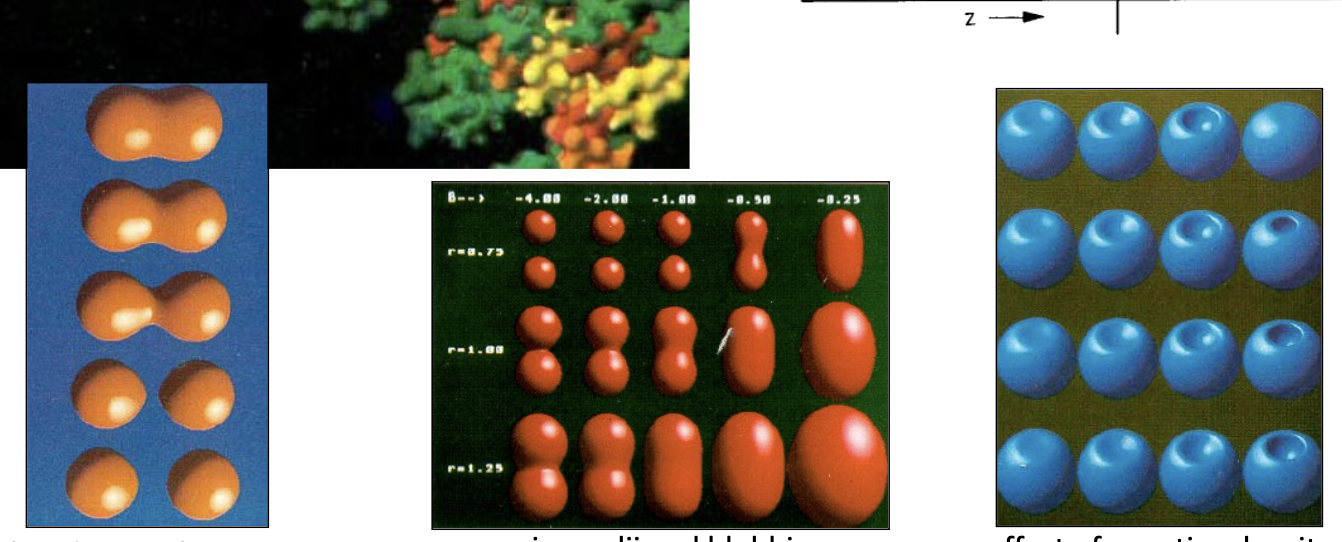
what does this demonstrate
implicit surfaces blending
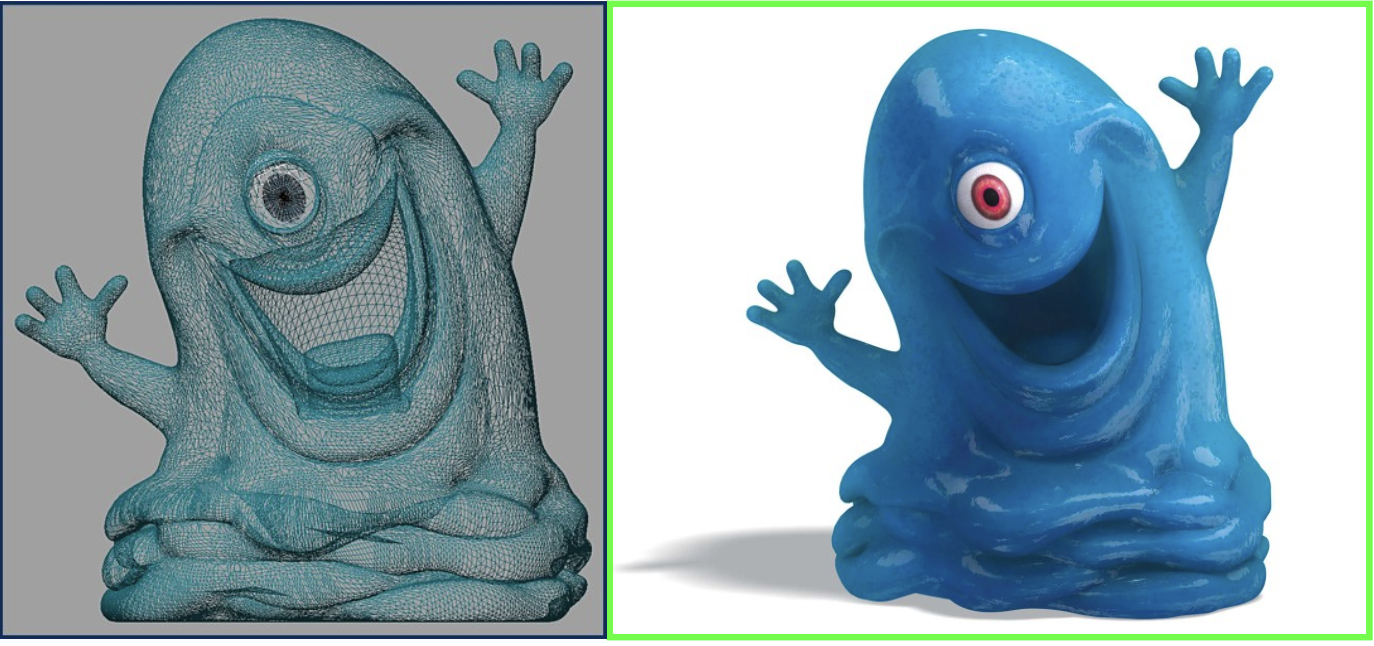
what does this image demonstrate
implicit surfaces

what does this image demonstrate
particle systems
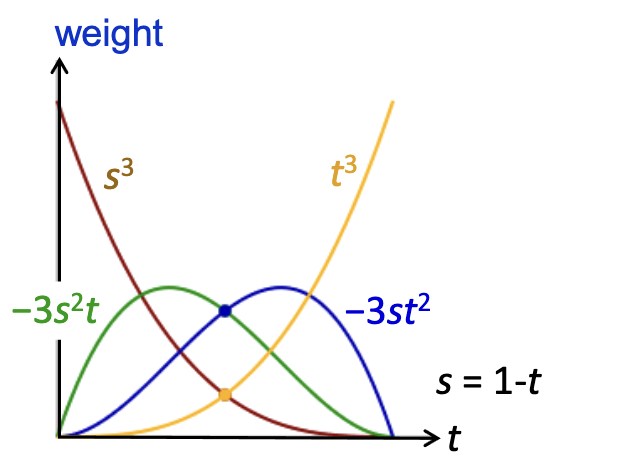
what is this image showing?
bernstein basis functions for 4 bezier control points