AUDIOLOGY FINAL
 Call Kai
 Learn
Learn Practice Test
 Spaced Repetition
 Match
Match Flashcards
 Knowt Play
1/263

There's no tags or description
Looks like no tags are added yet.
Name | Mastery | Learn | Test | Matching | Spaced | Call with Kai |
|---|
No analytics yet
Send a link to your students to track their progress
264 Terms
What are the three main components of evidence-based practice?
Evidence, clinical expertise/judgement, and client and family values and perspectives
Who are some people that may help a patient/patient family make the best decision for them? List at least two.
Pediatrician and/or teachers
The failure of the __ to perform typically results in negative ear pressure.
Eustachian tubes
The name for an infected middle ear
Otitis media
The term for fluid in the middle ear that is NOT infectious
Serous fluid
Name for a chronically open eustachian tube
Patulous Eustachian tubes
The term for excessive bone growth over the middle ear bones
Otosclerosis
Name the fluids within the vestibular system.
Parilymph and endolymph
Rapid eye movement associated with the sensation of true turning
Nystagmus
The sensation of true turning is called
Vertigo
What three systems combine to give you balance?
Vestibular, eyesight, and proprioceptive
Yes or no: if two speakers are playing the same frequency at the same decibel level, can the two decibel levels be added together?
No
Do loud sounds have a higher or lower amplitude when compared to quiet sounds?
Higher
Do low frequency sounds have longer or shorter wavelengths compared to high frequency sounds?
Longer
What is the physical correlate of pitch?
Frequency
What is the psychological correlate of amplitude?
Loudness/intensity/volume
What two documents guide the profession of audiology?
Code of ethics and scope of practice
What is required to legally practice audiology?
State license
Audiology was formed from what two professions?
Speech language pathology and otolaryngology
What degree is required for audiology?
AuD
Order of pathways:
Cochlear Nucleus, Superior Olivary Complex, Lateral Lemniscus, Inferior Colliculus, Medial Geniculate Body, Auditory Cortex
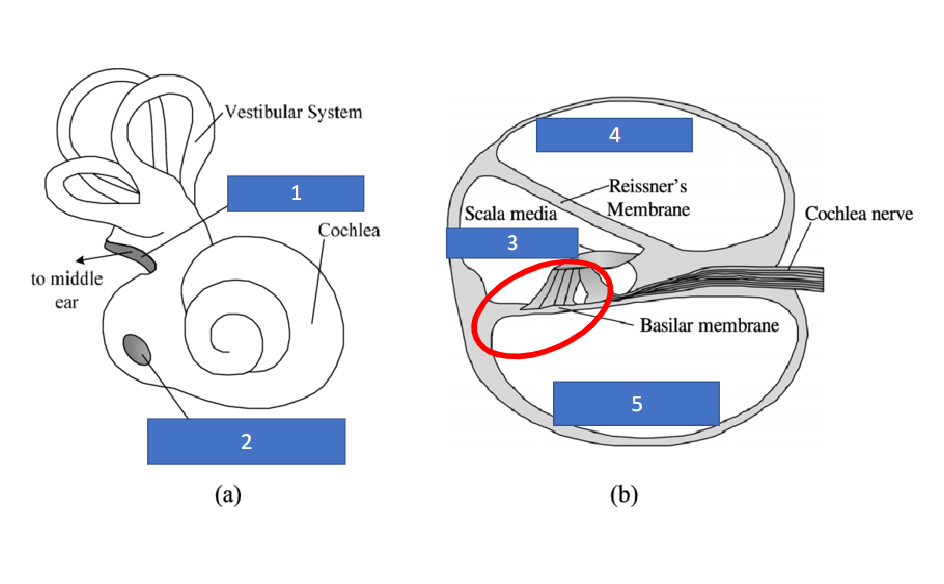
1: Oval window
2: Round window
3: Organ of Corti
4: Scala Vestibuli (perilymph)
5: Scala Tympani (endolymph)
The internal auditory canal contains ___, ___, ___, and ___.
Vestibular branch of the 8th cranial nerve, auditory branch of the 8th cranial nerve, cerebellar artery, and facial nerve
The light reflex which may be seen when inspecting the tympanic membrane with a bight light directed down the external auditory canal is known as the
Cone of light
The tympanic membrane is held in position at the end of the external auditory canal by a ring of tissue called
Tympanic annulus
The human tympanic membrane is comprised of ___ layers.
Three
The arrangement of auditory nerve fibers from the cochlea through the central auditory structures reflect a
Tonotopic organization
The muscle in the middle ear that stiffens the membrane in the oval window when it contracts in response to loud sounds is the ___.
Stapedius muscle
The ___ comprises the greatest surface area of the tympanic membrane.
Pars tensa
The stereocilla on the tips of the outer hair cells are embedded in the
Tectorial membrane
The auricle is made of
Cartilage
Vibratory connections between the ossicular chain and the inner ear are established by the
Oval window
Cerumen is produced by the secaceous glands in what portion of the external auditory canal?
Outer portion
The reflex activity of the middle ear muscles is mediated at the level of the
Superior Olivary Complex
The basilar membrane supports the
Organ of Corti
Three to five parallel rows of outer hair cells and one row of inner hair cells are situated on
Basilar membrane
The purpose of the eustachian tube is to match the pressure of the middle ear to the pressure of the
Outer ear
Scala media contains
Endolymph

A: Tympanic Membrane
B: Malleus
C: Incus
D : Stapes
G: Helix
J: Antitragus
K: Concha
L: Lobe
M: Semicircular Canals
N: Eustachian Tube
O: Cochlear Branch of the 8th Cranial Nerve
P: Cochlea
W: Umbo
Y: External Auditory Canal

E: Oval Window
F: Round Window
M: Semicircular Canals
P: Cochlea

O: Cochlear Branch of the 8th Cranial Nerve
Q: Organ of Corti
R: Scala Vestibuli
S: Scala Media
T: Scala Tympani
U: Basilar Membrane
V: Reissner’s Membrane

G: Helix
H: Tragus
I: Antihelix
J: Antitragus
K: Concha
L: Lobe
X: Auricle
Describe the movement of sound from the outer ear to the auditory cortex. Include in your description at least two anatomical structures/labels from the outer ear, three anatomical points from the middle ear, the connection point between the outer ear and middle ear, the connecting point between the middle and inner ear, and two anatomical points from the inner ear, and a description of how the signal travel to the auditory cortex. (A total of 10 anatomical features- extra anatomical labeling/description will not result in extra points, but misuse of a term will result in a loss of points).
Sound enters through the pinna (auricle) and travels down the external auditory canal to the tympanic membrane (eardrum), which connects the outer and middle ear. The vibration then moves through the middle ear bones: the malleus, incus, and stapes. The stapes pushes on the oval window, which connects the middle and inner ear. In the inner ear, vibrations move through the cochlea and stimulate the hair cells in the organ of Corti. These hair cells change sound into electrical signals that travel through the auditory nerve to the brainstem, then to the thalamus, and finally to the auditory cortex in the temporal lobe where sound is interpreted.
The portion of the inner ear responsible for equilibrium is called the
Vestibular System
Disturbance of the vestibular mechanism often results in the sensation of true turning called ____. It is associated with rapid eye movement called ___.
Vertigo; nystagmus
Middle ear pressure is regulated through the
Eustachian Tube
The portion of the inner ear responsible for hearing is called the
Cochlea
What needs to be undamaged for a cochlear implant to be considered?
Auditory Pathway
What level of hearing loss is cochlear implantation considered for?
Profound
Aligning a cochlear implant to a specific patient is referred to as what?
Mapping
What are some considerations that need to be considered when deciding if cochlear implant is the right choice?
If viable hair-cell function is not present and if the patient has considerable hearing loss
What is the most common hearing aid type?
Receiver in the canal
What is the term for the difference between auditory input and output of a hearing aid?
Acoustic gain
What is the name for the type of hearing aid where information is gathered from an unaidable ear and transferred to be projected to a typical ear?
CROS
What is the name for the portion of the hearing aid that is fitted specific to each client's ear?
Ear mold
What is the term for the high-pitched sound created from the output signal being picked up by the microphone in a continual loop?
Feedback
The name of disorders you are born with/that develop in utero
Congenital
The name for illness that are long lasting/will be present over a long amount of time
Chronic
The sudden loss of hearing is a medical emergency.
True
The name for hearing loss due to aging
Presbycusis
Hearing loss as a side effect of chemicals or drugs
Ototoxicity
Term for a small pinna
Microtia
Term for an absent pinna
Anotia
Term for absent EAC
Atresia
Term for an infection in the EAC
Otitis externa
Term for earwax
Cerumen
What are SDT and SRT, how are they different?
SDT (Speech Detection Threshold) is the softest level a stimuli is detected (not understood) 50% of the time. SRT (Speech Recognition Threshold) is the softest level a stimuli is repeated correctly 50% of the time.
What is dynamic range?
The difference between speech recognition threshold and uncomfortable loudness level.
What is interaural attenuation?
The loss of energy as sound travels from the test ear to the non test ear.
What is cross hearing?
When the non test ear is stimulated
What is the interaural attenuation for bone conduction, air conduction- supra aural headphones, and air conduction- insert headphones?
Bone conduction: 0 dB
Supra aural headphones: 40 dB
Insert headphones: 75 dB for 250 - 1,000 Hz and 50 dB for 1,000+ Hz
What are the 5 types of tympanograms?
Type A, Type AS, Type AD, Type B, Type C
What portion of the ear do OAEs assess?
The inner ear
What are the three tests of that measure tympanic membrane compliance/movement?
Tympanograms
Static compliance
Acoustic reflex
What frequencies are testing during hearing screens?
1,000 Hz, 2,000 Hz, and 4,000 Hz
Which decibel level is testing during hearing screens?
20 dB
Explain symmetrical versus asymmetrical meaning on audiograms.
Symmetrical means similar so the ears are doing the same thing and appear relatively similar on an audiogram. Asymmetrical means different so one ear is doing something different than the other ear and results on an audiogram will be different.
What are the 'configuration' options seen on an audiogram?
Rising, sloping, cookie-bite, and flat
What are the 'degree' options seen on an audiogram? (give label and decibel ranges)
-10 - 20 dB: typical hearing
20 - 40 dB: mild hearing loss
40 - 55 dB: moderate hearing loss
55 - 70 dB: moderate - severe hearing loss
70 - 90 dB: severe hearing loss
90+ dB: profound hearing loss
What are the "type" options seen on an audiogram?
Sensorineural: hearing loss present in the inner ear (cochlea, mastoid bone)
Conductive: hearing loss present in the outer/middle ear (external auditory pathways)
Mixed: a combination of sensorineural and conductive hearing loss
If the patient does respond to a given sound, how much should you lower the decibel level?
10 DB
If a patient fails to respond to a given sound, how much should you increase the decibel level?
5 dB
What decibel level do you start with on a pure tone aud test?
30 dB
What two types of conduction can be tested with pure tones? Describe the difference.
Air conduction and bone conduction. Bone conduction is done in the inner ear and mastoid bone. Air conduction is done in the external auditory canal.
What frequencies are tested in a pure tone audiometric test?
1,000 Hz, 2,000 Hz, 4,000 Hz, 8,000 Hz back down to 1,000 Hz and then 500 Hz to 250 Hz
Binaural hearing refers to listening with ___ ears
Both
___ indicates single ear listening.
Monaural
CROS hearing aids were originally designed for people with ___ hearing losses.
Monaural
When sending reports, HIPAA mandates that a ___ be on file.
Written consent
Emotional responses to bad news may include ____, ____, ____, and ____ (among others) but may not occur in a set order and may reappear at later dates.
Denial, anger, guilt, shock
The word 'deaf from an audiometric orientation implies a profound hearing loss that cannot effectively utilize auditory input. When this word refers to members of a distinct culture.
Capitalized
The gain of a hearing aid is
The difference in decibels between the input signal and the ouput signal
A CROS style hearing aid is designed specifically for
Those with one unaidable ear
Which of the following is NOT a requirement for a bone-anchored hearing aid?
A mixed hearing loss
When the audiologist adjusts the stimulus parameters of a choclear implant's speech processor, it is said the device is being
Mapped
Assistive listening devices are also called
Hearing Assistance Technologies
HIPAA legislation
provides standard for the exchange, privacy, and security of private health information
SOAP stands for
Subjective (the patient’s own report of symptoms, history, and concerns), objective (Measurable, observable data such as vitals, lab results, and physical exam findings), assessment (The provider’s clinical impression, diagnosis, or analysis of the situation), and plan (The proposed treatment, follow-up steps, referrals, and education)
Children with PRElinguistic hearing impairments are not those who
Lose hearing AFTER they learn language
How are amplification devices different from hearing aids?
Amplificaton devices simply make everything louder, so there is no distinct difference between speech and background noise. Hearing aids only amplify be distinguished and speech can be heard more clearly.