Lossless Transmission Lines (Part-III)
 Call Kai
 Learn
Learn Practice Test
 Spaced Repetition
 Match
Match Flashcards
 Knowt Play
1/39

There's no tags or description
Looks like no tags are added yet.
Name | Mastery | Learn | Test | Matching | Spaced | Call with Kai | Chat |
|---|
No analytics yet
Send a link to your students to track their progress
40 Terms
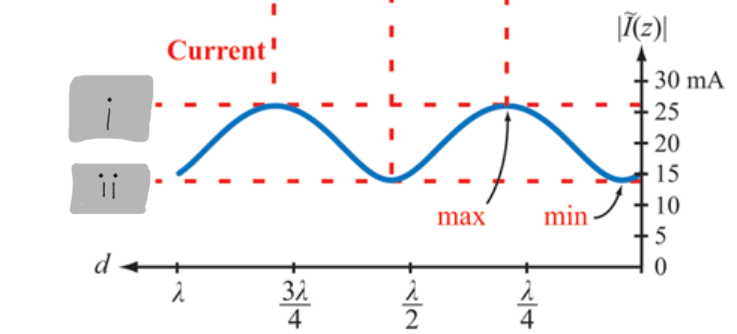
|Ĩ_max|
(i)
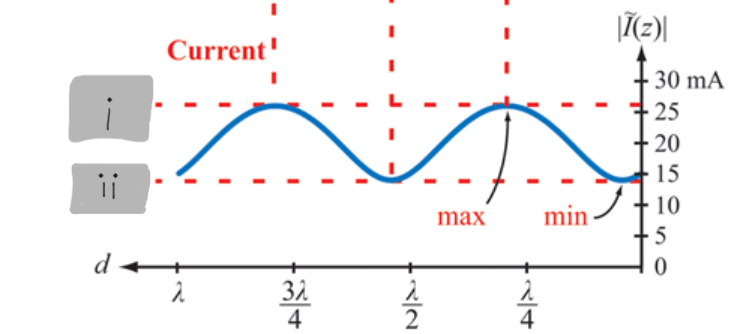
|Ĩ_min|
(ii)
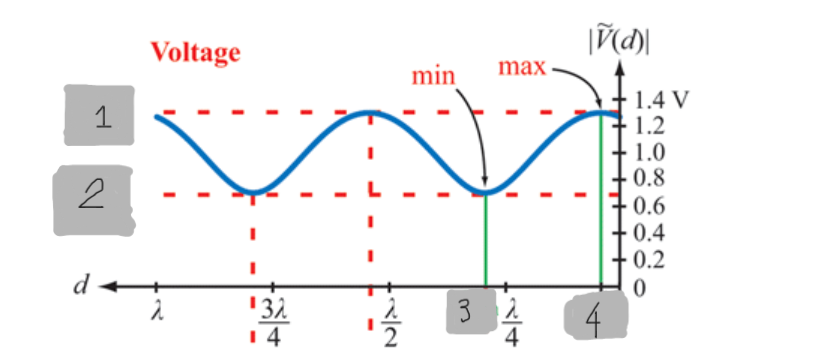
|Ṽ_max|
(1)
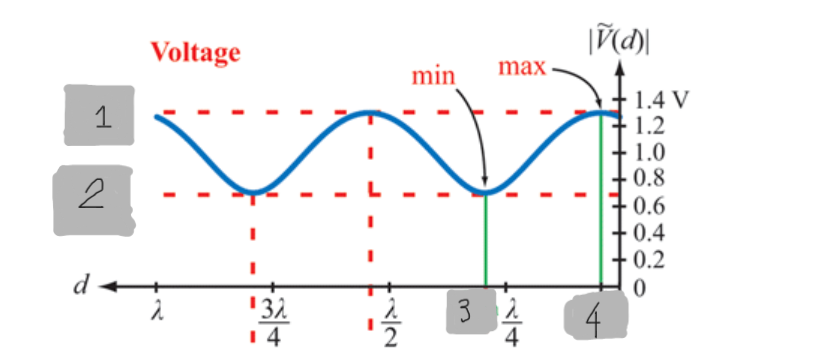
|Ṽ_min|
(2)
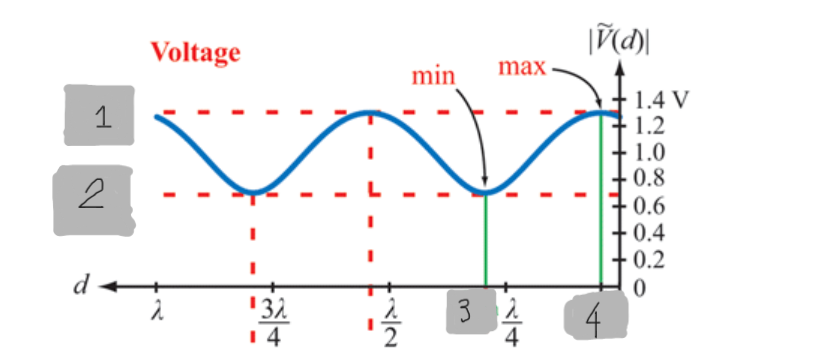
d_min
(3)
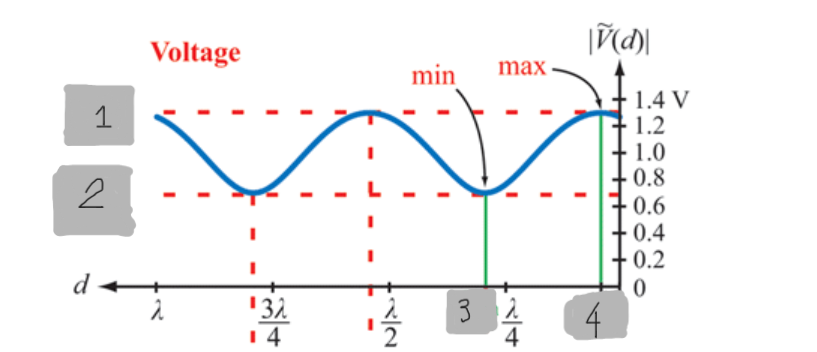
d_max
(4)
d = -z
Distance from the Load (The alternative coordinate system)
2βd - θ_r = 2nπ
Constructive Interference Condition: Condition where incident and reflected waves are in-phase
2βd - θ_r = (2n + 1)π
Destructive Interference Condition: Condition where incident and reflected waves are in phase opposition
|Ṽ_max| = (1 + |Γ|)|V0^+|
Maximum Standing-Wave Voltage: Largest voltage magnitude along the transmission line
|Ṽ_min| = (1 - |Γ|)|V0^+|
Minimum Standing-Wave Voltage: Smallest voltage magnitude along the transmission line
λ/2
Standing-Wave Repetition Period: Spatial repetition period of a standing-wave pattern ___
maxima, maxima
Voltage ______ correspond to current minima, and voltage minima correspond to current ______
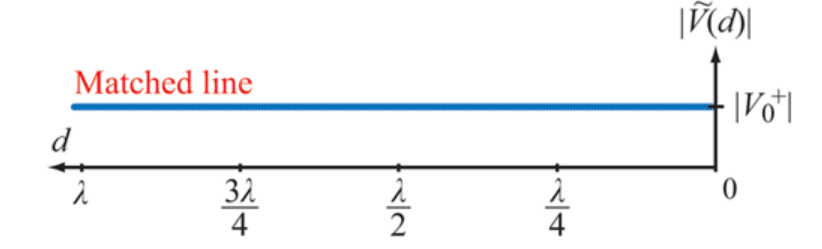
Z_L = Z_0
Matched Transmission Line: A transmission line with no reflected wave because …
Γ = 0
Reflection coefficient of the Matched Transmission Line
Matched Line
Short-Circuited Line
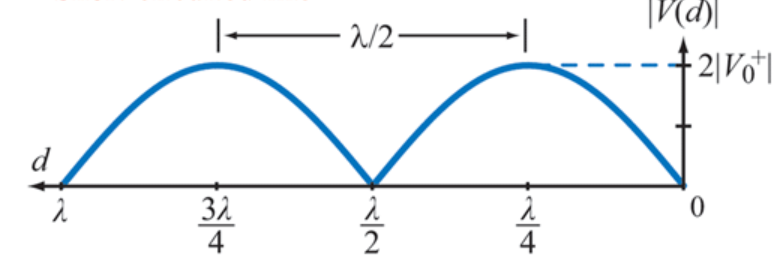
Z_L = 0
Load Impedance of a short circuited line
Open-Circuited Line
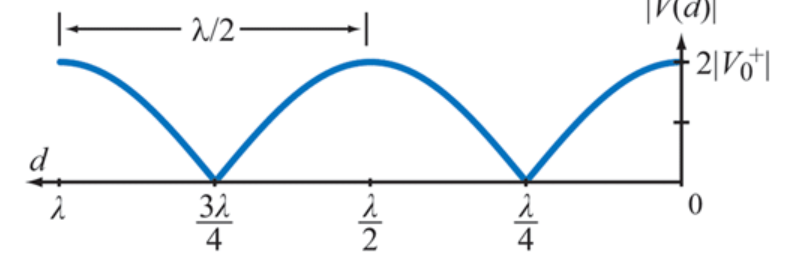
Γ = -1
Reflection Coefficient of a short-circuited line
Z_L = ∞
Load Impedance of a open-circuited line
Γ = 1
Reflection Coefficient of a open-circuited line
No-Reflection Condition
Condition in which no standing waves exist because there is no reflected wave: Γ = 0
Purely Reactive Load
A load containing only reactance (inductive or capacitive), for which: |Γ| = 0
Voltage Maximum Location Condition
Condition for locations where voltage magnitude is maximum: (2β(d_max)) - θ_r = 2nπ
d_max = ((θ_r) + (2nπ))/(2β)
Voltage Maximum Location: Distance from the load where the voltage magnitude reaches a maximum
d_max = ((θ_r)λ)/(4π) + (nλ)/2
Voltage Maximum Location Using Wavelength: Voltage maximum position written in terms of wavelength
Voltage Minimum Location Condition
Condition for locations where voltage magnitude is minimum:
(2β(d_min)) - θ_r = (2n + 1)π
λ/4
Spacing Between Adjacent Voltage Maximum and Minimum: Distance separating adjacent voltage maxima and minima ___
d_min = d_max ± (λ/4)
Voltage Minimum Position Rule: Relationship between the first voltage minimum and voltage maximum
Voltage Standing-Wave Ratio (VSWR)
Ratio of maximum voltage magnitude to minimum voltage magnitude
S = |Ṽ_max|/|Ṽ_min|
Mathematical Representation of Voltage Standing-Wave Ratio (VSWR)
S = (1 + |Γ|)/(1 - |Γ|)
VSWR in Terms of Reflection Coefficient: Expression relating standing-wave ratio to reflection coefficient magnitude
S = 1
Matched-Line VSWR: Standing-wave ratio for a perfectly matched line (Γ = 0)
S = ∞
Complete Reflection VSWR: Standing-wave ratio when total reflection occurs (Γ = 1)
Γ = |Γ|e^(j(θ_r))
Phase Angle of Reflection Coefficient: Angular component of the complex reflection coefficient
Standing-Wave Envelope
The curve traced by the maxima and minima of the standing-wave pattern along the transmission line
Wave Impedance
Ratio of total voltage to total current at a distance d from the load on a lossless transmission line
Z(d)
Symbol to represent the wave impedance
Z(d) = Ṽ(d)/Ĩ(d)
Mathematical Representation of Wave Impedance