Comprehensive Psychology and Language Processing Quizlet Set
 Call Kai
 Learn
Learn Practice Test
 Spaced Repetition
 Match
Match Flashcards
 Knowt Play
1/74

There's no tags or description
Looks like no tags are added yet.
Name | Mastery | Learn | Test | Matching | Spaced | Call with Kai |
|---|
No analytics yet
Send a link to your students to track their progress
75 Terms
What is language comprehension?
Language comprehension is the ability to understand spoken or written language, which allows access to existing knowledge, drawing conclusions, setting and accomplishing goals, and understanding complex social relationships.
What is psycholinguistics?
Psycholinguistics is a discipline that combines psychology and linguistics to study how language is processed in the brain.
What is a phoneme?
A phoneme is the smallest unit of sound in a language that can distinguish meaning, such as the sounds /b/, /i/, and /t/ in the word 'bit'.
How many phonemes does English have?
English has around 45 phonemes.
What is a morpheme?
A morpheme is the smallest unit of meaning in a language, which can consist of one or more phonemes.
What is the difference between free morphemes and bound morphemes?
Free morphemes can stand alone as words (e.g., 'dog'), while bound morphemes must be attached to other morphemes (e.g., 's' in 'dogs').
What is syntax?
Syntax is the set of rules and processes that govern the structure of sentences in a language.
What is generative grammar?
Generative grammar is a theory that describes how a finite set of rules can generate an infinite variety of sentences in a language.
What is semantics?
Semantics is the study of meaning in language, including the meanings of words and sentences.
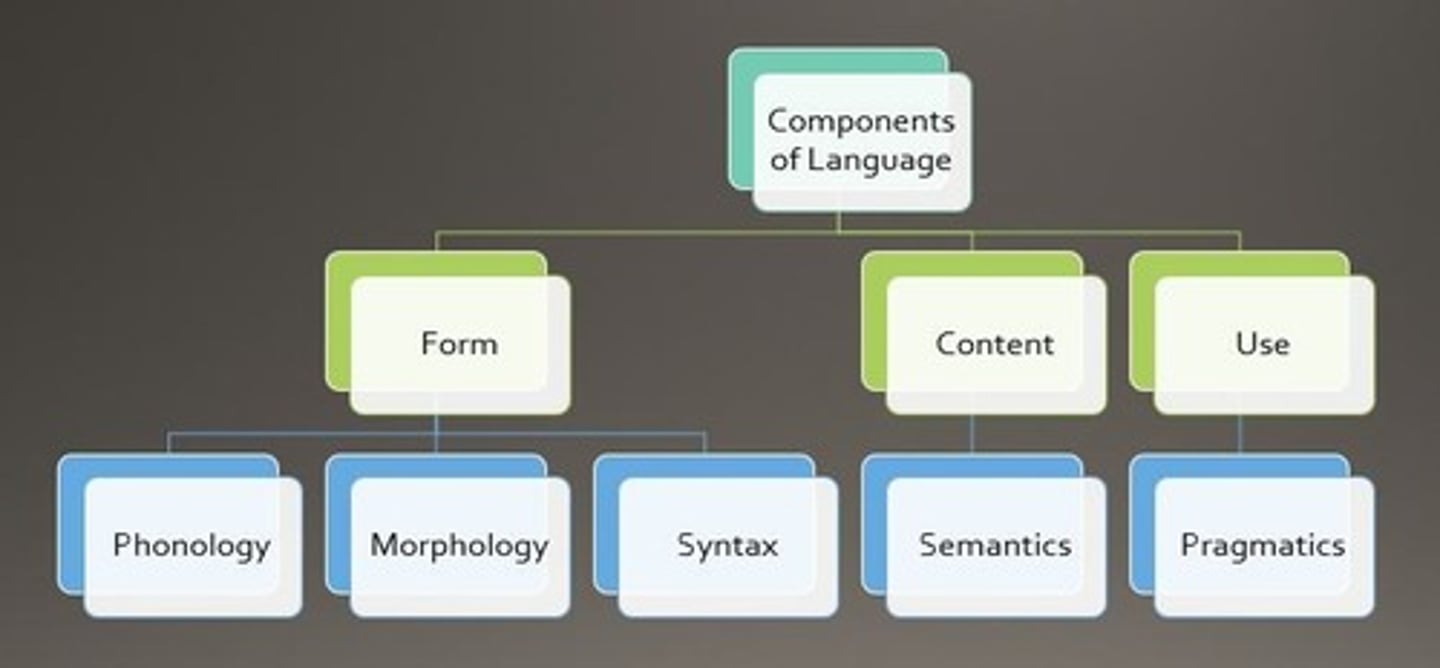
What is pragmatics?
Pragmatics refers to the contextual information surrounding language that helps in interpreting meaning.
What is speech perception?
Speech perception is the process by which the brain interprets and understands spoken language.
What is the dual-route model of reading?
The dual-route model of reading suggests there are two pathways for reading: the lexical route for familiar words and the non-lexical route for unfamiliar words.
What is the garden path model of parsing?
The garden path model explains that parsing a sentence involves connecting its components in the simplest possible structures, often leading to initial misinterpretations.
What is an example of how language can influence thought?
Spatial orientation in some languages uses cardinal directions instead of left and right, affecting speakers' sense of orientation.
What is a common challenge faced by Natural Language Processing (NLP) systems?
Ambiguities in human language, such as slang, idioms, and sarcasm, pose significant challenges for NLP systems.
What is fast thinking?
Fast thinking is an automatic, quick response to stimuli, often based on intuition or immediate perception.
What is slow thinking?
Slow thinking involves deliberate, effortful processing of information, requiring more cognitive resources to arrive at a solution.
What is the significance of the 10-month milestone in speech perception?
By 10 months of age, a child's ability to recognize phonemes becomes similar to that of adult speakers of their native language.
What is the role of determiners in language?
Determiners are words like 'the' and 'a' that introduce nouns and can influence how easily a person learns a second language if their native language lacks them.
What is an example of a lexical route scenario?
Reading a familiar irregular word like 'yacht' requires the lexical route, as it must be retrieved from stored lexical knowledge.
What is an example of a non-lexical route scenario?
Reading a newly encountered non-word by applying grapheme-to-phoneme conversion rules requires the non-lexical route.
What does the term 'minimal attachment' refer to?
Minimal attachment is a principle in parsing that suggests connecting components of a sentence in the simplest structure possible.
What is the relationship between grammatical gender and object description?
Grammatical gender can influence how people describe objects, as seen in languages where the word for 'bridge' is feminine, leading to more feminine adjectives used for it.
What is the impact of color perception in language?
If two color samples can be described by the same basic color term, people may not respond with surprise; however, different terms can elicit surprise.
What is System 1 Thinking?
A type of thinking that is automatic, requires minimal attentional resources, and is involuntary.
What is System 2 Thinking?
A type of thinking that requires attention to effortful mental activities, associated with agency, choice, and concentration.
What is inattentional blindness?
The phenomenon where focusing on one task causes individuals to miss other important details.
What is the primary characteristic of System 2 thinking?
It requires selective attention and can stop System 1 thinking from occurring.
What is the Mϋller-Lyer Illusion?
An optical illusion where two lines of equal length appear to be different lengths due to the orientation of arrowheads at their ends.
What is a cognitive illusion?
A type of illusion that occurs in our thinking processes, such as being blind to the obvious.
What is Histrionic Thinking?
An experience-based strategy that provides an efficient means of finding answers but cannot guarantee a correct outcome.
What is Algorithmic Thinking?
A well-defined procedure or set of rules that guarantees a solution, though it may be inefficient.
What is Deduction?
A reasoning process where the conclusion logically follows from the premises, often using syllogisms.
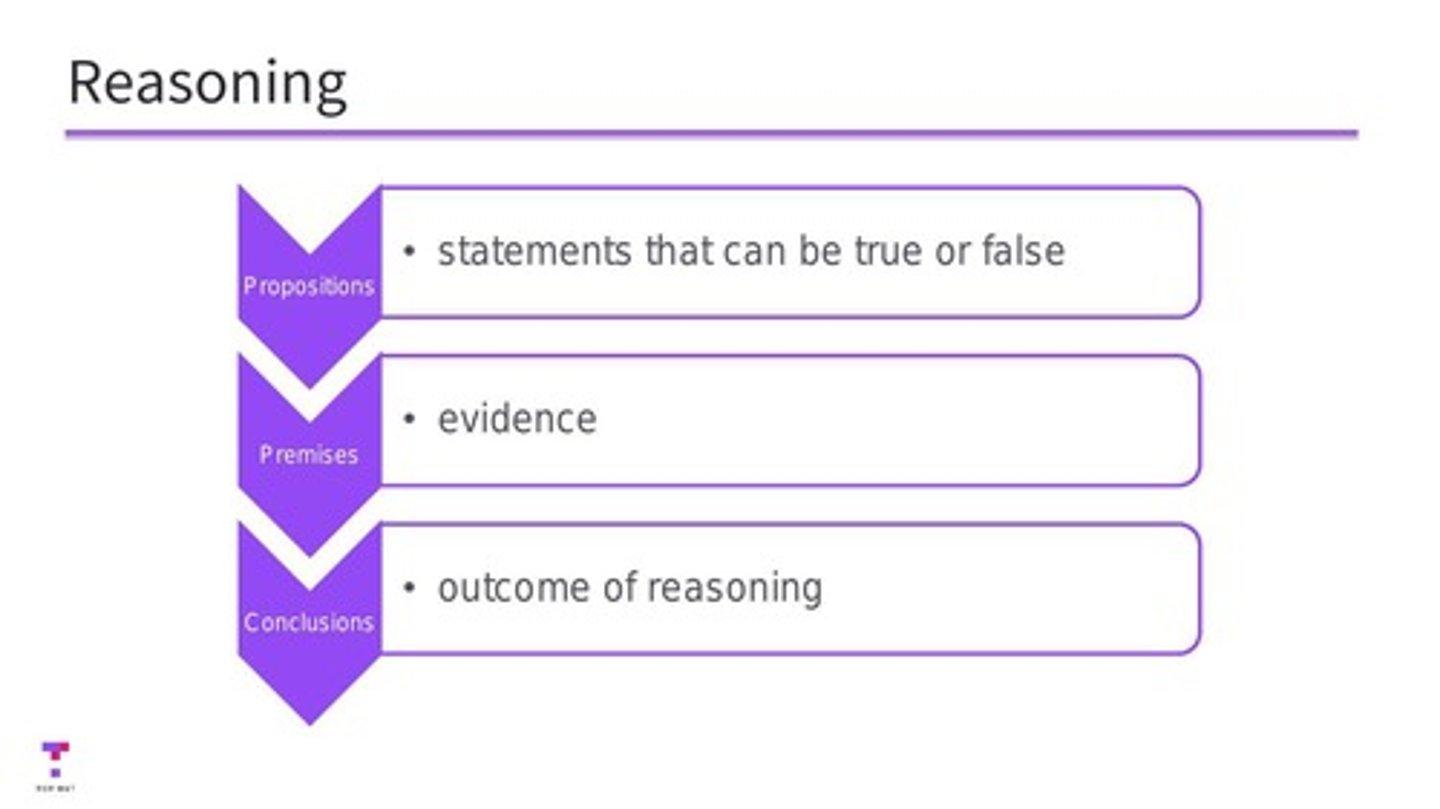
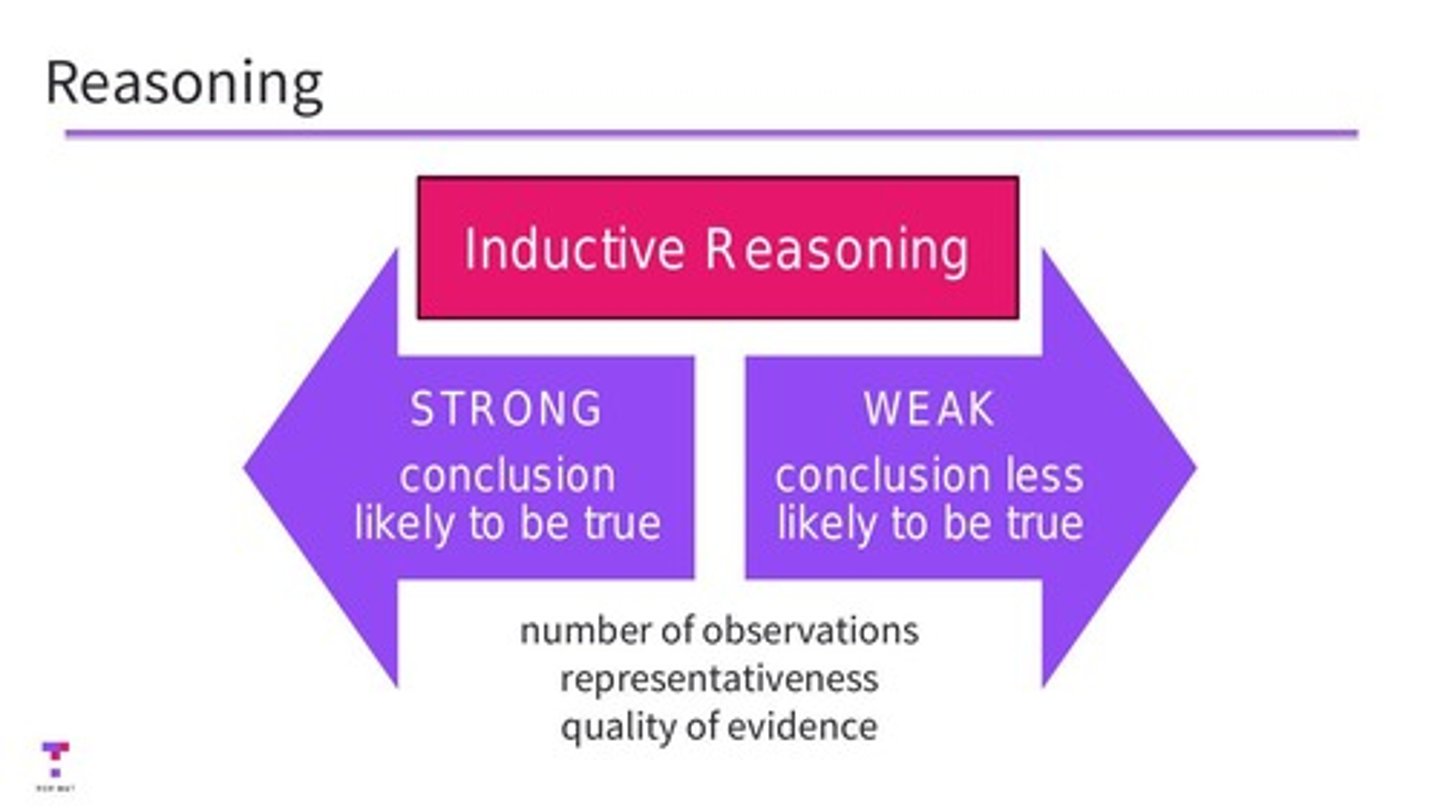
What is Inductive Reasoning?
A reasoning process that involves making observations and generalizing them to arrive at a conclusion, never 100% certain.
What are Categorical Syllogisms?
Syllogisms that describe a relationship between two categories.
What are Conditional Syllogisms?
Syllogisms where the first premise has the form 'If...then' and assesses the validity of the reasoning.
What is Problem Solving?
The process by which individuals attempt to overcome difficulties and achieve goals through logical reasoning or creative thinking.
What is the Permission Schema?
A long-term memory developed over time of social rules that helps in reasoning about social behaviors.
What is the Evolutionary Approach in reasoning?
The idea that humans have evolved abilities to detect cheaters in social situations, enhancing reasoning skills.
What is the significance of attention in cognitive processes?
Attention is crucial for engaging System 2 thinking and can influence the effectiveness of problem-solving and decision-making.
What is the interaction between System 1 and System 2?
Both systems work together in information processing, where System 1 handles quick judgments and System 2 engages in more deliberate thought.
What is the effect of selective attention?
Focusing mental effort on one task can lead to missing other important details, known as inattentional blindness.
What is the role of self-control in thinking?
System 2 creates self-control to overcome the impulses and biases of System 1 thinking.
What is the difference between cognitive and perceptual illusions?
Cognitive illusions involve errors in thinking processes, while perceptual illusions involve misinterpretations of sensory information.
What is the relationship between attention and flow?
The experience of flow involves maintaining focused attention on an activity, which requires self-control and effort.
What is the significance of biases in System 1?
System 1 can lead to biases and may answer easier questions than the ones actually asked, affecting decision-making.
What is the Problem-Solving Cycle?
A series of steps including recognizing a problem, representing it mentally, developing a solution strategy, organizing knowledge, allocating resources, monitoring progress, and evaluating the solution.
What is an Initial State in problem solving?
The initial situation or starting point before any actions are taken to solve a problem.
What are Intermediate States?
All possible states between the initial and goal states, created by applying operators or actions that transform the current problem state.
What is a Goal State?
The desired final state or ending that one aims to achieve in problem solving.
What is a Well-defined Problem?
A problem that has correct answers, clearly defined states, and can be solved by humans and computers, such as playing a game of chess.
What is an Ill-defined Problem?
A problem that can have multiple correct answers, an unclear goal state, and can be solved in many ways, such as choosing a college major.
What is Thorndike's Law of Effect?
A principle stating that behaviors followed by satisfaction are strengthened and more likely to be repeated, while those followed by discomfort are weakened.
What is the Gestalt Approach to problem solving?
A perspective that views problem solving as a productive process involving the manipulation and reconstruction of information.
What did Metcalfe and Wiebe (1987) study?
They investigated cognitive processes in solving insight versus non-insight problems, finding differences in prediction accuracy.
What is the Heuristic-Working Backwards?
A problem-solving strategy that focuses on the end result and generates backwards steps to reach that result.
What is Heuristic-Means-End Analysis?
A problem-solving method that involves completing sub-goals to move closer to the final goal state.
What is Convergent Thinking?
A type of thinking that uses logic and established rules to arrive at conventional solutions.
What is Divergent Thinking?
A type of thinking that involves brainstorming and free-thinking to generate unique solutions.
What is the Endowment Effect?
A phenomenon where individuals place a higher value on things they own compared to things they do not.
What is Kahneman and Tversky's Framing Effect?
The tendency for the presentation of information to influence decisions, even when the facts are identical.
What is the Expected Value Theory?
A decision-making theory that suggests individuals make choices based on the expected value or probability of outcomes.
What is Bernoulli's Expected Utility Theory?
A theory that incorporates psychological value and accounts for risk aversion in decision-making.
What is Kahneman and Tversky's Prospect Theory?
A theory that emphasizes the role of reference points, focusing on gains and losses, and highlights loss aversion.
What is Impulsivity in decision-making?
The tendency to make choices or act without considering the consequences beforehand.
What is Myopia in decision-making?
The focus on immediate rewards or outcomes while ignoring future consequences or information not immediately available.
What is Risk Aversion?
The tendency for individuals to prefer options perceived as having lower uncertainty.
What is the Iowa Gambling Task?
A psychological task designed to assess decision-making and risk-taking behaviors, particularly in individuals with ventromedial prefrontal cortex damage.
What is Normative decision-making?
A focus on how decision-makers ought to make decisions if they behave rationally.
What is Descriptive decision-making?
A focus on how real-life decision-makers actually make decisions.
What is incubation in problem solving?
Taking a break from a problem to allow the unconscious mind to work on it.
What is an example of a non-trivial, ill-defined problem?
Deciding what to major in for your undergraduate degree.
What does insight refer to?
The sudden realization of a solution to a problem, often described as the 'Ah-Ha' moment.
What do Dunker's candle problem, Maier's 2-string problem, and Luchin's water-jug task have in common?
They tend to result in fixation, which prevents people from solving the problem.
What is the relationship between problem-solving and creativity according to Zirhliglu (2012)?
There is a positive relationship between problem-solving abilities and creative capabilities.