Biology- Life processes
 Call Kai
 Learn
Learn Practice Test
 Spaced Repetition
 Match
Match Flashcards
 Knowt Play
1/32

Earn XP
Description and Tags
Name | Mastery | Learn | Test | Matching | Spaced | Call with Kai |
|---|
No analytics yet
Send a link to your students to track their progress
33 Terms
Characteristics of living things
Movement, growth, sensitive, respire, excrete, reproduce, and utilize nutrients
Life processes
Basic functions performed by living organisms for maintaining life
Nutrition
Process of intake and utilisation of nutrients in food by an organism, as an energy resource or for the biosynthesis of body constituents.
Autotrophic Nutrition
Type of nutrition in which organisms synthesise organic material from inorganic material- plants and blue green algae.
Steps of photosynthesis
Absorption of light by chlorophyll
Conversion of light energy to chemical energy and splitting of water into o2 and h2.
Reduction of co2 to produce carbohydrates.
Chloroplast- function, chlorophyll and location
Site of photosynthesis. Below upper epidermis in a tissue called palisade. chlorophyll absorb light
Where does gaseous exchange occur?
in leaves through stomata and also on the surface of stems, roots and leaves.
When does stomata open and close?
When guard cells swell when water flows through them causing stomata to open and when they shrink stomata closes
Heterotrophic nutrition
Type of nutrition in which energy is derived from the intake and digestion of the organic substances obtained from a plant or animal.
Saprophytic Nutrition
Obtain nutrients from dead and decaying organic matter- fungi and bacteria
Parasitic nutrition
Organism (parasite) obtains food synthesised by other (host)- Cuscuta, Plasmodium and lice.
Holozoic nutrition
Complex organic matter is taken in by ingestion and is digested and absorbed- amoeba and humans.
Phagocytosis
A process by which living organisms engulf large particles mainly food using its plasma membrane.
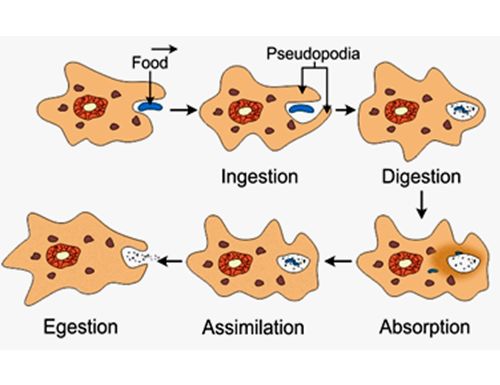
Assimilation and Egestion (Amoeba)
Digested food diffuses into the cytoplasm and utilized by the cell. The undigested food in the food vacuole is thrown out of the body.
Name the 5 steps of nutrition in amoeba.
Ingestion → Digestion → Absorption → Assimilation → Egestion
Name the glands associated with human digestion.
Salivary glands, liver and pancreas
Peristaltic movement
The rhythmic contraction and relaxation in the alimentary canal
Salivary amylase
Secreted by salivary glands and converts starch into sugar
Gastric Juices
Secreted by the glands in the walls of stomach. Contains pepsin, HCL, and mucus.
Pepsin
Secreted by stomach and acts on protein in an acidic medium
Function of HCL in stomach
to create an acidic medium for pepsin to act
Kill any bacteria that enters with the food.
Muscle that is present in the stomach that release small amount of food in in small intestine
Sphincter muscle
Largest part of alimentary canal
Small intestine- 6.5 m long
How does the length on small intestine differ in different animals? Give examples of carnivores and herbivores.
It depends on the food to be digested. in herbivores, it is long as