The other ps
 Call Kai
 Learn
Learn Practice Test
 Spaced Repetition
 Match
Match Flashcards
 Knowt Play
1/29

There's no tags or description
Looks like no tags are added yet.
Name | Mastery | Learn | Test | Matching | Spaced | Call with Kai |
|---|
No analytics yet
Send a link to your students to track their progress
30 Terms
Physical environment
Refers to the tangible aspects of a service. This is important because the physical environment is designed to make customers feel a certain way depending on the service, ensuring they have a memorable experience.
Packaging
A form of physical evidence, the art of presenting products in an advantageous way in order to improve sales
Processes
the way in which a service is provided or delivered: This includes payment methods, waiting times, customer services, after sales care, delivery processes.
Opportunity cost
it represents what must be sacrificed or given up in order to choose one option over another.
People
Relationship between employee-customer relationships. It is important for service oriented businesses to build good relationships and trust with their customers
Methods of measuring customer service quality (4)
Appearance and body language
Aptitudes and attitudes
Feedback (from customers and other stakeholders)
Efficiency
Place
refers to business activities that make the product available to consumers
Channels of distribution
the path taken for a product to get from the producer to the consumer. This is done by either selling directly to consumers or by using intermediaries like wholesalers and distributors
Intermediaries
firms or agents who act as middle-person between producers and consumers
Intermediation
the process to facilitate the distribution methods used to get a product to the consumer
Levels of distribution
The channels of distribution generally have the following levels: zero-level, one-level, two-level
Zero-level distribution
The zero-level distribution channel: skips out any intermediaries and sells directly to the customer
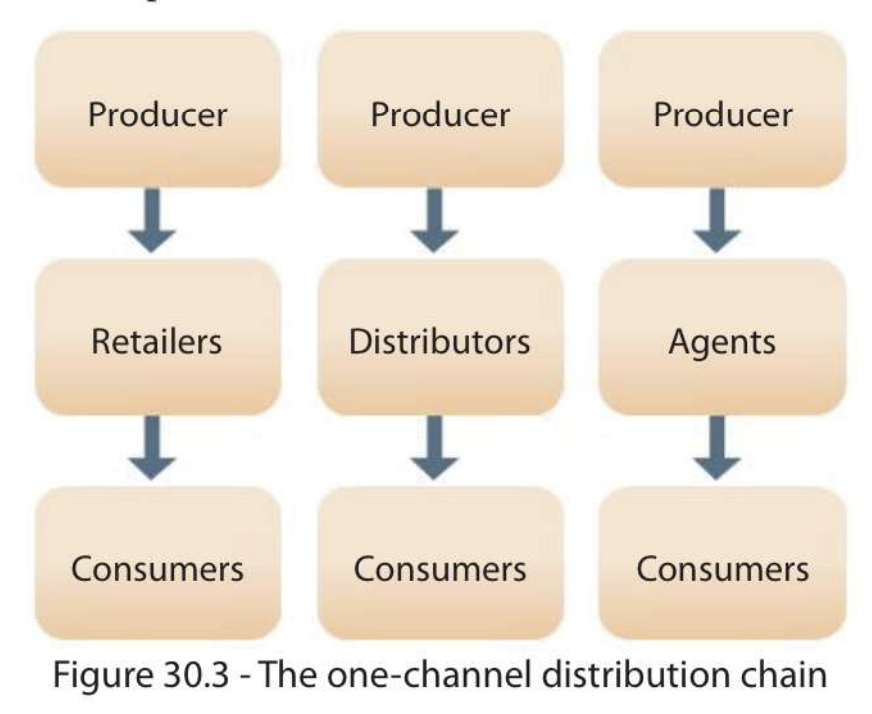
One level distribution channel
One intermediary, such as retailers, agents being used to sell a manufacturer's products to consumers.
Two level distribution channel
Uses two intermediaries, such as the use of wholesalers and retailers to get products to consumers.
Long chain disadvantages
Long chains of distribution are not suitable for perishable products businesses that purchase large quantities of products from a manufacturer and then separate the bulk-purchases into smaller units for resale, mainly to retailers.
Advantages of intermediaries (2)
Costs of storage --> freeing up space for retailers, intermediaries and manufacturers.
By breaking bulk, wholesalers sell smaller batches of product to retailers and intermediaries. This helps to eliminate their need to purchase large quantities directly from a manufacturer.
There are lower transaction costs for the manufacturer, as wholesalers are customers, not the countless smaller individual retailers and intermediaries.
Speciality channels of distribution
any indirect way to distribute products that does not involve retailers. (not using intermediaries)
Wholesalers
Businesses that purchase large quantities of products from a manufacturer and separate or break the bulk-purchases into smaller units for resale, mainly to retailers
Distributors (IS that T)
independent and specialist businesses that trade in the products of only a few manufacturers.
agents (brokers) (RN)
representatives and negotiators who act on behalf of buyers and vendors of a product. They are not usually employed by the producer but are used as an intermediary to help sell the vendor's products.
Retailers
sellers of products to the final consumer. they are often referred to as “shops” and are important in the distribution of products as they have the ability to reach large numbers of consumers.
Independent retailers
small local vendors, often owned by a sole proprietor
Speciality channels of distribution
any indirect way to distribute products that does not involve retailers, specifically the distribution of products without the use of intermediaries.
Examples of speciality channels
e-commerce, vending machines and mail order
E-commerce
Trading via the internet because it has a big impact on marketing considering many people use it nowadays. It allows for access to customers beyond traditional geographic boundaries of markets has been huge benefit to e-tailers”
Vending machines
specialist machines that stock products for sale. Due to their compact size, they can be placed almost anywhere and the payment methods are varied.
Mail order
Involves a business sending promotional material such as a catalogue, the postal system to entice customers to buy a firm’s products. Businesses that have a customer database tend to use this channel of distribution
Factors that affect the choice of distribution channels
Product, market (niche —> no need to intermediaries), time, legal constraints, cost and benefits.
Social media marketing (online traffic)
the promotional practice of gaining online traffic through social media platforms such as Facebook and Instagram.
Advertising
the method of informative or persuasive promotion that is usually paid for. Its aim is to raise the level of demand of the firm’s products.