H4: Texture Synthesis
 Call Kai
 Learn
Learn Practice Test
 Spaced Repetition
 Match
Match Flashcards
 Knowt Play
1/17

There's no tags or description
Looks like no tags are added yet.
Name | Mastery | Learn | Test | Matching | Spaced | Call with Kai |
|---|
No analytics yet
Send a link to your students to track their progress
18 Terms
The problem
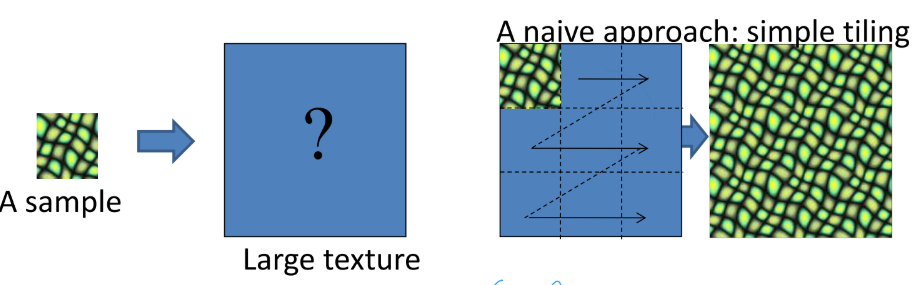
Given texture I, generate texture J
That looks like I (or differs from I in the same way as I differs from itself)
Doesn’t show any obvious copying or tiling
Types of Textures and Techniques
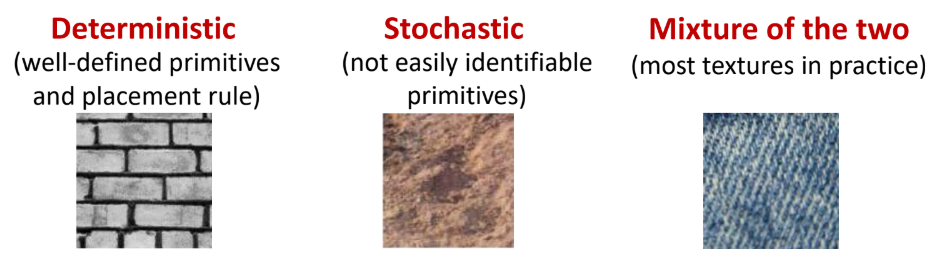
Model-based methods
First-order statistics (pyramidal methods)
Using Markov Random Fields (We don’t treat in this course)
Tiling and patch methods
“Image Quilting”
Wang tiles
Hybrid methods (tiling + stochastic modeling)
Pyramidal Methods (Heeger&Bergen)
Two textures are difficult to discriminate if they produce similar responses in a bank of (orientation and frequency selective) linear filters
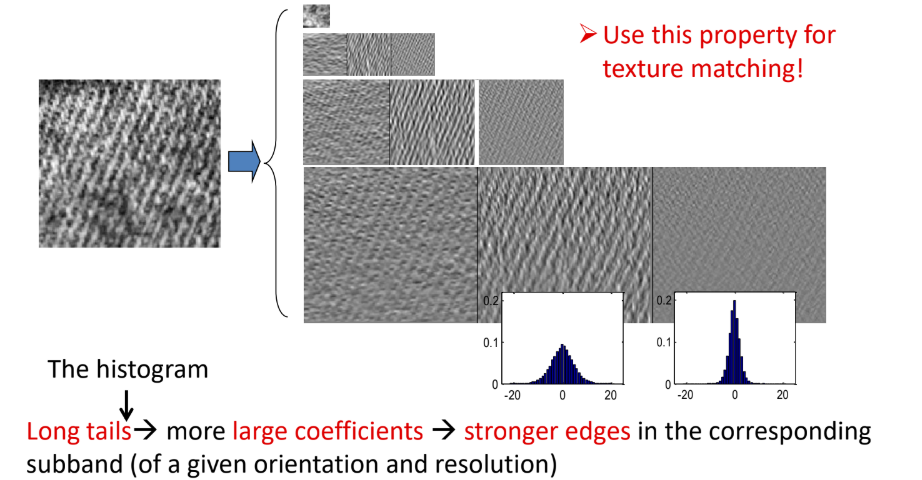
Suitable for homogeneous stochastic textures!
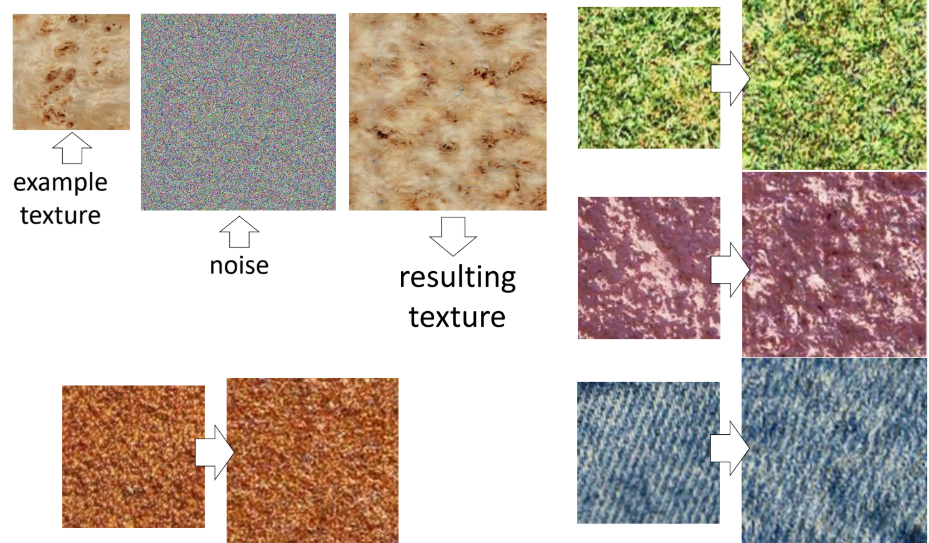
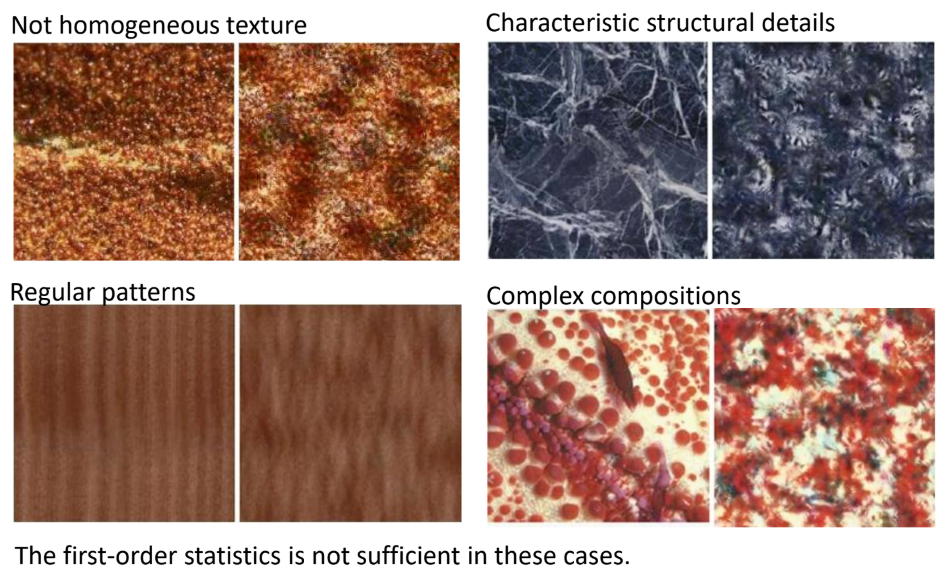
Where they don’t work
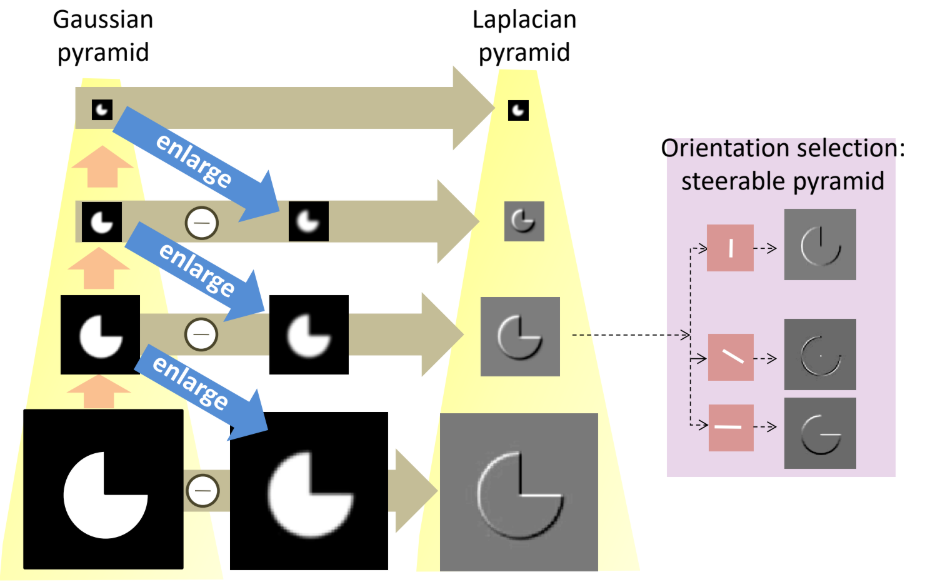
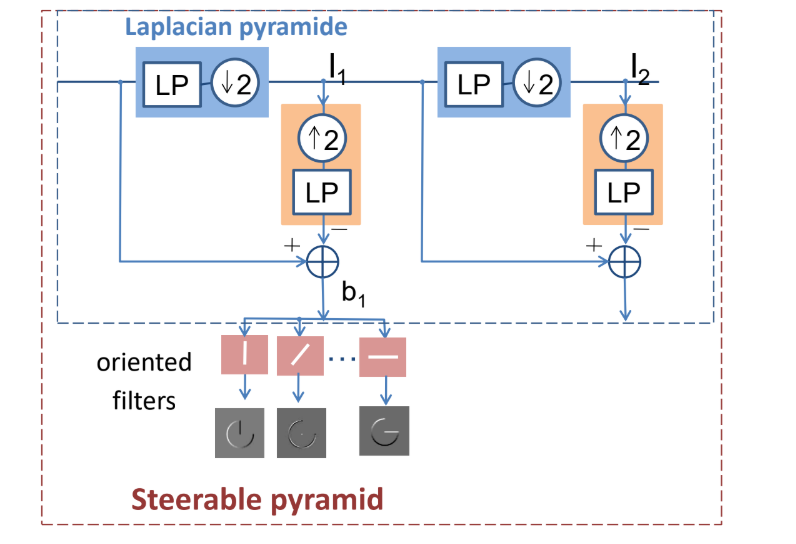
Pyramidal Decomposition
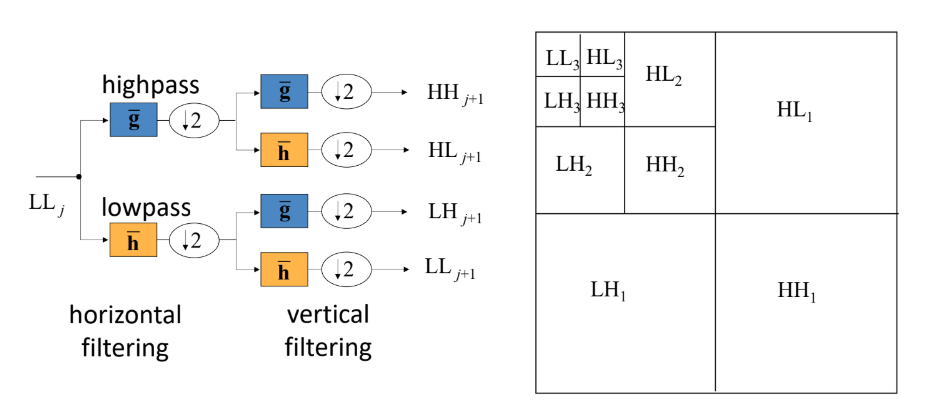
Discrete Wavelet Transform (DWT)
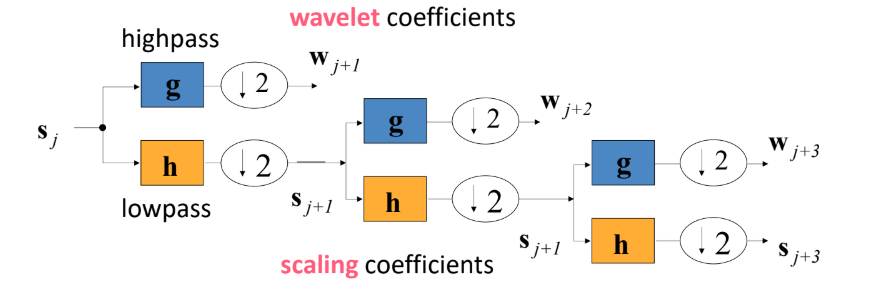
DWT algorithm: a filter bank iterated on the lowpass output
The same texture synthesis concept can be applied using image pyramid or DWT or a related multiresolution image representation
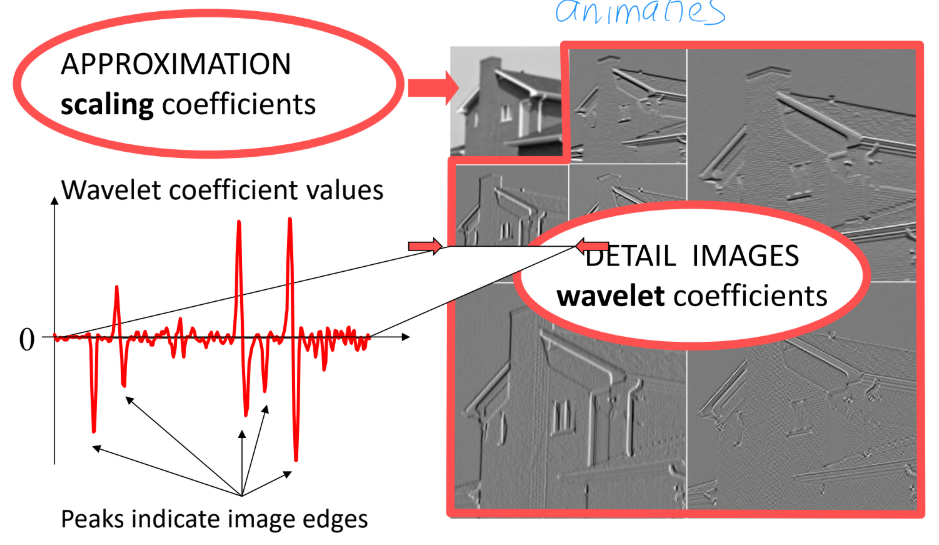
Twp dimensional DWT
Histogram matching
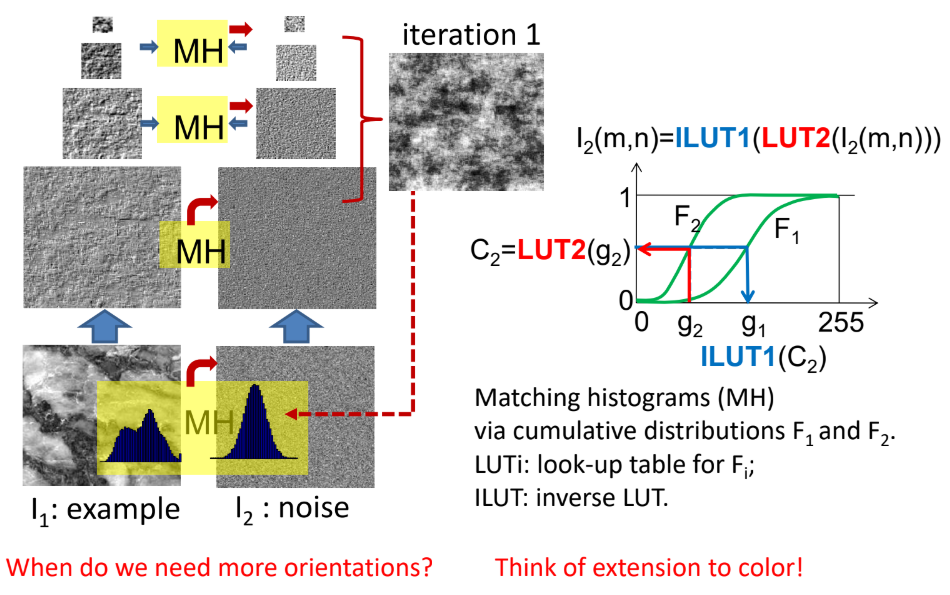
In the context of Chapter 4 (Texture Synthesis), Histogram Matching is a core mathematical operation used in Pyramidal Methods (specifically the Heeger & Bergen method) to synthesize new textures.
The overall goal of this method is to take an initial image of random noise and iteratively force it to look like a given "example" texture by matching their statistical properties (first-order statistics) at various scales and orientations.
Here is an intuitive breakdown of how the histogram matching process works:
Pyramidal Decomposition: First, both the example texture (I1) and the noise image (I2) are decomposed into a pyramid (like a Laplacian or Steerable pyramid). This breaks the images down into multiple "subbands" that isolate different resolutions (scales) and orientations.
Analyzing the Histograms: At each level of the pyramid, the algorithm calculates the histogram of the subband coefficients. The shape of these histograms tells us important information about the texture. For instance, if a histogram has long tails, it means there are more large coefficients, which indicates the presence of stronger edges in that specific orientation and resolution.
The Matching Process: The algorithm mathematically forces the histogram of the noise subband to match the histogram of the example subband. It does this by using their cumulative distribution functions (CDFs), denoted as F1 and F2:
It takes a pixel value from the noise image and looks up its cumulative probability using a Look-Up Table (C2=LUT2(g2)).
It then uses the Inverse Look-Up Table of the example texture (ILUT1) to find the exact pixel value in the example that corresponds to that same cumulative probability.
This translates to the formula: I2(m,n)=ILUT1(LUT2(I2(m,n))).
Iteration: This matching step (MH) is performed iteratively across every level of the pyramid. As the noise image's histograms are forced to match the example's histograms at every scale and orientation, the noise gradually transforms into a synthesized texture that visually mimics the original.
This approach is highly effective for generating homogeneous stochastic textures (like sand, bark, or rough surfaces), but struggles with highly structured or complex regular patterns where first-order statistics are not enough to capture the spatial relationships.
Pyramidal Methods: Summary
Based on first-order statistics
Motivated by studies of the human visual system
Effective for homogeneous stochastic textures
Image Quilting
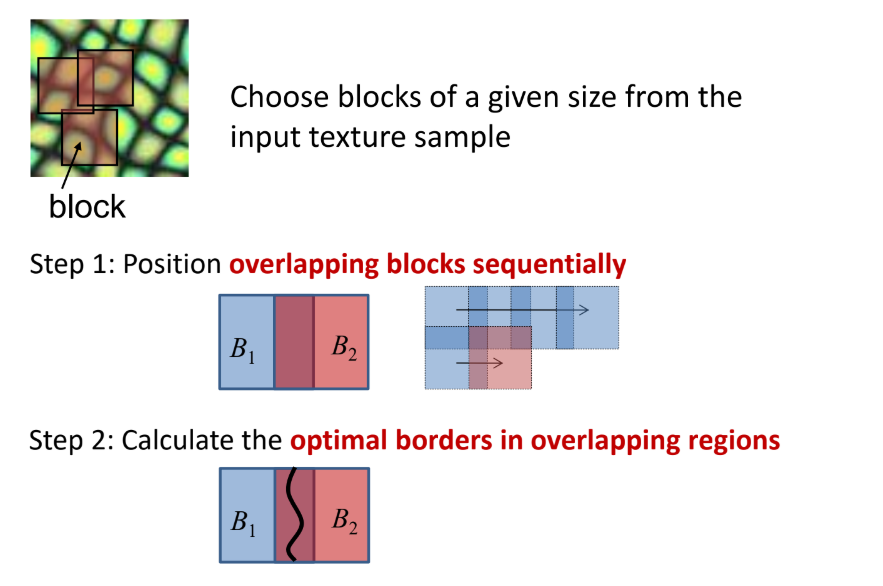
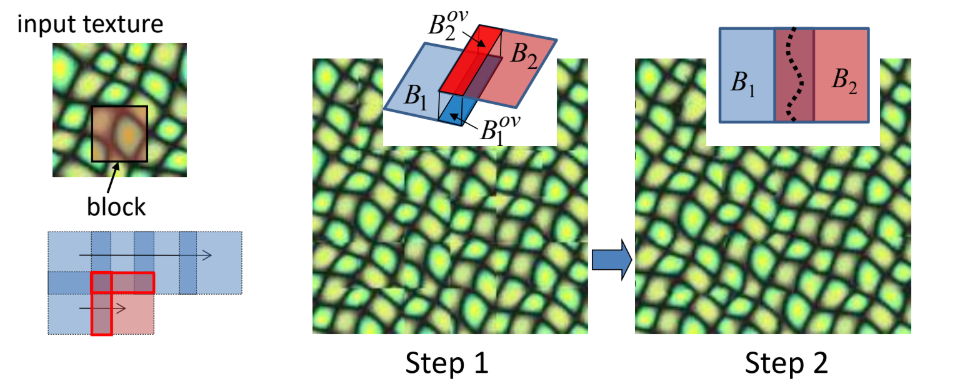
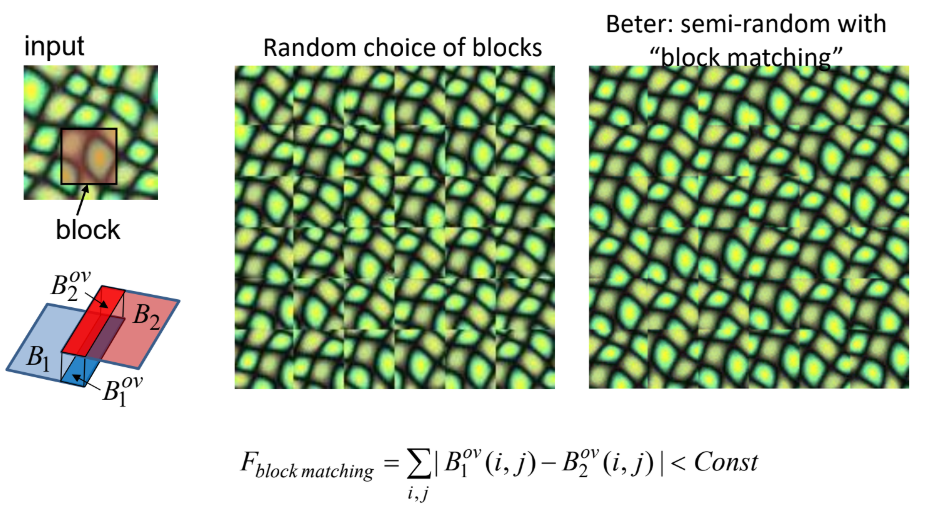
Step 1: position overlapping blocks sequentially
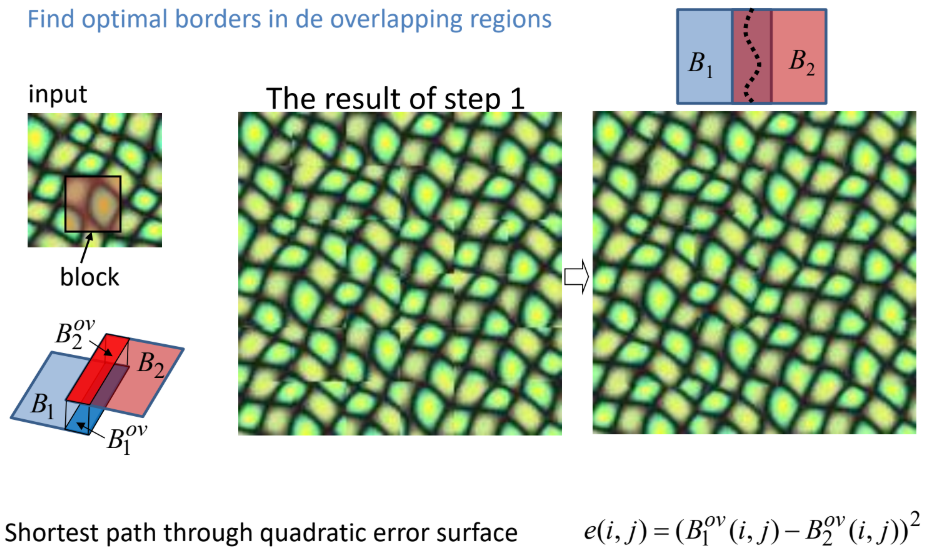
Step 2: Find optimal borders in the overlapping regions
Results:
✓ Works rather well for all texture types
But
Computationally intensive
The influence of the block size is difficult to define
Image Quilting and texture transfer
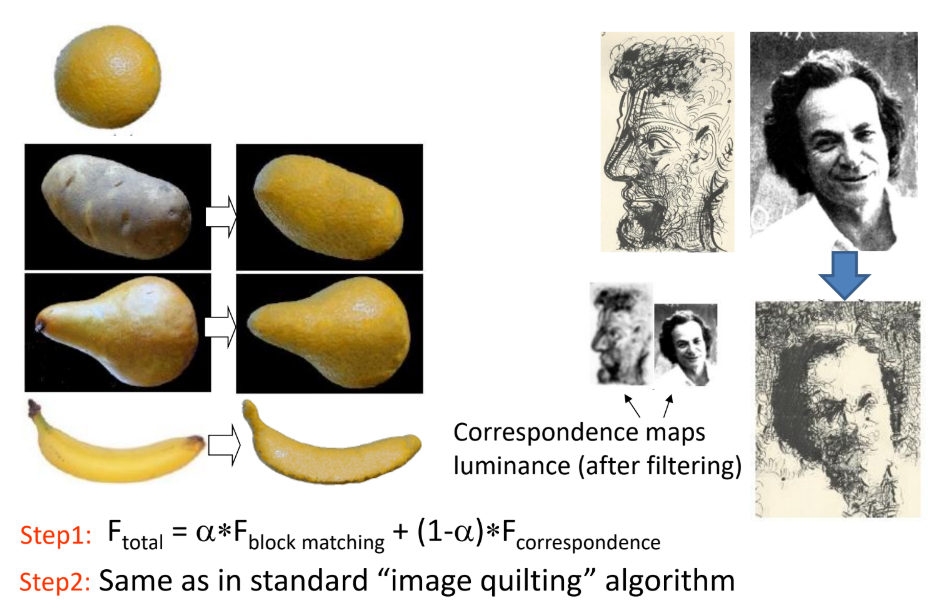
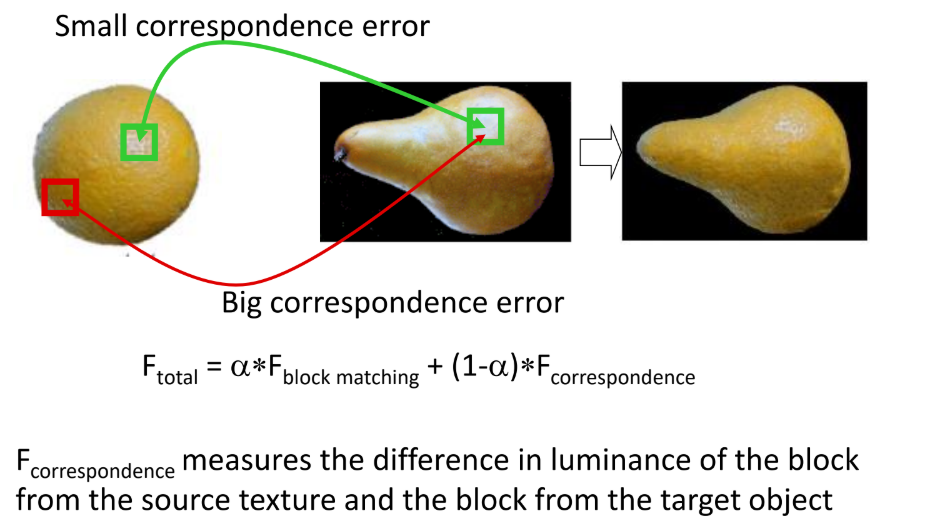
Image Quilting: summary
A tiling method
“Glues” blocks from the input texture sample
Works for almost all texture types
Computationally intensive
Wang tiles
Square tiles with color-coded edges.
Cannot be rotated in the tiling!
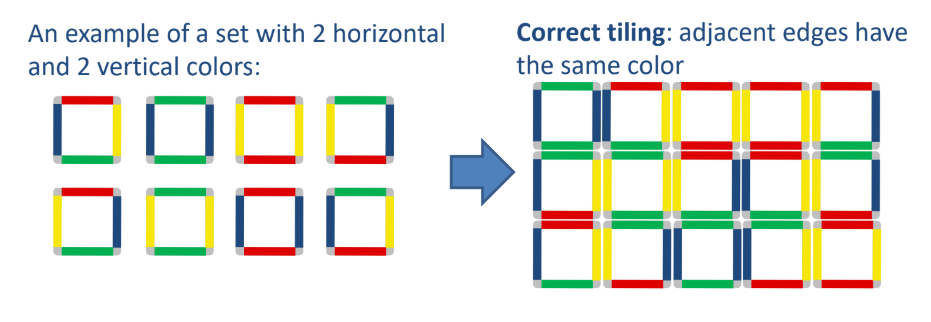
This tiling was named after Hao Wang, who conjectured in 1961 that any
set that can produce a valid tiling of the plane must also be able to
produce a periodic tiling
Later showed: not true! Berger (student of Wang) disproved this in 1966.
In the computer graphics we use sets that make periodic and not periodic
tiling (e.g. the set of 8 tiles above)
Wang tiles
Stochastic tiling
If there is at least one tile for each N-W combination → correct tiling is guaranteed
If there are at least two tiles for each N-W combination → not periodic tiling is guaranteed.
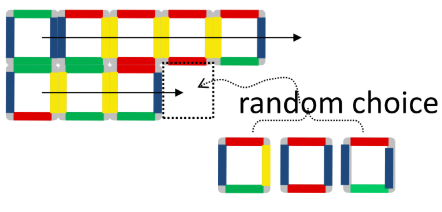
Wang Tiles:
Tile Design by Quilting
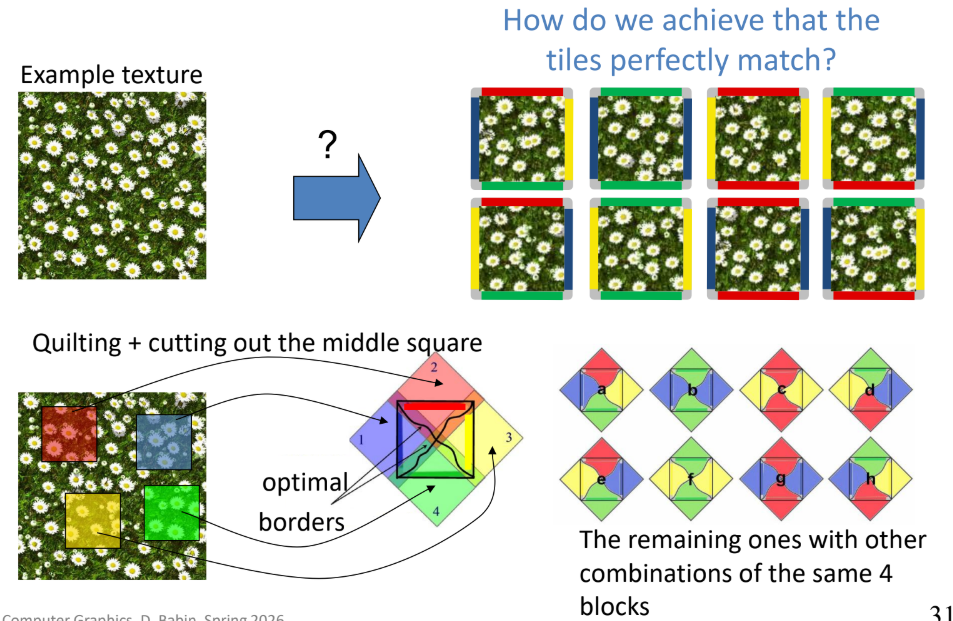
Introducing Inhomogeneity
We learned to solve this: extending to arbitrary size, no copying or tiling obvious, but does it look natural?
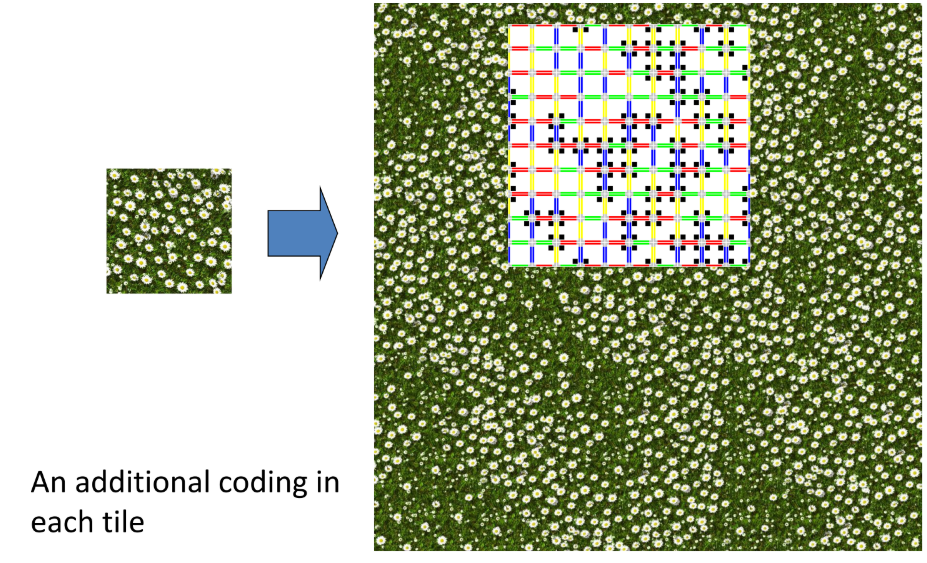
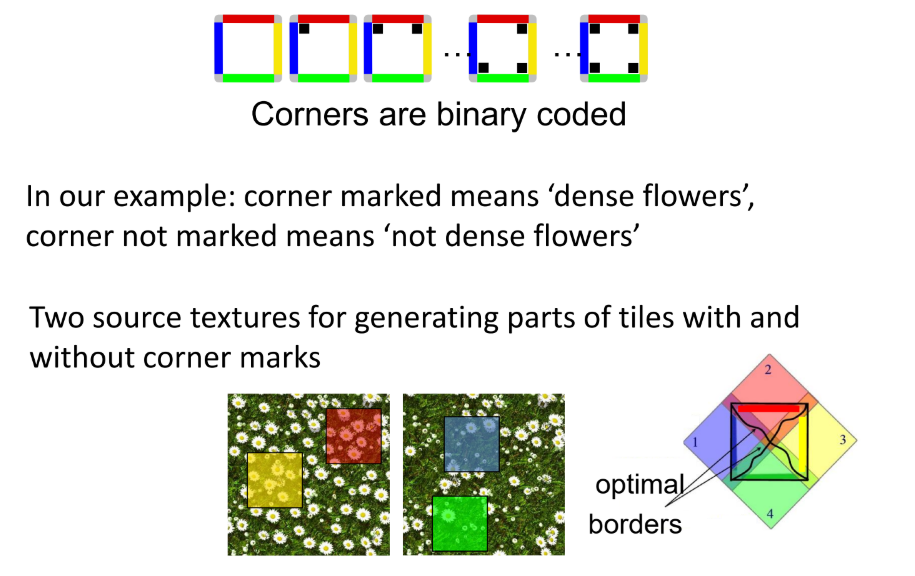
•For each tile: 2^4=16 possible corner codings
A set of 8 tiles extends to 8x16=128 tiles
This can be reduced to 64 and still keeping the stochastic selection. Why? (How many corners do we need to match at each step?)
Einstein problem
Einstein problem asks about the existence of a single prototile that by itself forms an aperiodic set of prototiles; that is, a shape that can tessellate space but only in a nonperiodic way.
Wang Tiles: Summary
The process of making tiles is complex (quilting)
Once tiles are made, tiling very fast
Works for almost all texture types
Very powerful for producing non-homogeneous textures
Algemene summary
Pyramidal methods based on first-order statistics
Work well for stochastic textures
Not for non-homogeneous textures, regular patterns and complex composites
Image Quilting
Conceptually simple but computationally intensive
For all textures (sometimes there are artifacts)
Very good for texture transfer and for making Wang tiles
Wang Tiles
Fast and simple, making infinitely large textures
Very good for complex textures
Making not homogeneous textures: coded corners and edges