Intermolecular Forces
 Call Kai
 Learn
Learn Practice Test
 Spaced Repetition
 Match
Match Flashcards
 Knowt Play
1/36

There's no tags or description
Looks like no tags are added yet.
Name | Mastery | Learn | Test | Matching | Spaced | Call with Kai |
|---|
No analytics yet
Send a link to your students to track their progress
37 Terms
Intermolecular forces vs Intramolecular Forces
intramolecular = within molecules = covalent / ionic bonds
intermolecular (IMF’s) = between molecules
Intermolecular forces are far stronger than Intramolecular Forces
IMF’s are up to 5% as strong
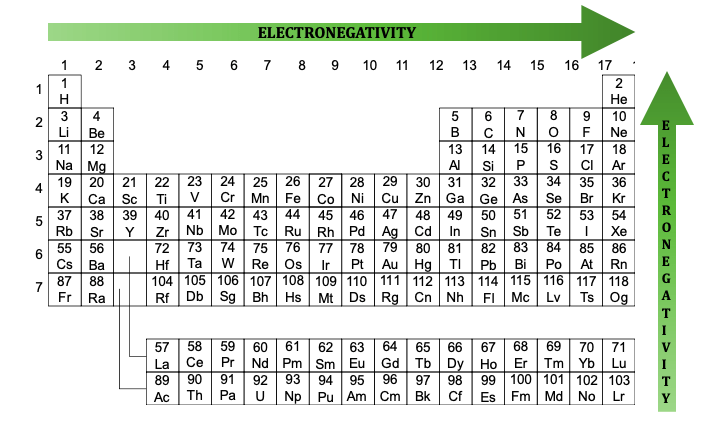
Electronegativity
top right is most electronegative (F)
bottom left is least electronegative
Lewis Dot Structure Steps
count valence electrons
Determine the central atom (least electronegative)
Draw single bonds from the center atom to each outer atom
Complete outer atom octets by adding pairs of electrons to outer atoms
place any leftover electrons on the central atom
form double or triple bonds if needed to satisfy all octets.
Ionic
contains a metal
Covalent
does not contain a metal
Polar Molecules
asymmetrical
Non-polar Molecules
symmetrical
Determining polarity questions
Is the molecule ionic? - if yes, polarity doesn’t matter
Is the molecule aqueous and does it start with H? - if yes, then its an ion
Is the molecule made up solely of carbon and hydrogen? - if yes, then it is non-polar
Are there 2 or more different elements around the central atom? - if yes, then it is polar
Are there any lone pairs on the central atom? - if yes, then it is polar
dipole
polar
induced dipole
non-polar
Type’s of IMF’s
dipole-dipole
hydrogen “bonding”
ion-dipole
ion-induced dipole
dipole - induced dipole
London dispersion forces
Dipole-dipole
attractive forces between polar molecules

Hydrogen “bonding”
special case of dipole-dipole
A hydrogen atom covalently bonded to N, O, or F is attached to N, O, or F on another molecule

Ion-dipole force
attractive forces between ions and polar molecules

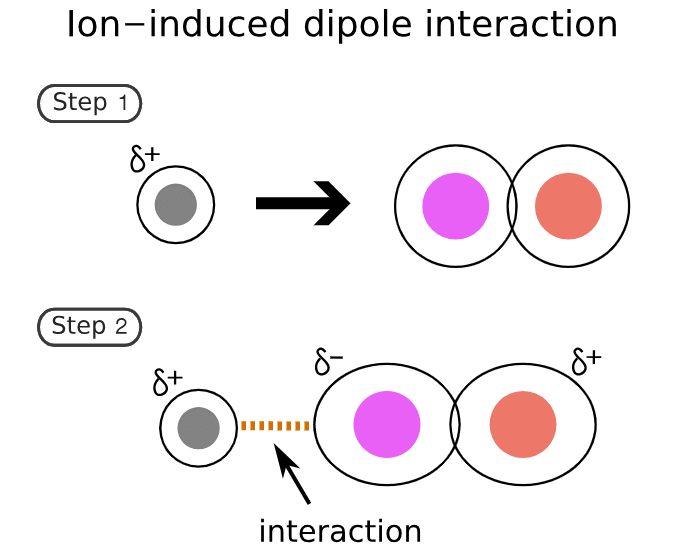
Ion-induced dipole
attraction between an ion and a nonpolar molecule
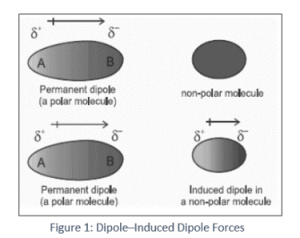
Dipole-induced dipole
attraction between a polar molecule and a nonpolar molecule
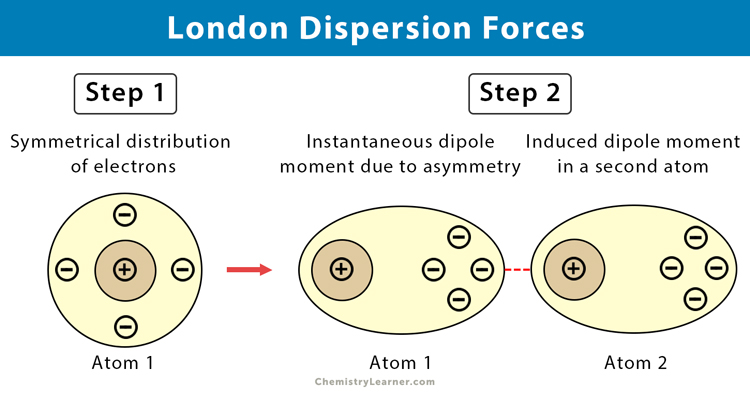
London dispersion forces
attraction between nonpolar molecules
position of the electrons causes temporary polarity
induces polarity in the next molecule
Higher LDF with
larger molecules
more electrons
more polarizable
IMF forces strength ranking
Ion-dipole forces
Hydrogen “bonding”
Dipole-dipole
Ion-induced dipole
Dipole-induced dipole
London dispersion forces
Boiling point
stronger forces = higher boiling point
Melting / freezing point
stronger forces = higher melting point
Viscosity
viscosity = resistance to flow, higher viscosity = less flowing
viscosity decreases at higher temperatures
stronger IMFs = higher viscosity
Surface Tension
molecules at the surface of a liquid pull tighter because they have fewer neighbors
stronger IMFs = higher surface tension
Vapor Pressure
The pressure above a liquid in a closed container when the rate of evaporation = the rate of condensation (equilibrium)
at higher temperatures, you get more vapor, so higher vapor pressure
higher IMFs = lower vapor pressure
Phase Diagrams
Heat Diagrams
Physical Properties of Solutions
Solution
Homogeneous mixture of 2 or more substances
Solute
substance(s) in smaller amounts
Solvent
substance present in smaller amounts
Saturated Solution
contains the maximum amount of solute that will dissolve in a given solvent at a given t
Unsaturated Solution
contains less than the maximum amount of solute at a given T
Supersaturated Solution
contains more solute than a saturated solution at a given T
∆Hsoln
amount of heat required to make a solution
amount of heat generated when a solute dissolves
Lattice Energy
Must always be positive
∆Hhydr
heat of hyrdation
∆Hsoln equation
∆Hsoln = lattice energy + ∆Hhydr
Like Dissolves Like