3.3.2 - Gas Exchange
 Call Kai
 Learn
Learn Practice Test
 Spaced Repetition
 Match
Match Flashcards
 Knowt Play
1/42

There's no tags or description
Looks like no tags are added yet.
Name | Mastery | Learn | Test | Matching | Spaced | Call with Kai |
|---|
No analytics yet
Send a link to your students to track their progress
43 Terms
What is the definition of breathing (ventilation)?
The movement of air in and out of the lungs
What is the definition of respiration?
A chemical reaction that releases energy in the form of ATP
What is the definition of gaseous exchange?
The diffusion of oxygen from the air into the blood in the alveoli
The diffusion of carbon dioxide from the blood into the air in the alveoli
What 3 features do gas exchange surfaces have?
Large surface area : volume ratio
Short diffusion distance
A maintained concentration gradient
What is Fick’s Law

How is the alveoli adapted for gas exchange?
300 million alveoli in each lung which increases surface area
The alveoli epithelial cells are very thin to minimise diffusion distance
Surrounded by capillaries therefore maintains a concentration gradient
Where does gas exchange take place in fish?
The lamella in the gills
a) What adaptation have fish produced to enable diffusion to occur?
Countercurrent flow
b) What is this adaptation?
When water flows over the gills in the opposite direction to the flow of blood in the capillaries
What is the anatomy of the fish gills?
There are 4 layers of gills made up of stacks of gill filaments
Each gill filament is covered in gill lamellae, perpendicular to the filaments
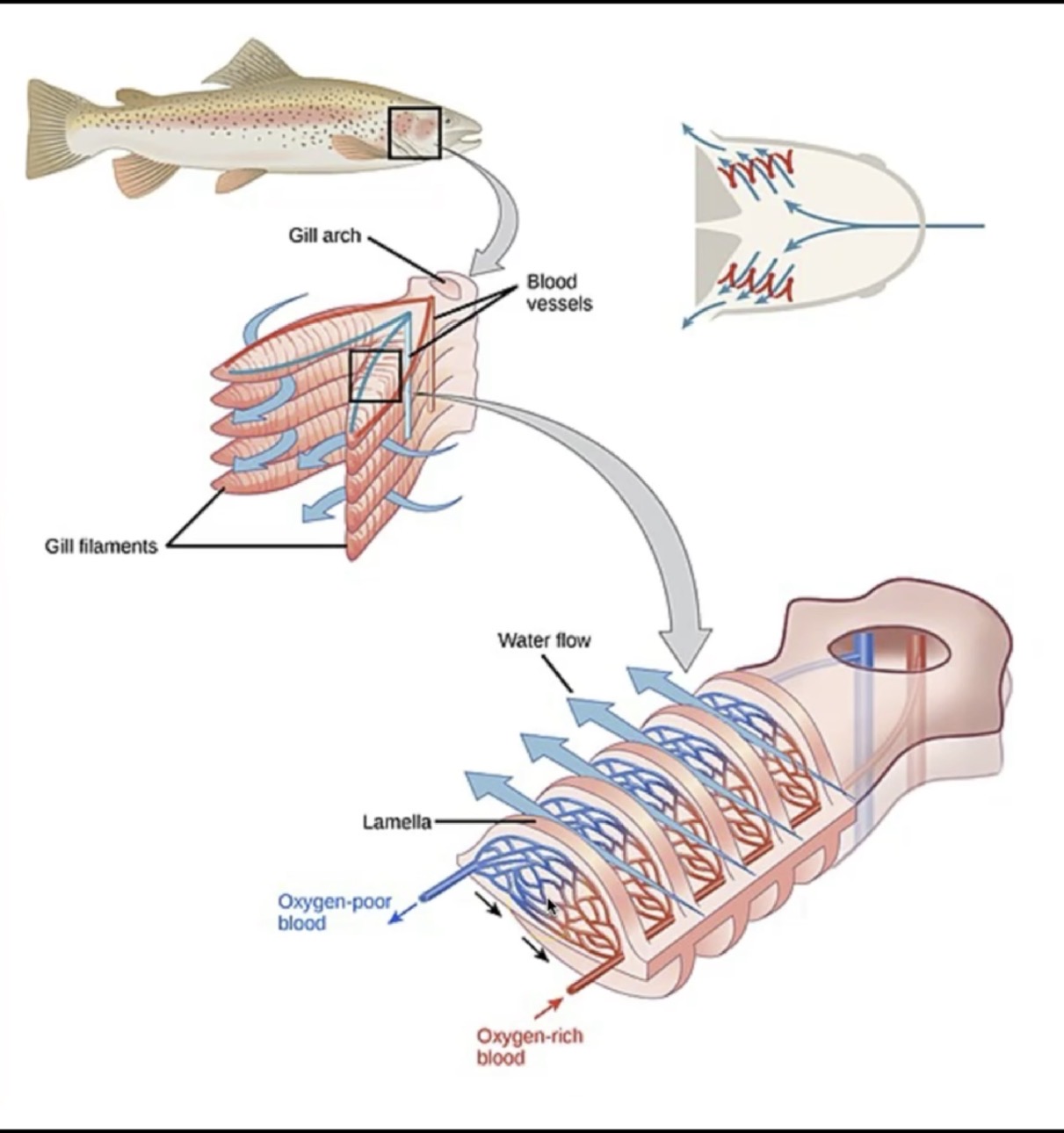
How is a short diffusion distance maintained in gills?
Because the gill lamellae are very thin
Every gill lamellae has a capillary network which comes into contact with the water therefore a short diffusion distance
How does countercurrent flow maintain a diffusion gradient across the entire length of the gill lamellae?
Insects have a hard exoskeleton, how is this an advantage? (2 points)
For protection
Prevents water loss
What does the tracheal system consist of? (3 points)
Trachea
Tracheoles
Spiracles
What are spiracles and what are their function?
Round openings running along the abdomen. Oxygen and carbon dioxide enter and leave via the spiracles
What is the trachea?
The network of internal tubes in the body which have rings within them to keep them open
What are tracheoles and what function do they serve?
Smaller tubes attached to the trachea that go deeper into the abdomen extending throughout all tissues to deliver oxygen to all respiring cells
How are the tracheoles adapted for gas exchange? (3 points)
Thin walls so short diffusion distance to cells
Highly branched providing a short diffusion distance
Highly branched providing a large surface area
At rest, how does gas exchange take place in an insect?
Diffusion is the main method of gas exchange - a steep concentration gradient is created when the cells respire using up oxygen and producing carbon dioxide
During periods of high activity, how does gas exchange take place?
The insect will undergo rhythmic abdominal movements, which actively moves air in and out of the tracheal system maintaining the diffusion gradient for oxygen and carbon dioxide
During periods of very intense activity, how does gas exchange take place?
Anaerobic respiration takes place producing lactic acid. This lowers the water potential of muscle cells causing water at the end of the tracheoles to move into the cells via osmosis. This reduces the volume of fluid in the tracheoles so gases diffuse quicker.
What is digestion?
When large biological molecules are hydrolysed into smaller molecules that can be absorbed across cell membranes
How are carbohydrates hydrolysed in the mouth?
Amylase is secreted by the salivary glands and hydrolyses polysaccharides into disaccharides
Where does the pancreas secrete more amylase and why?
In the duodenum (top of the small intestine)
Because the stomach acid denatures the amylase that is present
Once the carbohydrates have been hydrolysed into disaccharides and travelled through the stomach, where are they hydrolysed again?
The ileum
What enzymes hydrolyse disaccharides?
Membrane-bound disaccharidases
eg:
Sucrase - Sucrose
Maltase - Maltose
Lactase - Lactose
How many enzymes are capable of hydrolysing a protein?
3 - Exopeptidase, Endopeptidase, Dipeptidase
What does endopeptidase hydrolyse?
Peptide bonds in the middle of a polymer chain producing smaller chains
What does exopeptidase hydrolyse?
Peptide bonds at the end of a polymer chain - terminal peptide bonds
Why does endopeptidase increase rate of hydrolysis for exopeptidase?
Because endopeptidase increases the number of exposed ends for exopeptidase to hydrolyse terminal peptide bonds
What do dipeptidases hydrolyse?
Any remaining dipeptides into amino acids
Where are the 3 types of enzymes for proteins found?
Endopeptidase - Stomach/Duodenum
Exopeptidase - Stomach/Duodenum
Dipeptidase - Ileum
What 2 things hydrolyse lipids?
Lipase
Bile Salts
Where is lipase produced and secreted?
Produced - Pancreas
Secreted - Duodenum
What does lipase hydrolyse triglycerides into?
It hydrolyses the ester bond in triglycerides into monoglycerides, glycerol and fatty acids
Where are bile salts produced and released?
Produced - liver
Released - gall bladder then duodenum
What are the function of bile salts? (2 points)
They emulsify lipids to form lipid droplets to increase the surface area for lipase to hydrolyse lipids
They make micelles water-soluble
What are micelles?
Water-soluble vesicles
How do micelles help with lipid absorption?
Makes fatty acids more soluble in water which allows the micelles to move them towards the surface membrane
They carry and then release fatty acids to the ileum lining helping maintain a high concentration gradient so fatty acids diffuse down the concentration gradient into the epithelial cell via simple diffusion
Once fatty acids are absorbed into the ileum what do they reform into?
Triglycerides
Where are triglycerides reformed?
In the golgi body
Once triglycerides are reformed, what happens?
They are packaged into vesicles, allowing them to move to the opposite cell membrane. Then the vesicle releases the triglyceride where it then enters a lacteal
How are glucose and amino acids absorbed into the blood?
Via co-transport