Computer Organization and Architecture: Chapter 2 - Computer Evolution and Performance
 Call Kai
 Learn
Learn Practice Test
 Spaced Repetition
 Match
Match Flashcards
 Knowt Play
1/52

There's no tags or description
Looks like no tags are added yet.
Name | Mastery | Learn | Test | Matching | Spaced | Call with Kai |
|---|
No analytics yet
Send a link to your students to track their progress
53 Terms
The ENIAC stands for...
Electronic Numerical Integrator and Computer
When was the ENIAC invented?
1946
Who created the ENIAC?
John Mauchly and J. Presper Eckert
The ENIAC was the world's first...
General purpose electronic digital computer
Why was the ENIAC built?
Needed a way to supply trajectory tables for new weapons accurately and within a reasonable time frame
BRL stands for
Army's Ballistics Research Laboratory
They are the ones that needed the ENIAC
EDVAC stands for...
Electronic Discrete Variable Automatic Computer
EDVAC was proposed by...
John von Neumann
Stored program concept is a...
Program represented in a form suitable for storing in memory alongside the data
Stored program concept became...
A prototype for all subsequent general-purpose computers
main memory
stores both data and instructions
arithmetic and logic unit (ALU)
capable of operating on binary data
control unit
interprets the instructions in memory and causes them
to be executed
Input/output (I/O)
equipment operated by the control unit
Four components of the IAS
Main memory
Arithmetic and Logic Unit (ALU)
Control Unit
Input/Output (I/O)
IAS stored numbers in...
Binary form and each instruction is a binary code
The IAS memory consisted of...
1000 storage locations (called words) of 40 bits each
Both data and instructions were stored in the IAS memory. True/False.
True
Memory Buffer Register (MBR)
Contains a word to be stored in memory or sent to the I/O unit, or is used to receive a word from memory or from the I/O unit.
Memory Address Register (MAR)
Specifies the address in memory of the word to be written from or read into the MBR.
Instruction Register (IR)
Contains the 8-bit opcode instruction being executed
Instruction Buffer Register (IBR)
Employed to hold temporarily the right hand instruction from a word in memory
Program Counter (PC)
contains the address of the next instruction to be executed
Accumulator and Multiplier Quotient
Employed to hold temporarily
operands and results of ALU operations.
For example, the result of multiplying two 40-bit numbers is an 80-bit number; the most significant 40 bits are stored in the AC and the least significant in the MQ.
UNIVAC I
first general purpose commercial computer
Was intended for both scientific and commercial applications
Commissioned by the US Bureau of Census for 1950 calculations
UNIVAC II
delivered in the late 1950's
Had greater memory capacity and higher performance
backwards compatible
The term given to software it it runs on older versions of an operating system.
_______was the major manufacturer of ___________
IBM
punched-card processing equipment
Series of 700/7000 computers established IBM as...
nthe overwhelmingly dominant computer manufacturer
Second generation of computers used _______
Transistors
The use of the ________ defines the _______________.
Transistors
Second generation of computers
Computer generations technology
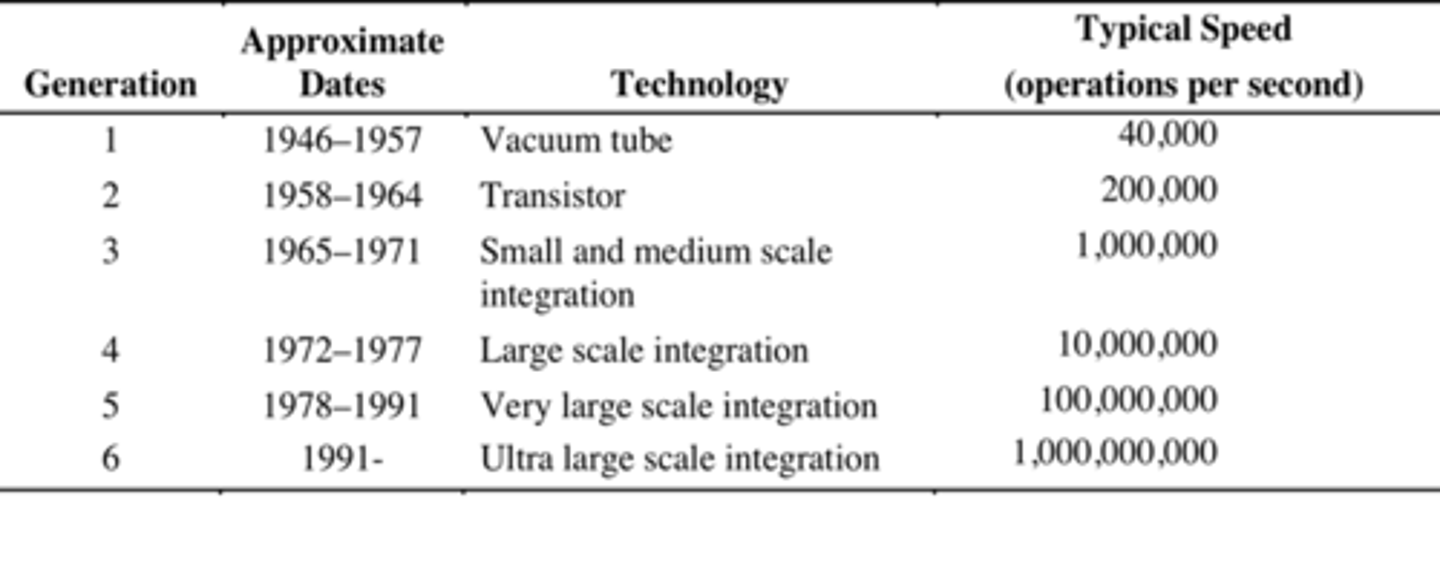
The first generation of computers used _______
Vacuum Tubes
What did second generation of computer introduce?
More complex arithmetic and logic units and control units
The use of high-level programming languages
Provision of system software which provided the ability to:
load programs
move data to peripherals and libraries
perform common computations
The third generation of computers used ________
Integrated circuits
Discrete component
Single, self-contained transistor
Manufactured separately, packaged in their own containers, and soldered or wired together onto masonite-like circuit boards
Manufacturing process was expensive and cumbersome
The two most important member of the third generation of computers were _________
IBM System/360
DEC PDP-8
What are the four componet of integrated circuits?
Data storage
Data processing
Data movement
Control
Data storage are provided by
Memory cells
Data processing is provided
Gates
Data movement components are used to...
Move data from memory to memory and from memory through gate to memory
wafer
A slice from a silicon ingot no more than 0.1 inches thick, used to create chips.
chips
Consist of tiny circuit boards etched onto squares of sandlike material called silicon.
Moore's Law
Refers to the computer chip performance per dollar doubles every 18 months
Consequences of Moore's Law
1. The cost of a chip has remained virtually unchanged during this period of
rapid growth in density. This means that the cost of computer logic and memory
circuitry has fallen at a dramatic rate.
2. Because logic and memory elements are placed closer together on more
densely packed chips, the electrical path length is shortened, increasing
operating speed.
3. The computer becomes smaller, making it more convenient to place in a
variety of environments.
4. There is a reduction in power and cooling requirements.
5. The interconnections on the integrated circuit are much more reliable than
solder connections. With more circuitry on each chip, there are fewer interchip
connections.
In 1970 Fairchild...
produced the first relatively capacious semiconductor
memory. This chip, about the size of a single core, could hold 256 bits of memory.
It was nondestructive and much faster than core. It took only 70 billionths of a second to read a bit. However, the cost per bit was higher than for that of core.
In 1974 the price per bit of semiconductor...
Dropped below the price per bit of core memory
There has been a continuing and rapid decline in memory cost accompanied by a corresponding increase in physical density
Developments in memory and processor technologies changed the nature of computers in less than decade
Since 1970 semiconductor...
Memory has been through 13 generations
Each generation has provided four time the storage density of the previous generation, accompanied by declining cost per bit and declining access time.
Microprocessors
an integrated circuit that contains all the functions of a central processing unit of a computer.
Improvements in chip organization and architecture
Increased hardware speed of processor
Increased size and speed of cahces
Change processor organization and architecture
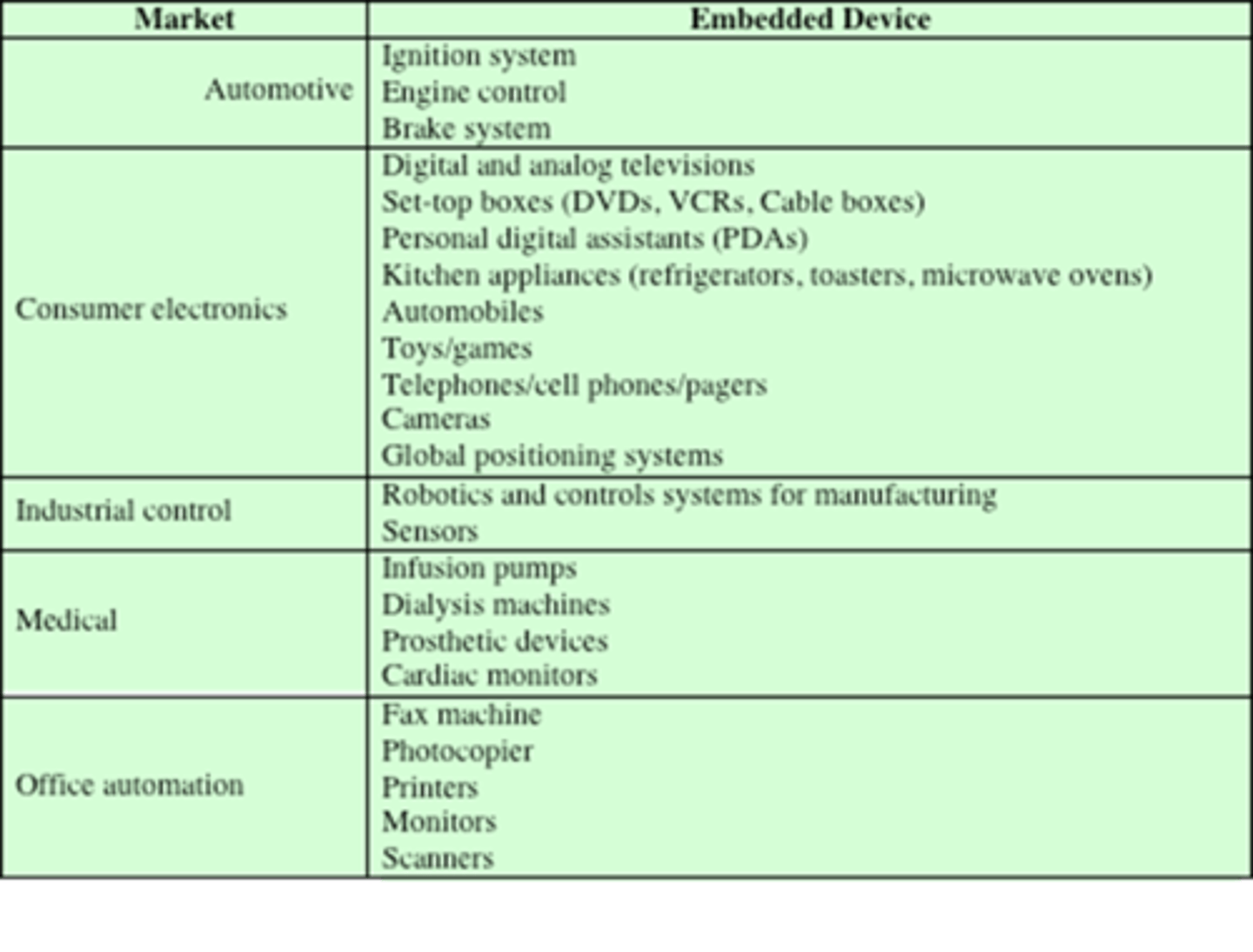
Embedded System
A combination of computer
hardware and software, and perhaps additional mechanical or other parts, designed to perform a dedicated function. In many cases, embedded systems are part of a larger system or product, as in the case of an antilock braking system in a car
Examples of Embedded Systems
Acorn RISC Machine (ARM)
ARM is probably the most widely used embedded processor
architecture and indeed the most widely used processor architecture of any kind
in the world.