OCHEM Ch. 4 Substitution & Elimination
 Call Kai
 Learn
Learn Practice Test
 Spaced Repetition
 Match
Match Flashcards
 Knowt Play
1/35

Earn XP
Description and Tags
Name | Mastery | Learn | Test | Matching | Spaced | Call with Kai |
|---|
No analytics yet
Send a link to your students to track their progress
36 Terms
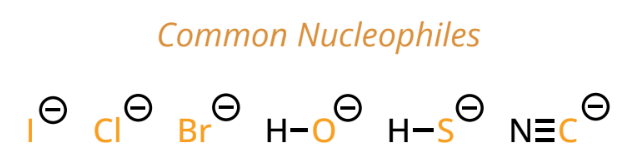
nucleophile
electron-rich (has lone pair or π); donates electrons
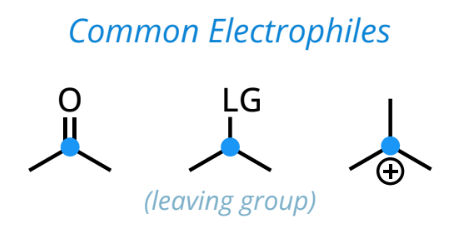
electrophile
electron-poor; accepts electrons
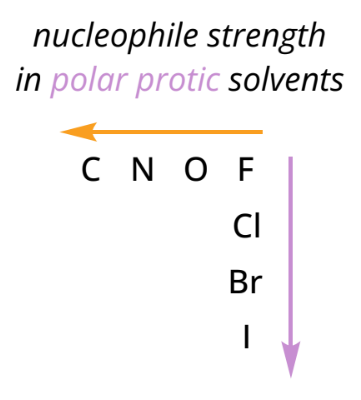
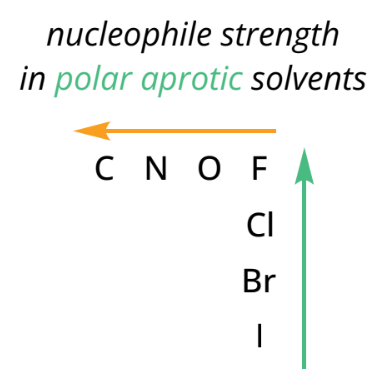
nucleophile strength increases _ to _ across a row in both polar protic and polar aprotic solvents
R, L
polar protic solvents
solvents that form H-bonds
nucleophilicity increases down a group
Ex: H2O, CH3OH
polar aprotic solvents
solvents that cannot donate H-bonds
nucleophilicity decreases down a group
ex: acetone, THF, DMSO
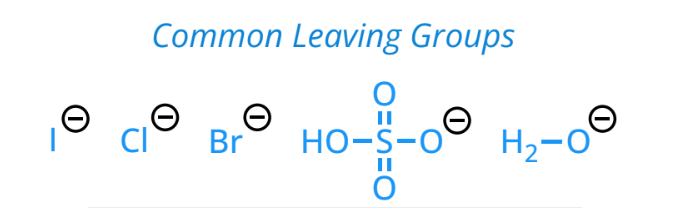
leaving groups (LG)
atoms that detach from molecule, taking electrongs
best LG = weak bases
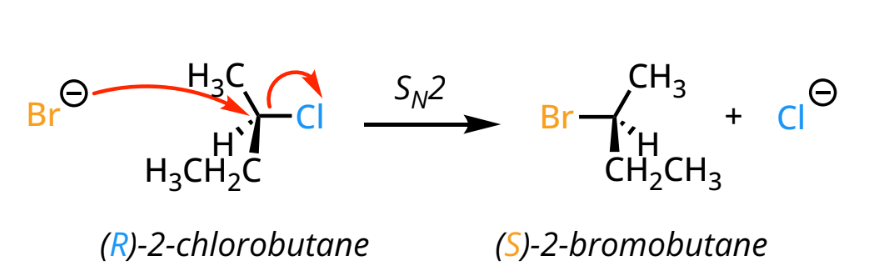
SN2 Reaction
bimolecular nucleophillic substitution
1 step (concerted): backside attack
sterospecific: inversion (umbrella flip)
rate = k[nucleophile][substrate]
![<p>bimolecular nucleophillic substitution</p><ul><li><p>1 step (concerted): backside attack</p></li><li><p>sterospecific: inversion (umbrella flip)</p></li><li><p>rate = k[nucleophile][substrate]</p></li></ul><p></p>](https://assets.knowt.com/user-attachments/b168c174-cd4c-4996-b3d4-a0cda432a34f.png)
SN2 reactions are favored by
strong nucleophile
primary/secondary carbon substrate type
polar aprotic solvents (ex: DMSO, acetone)
SN1 Reaction
unimolecular nucleophilic substitution
3 steps: LG leaves → carbocation forms → nucleophile attacks
forms racemic mix (not stereospecific)
rate = k[substrate]
rate-determining step: formation of a carbocation
![<p>unimolecular nucleophilic substitution</p><ul><li><p>3 steps: LG leaves → carbocation forms → nucleophile attacks</p></li><li><p>forms racemic mix (not stereospecific)</p></li><li><p>rate = k[substrate]</p></li><li><p>rate-determining step: formation of a carbocation</p></li></ul><p></p>](https://assets.knowt.com/user-attachments/5ac07bf5-6e1a-4216-b07e-b80c631e63b1.png)
SN1 reactions are favored by
weak nucleophile
tertiary > secondary > never primary carbon substrate
polar protic solvents (ex: H2O, ROH)
_____ stable carbocations = faster SN1 reactions
more
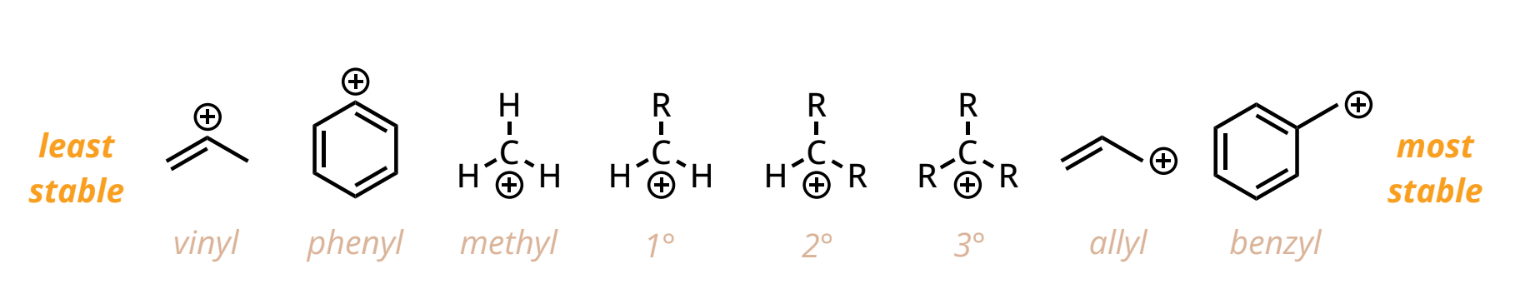

going L to R, are the carbocation arrangements getting less or more stable?
more
Zaitsev vs. Hofmann Products
Zaitsev = thermodynamic product (more stable)
more substituted alkene, greater stability
favored by small bases: EtO-, MeO-
Hofmann = kinetic product (forms faster with bulky base)
less substituted alkene, decreased steric hindrance
favored by bulky bases: tBuO-
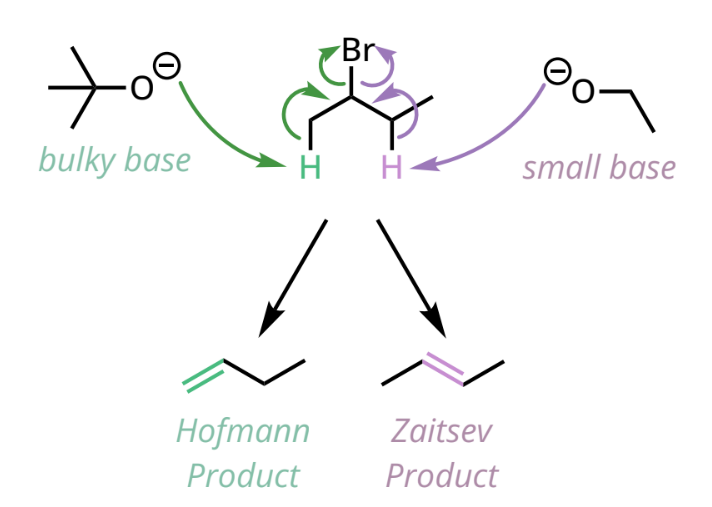
Zaitsev product
more substituted alkene in an elimation rxn → greater stability
Hofmann product
less substituted alkene in an elimation rxn
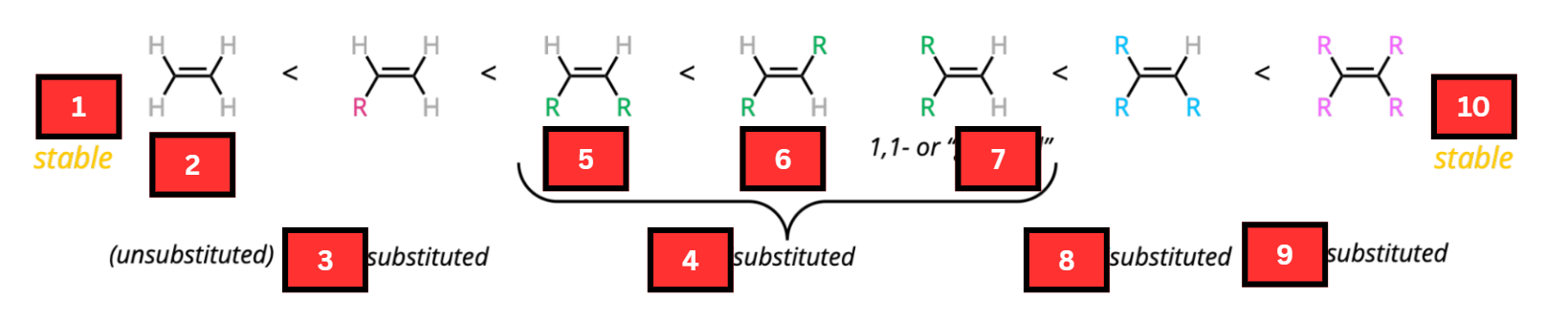
least
ethene
mono
di
cis-
trans-
geminal-
tri
tetra
most

E2 Reaction
bimolecular elimination
1 step (concerted): base removes β-Hydrogen, LG leaves, forms alkene
rate = k[base][substrate]
stereoselectivity when two β-protons are available
stereospecificity when only one β-proton is available
![<p>bimolecular elimination</p><ul><li><p>1 step (concerted): base removes β-Hydrogen, LG leaves, forms alkene</p></li><li><p>rate = k[base][substrate]</p></li><li><p>stereoselectivity when two <span>β-protons are available</span></p></li><li><p><span>stereospecificity when only one β-proton is available</span></p></li></ul><p></p>](https://assets.knowt.com/user-attachments/d7b7744d-f815-4a4b-9577-de7ae66b0e5f.png)
E2 reactions are favored by
strong base (ex: NaOet, NaOMe)
tertiary, secondary, or primary carbon
polar aprotic solvents
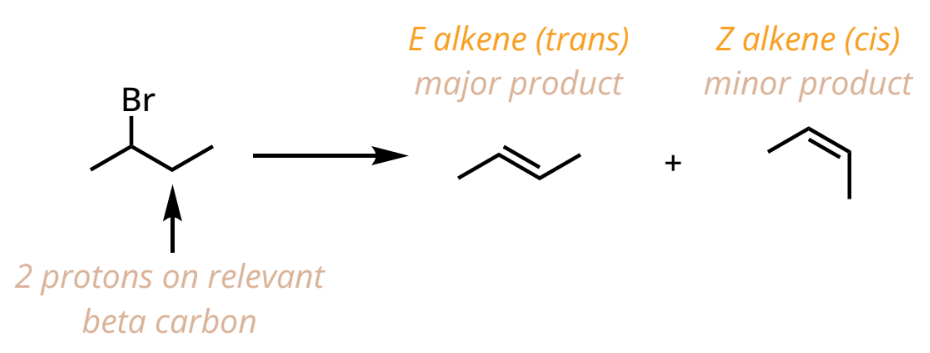
stereoselectivity
when two β-protons are available
E (trans) = major product → more stable
Z (cis) = minor product → increase steric hindrance
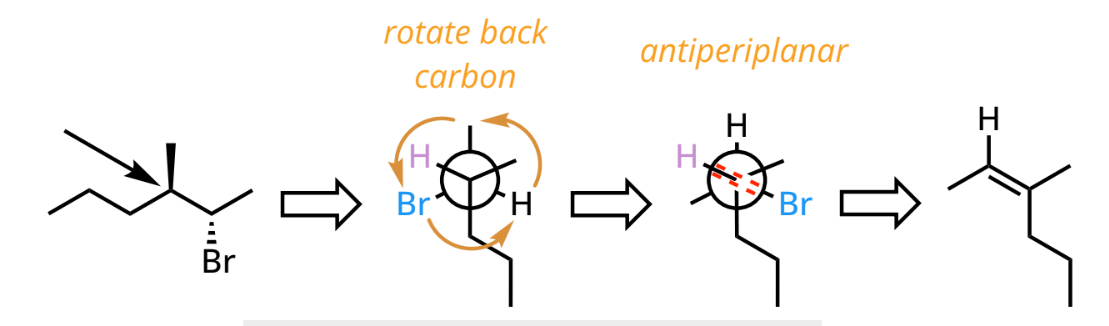
stereospecificity
when only one β-proton is available
LG & β-H must be anti-periplanar
E1 Reaction
unimolecular elimination
3 steps: LG leaves → carbocation forms → proton removal
rate = k[substrate]
![<p>unimolecular elimination</p><ul><li><p>3 steps: LG leaves → carbocation forms → proton removal</p></li><li><p>rate = k[substrate]</p></li></ul><p></p>](https://assets.knowt.com/user-attachments/a48a3db1-b161-4295-a0a6-0ed9cf846acf.png)
E1 reactions are favored by
weak base (ex: H2O, ROH)
tertiary/secondary carbons
heat
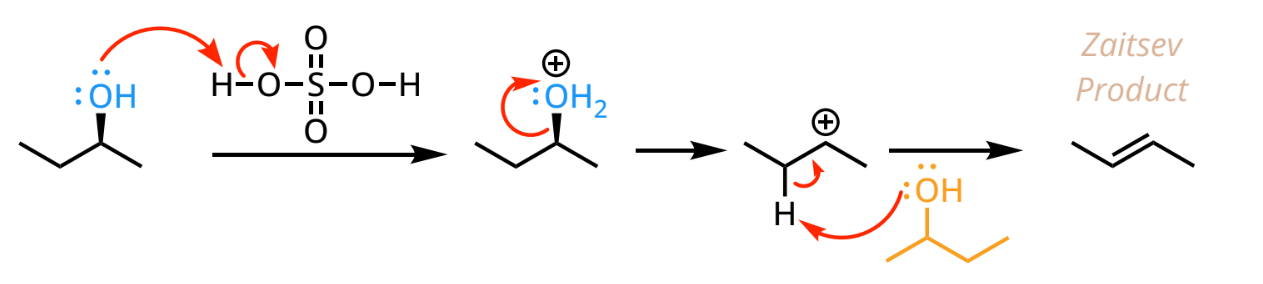
acid-catalyzed dehydration of alcohols
reagent: H2SO4 + heat
OH → H2O (good LG), then E1 mechanism (or E2 for 1° alcohol)
forms Zaitsev alkene
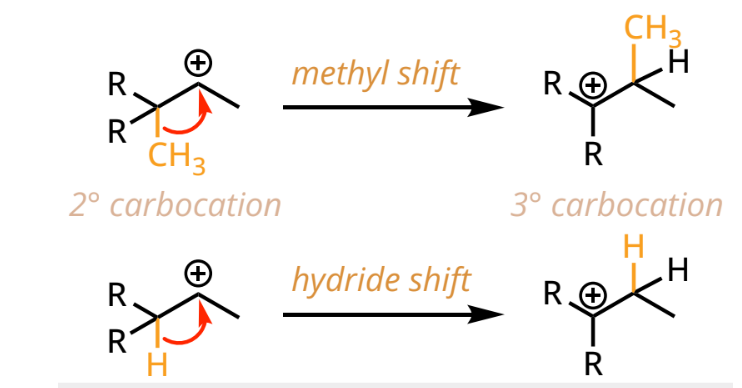
carbocation rearrangements
only in SN1/E1
hydride/methyl shift to form more stable carbocation
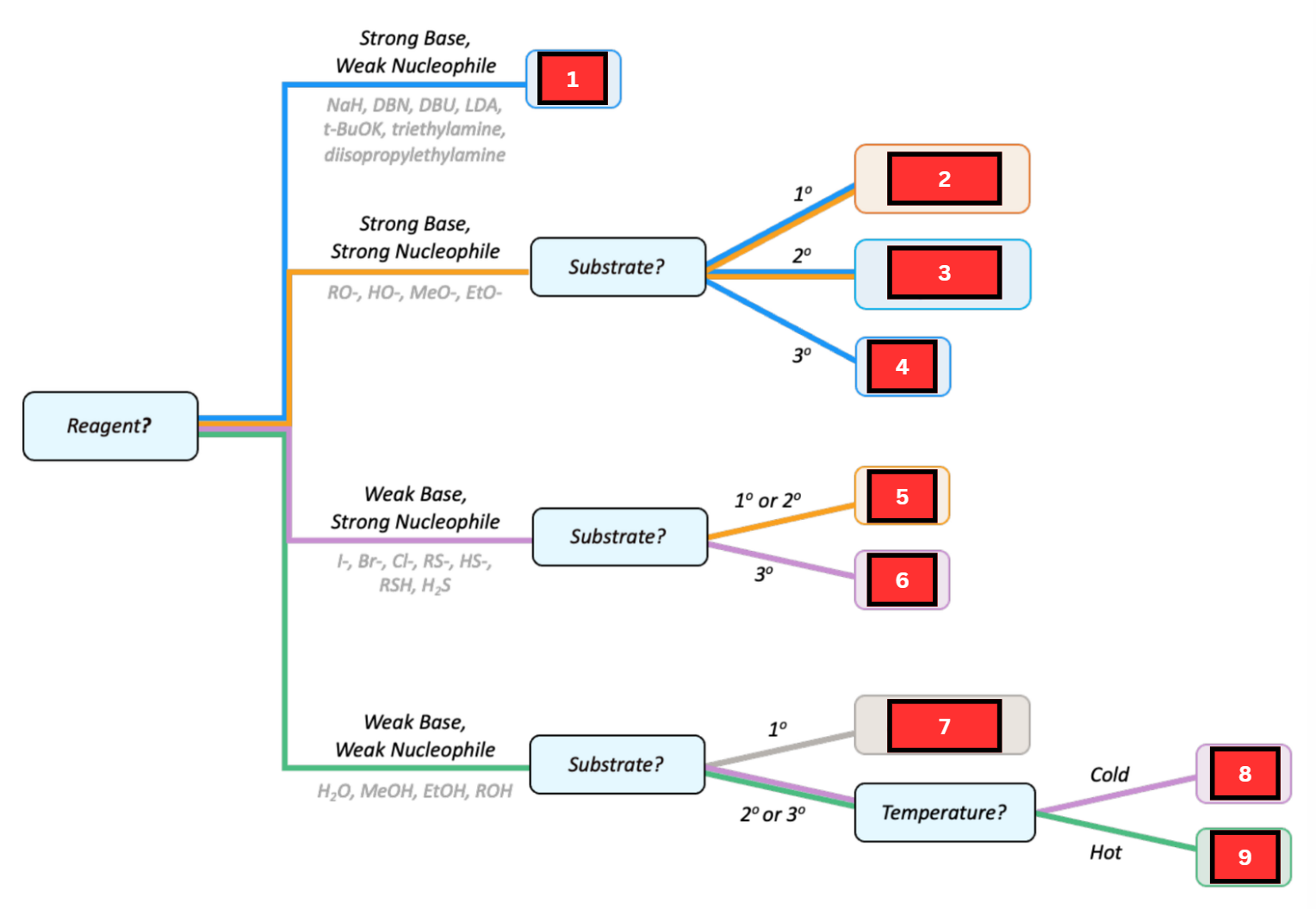
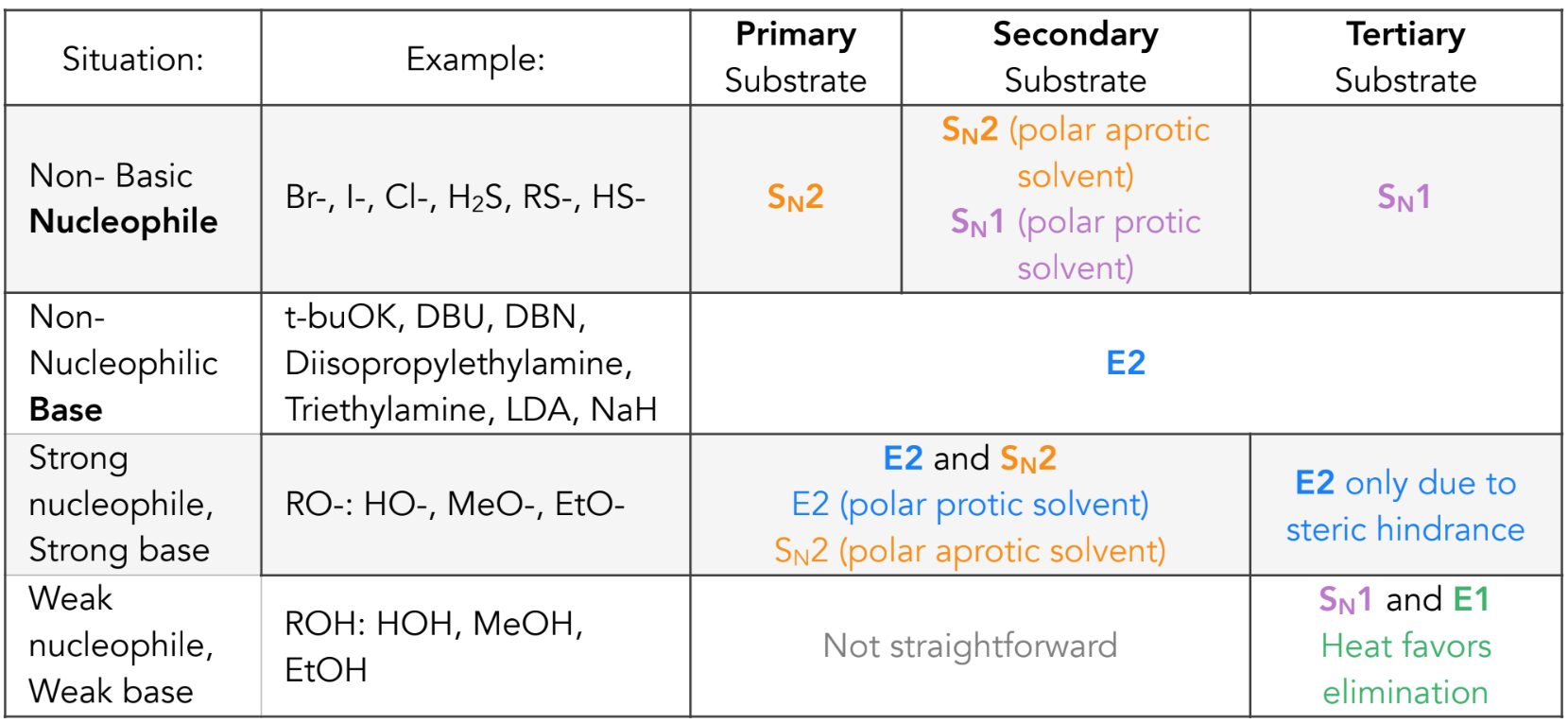
How to Choose: SN1, SN2, E1, E2
Degree of Substitution (on C bonded to LG)
1°: SN2 / E2 only
2°: all possible
3°: SN1 / E1 / E2 only
Strength of Nucleophile/Base
Strong = SN2 / E2
Weak = SN1 / E1
Bulky Base: Hofmann Product + E2 favored
Solvent
Protic → SN1 / E1
Heat: Elimination (E1 / E2)
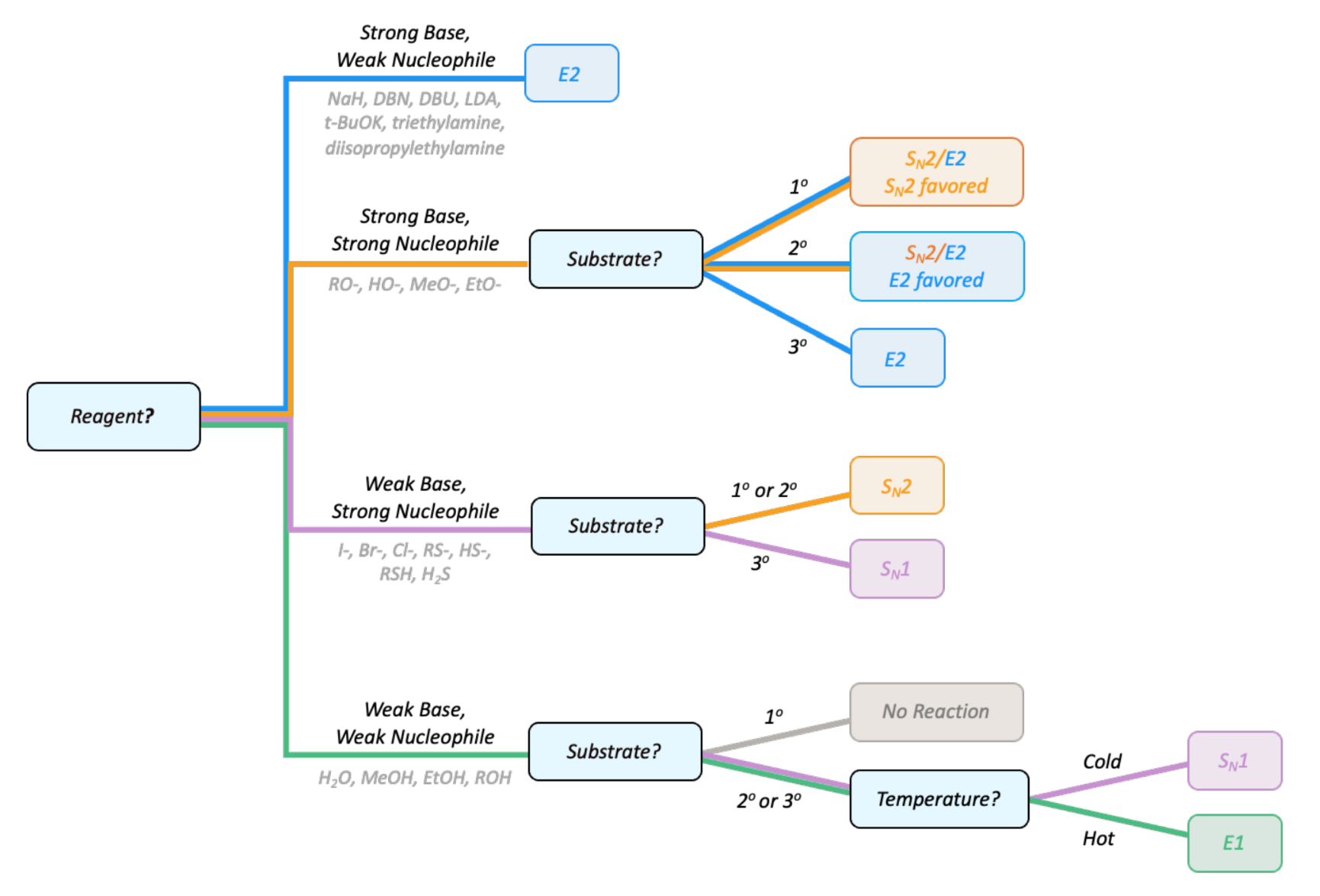
E2
SN2 / E2
SN2 / E2 (E2 favored)
E2
SN2
SN1
No Reaction
SN1
E1
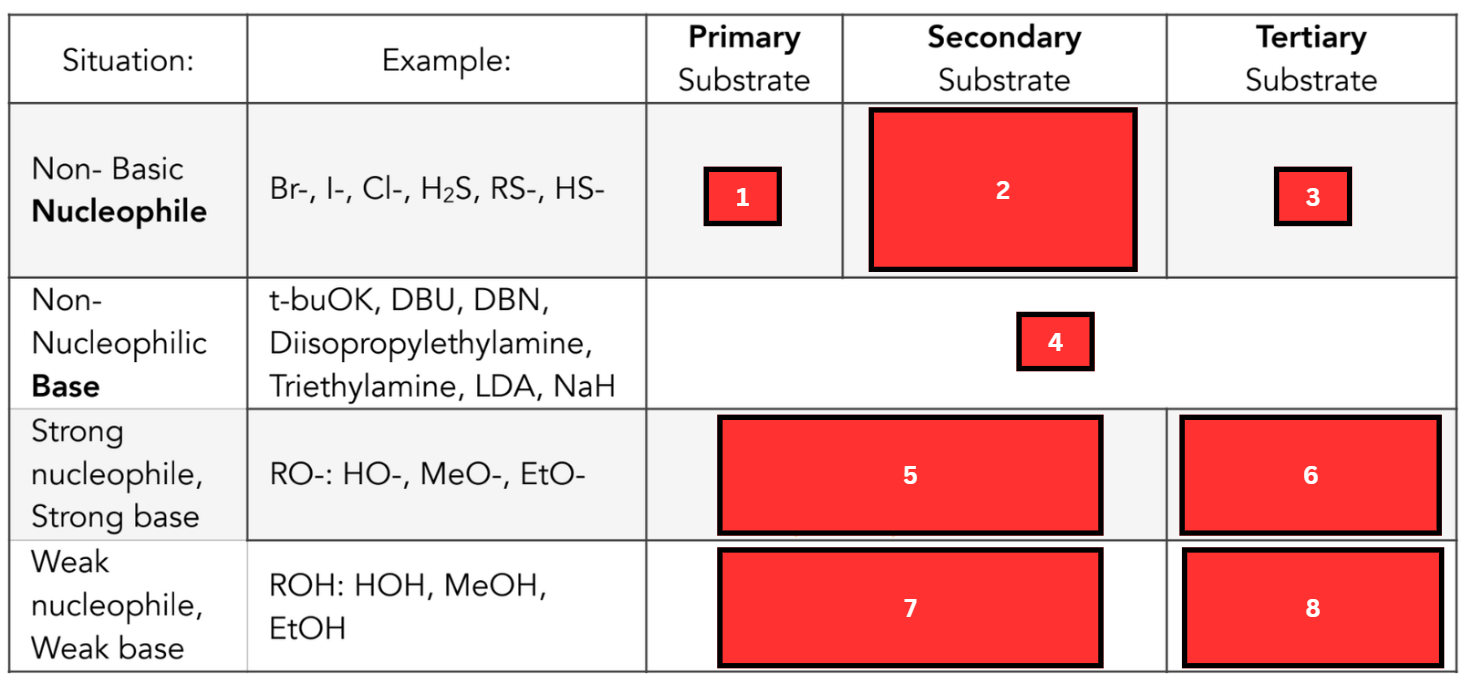
SN2
SN2 (polar aprotic solvent) / SN1 (polar protic solvent
SN1
E2
E2 (polar protic solvent) and SN2 (polar aprotic solvent)
E2 only due to steric hindrance
Not straightforward
SN1 and E1 - Heat favors elimination
regiochemical and sterochemical outcome: SN2
regiochemical: Attack at the alpha position, kick out leaving group in same step.
sterochemical: Inversion of configuration (flip like an umbrella).
regiochemical and sterochemical outcome: SN1
regiochemical: Nucleophilic attack of the carbocation. Carbocation could be where the leaving group was, or it could have rearranged.
sterochemical: Since the carbocation intermediate is planar, nucleophile can attack from either face with equal probability. Produces a racemic mixture if the product is chiral.
regiochemical and sterochemical outcome: E2
regiochemical
Zaitsev Product: more substituted alkene is favored if base is unhindered.
Hofmann Product: less substituted alkene is favored if base is bulky.
sterochemical
Stereoselective if there are 2 protons on the appropriate beta carbon can form E or Z alkene, but the major product is the E alkene.
Stereospecific if there is only 1 proton on the appropriate beta carbon need to draw the Newman projection so that the leaving group and hydrogen being pulled are antiperiplanar.
regiochemical and sterochemical outcome: E1
regiochemical: Zaitsev Product- more substituted alkene is favored.
stereochemical: Stereoselective- E alkene will be favored over Z (no antiperiplanar requirement).
strong base, weak nucleophile examples
NaH, DBN, DBU, LDA, t-BuOK, triethlamine, diisopropylethylamine
strong base, strong nucleophile examples
RO-, HO-, MeO-, EtO-
weak base, strong nucleophile examples
I-, Br-, Cl-, RS-, HS-, RSH, H2S
weak base, weak nucleophile examples
H2O, MeOH, EtOH, ROH
most nucleophilic molecule will be the ________ or _____ reactive base
strongest, most
Negatively charged bases are more reactive than neutral ones