L2: Rise of neural networks and deep learning
 Call Kai
 Learn
Learn Practice Test
 Spaced Repetition
 Match
Match Flashcards
 Knowt Play
1/15

There's no tags or description
Looks like no tags are added yet.
Name | Mastery | Learn | Test | Matching | Spaced | Call with Kai |
|---|
No analytics yet
Send a link to your students to track their progress
16 Terms
Training
Input data into neural networks
Choose algorithms
Feed data and adjust parameters
Evaluate generalisation to real data
Prediction
Receive data
Generate predictions based on patterns
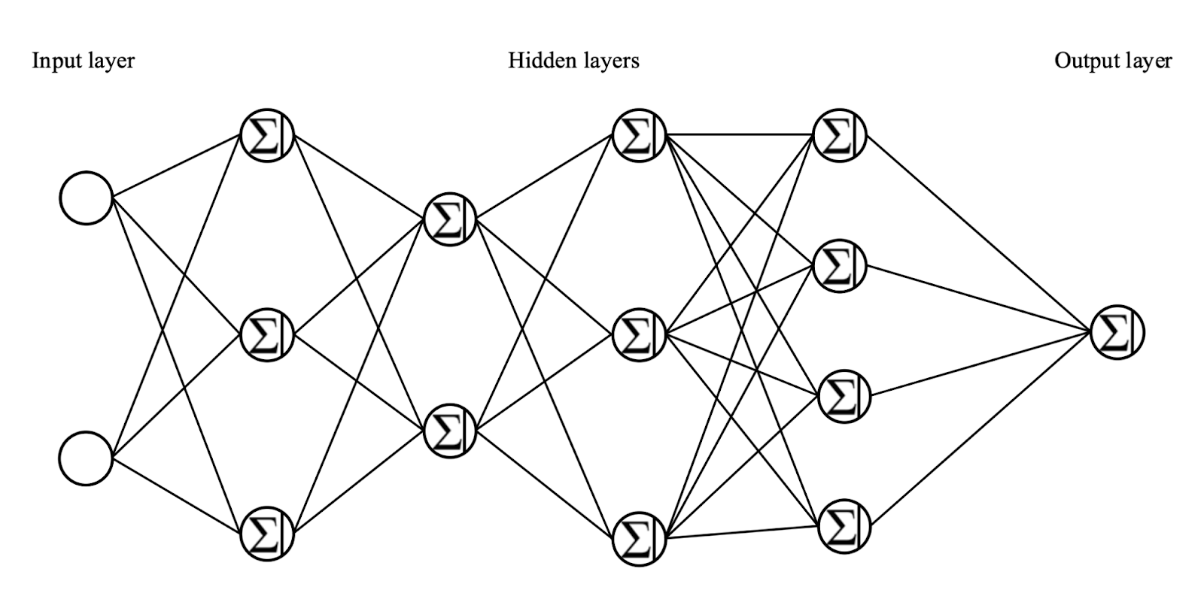
Structure of a deep network
Hidden layer: Columns of middle neurons
Deep network: Machine learning model with multiple hidden layers of interconnected nodes between input and output layers
Hyperparameters
Define the structure of the neural network
E.g. number of hidden layers, neuron per layer
Forward propogation
Synapse takes value from input and multiplies it by its weight
Neuron adds output of all synapses and applies activation function
Synapse weight → Connection strength
Trained network
Gives correct score for all training data
Weights = Trainable parameters
Neural network is like a machine with knobs (e.g. synthesizer)
Weights = knobs
Training = turning knobs til output sounds right
Number of trainable parameters (500B+)
How do you train large neural networks?
Initialise with random weights
Measure the error
J = how wrong the model is
Minimise error → Adjust parameter so J gets smaller
Naive (Brute-force) approach
Try every knob position
Find where J is lowest
IMPOSSIBLE
Minimisation: Backpropagation
Use backpropagation and update weights with gradient descent
Works for deep networks
How to do backpropagattion?
Randomly pick value for w
Pick two more around the point
Compute gradient (slope of error)
Update weights in downhill direction
Repeat until error is near 0
Prediction
Learning to predict the future from the past