1.6 motor system, LMN, and spinal motor function
 Call Kai
 Learn
Learn Practice Test
 Spaced Repetition
 Match
Match Flashcards
 Knowt Play
1/87

There's no tags or description
Looks like no tags are added yet.
Name | Mastery | Learn | Test | Matching | Spaced | Call with Kai |
|---|
No analytics yet
Send a link to your students to track their progress
88 Terms
what are the complex steps involved in voluntary motion?
1. decision making in anterior frontal love
2. motor planning and control
3. upper motor neurons deliver signal
4. LMN trigger skeletal muscle contraction
where does motor planning and control happen in voluntary motion?
motor planning: frontal lobe
control circuits: cerebellum, basal ganglia
where do the UMN deliver signals in voluntary motion?
•Brainstem
•Interneurons
•Lower motor neurons (LMNs)
what are characteristics of skeletel muscle?
excitable, contractile, extensile, elastic
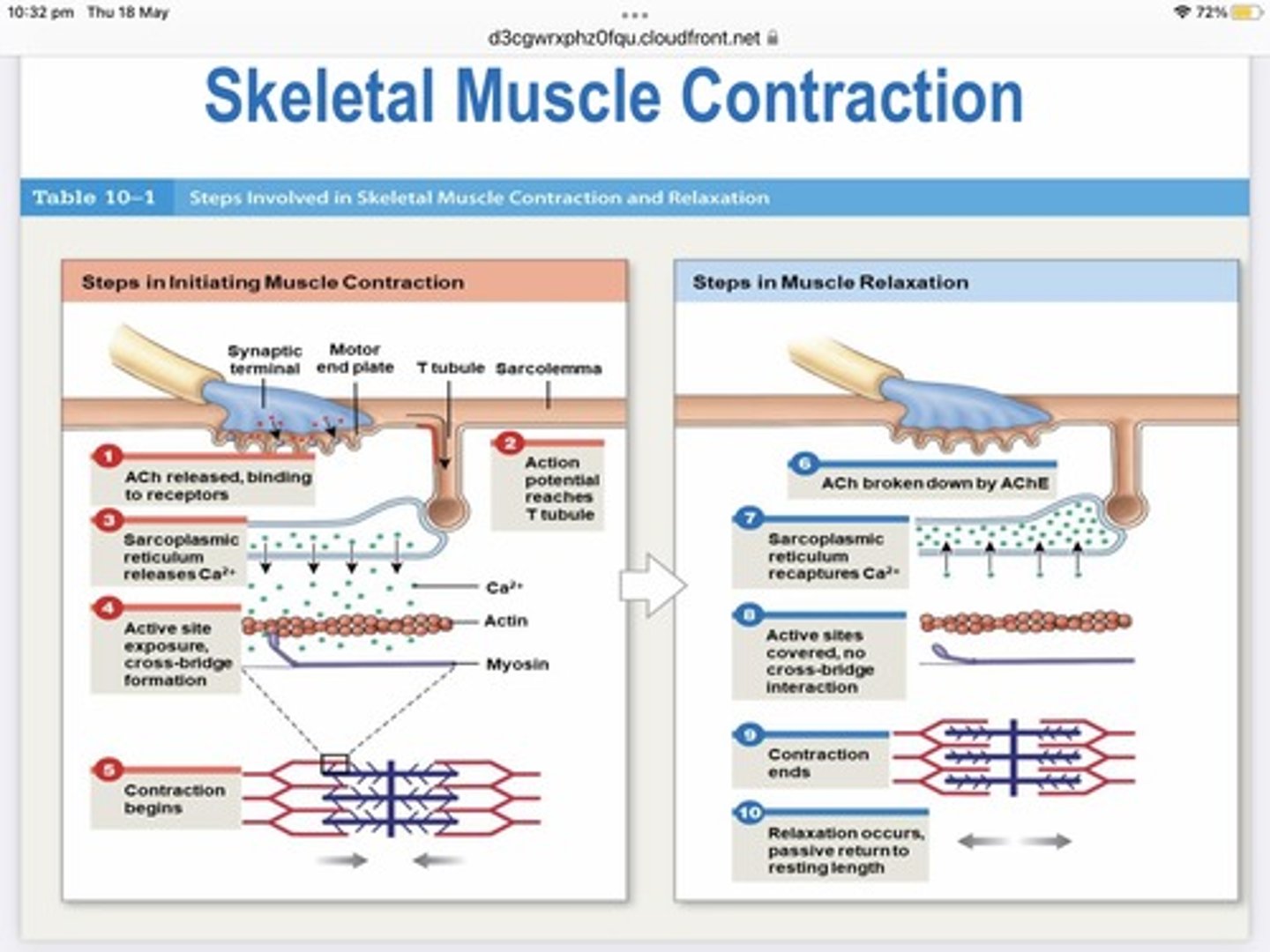
what are the steps of initiating a muscle contraction?
1.Action potential
2.ACh binds to sarcolemma
3.Signal reaches T-tubule
4.SR releases Ca2+
5.Ca2+ binds to troponin
6.Conformational change moves tropomyosin
7.Cross bridge binding site exposed on actin
8.Myosin heads bind
9.Myosin swivels, pulls actin towards center of sarcomere
how does myosin bind?
- ATP is dephosphorylated (loses Pi) producing hydrolysis and energy to myosin for power stroke to occur
- ADP detaches, new ATP bind and
how does myosin detach?
after power stroke, ADP detachines and a new ATP binds and myosin head detaches from actin
when we lengthen our muscle, what happens to myosin and actin?
myosin head straightens out but still catches every actin binding site (just slower and no powerstroke)
aka powerstroke in reverse
breakdown the parts of a skeletal muscle
Muscle fiber ---> myofibrils ---> sarcomeres
what is a sarcomere?
functional unit of muscle
what makes up a sarcomere?
structural and contractile components
structural components of sarcomere
m and z lines, titin
contractile components of sarcomere
actin, myosin, troponin, tropomyosin
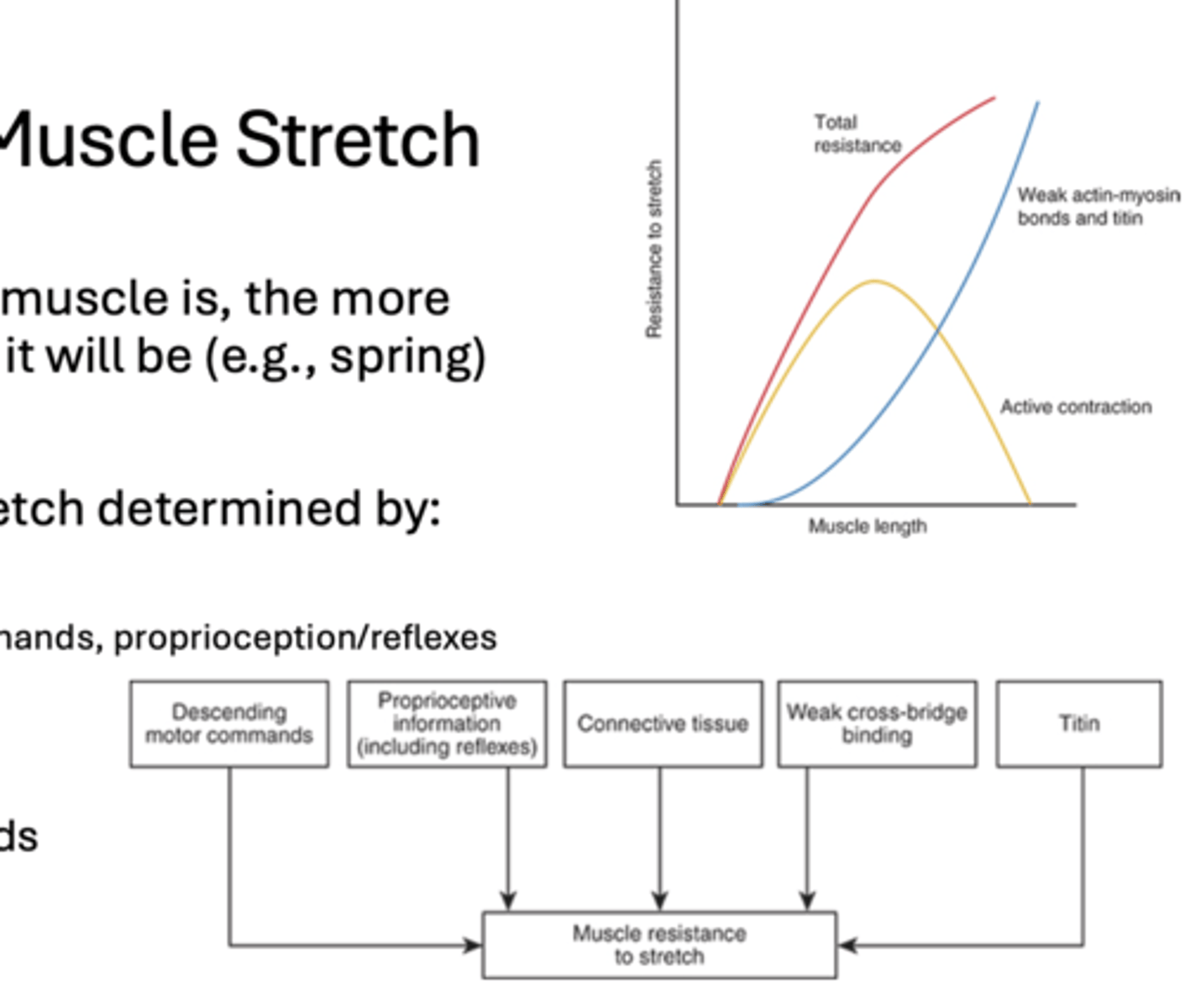
the more elongated a muscle its, what happens to its resistance to stretch?
it increases
what determines a muscles total resistance to stretch?
- active contraction (descending motor commands, proprioception/reflexes)
- titin
- connective tissue
- weak actin-myosin bonds
what is muscle tone?
resistance to stretch in a resting muscle
how is muscle tone clinically assessed?
via passive stretch
what indicates normal muscle tone using passive stretch?
- Titin and weak actin-myosin bonds functioning normally (no swivel)
- Signals from somatic NS acting normally
resistance to a muscle stretch increases after periods of
prolonged contraction and periods of immobility
ex. gripping a tiny object, then slowly releasing
ex. hamstring tightness after sitting for a long time
why is it that after prolonged contraction or periods of immobility it takes a second for those muscles to lengthen and relax?
this is because cross bridges need to break and the muscles need to fight against weak actin-myosin cross bridges that were formed during contracting
what are examples of neuro conditions that impact muscle tone?
1. CP
2. MS
3. PD
what is CP?
damage to motor areas of the cerebral cortex can lead to increased or decreased muscle tone
what is MS?
loss of myelination of axons can lead to increased or decreased muscle tone
what is PD?
loss of dopamine-producing neurons can lead to increased or decreased muscle tone
what determines a joints resistance to movement?
elastic and contractile forces of muscles
how can joint resistance be increased?
co contraction meaning agonist and antagonist muscles contract @ same time
ex. wrist when painting, writing, LE when balancing on wobble board, learning a new motor skill
co contraction provides joint
stability
where do lower motor neurons (LMN) convery info? what type of info do they convey?
Convey efferent signals to extrafusal and intrafusal muscle fibers
where are cell bodies of LMN located?
ventral horn of SC
what path do LMN axons take? where do they develop from?
exit ventral root of SC
develop from neural tube
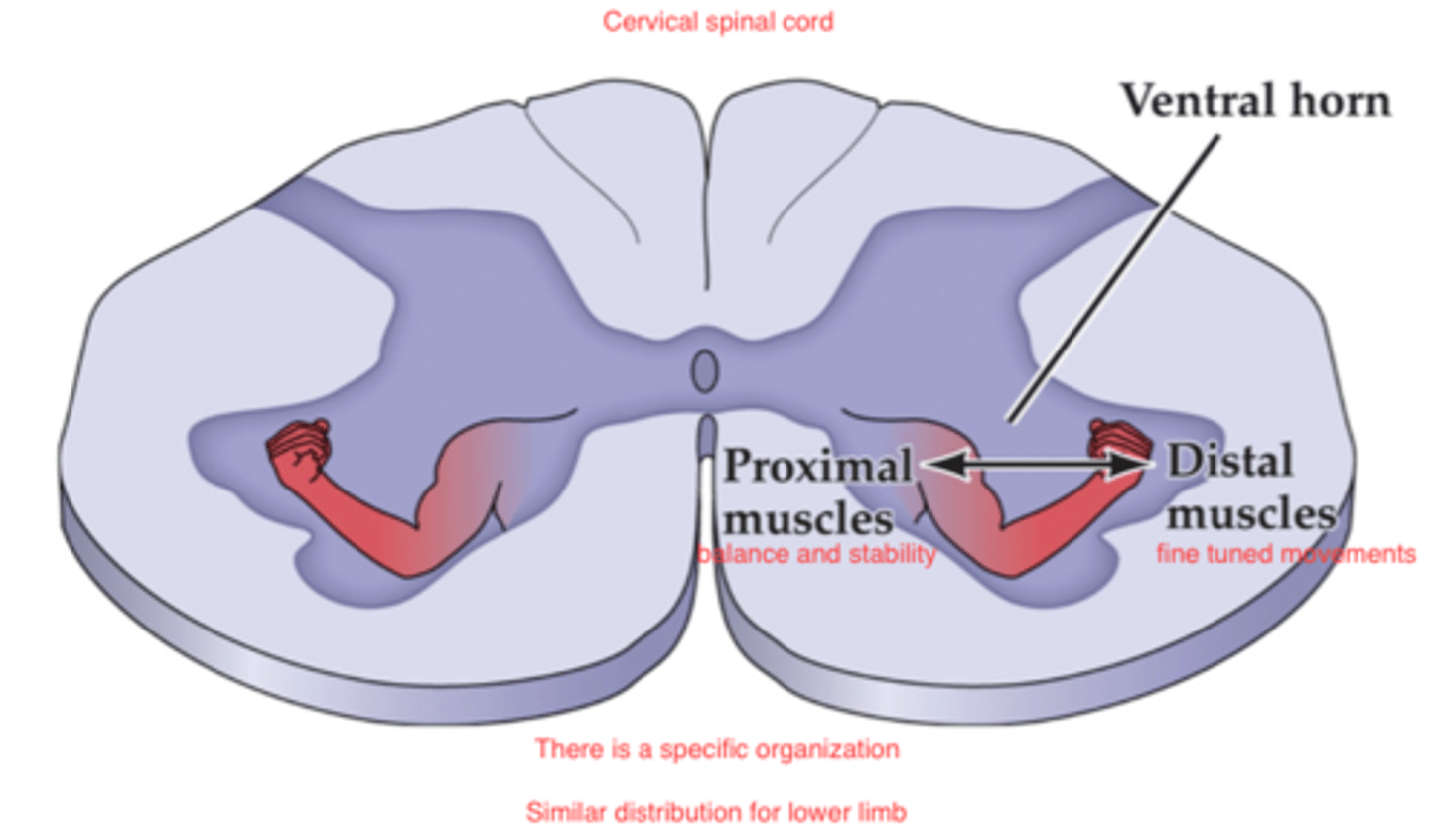
explain relationship of LMN cell bodies and location in ventral horn
Cell bodies of nerves innervate the same muscle cluster in ventral horn(motor pools)
what are the parts of the ventral horn that LMN cell bodies innervate? what are the muscles?
•Medial part = axial, proximal muscles
•Lateral part = distal muscles
•Anterior part = extensors
•Posterior part = flexors
*pools may extend several spinal cord levels
what part of ventral horn are abductors, adductor, and rotator muscles innervated by?
LMN cell bodies will lie more medial because they drive motion more at proximal joints
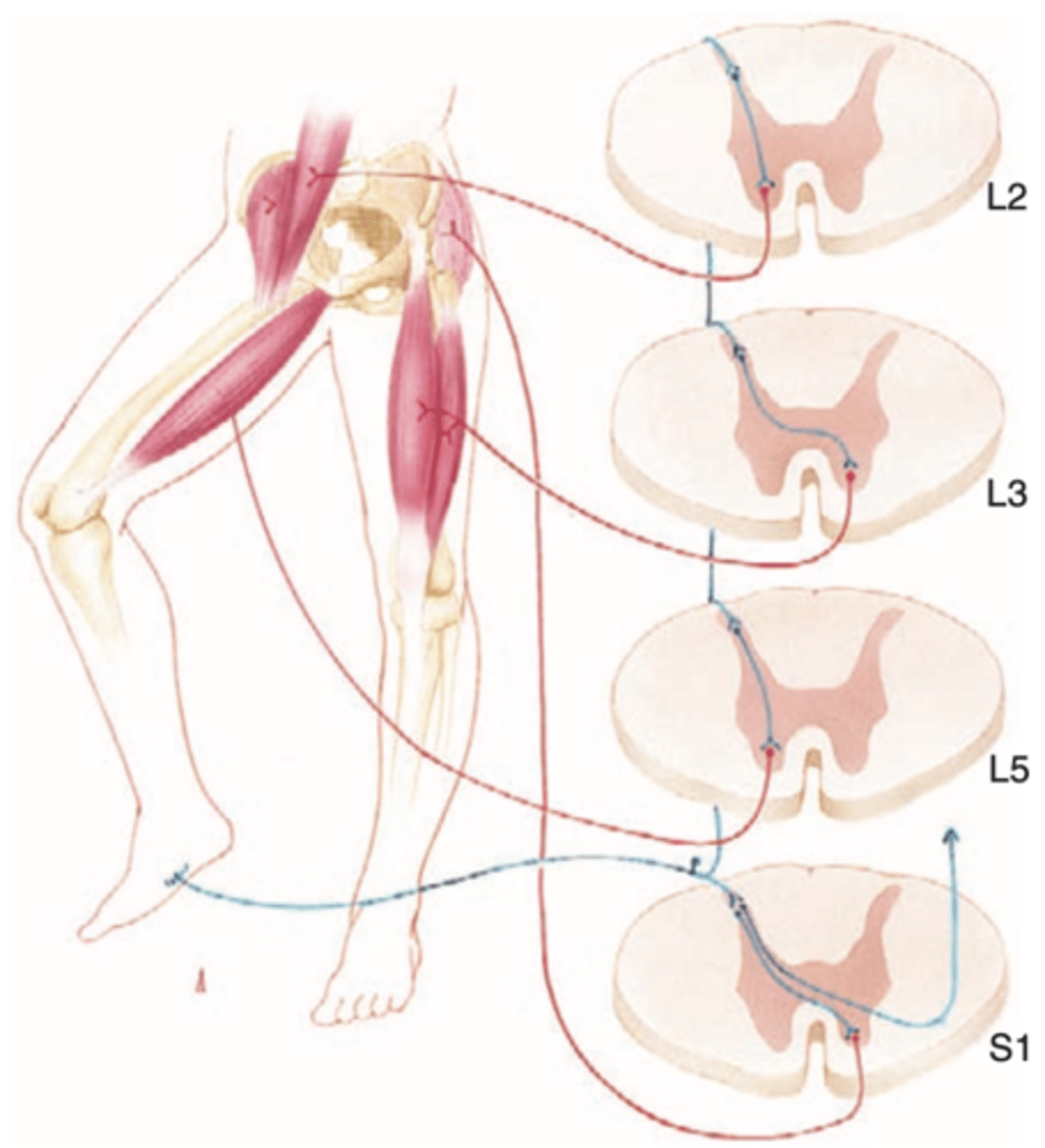
what are myotomes?
group of muscles innervated by single spinal nerve
c1 myotome
cervical rotation
c2 myotome
cervical flexion, shoulder shrug
c3 myotome
shoulder shrug
c4 myotome
shoulder shrug
c5 myotome
should abduction
c6 myotome
elbow flexion, wrist extension
c7 myotome
elbow extension, wrist flexion
t1 myotome
finger adduction or little finger abduction
l1 myotome
hip flexion
l2 myotome
hip flexion
l3 myotome
knee extension (2 degree hip adduction)
l4 myotome
dorsiflexion
l5 myotome
- great toe extension (2 degree hip abduction)
- functional heel walking
s1 myotome
- eversion, plantar flexion (2 degree knee flexion, hip extension)
- functional toe walking
s2 myotome
bowel/bladder problems
types of LMN
alpha and gamma
characteristics of alpha motor neurons
•Cell bodies in ventral horn
•Axons leave ventral root
•Large cell bodies
•Large, myelinated axons that branch into numerous terminals
•Extrafusal muscle fibers (Force production)
characteristics of gamma motor neurons
•Cell bodies in ventral horn
•Axons leave ventral root
•Smaller cell bodies
•Smaller, myelinated axons
•Intrafusal muscle fibers (Sensation, muscle stretch)
alpha neurons contract
extrafusal fibers
gamma neurons contract
intrafusal fibers
how do excitatory signals to alpha motor neurons reach gamma motor neurons?
via collateral projections
what is a motor unit?
alpha motor neuron (AMN) + all muscle fibers it innervates
when a signal is sent _____ muscle fibers contract (MU)
all
muscle fibers can be classified as _____ or _____ twitch
slow; fast
characteristics of slow AMN
example?
• smaller diameter, slower conducting speed
• ex. Muscle of posture, e.g., soleus
characteristics of fast AMN
example?
•larger diameter, faster conducting speed
• ex. Muscles of powerful movement, e.g., gastrocnemius
in most movements what muscle fibers are recruited first? why?
slow twitch because they take less time time depolarize/depolarize fast
what is the henneman size principle?
AMN recruited in order from smallest to largest (can depend on task; e.g. high intensity movement and fatigue)
motor units vary in the number of fibers per neuron. why is this?
some muscles perform fine movements (precise control) vs large movements
ex. eye (2.5 muscle fiber/neuron)
ex. gastroc (2000 muscle fibers/neuron)
in the spinal cord, what are used to help coordinate signals?
•Somatosensory information
•Spinal interneurons
•Descending motor commands
what coordinated functions of the spinal cord contribute to smooth movement?
•Reciprocal inhibition
•Muscle synergies
•Proprioceptive input
•Stepping pattern generators
what is reciprocal inhibition?
inhibition of antagonist muscles during agonist contraction
how is reciprocal inhibition achieved?
internous
what do interneurons connect in the spinal cord?
•Agonist somatosensory afferents (via muscle spindle)
•Alpha motor neurons (inhibitory signal sent to antagonist muscle)
when is reciprocal inhibition triggered? ex?
during voluntary and reflexive muscle contractions
ex: flexion and extension of knee
what are muscle synergies?
coordinated muscle action
in muscle synergies, somatosensory afferent signals from one muscle are sent from what 3 things?
•Muscle spindles
•Joint receptors
•Cutaneous touch/pressure receptors
somatosensory afferent signals connect with interneurons. what does this trigger?
LMN from other joints/muscles which prepares and triggers other agonists/antagonists
ex. picking up and eating something
what is proprioceptive input?
spinal cord generates a complete proprioceptive image (schema) of the body in time and space
how does the spinal cord generates a complete proprioceptive image (schema) of the body in time and space? (3 things)
uses
•Joint capsule and ligament receptors
•Muscle spindles
•Golgi tendon organs
proprioceptive helps us ____ and ____ movements
example?
plan; adapt
ex. hitting a baseball
proprioceptive function of GTO
detects tension in msucle tendons
how do GTO impact LMN firing?
ex?
either facilitate or inhibit fiting
ex: stance vs swing, plantar flexors firing vs relaxed
what are stepping patter generators (SPGs)?
Adaptable networks of spinal interneurons that activate LMNs to cause alternating flexion, extension of the hips, knees
does each limb have a dedicated SPG?
- yes. when one triggers flexion, other triggers extension
- interpret proprioceptive input, predict next steps
what are spinal reflexes?
involuntary motor response to an external stimulus
pathway of spinal reflexes
Receptor ---> afferent ---> efferent (LMN) ---> effector
spinal reflexes can operate without
brain input
how can spinal reflexes be triggered?
in response to musculoskeletal or cutaneous receptors
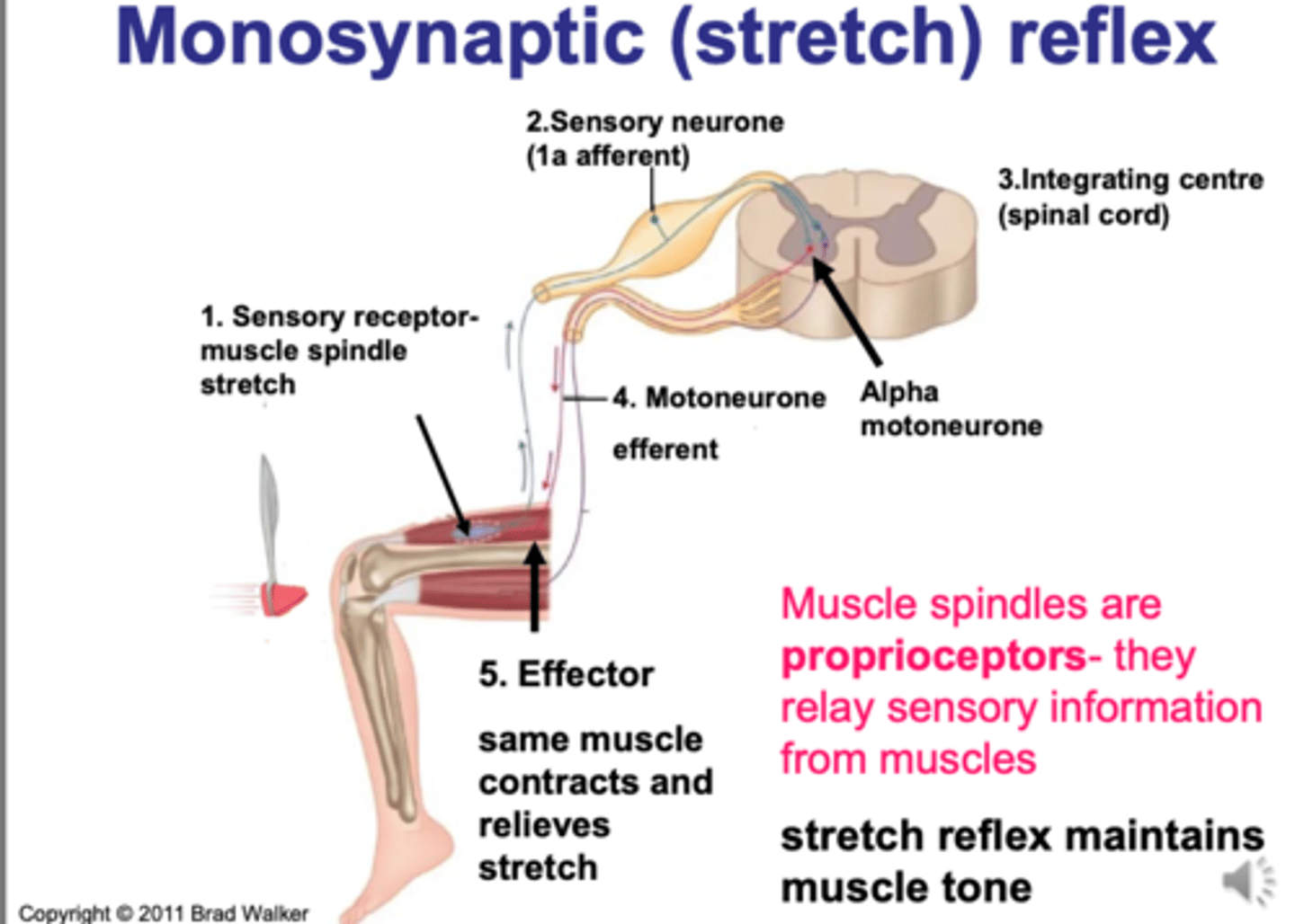
what is the phasic stretch reflex: muscle spindles?
also called deep tendon reflex or myotatic reflex
Muscle contraction in response to quick stretch
what does phasic stretch reflex: muscle spindles trigger?
alpha motor neurons of same muscle being stretched
what is the sequence of events of stretch reflex?
1. stimulus (ex. mallet hitting knee)
2. Quick stretch of tendon activates muscle spindle
3. Afferents send signal to spinal cord
4..Synapse with alpha motor neurons, triggering efferents to muscle
5. Muscle contracts
what is the cutaneous reflex: withdrawal reflex?
cutaneous stimulation triggers reflexes usually in repsonse to a painful stimulus
process of cutaneous/withdrawal reflex
1. painful stimulus
2. afferent neuron
3. brain process
4. alpha motor neuron triggers reflex