Motor Control and Motor Learning Review
 Note
Note Call Kai
 Learn
Learn Practice Test
 Spaced Repetition
 Match
Match Flashcards
 Knowt Play
1/33

Earn XP
Description and Tags
Flashcards covering foundational theories, motor control theories, motor learning concepts, and types of practice based on the lecture notes.
Name | Mastery | Learn | Test | Matching | Spaced | Call with Kai | Chat |
|---|
No analytics yet
Send a link to your students to track their progress
34 Terms
Which developmental theorist organized human motivations into a hierarchy of 5 stages: physiological, safety and security, love and belonging, self-esteem, and self-actualization?
Maslow
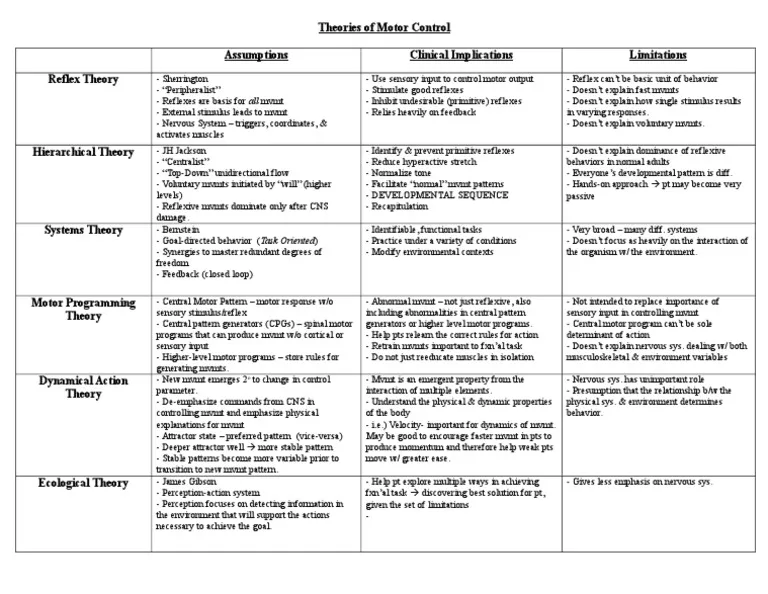
Name some foundational theories of Motor Control discussed in the course.
Reflex Theory, Hierarchical Theory, Motor Programming Theories, Systems Theory, Ecological Theory, and Task-Oriented Approach
Why is it important for an occupational therapist to understand the classification of movement tasks?
To more successfully grade activities for clients struggling with occupational performance.
What two types of memory are key concepts within Motor Learning theories?
Implicit and Explicit Memory
What type of practice supports a client repeating the same task multiple times in the same environment?
Blocked practice
What type of practice promotes generalization and retention of skills?
Random practice
What type of practice involves a client practicing only one step of a larger task?
Part-task practice
whats significant about theories in OT prac?
assists in developing a working hypothesis for evaluation in intervention and guides clinical decision-making to improve client outcomes.
Name some limitations to the Reflex theory?
It does not account for complex voluntary movements (fast movements like playing the piano), does not explain movement variability, and oversimplifies the role of the central nervous system.
Define the Hierarchical theory by charles sherrington
The Hierarchical theory, proposed by Charles Sherrington, suggests that motor control is organized hierarchically, meaning that higher levels of the nervous system coordinate and control lower levels to produce voluntary movement, emphasizing the role of the brain in regulating motor functions. It posits that motor responses are organized in a top-down manner, with inhibitory and facilitatory influences from the brain on reflexive actions.
What are some examples of play activities that can be used to promote repetitive practice?
Activities such as throwing a ball, jumping rope, and playing catch can be used to promote repetitive practice.
Which developmental theorist organized human motivations into a hierarchy of 5 stages: physiological, safety and security, love and belonging, self-esteem, and self-actualization?
Maslow
Name some foundational theories of Motor Control discussed in the course.
Reflex Theory, Hierarchical Theory, Motor Programming Theories, Systems Theory, Ecological Theory, and Task-Oriented Approach
Why is it important for an occupational therapist to understand the classification of movement tasks?
To more successfully grade activities for clients struggling with occupational performance.
What two types of memory are key concepts within Motor Learning theories?
Implicit and Explicit Memory
What type of practice supports a client repeating the same task multiple times in the same environment?
Blocked practice
What type of practice promotes generalization and retention of skills?
Random practice
What type of practice involves a client practicing only one step of a larger task?
Part-task practice
whats significant about theories in OT prac?
assists in developing a working hypothesis for evaluation in intervention and guides clinical decision-making to improve client outcomes.
Name some limitations to the Reflex theory?
It does not account for complex voluntary movements (fast movements like playing the piano), does not explain movement variability, and oversimplifies the role of the central nervous system.
Define the Hierarchical theory by charles sherrington
The Hierarchical theory, proposed by Charles Sherrington, suggests that motor control is organized hierarchically, meaning that higher levels of the nervous system coordinate and control lower levels to produce voluntary movement, emphasizing the role of the brain in regulating motor functions. It posits that motor responses are organized in a top-down manner, with inhibitory and facilitatory influences from the brain on reflexive actions.
What are some examples of play activities that can be used to promote repetitive practice?
Activities such as throwing a ball, jumping rope, and playing catch can be used to promote repetitive practice.
What is the Biomechanical approach in occupational therapy?
Focuses on the kinetics and kinematics of human movement to improve strength, range of motion, and endurance to enhance occupational performance.
What is the Rehabilitative approach in occupational therapy?
Focuses on adapting the environment, compensating for lost function, and facilitating the client's remaining abilities to achieve maximum independence in occupations.
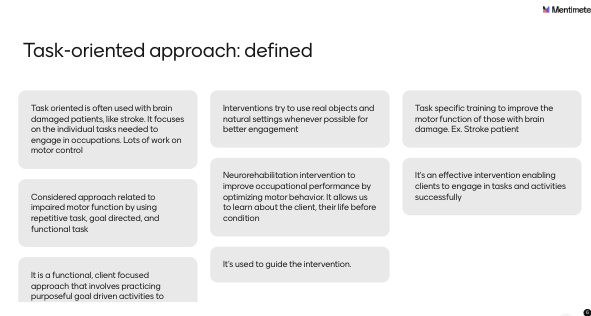
What is the Task-oriented approach in occupational therapy?
Emphasizes the interaction between the person, environment, and occupation, suggesting that motor control is recovered through engaging in meaningful tasks in varied contexts.
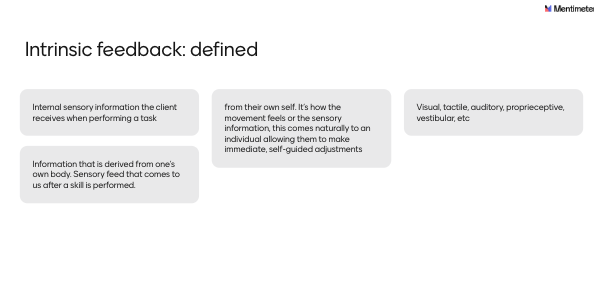
Define Intrinsic feedback.
Information received by the learner from their own body's sensory systems during or after a movement, such as proprioception, vision, or auditory cues.
Ex: shooting a basket; when you perform, you already know “ugh I didn’t do that right”
proprioception: body’s awareness of where you are in space
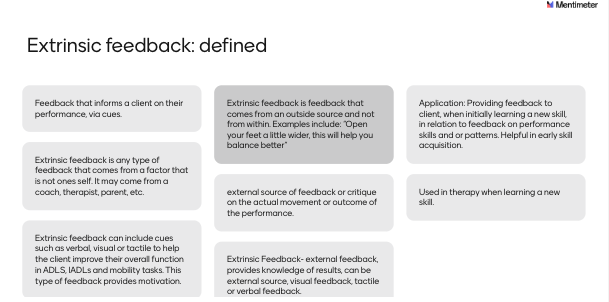
Define Extrinsic feedback.
Information provided to the learner from an external source, such as a therapist, coach, or equipment, about the performance or outcome of a movement.
This type of feedback can help learners understand their performance and make necessary adjustments to improve their skills.
ex. therapist giving cues to get back on track during the session
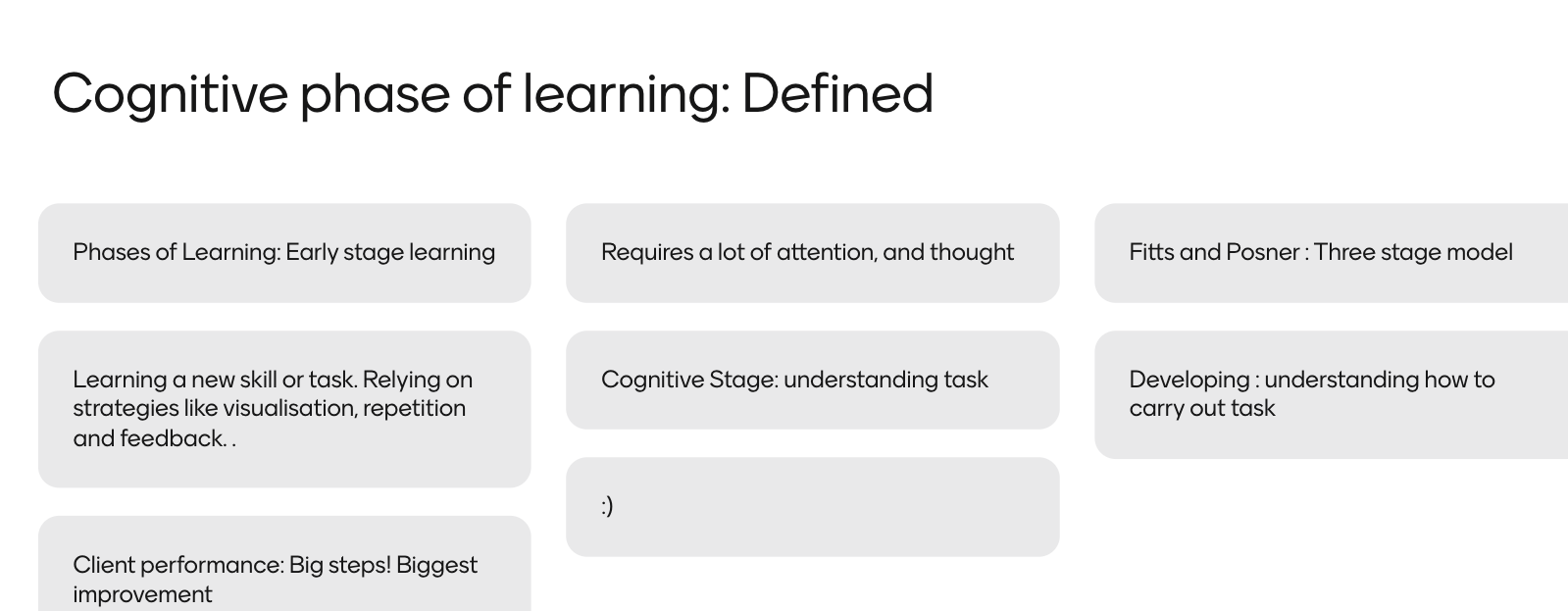
Describe the Cognitive phase of learning.
The initial stage of motor learning where the learner tries to understand the task, makes many errors, relies heavily on verbal cues, and needs conscious attention to perform. (talking about steps)
Early phase, requires alot of attention.
Fitts and Posner: model 3
exam question: talking about the steps on how to put on shoes
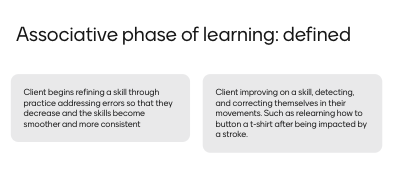
Describe the Associative phase of learning.
The second stage of motor learning where the learner refines their movements, reduces errors, becomes more consistent, and relies less on conscious thought, often focusing on how to perform more efficiently.
“Hey show me the home exercise phase, are you able to do that” (your doing but doing with errors)
This phase involves practicing skills to enhance coordination and timing. Learners start to develop better strategies and can perform tasks with greater efficiency.
exam question: My patient is able to pull sock on halfway but needs help or cues from therapist to complete the task.
Describe the Autonomous phase of learning.
The final stage of motor learning where the skill becomes automatic, requiring little conscious attention, allowing the learner to perform tasks accurately and consistently even in complex or distracting environments.
Able to move through, but for the most part, doing things independently.
exam question:
Backwards training
starting low then going high. Start by seeing if patient can take off their shoes before putting on. A technique where tasks are practiced in reverse order, enhancing understanding and facilitating successful completion of sequential activities.
Forward training
starting patient with putting on shoes before taking them off, gradually increasing complexity and skill demands. A technique where tasks are practiced in a forward sequence, beginning with simpler actions and progressing to more complex ones, helping the learner develop skills effectively.