12.2 Price and Output in Monopolistic Competition
 Call Kai
 Learn
Learn Practice Test
 Spaced Repetition
 Match
Match Flashcards
 Knowt Play
1/21

There's no tags or description
Looks like no tags are added yet.
Name | Mastery | Learn | Test | Matching | Spaced | Call with Kai |
|---|
No analytics yet
Send a link to your students to track their progress
22 Terms
How does a monopolistic competitor choose output?
Produce where MR = MC.
How does it choose price?
Go UP from MR=MC to the demand curve → that price.
Why is the demand curve highly elastic?
Because there are many close substitutes.
Why is the demand curve NOT perfectly elastic?
Because there are fewer rivals than perfect competition AND products are differentiated.
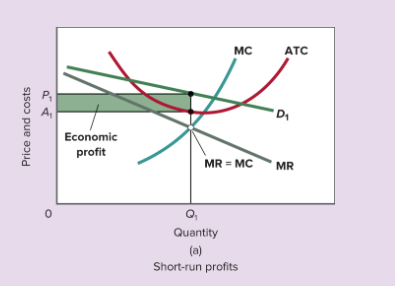
When does the firm earn profit? (shortrun outcome)
MR = MC → choose Q
Go up to demand → price
If price > ATC, the firm earns economic profit
This is the green shaded area in the graph
Why can it profit?
Because it has some monopoly power from product differentiation.
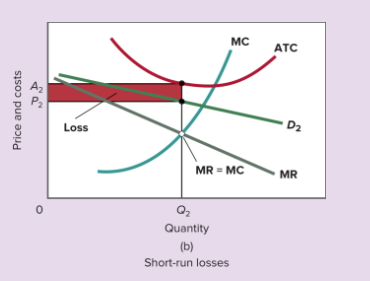
When does the firm take a loss? (short run outcome)
MR = MC → choose Q
Go up to demand → price
If price < ATC, the firm loses money
This is the red shaded area in the graph
Why does it still produce?
Because price still covers AVC, so shutting down would be worse.
Why does the firm still produce even if losing? (short run outcome)
Because price still covers AVC, so shutting down would be worse.
What happens if firms earn profit? (long run outcome)
New firms enter → supply goes up → demand for each firm shifts left → profit disappears.
What happens if firms take losses? (long run outcome)
Firms exit → demand for remaining firms shifts right → losses disappear.
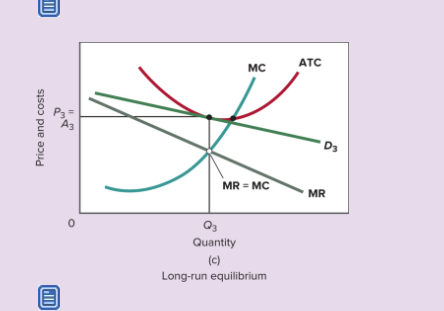
What is long‑run equilibrium?
MR = MC
Price equals ATC
Firm earns zero economic profit (normal profit)
This is the long-run destination, but it can happen in the short run too.
Why only normal profit in the long run?
Because entry and exit are easy.
What makes demand more elastic?
More rivals + weaker differentiation.
What makes demand less elastic?
Fewer rivals + stronger differentiation.
Can firms earn long‑run profit in real life?
Yes — if they have strong differentiation (brand, location, reputation).
Why might entry not be perfectly free?
Advertising costs, brand loyalty, trademarks → financial barriers.
What does strong differentiation create?
A bit of monopoly power → small long‑run profits.
Why do firms advertise?
To make demand shift right and become less elastic.
What happens if advertising works?
Revenue ↑ more than cost ↑ → profit increases.
What happens if advertising fails?
Costs ↑ but demand doesn’t → profit decreases.
How does advertising affect cost curves?
It raises ATC and AVC because it’s a variable cost.
What happens in the long run?
Economic profits disappear because of invisible hand
If you’re making extra profits
A competitor will enter and their demand curve will shift as some customers go to new competitor, which eliminates the economic profit
This makes it so P = ATC again