Unit 4B: Personality, Motivation, and Emotion
 Call Kai
 Learn
Learn Practice Test
 Spaced Repetition
 Match
Match Flashcards
 Knowt Play
1/65

There's no tags or description
Looks like no tags are added yet.
Name | Mastery | Learn | Test | Matching | Spaced | Call with Kai |
|---|
No analytics yet
Send a link to your students to track their progress
66 Terms
Psychodynamic theory
Argues that unconscious processes drive personality.
Unconscious processes
mental processes occurring outside of and not available to conscious awareness.
Ego defense mechanisms
largely unconscious distortions of thoughts or perceptions that act to reduce anxiety.
Denial
Refusing to admit that something unpleasant is happening.
Displacement
Shifting sexual or aggressive impulses towards a more acceptable or less threatening object or person.
Projection
People disguise their own threatening impulses by attributing them to others.
Rationalization
Justifying one's behavior with socially acceptable reasons rather than real reasons.
Reaction formation
The ego transforms anxiety-producing thoughts into their opposites.
Regression
Returning to more primitive levels of behavior.
Repression
Blocking a threatening memory from consciousness.
Sublimation
Channeling unwanted feelings in to more acceptable forms.
Projective tests
personality assessments that present ambiguous visual stimuli to the client and ask the client to respond with whatever comes to mind; used to uncover unconscious motives/thoughts as part of psychodynamic therapy.
Preconscious mind
level of the mind in which information is available but not currently conscious.
Unconscious mind
level of the mind in which thoughts, feelings, memories, and other information are kept that are not easily or voluntarily brought into consciousness.
Humanistic psychology
Argues that humans are motivated by a self-actualizing tendency, which pushes each of us to reach our full potential.
Unconditional (positive) regard
The basic acceptance and support of a person regardless of what the person says or does.
Self-actualizing tendency
the striving to fulfill one's innate capacities and capabilities.
Social-cognitive theory
It emphasizes the learning that occurs within a social context. In this view, people are active agents who can both influence and are influenced by their environment.
Reciprocal determinism
Argues the environment influences behavior, behavior influences the environment, and both influence the individual, who also influences them.
Self concept
One's description and evaluation of oneself.
Self-efficacy
An individual's subjective perception of their capability to perform in a given setting or to attain desired results.
Self-esteem
The degree to which the qualities and characteristics contained in one's self-concept are perceived to be positive.
Trait theories
A trait is a personality characteristic that meets three criteria: it must be consistent, stable, and vary from person to person. These theories try to identify and measure traits.
Big Five Theory of Personality
A leading theory that holds that personality can be effectively organized and described by five broad dimensions of personality—openness, conscientiousness, extraversion, agreeableness, and neuroticism.
Agreeableness
A personality dimension that describes someone who is good natured, cooperative, and trusting.
Openness
a personality dimension that describes one's willingness to try new things and be open to new experiences.
Conscientousness
A personality dimension describing someone who is organized, careful, disciplined.
Extraversion
A personality dimension describing someone who is sociable, gregarious, and assertive.
Emotional stability
A personality dimension that describes the degree to which someone is not angry, depressed, anxious, emotional, insecure, and excitable; it's the opposite of neuroticism.
Personality inventories
a self-report questionnaire on which people respond to items designed to gauge a wide range of feelings and behaviors; used to assess selected personality traits.
Factor analysis
a statistical procedure that identifies clusters of related items (called factors) on a test; used to identify different dimensions of performance that underlie a person's total score.
Drive-reduction theory
It assumes all motivated behavior arises from drives, stemming from a disruption in homeostasis.
Homeostasis
a balanced, internal state.
Arousal theory
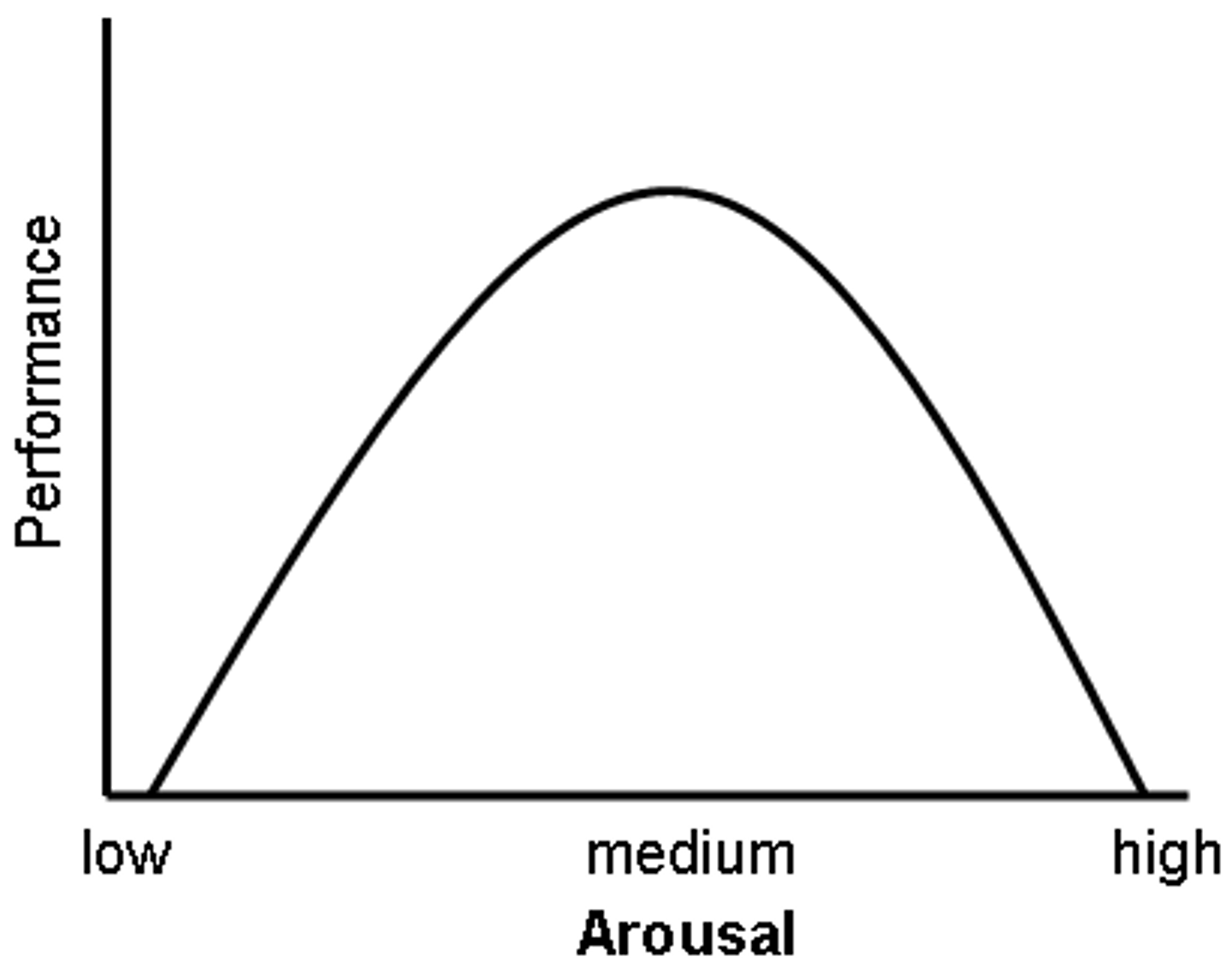
People seek an optimal level of arousal when they behave as demonstrated by the Yerkes-Dodson Law.
Optimal level of arousal
the level of arousal at which performance peaks.
Yerkes-Dodson law
the principle that performance increases with arousal only up to a point, beyond which performance decreases.
Self-determination theory
People are motivated by intrinsic (internal) or extrinsic (external) motivations. People want to feel competence, autonomy, and relatedness.
Intrinsic motivation
A desire to perform a behavior for its own sake.
Incentive theory
A theory of motivation stating that behavior is directed toward attaining desirable stimuli and avoiding unwanted stimuli.
Extrinsic motivation
a desire to perform a behavior to receive promised rewards or avoid threatened punishment.
Instincts
Innate, typically fixed patterns of behavior in response to certain stimuli.
Lewin's motivational conflict theory
idea that motivation to achieve desirable outcomes (approach motivation) and motivation to stay away from undesirable outcomes (avoidance motivation) causes internal conflicts within a person.
Approach-approach conflict
Conflict that results from having to choose between two attractive alternatives.
Approach-avoidance conflict
Conflict that results from having to choose an alternative that has both attractive and unappealing aspects.
Avoidance-avoidance conflict
Conflict that results from having to choose between two distasteful alternatives.
Sensation-seeking theory
The tendency to search out and engage in thrilling activities as a method of increasing stimulation and arousal.
Experience seeking
the tendency to seek novel experiences through the mind and the senses.
Thrill seeking
the desire to engage in physically risky activities.
Disinhibition
Acting without consideration of the consequences.
Boredom susceptibility
low tolerance for repetitious or constant experiences.
Ghrelin
A hunger-arousing hormone secreted by an empty stomach.
Leptin
hormone that signals the hypothalamus and brain stem to reduce appetite (satiety).
Hypothalamus
a neural structure lying below the thalamus; directs eating, drinking, body temperature; helps govern the endocrine system via the pituitary gland, and is linked to emotion.
Pituitary gland
The endocrine system's most influential gland. Under the influence of the hypothalamus, it regulates growth and controls other endocrine glands.
Affect
Appearance of observable emotions.
James-Lange
the theory that our experience of emotion is our awareness of our physiological responses to emotion-arousing stimuli.
Cannon-bard
the theory that an emotion-arousing stimulus simultaneously triggers (1) physiological responses and (2) the subjective experience of emotion.
Schachter-Singer two-factor theory
theory that to experience emotion one must be physically aroused and cognitively label the arousal.
Broaden-and-build theory
positive emotions prompt people to consider novel solutions to their problems.
Positive emotional experiences
Emotions including joy, interest, contentment, love...
Negative emotional experiences
Emotions including anxiety, sadness, anger, despair...
Cognitive label/appraisal
the personal interpretation of a situation that ultimately influences the extent to which the situation is perceived as stressful.
Facial-feedback hypothesis
The hypothesis that emotional expressions can cause the emotional experiences they signify.
Display rules
learned ways of controlling displays of emotion in social settings.
Elicitors
Something that leads to the experience of an emotion.
Universal emotions
according to Paul Ekman, they are anger, disgust, sadness, happiness, surprise, and fear.