Ch 6: Corporate Level Strategy
 Call Kai
 Learn
Learn Practice Test
 Spaced Repetition
 Match
Match Flashcards
 Knowt Play
1/27

There's no tags or description
Looks like no tags are added yet.
Name | Mastery | Learn | Test | Matching | Spaced | Call with Kai |
|---|
No analytics yet
Send a link to your students to track their progress
28 Terms
Corporate level strategy
a strategy that focuses on gaining long-term revenue, profits, and market value through managing operations in multiple businesses
Ex: Apple - is in the PC, smartphone, and tablet industry

Diversification
The process of firms expanding their operations by entering new businesses
Ex: Louis Vuitton

Related diversification
firm entering a different business in which it can benefit from leveraging core competencies, sharing activites, or building market power
Ex: Maybelline and Loreal (their products are related)
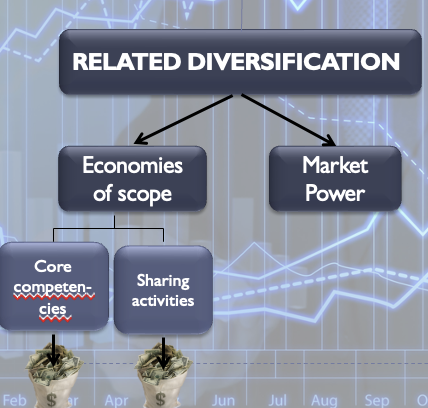
Economies of scope
cost savings from leveraging core competencies or sharing related activities among businesses in a corporation
Leveraging core competencies: firm’s strategic resources that reflect the collective learning in the organization
Sharing activities: having activities in 2 or more business value chains done by one of the businesses
Market power
firms’ abilities to profit through restricting or controlling supply to a market or coordinating with other firms to reduce investments
Pooled negotiating power
the improvement in bargaining position relative to suppliers and customers (results in market power)
If you provide multiple services all together you increase your bargaining power → gives u some control over the pricing
Vertical integration
an expansion or extension of the firm by integrating preceding or successive production processes (organization is involved in the production process) → ALLOWS BUILDING MARKET POWER
Low vertical integration: BMW (dealers are nnot owned by BMW)
High vertical integration: Tesla owns the entire business (makes and sells them)
Transaction cost perspective
Vertical integration is better than market transactions when transaction costs are high
Transaction costs: hidden costs associated with the cost itself (e.g., search, negotiating, contracting, monitoring and enforcement costs)
Benefits of vertical integration
Secure source of raw material or distribution channels
Control of valuable assets
Risks of vertical integration
Higher overhead costs and capital expenditures
Loss of flexibility
Unrelated diversification
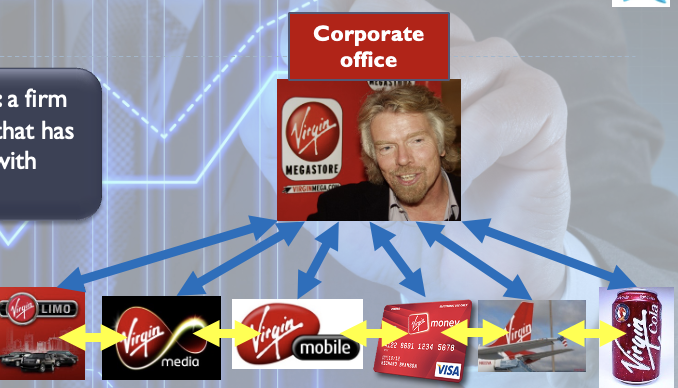
a firm entering a different business that has little horizontal interactions with other businesses in a firm
Horizontal interactions
relationships among 2 business units
Core competencies, sharing activies, market power
Vertical interactions
relationships between business units and corporate office
Corporate parenting, restructuring, and portfolio management
Corporate parenting
The positive contributions of the corporate office to a new business as a result of expertise and support provided and not as a result of substantial changes in assets, capital structure, or management
Restructuring
The intervention of a corporate office in a new business that substantially changes assets, capital structure and or management (selling parts of business, changing management, downsizing, reducing costs, etc…)
Protfolio management
A method for (a) assessing the competitive position of a portfolio of businesses within a corporation, (b) suggesting strategic alternatives for each business, and (c) identifying priorities for the allocation of resources across the businesses
BCG Matrix
*Companies make the most moeny when their portfolio follows the triangle of love (Cash cow invests $ in the Question Mark to become a Star which overtime will become a Cash Cow)
*Star is expensive so does not make the most profit
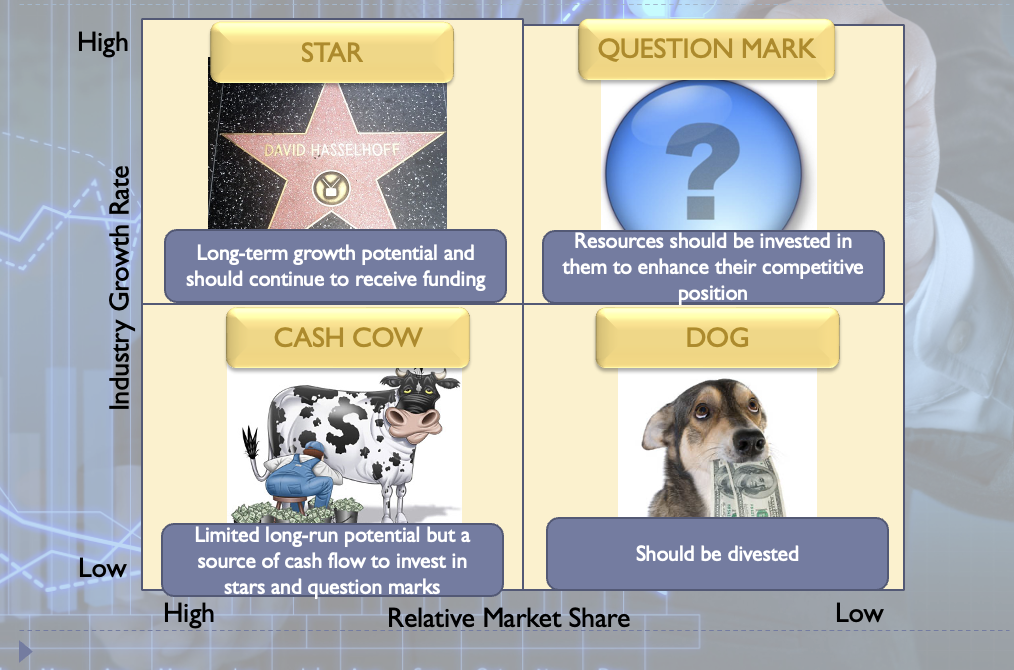
Star
High industry growth rate and High relative market share
Long-term growth potential and should continue to receive funding
Question mark
High industry growth rate and Low relative market share
Resources should be invested in them to enhance their competitive position
Cash cow
Low industry growth rate and High relative market share
Limited long-run potential but a source of cash flow to invest in stars and question marks
Dog
Low industry growth rate and low relative market share
should be divested
Merger
Combining two or more firms into one new legal entity
Ex: Exxon and Mobil → ExxonMobil
Acquistion
The incorporation of one firm into another through purchase
Ex: Disney bought Pixar
In 60% of cases, acquistion leads to value desctruction instead of value creation
Strategic alliance
a cooperative relationship between two or more firms
50% of strategic alliances fail
Joint venture
New entities formed within a strategic alliance in which two or more firms (the parents) contribute equity to form the new legal entity
Internal development
Entering a new business through investment in new facilities, often called corporate entrepreneurship and new venture development
Pros:
Do not share wealth generated
No difficulties for combining activities
Growth for growth’s sake
Managers’ actions to grow the size of the firms and not to increase long-term profitability to serve managerial self-interest
Egotism
Managers’ actions to shape their firms’ strategies to serve their selfish interest rather than to maximize long-term shareholder value