Block 8 Lesson 4
 Call Kai
 Learn
Learn Practice Test
 Spaced Repetition
 Match
Match Flashcards
 Knowt Play
1/25

Earn XP
Description and Tags
Observing at Different Wavelengths
Name | Mastery | Learn | Test | Matching | Spaced | Call with Kai |
|---|
No analytics yet
Send a link to your students to track their progress
26 Terms
How many of the rays that are emitted by distant space objects does the Earth’s atmosphere absorb?
Earth’s atmosphere absorbs most of the rays that are emitted by distant space objects. This means that most of them are stopped and don’t reach the surface of the Earth.
What activity is made difficult because of this?
This makes it especially difficult for us to observe the stars using waves that aren’t visible light.
What is astronomy and observations made using other parts of the electromagnetic spectrum called?
‘Invisible’ or ‘non-optical’ astronomy.
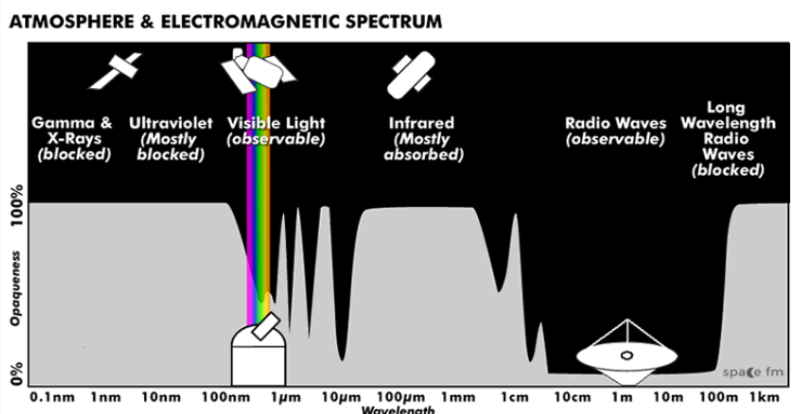
What radiation does Earth’s atmosphere block?
Earth’s atmosphere blocks all of the radiation from the electromagnetic spectrum except visible light and radio waves.
Therefore, observation of anything except those two small regions has to happen above the Earth’s atmosphere.
Effects made by the atmosphere on images from telescopes
The atmosphere refracts light which means that the position and clarity of a star is less accurate
The pollution from light and chemicals obscure the stars.
The atmosphere reflects most waves on the spectrum which makes observations on some wavelengths weaker.
Images from telescopes that aren’t radio and optical would be completely ruined if they were taken from the ground because of Earth’s atmosphere.
What are the 4 main kinds of observatories?
Underground
Ground
Airborne
Space
What wavelengths can we and can we not study from Earth?
From Earth we can study optical and radio wavelengths fairly easily, since they pass through the atmosphere.
Only some Infrared and UV waves pass though the atmosphere so it is more difficult.
Gamma and X-ray waves are completely unobservable from the ground.
Where are observatories normally built?
Observatories are normally:
Built in remote locations which are far - removes from light pollution.
Built on high mountains so there’s less atmosphere to obscure viewing.
Located in dry places with little clouds.
What are space telescopes?
Space telescopes are telescopes that function in space.
What are the advantages of space telescopes?
Clearer observations can be taken as there is no atmosphere that gets in the way
Wider wavelengths of the electromagnetic spectrum can be used to observe since they aren’t blocked by the atmosphere
There aren’t any time limitations since there is no day/night cycle. A telescope like Hubble can also image an area of space over many days.
What are the disadvantages of space telescopes?
There are limitations when imaging the Moon due to Hubble’s sensitivity to light. It also can’t image areas close to the Sun.
They are very expensive to build and place in space.
Maintenance is very difficult and tedious. Gyroscopes and mirrors that move the mirrors into place need updating. The Hubble Space Telescope was maintained twice before maintenance was called off.
How do radio telescopes work?
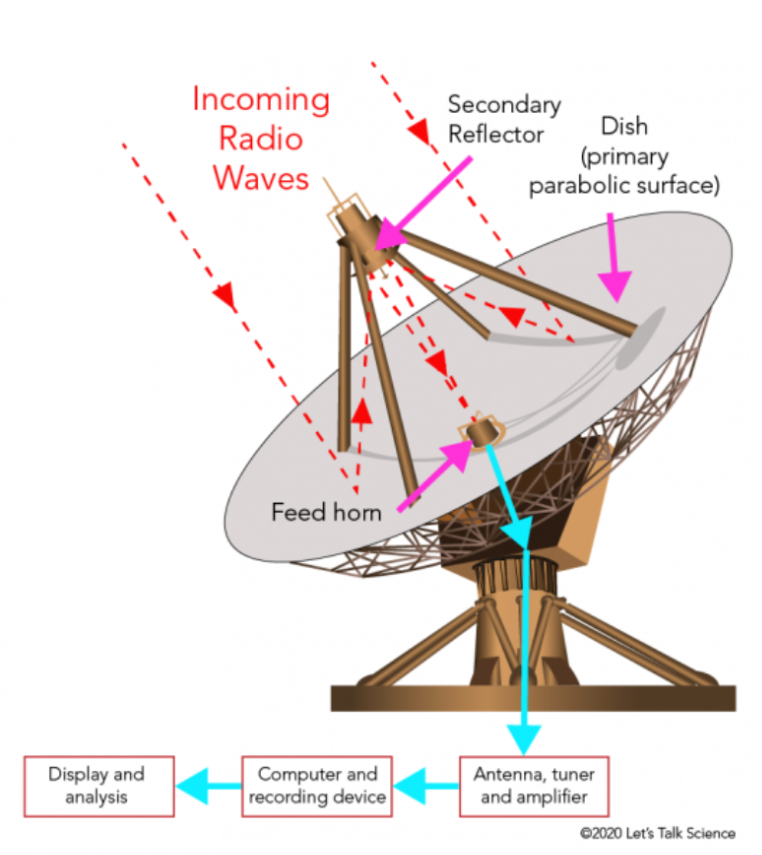
A radio telescope consists of a large, bowl-shaped dish that acts as a parabolic reflector, focusing incoming radio waves to a point.
This design often includes a secondary amplifier and a feed horn to sharpen the focus.
At the feed horn, an antenna converts the radio waves into an electric current by causing electrons to move. The electronics, often cooled with liquid nitrogen or Helium, reduce noise to detect weak signals more effectively.
The larger the dish, the more waves to be collected and so the larger the resolution.
These are also normally farther from developed areas as radio waves from phones and other electronic devices can interfere with signals.
What are the key components of a radio telescope?
Key components include the tuner, which isolates specific radio signals, and the amplifier, which strengthens these signals.
The data is then processed and stored by computer systems, which also control the telescope's movements.
How can arrays be formed?
By connecting radio telescopes together. This is called an aperture synthesis system and it uses interferometry to combine the signals.
What is the VLA?
The VLA (Very Large Array) is the largest array in the world and is in New Mexico, USA.
It links 27 telescopes and its resolution is 0.2-0.04 arcseconds.
What do infrared telescopes allow astronomers to do?
They allow astronomers see past cooler dust and see objects that are generating heat.
Where are infrared telescopes usually put?
They are normally put in high altitude and dry locations, since the water vapour in the atmosphere absorbs the infrared waves.
What 3 major things have infrared telescopes discovered?
Protostars:
A protostar is the object in the middle of the cloud of gas which will turn into a star
The dust and gas normally blocks the visible light of the protostar but we can see the infrared given off.
Dust and Molecular Clouds:
Molecular clouds are clouds of hydrogen and helium with some having masses of more than 100,000 solar masses.
These are where new stars are born
Infrared can see through the gas, which blocks visible light, and can see the formation of new stars.
Hotspots on Moons:
Infrared can be used to distinguish between cooler and hotter areas on the moon
The 'Compton–Belkovich Thorium Anomaly' is a hotspot on the back of the moon and contains radioactive elements.
What does UV astronomy allow us to do
UV astronomy lets us study the chemical compositions and temperature of stars.
What is UV astronomy usually used for?
UV is normally the signature for objects that are hotter, like stars in early/late stages of evolution.
What is commonly observed by UV space observatories that we can see?
The sun is observed by UV space observatories (SOHO and SDO) where they study the corona and chromosphere in detail.
Where are UV telescopes commonly placed?
In space.
What can X-ray astronomy be used to observe and where are X-ray telescopes commonly placed
X-rays also produced by hotter objects
For example, black holes, which gather matter around their event horizons in an accretion disk.
The effect of fast-moving particles under strong gravitational forces that surround a black hole can be observed in the x-ray part of the spectrum.
To observe objects using these wavelengths, the telescope used is normally above the atmosphere.
What does the Neil Gehrels Swift Observatory observe?
The Neil Gehrels Swift Observatory observes gamma bursts, powerful explosions which are the brightest electromagnetic events in the universe.
They are thought to occur during a supernova and last a fraction of a second so it is very hard to detect them.
Swift was able to view the afterglow of some in UV and X-ray
How were photos from space sent to Earth in the past?
In the past, photos from space had to be taken on film, which was processed, developed and sent back to Earth by radio signal.
How do photos get sent to Earth from space in the modern age?
In the modern age, everything is done using digital processors. These processors have to somehow turn light into an electrical signal. They do this by:
Passing light firstly through a lens, then a shutter
The light then hits a sensor, usually a CCD (Charge-Coupled Device) or a CMOS (Complementary Metal-Oxide-Semiconductor), measures the electrons received and a bayer filter over the CCD measures red, green and blue colours. Then, that information is saved into a computer file
This is much more efficient than manually processing film as it takes a lot of the work away. It also allows images to be instantly available and enhanced.