Acc 212 Exam 1
 Call Kai
 Learn
Learn Practice Test
 Spaced Repetition
 Match
Match Flashcards
 Knowt Play
1/40

There's no tags or description
Looks like no tags are added yet.
Name | Mastery | Learn | Test | Matching | Spaced | Call with Kai |
|---|
No analytics yet
Send a link to your students to track their progress
41 Terms
Managerial Accounting
Focuses on internal accounting processes and generates reports that are referenced by management
Provides financial and nonfinancial information to an organization’s managers
Current performance
Financial Accounting
Involves collecting data to create financial statements for both internal and external use
Past performance
Planning
Process of setting goals and making plans to achieve them
Build a new factory?
Develop new products?
Expand into new markets?
Control
Process of monitoring and evaluating an organizations activities
Are costs too high?
Are services profitable?
Are customers satisfied?
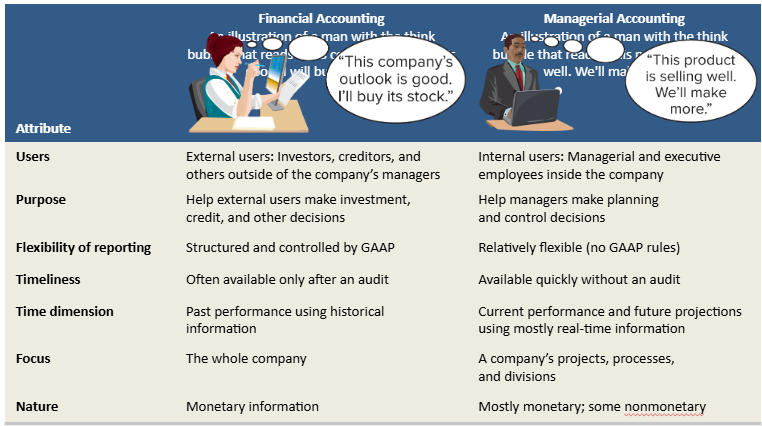
Financial Accounting comparison
Users: External users (investors, creditors, others outside of the company’s managers)
Prupose: Help external users make investment, credit, and other decisions
Flexibility of reporting: structured and cotnrolled by GAAP
Timeliness: Often available only after an audit
Time dimension: Past performance using historical information
Focus: The whole company
Nature: Monetary information
Managerial Accounting comparison
Users: Internal users (managerial and executive employees inside the company)
Purpose: Help managers make planning and control decisions
Flexibility of reporting: Relatively flexible (no GAAP rules)
Timeliness: Available quickly without an audit
Time dimension: Current performance and future projections using mostly real-time information
Focus: A company’s projects, processes, and divisions
Nature: Mostly monetary; some nonmonetary
Fraud
Affects all business and it is costly
The Association of Certified Fraud Examiners (ACFE) estimates the average US business to lose 5% of its annual revenues to fraud.
An internal control system is procedures managers use to:
Ensure reliable accounting
Protect assets
Uphold company policies
Promote efficient operations
The institute of managemetn accountants requires that managemetn accountants be
Competent, maintain confidentiality, act with integrity, and communicate information in a fair and credible manner
Managerial accounting is used in many careers
Marketing staff need sales and cost data to decide whcih products to promote
Managemetn needs sales force details to evaluate perfomrance
Entrepreneurs use costs, budgets, and financial statements
Decision makers in both for-profit and non-profit organizations use accounting data to make informed decisions and secure financing from donors
Direct costs
Cost-effectively traceable to a cost object
Indirect costs
Cannot be cost-effectively traced to a cost object
Direct materials
Costs for direct materials that can be cost-effecitvley traced through the manufacturing process to finished goods.
Ex. Tires, seats, frame, pedals, brakes, and cables
Direct labor
Wages and salaries for direct labor that are cost-effectively traced through manufacturing process to finished goods
Ex. Wages paid to bike assembly worker
Factory overhead
All manufacturing costs that are not direct materials or direct labor and cannot be cost-effectively traced to finished goods
Ex. Indirect labor (maintenance workers), indirect mateiral (screws, nuts, staples), indirect other costs (factory utility costs)
Manufacturing costs
Prime cost
Conversion cost
Prime cost
Direct material
Direct labor
Conversion cost
Direct labor
Factory overhead
Product costs
Direct labor
Direct material
Factory overhead
Production costs necessary to create a product
Period costs
Nonproduction costs linked to a time period (not products)
Selling expenses: costs to obtain orders and to deliver finished goods to customers
General and administrative expenses: costs of staff support and administrative functions
Nature of Managerial Accounting
Fraud triangle
Opportunity
Rationalization
Pressure
Artificial Intelligence
Artificial Intelligence (AI) uses software and can be used to complete repetitive tasks such as entering invoices and transaction data.
Managerial accountants are vital to evaluating AI generated reports and in making key business decisions.
Data analytics
Data analytics is a process of analyzing data to identify meaningful relations and trends.
There are four basic types of analytics:
Descriptive – summarizes and describes events from the past.
Diagnostic – reveals causes of events from the past.
Predictive – predicts likely events for the future.
Prescriptive – creates action plans to achieve a desired future.
Data visualization
Data visualization is a graphical presentation of data to help people understand their significance and make informed business decisions.
A popular tool to create data visualizations is a Tableau dashboard.
A dashboard is a data visualization that includes charts, graphs, and other imaging to help users see important trends and relations.
Cost concepts for service companies
The cost concepts described are generally applicable to service organizations.
Service companies can classify costs as direct materials, direct labor, overhead, selling, or general and administrative costs.
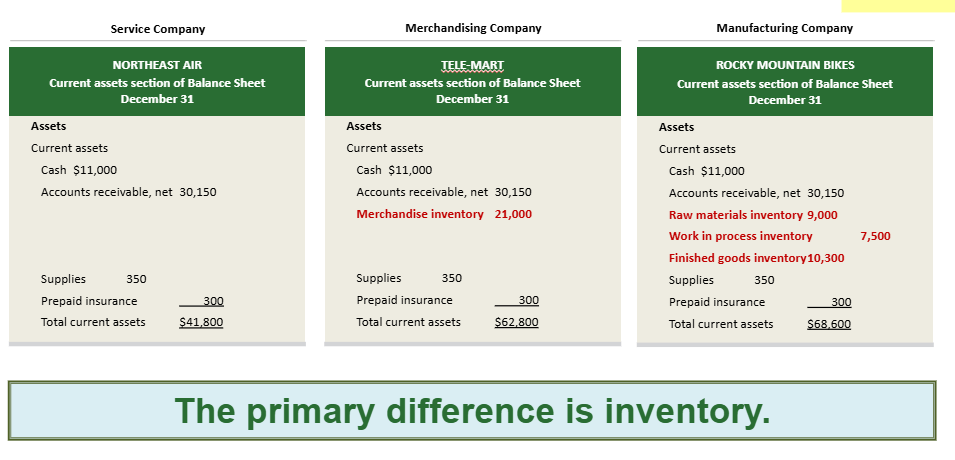
Reporting inventory on the balance sheet
Raw materials inventory: materials waiting to be processed
Work in process inventory: partially complete products, some materials, labor and/or overhread have been added
Finished goods inventory: completed products ready for sale
Balance sheets for manufacturers, merchandisers, and servicers
The primary difference is inventory
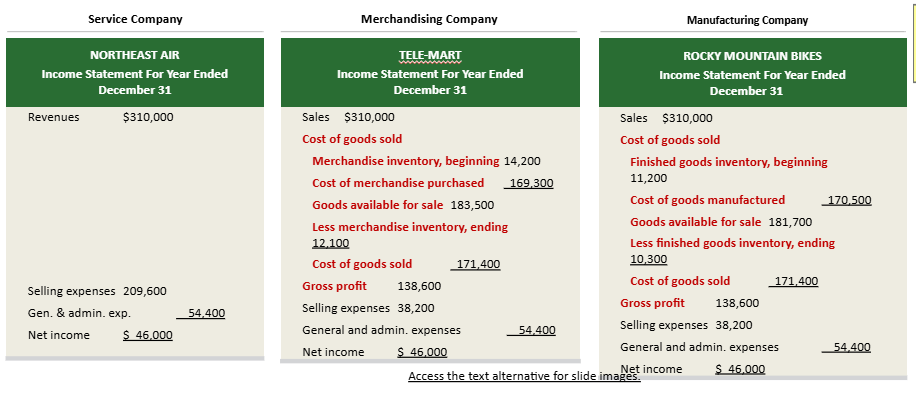
Merchandiser COGS equation
Beginning merchandise inventory + cost of merchandise purchased - ending merchandise inventory = COGS
Manufacturer COGS equation
Beginning finished goods inventory + cost of goods manufactured - ending finished goods inventory = COGS
Reporting costs and the income statement
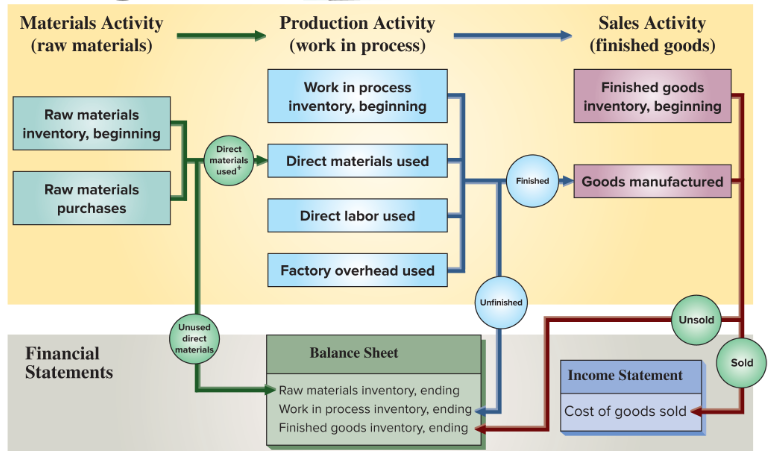
Flow of manufacturing activities
Materials activity (raw materials)
Production activity (work in process)
Sales activity (finished goods)
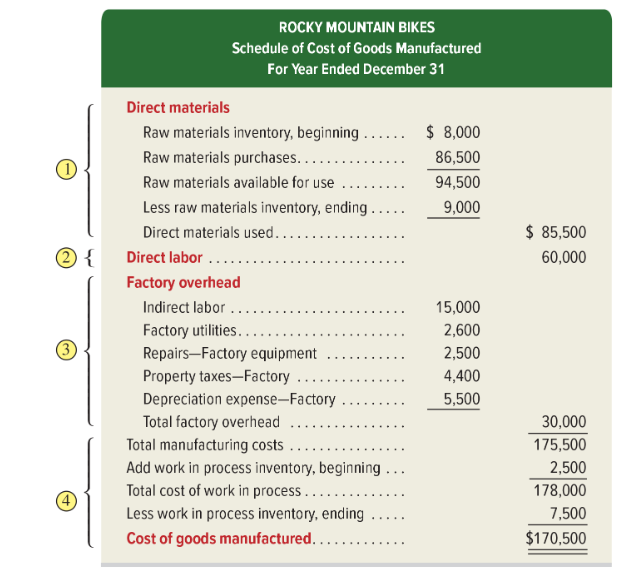
Schedule of cost of good manfactured
Summarizes the types and amounts of costs incurred in a company’s manufacturing process.
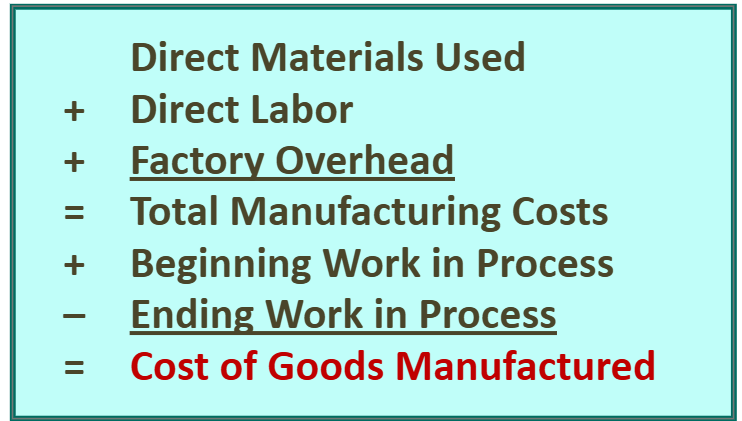
Manufacturing statement
Trends in managerial accounting
Digital manufacturing
Customer orientation
E-commerce
Lean practices
Global economy
Service economy
Value chain
Lean principles
The goal of a lean business model is to eliminate waste while “satisfying the customer” and “providing a positive return” to the company.
Continuous improvement rejects the notion of “good enough” and challenges employees and managers to continuously improve operations.
Total quality management
Quality improvement applied to its business activities
Seek and uncover waste
Constant focus on higher standards
Just-in-time (JIT) manufacturing
Receive customer orders → schedule production → receive materials just-in-time for production → complete parts just-in-time for assembly into products → complete products just-in-time to ship to customers
Value chain
Refers to the series of principles that add value to a company’s products or services. Companies can use lean principles to increase efficiency and profits.
Triple bottom line
Focuses on three measures:
Financial “profits”
Social “people”
Environmental “planet”
ESG insight: reporting and analysis
Environmental, social, and governance (ESG)
Framework that depicts how companies behave as responsible stewards of the environment, principled members of society, and accountable leaders.
Includes sustainable practices and socially responsible activities.
Sample metrics are shown in the graphic below.
Environmental
Social
Governance