5. The international Financial System
 Call Kai
 Learn
Learn Practice Test
 Spaced Repetition
 Match
Match Flashcards
 Knowt Play
1/53

There's no tags or description
Looks like no tags are added yet.
Name | Mastery | Learn | Test | Matching | Spaced | Call with Kai |
|---|
No analytics yet
Send a link to your students to track their progress
54 Terms
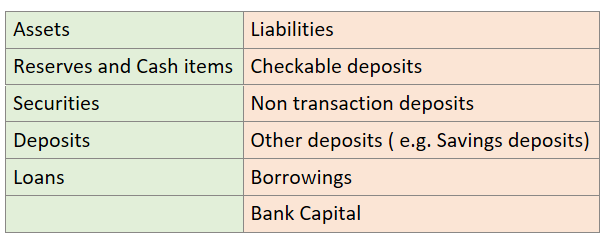
For a commercial bank, what are the liabilities on the bank balance sheet?
checkable deposits
Nontransaction deposits
Borrowings
Bank Capital
For a commercial bank what are the assets of a balance bank sheet?
reserves
cash items in process of collection
Deposits at other banks
Securities
Loans
Other assets
What does a commercial banks balance sheet table look like?
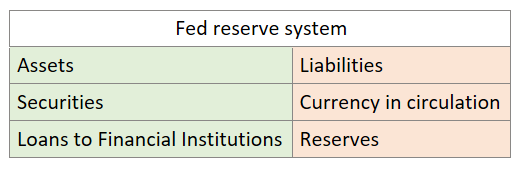
For Feds what are the liabilities of a balance sheet?
Currency in circulation: in the hands of the public
Reserves: bank deposits at the Fed and vault cash
For Fed’s what are the assets of a balance sheet?
Government securities: holdings by the Fed that affect the money supply and earn interest
Discount loans: provide reserves to
What does a Fed reserve system balance sheet table look like?
When do Foreign exchange interventions occur?
when central banks engage in international transactions to influence exchange rates?
How can Central banks intervene with the Exchange rate?
pay using currency and pay using deposits - make sure the balance sheets always end up the same
purchase of domestic currency and corresponding sale fo foreign assets in the foreign exchange market → equal decline in its international reserves and the monetary base
sale of domestic currency to purchase foreign asstes in the foreign exchange market results in an equal rise in its international reserves and the monetary base
What is Unsterilised foreign exchange intervention?
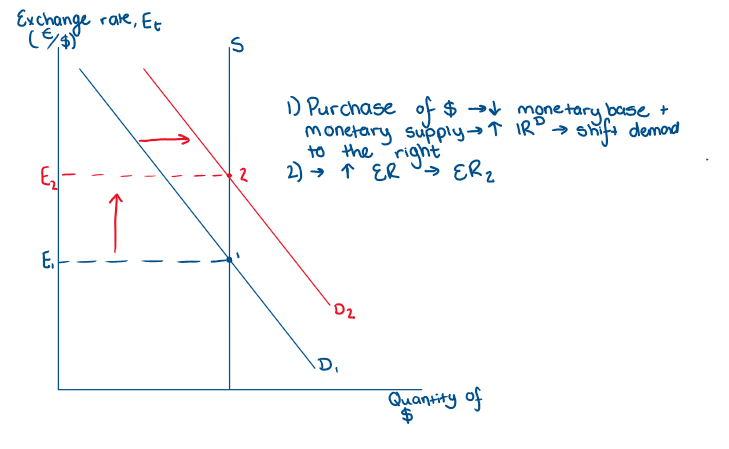
An unsterilized intervention in which domestic currency is sold to purchase foreign assets leads to a gain in international reserves an increase in the money supply and depreciation of the domestic currency
increase money supply → more domestic currency → IR dfall → depreciate domestic currency
Relationship btw money supply + IR
What is the effect of an unsterilised purchase of dollars and sale of foreign assets - graphically?
What is sterilized foreign exchange intervention?
To counter the effect of the foreign exchange intervention conduct an offsetting open market operation → buy or sell gov bonds or securities
There is no effect on the monetary base and no effect on the ER
What are the 2 basic types of exchange rate regimes in the international financial system?
fixed exchange rate regime
Floating exchange rate regime
What is a fixed exchange rate regime?
values of currencies are kept pegged relative to one currency → the ER is fixed
The currency against which the others are pegged is known as the anchor currency
What is a floating exchange rate regime?
the values of currencies are allowed to fluctuate against one another
Who is Bretton Woods?
created the IMF → sets rules and provides loans to deficit countries
Set up the International bankf or reconstruction and development => provides loans to developing banks
US emerged from WII as largest economic power. → Us dollar became reserve currency → abandoned in 1971
Even post 1971 - the dollar was reserve currency in which international financial transactions were conducted
What is a reserve currency
It is used by other countries to denominate the assets they held in internal reserves
When will the central bank act in the foreign exchange market?
When domestic currency is either overvalued or undervalues
What happens in a fixed exchange rate when the domestic currency is overvalued?
Central bank must purchase domestic currency to keep the exchange rate fixed
Result: CB loses international reserves
What happens in a fixed exchange rate system when the domestic currency is undervalued?
the CB must sell domestic currency to keep the exchange rate fixed
Result
CB gains international reserves
What does intervention in case of overvalued exchange rate look like?
What does intervention in case of undervalued exchange rate look like?
When does devaluation occur?
when the domestic currency is overvalued
Eventually the CB may run out of international reserves eliminating its ability to prevent the domestic currency depreciating
What happens if there is a perfect capital mobility?
the sterilized exchange rate intervention keep the exchange rate at Epar
If a country ties it ER to an anchor currency of a larger country it loses control of its monetary policy
What is the policy Trilemma
A country cant pursue the 3 policies at the same time
free capital mobility
A fixed ER
Independent monetary policy
What is floating exchange in terms of policy trilemma
Free capital mobility and independent monetary policy
e.g. Us or EU
What is a dependent monetary policy in policy trilemma?
Fixed ER and Free capital movement
hong kong and belize
What is a weighted basket exchange in policy trilemma?
Fixed ER and independent monetary policy
e.g. China
doesnt have free capital mobility via capital controls that restrict capital movement across their borders
What is a monetary union
Union of countries who adopt a common currency, such as EU monetary union and the euro
Aids in cross border trades
all have a dependent monetary policy
What is a currency board?
the most extreme example of monetary union
the domestic currency is 100% backed by foreign currency
e.g. Argentina, Hong Kong, Estonia
most extreme example is dollarization
What was Argentina’s currency board?
Adopted in 1991 to end a long history of monetary instability
Peso/dollar exchange rate fixed and rate guaranteed by the central bank
Early success was stifled by a mass exchange of pesos for dollars - Real GDP shrunk and unemployment rose to 15% in 1995
Central bank could do nothing to control - ER was fixed But world organisiations helped out (World bank, IMF)
ANother recession in 1999 eventually lead to the collapse of the currency board in 2002. The peso depreciated by 70% and a financial crisis ensued.
What are the positives and negatives of dollarisation?
Pos
avoid CV creating inflationa dn eliminates speculative attacks on currency
Neg
country cannot pursue its own monetary policy → loses revenue a gov receives by issuing currency
What is seigniorage?
profit a government makes by issuing currency
difference btw/ face value of currency and cost to produce it
What are the controls on capital outflow?
promote financial instability by forcing a devaluation
Seldom effective and may increase capital flight
Lead to corruption
Lose opportunity to improve the economy
What are controls on capital inflows?
lead to a lending boom and excessive risk-taking by financial intermediaries
controls may block funds for production uses
Produce substantial distortion and misallocation
Leads to corruption
What is the effect of capital controls?
It is a strong case for improving bank regulation and supervision
What is the role of the IMF
Act as international lender of last resort (ILLR)
ILLR creates moral hazard ( countries have an incentive to behave recklessly bc/ they know IMF will step in
IMF needs to limit moral hazard - lend only to countries w/ good bank supervision
Need to do ILLR role fast and infrequently
What is the monetary approach to the balance of payments?
Views the balance of payments as a monetary phenomenon
Money plays crucial role in the LR as both a disturbance and an adjustment
What is the monetary approach under fixed exchange rates?
Excess stock of money demand that is not satisfied by domestic monetary authorities → BoP surplus
Excess stock of money supply that is not eliminated by monetary authorities → BoP deficits
Surplus/deficit is temp + selfcorrecting in LR
Except for currency-reserve nation
What happens in currency-reserve nation when there is a monetary approach?
the nation has no control over its money supply in the LR under fixed exchange system
What are the assumptions for money demand?
demand for nominal money balances is positively related to the level of nominal income
stable in LR
What is the equation for demand for money?
Md = kPY
Md = quantity demanded of nominal money balances - stable positive function of the domestic price level and national income
k = desired ratio of nominal money balances to nominal income
P = domestic price level
Y = real output
PY = nominal national income or output
K = 1/v where v= belocity of circulation of money
What is the equations for the supply of money
Ms = m(D + F)
Ms = nations total money supply
m = money multiplier
D = domestic component of nation’s monetary base - domestic assets backing the nation
F = international or foreign component of nation’s monetary base - international reserves of the nation, which can be increased or decreased through BoP surpluses and deficits
From the equation for supply of money what does D + F represent?
D + F = monetary base or high-powerd money
under a fractional reserve banking system, each nw dollar of D or F deposited results in an increase of m(D+F)
What happens in the equilibrium of Money supply and demand market?
Md = Ms
Increase in Md can be satisfied by either an increase in D or F
What happens if there is excess demand for money?
BoP surplus → may increase Ms by the same amount
What happens if there is excess stock of money supplied?
Outflow of reserves (BoP deficit) sufficient to eliminat the excess supply of the money in the country
What do countries have control over?
A country has no control over its money supply under a fixed Er system in the LR
Only a reserve-currency country can retain control over its money supply in the LR under fixed exchange as foreigners willingly hold the currency
Under a flexible exchange rate system what happens in disequilibria?
Immediately corrected by automatic changes in ER w/o international flows of money or reserves
Nation retains dominant control over is money supply and monetary policy
Adjustment occurs as result of the change in domestic prices accompanying the change in ER
Under Flexible exchange rates which does a BoP deficit lead to?
deficit in BoP → automatic depreciation of the nation’s currency → prices and demand for money increase → absorb supply of money → eliminate automatically BoP
Under Flexible exchange rates which does a BoP surplus lead to?
surplus in BoP → automatic appreciation of the nation’s currency → prices fall → eliminating excess demand and BoP surplus
What causes BoP disequilibrium under fixed exhange rates?
Under fixed exchange rates BoP disequilibrium results from an international flow of money and reserves
According to Monetary approach, what does a currency depreciation result from?
excessive money growth in the nation over time
greater inflationary pressure compared to others → currency is depreciating
According to Monetary approach, what does a currency appreciation result from?
inadequate money growth in the nation