Unit D - Energy & Rates
 Call Kai
 Learn
Learn Practice Test
 Spaced Repetition
 Match
Match Flashcards
 Knowt Play
1/54

There's no tags or description
Looks like no tags are added yet.
Name | Mastery | Learn | Test | Matching | Spaced | Call with Kai | Chat |
|---|
No analytics yet
Send a link to your students to track their progress
55 Terms
How does how effectively transformation energy affect human civilization.
Our ability to harness energy has greatly, contributed to the development of human civilization, but how efficiently we transform energy determines the sustainability and effectiveness of those advancements.
What is energy efficiency? (6)
Energy efficiency is the percentage of useful energy produced compared to the total energy used.
Higher efficiency = less wasted energy
Hydroelectricity ≈ 85% efficient
Solar energy ≈ 15% efficient
Using energy-efficient devices helps conserve energy and reduce costs.
an alternative energy source
Hydrogen gas is an alternative energy source that can be used as a fuel. When hydrogen burns, it releases a large amount of energy, and the only product formed is water vapour, which makes it cleaner for the environment than fossil fuels. However, hydrogen gas also has some disadvantages. It is expensive to produce because it is usually made through electrolysis (the process of using electricity to split water into hydrogen gas and oxygen gas). It is also difficult to store and transport safely because hydrogen is highly flammable.
Why doesn’t a perpetual motion machine work?
t would violate the laws of thermodynamics.
First Law of Thermodynamics: Energy cannot be created or destroyed. A machine cannot make more energy than it receives.
Second Law of Thermodynamics: Every energy transfer loses some energy as heat due to friction and inefficiency.
Therefore, a machine cannot run forever while producing unlimited energy.
Thermochemistry
The study of energy changes during physical or chemical changes in matter
Energy
the ability to do work (Joules or J)
Work
the amount of energy transferred by a force over a distance (J)
All forms of energy can be classified as either…
kinetic energy: the energy of an object due to its motion
potential energy: the energy of a body or system due to its position or composition:
thermal energy Vs Heat Vs Temp
The total quantity of potential energy of a substance
Heat The transfer of thermal energy from a warm object to a cooler object. ( - When you heat water in a kettle, you transfer thermal energy from the burner to the kettle on the water. - When you cool an object such as letting the kettle rest, the energy is transferred to its surroundings.)
Temperature a measure of the average kinetic energy of entities in a substance
Temperatures relation to kinetic energy
The higher the temperature the higher the kinetic energy
Law of Conservation of Energy, What does is tell us about Chemical Systems?
Energy cannot be created or destroyed, It just changes from.
From the law of conservation fo energy, you know that the total energy in a chemical system and its surrounds must be the same before and after the reaction
Chemical System Vs surrounding
a group of reactants and products being studied vs All the matter that is not part of the system
Types of Reactions explain
Exothermic: releasing energy to the surroundings Eng on product side
Endothermic: Absorbing energy from the surroundings Energy on reactant side
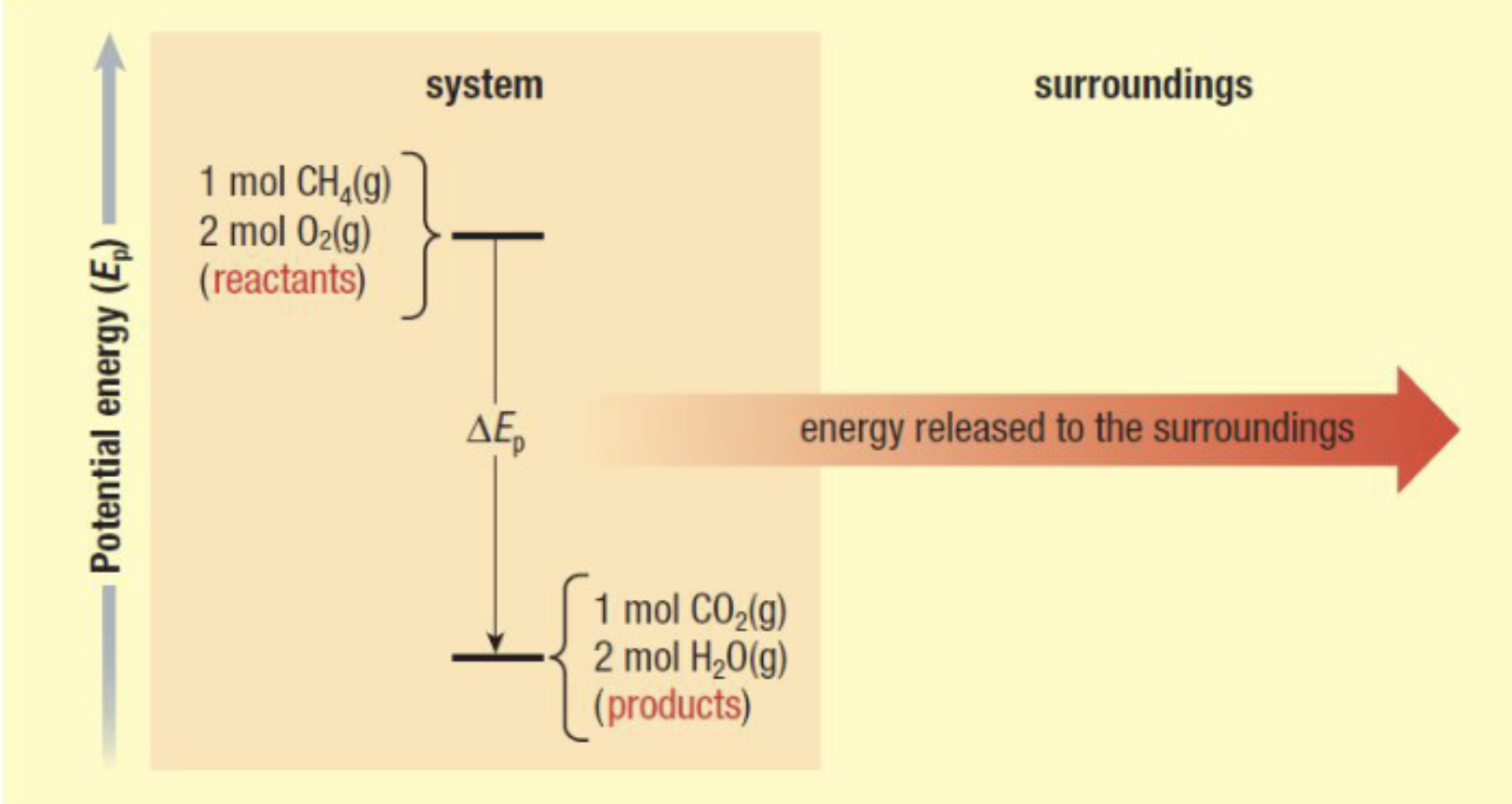
Endothermic or Exothermic?
Exothermic
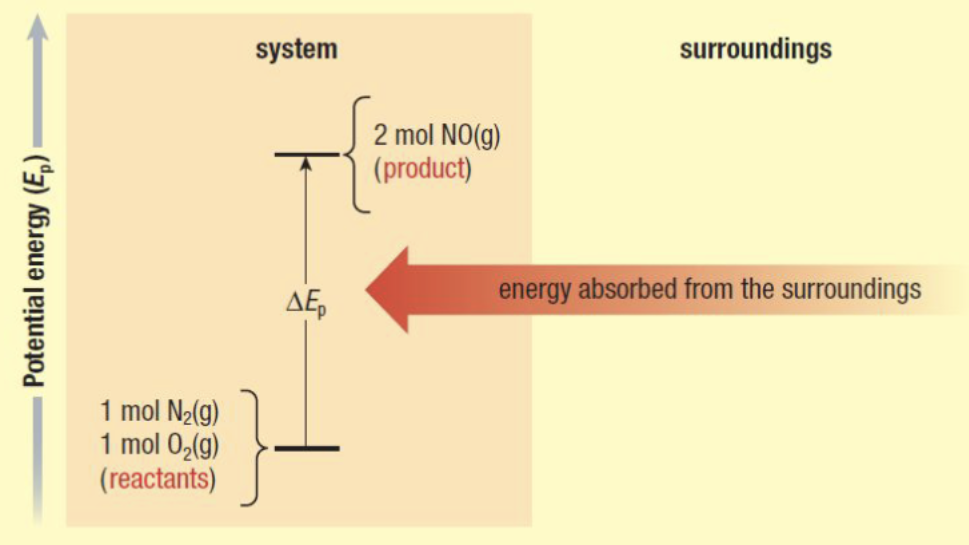
Endothermic or Exothermic?
Endothermic
Nuclear Energy (3) + 2 forms (3 each)
all nuclear reactions are exothermic.
Per unit of mass, nuclear reactions release much more energy than standard exothermic chemical reactions.
There a two types of nuclear reactions: Fusion & Fission
Fusion: the process of combining two or more nuclei of low atomic mass to form a heavier, more stable nucleus Currently the sun is undergoing this kind of fusion reaction making helium. As planets get older they will start fusing heavier elements. Hydrogen > Helium > Lithium etc Fusion reactions are extremely energy efficient
Fission: the process of using a neutron to split a nucleus of high atomic mass into two nuclei with smaller masses Fusion reactions are 3-4x more efficient than fission reactions Fusion is 4 million times more efficient than gas
potential or kinetic?
A stick of dynamite prior to explode
a space shuttle before launch
the soot rising above a campfire
the chemicals inside a battery
potential
potential
kinetic
potential
endo or exo?
water evaporating into steam.
a candle burning
the combustion of gasoline
the melting of ice
the splitting of a nitrogen molecule, n2, into two individual atoms
endo
exo
exo
endo
exo
mass
n x M
Specific heat capacity (fancy. simple, symbol)
(c) The quantity of thermal energy required to raise the temperature of 1g of substance by 1C; J/(g.C)
- In simple terms it tells you how resistant a material is to changing temperature. How “stubborn” the substance is.
Lower specific heat → ______ resistant to change
Higher specific heat→ ______ resistant to change
Less
more
Specific heat capacity (Water)
4.18 J/g.c
Calorimetry? What do scientists use calorimetry for? Calorimeter
the process of measuring energy changes during physical/chemical changes
study the thermal energy transfer
a device that is used to measure thermal energy change in physical/chemical changes
specific heat capacity formula or the heat energy formula.
Q=MCT
q: the total amount of thermal energy absorbed or released by a chemical system (J)
m: mass in grams
c: specific heat capacity (J/g x C)
ΔT: change in temperature (C)
ΔT = Tfinal - Tinitial
Enthalpy (H)
The total amount of thermal energy in a substance/system
Enthalpy Change (ΔH) (3)
Enthalpy change represents the heat energy transferred into or out of a chemical system during a reaction/chemical or physical change
H is neg (exothermic)
H is pos (endothermic)
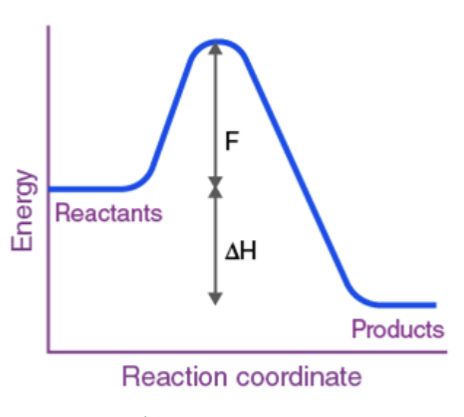
Endothermic or Exothermic?
Exothermic
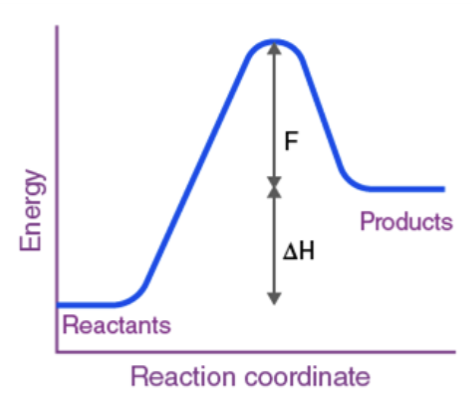
Endothermic or Exothermic?
Endothermic
Change in Hr
ΔHr: The enthalpy change associated with a physical, chemical, or nuclear change involving 1 mol of a substance, J/mol
We use this to determine how much energy might be produced or absorbed in a given chemical reaction
Change in Hr for solution, combustion, vaporization, formation, neutralization
Hsol
Hc
Hvap
Hf
Hneut
Always set to one mol
total enthalpy change formula
ΔH=nΔHr
ΔH = total enthalpy change of the reaction (kJ)
n = number of moles (mol)
ΔHr = molar enthalpy change (enthalpy change per mole of reaction) (kJ/mol)
ΔHsystem = −q surroundings, what does it show?
It shows that heat energy is conserved. The heat lost by the system is gained by the surroundings (and vice versa). If the system releases heat, the surroundings absorb the same amount of heat, and if the system absorbs heat, the surroundings lose it.
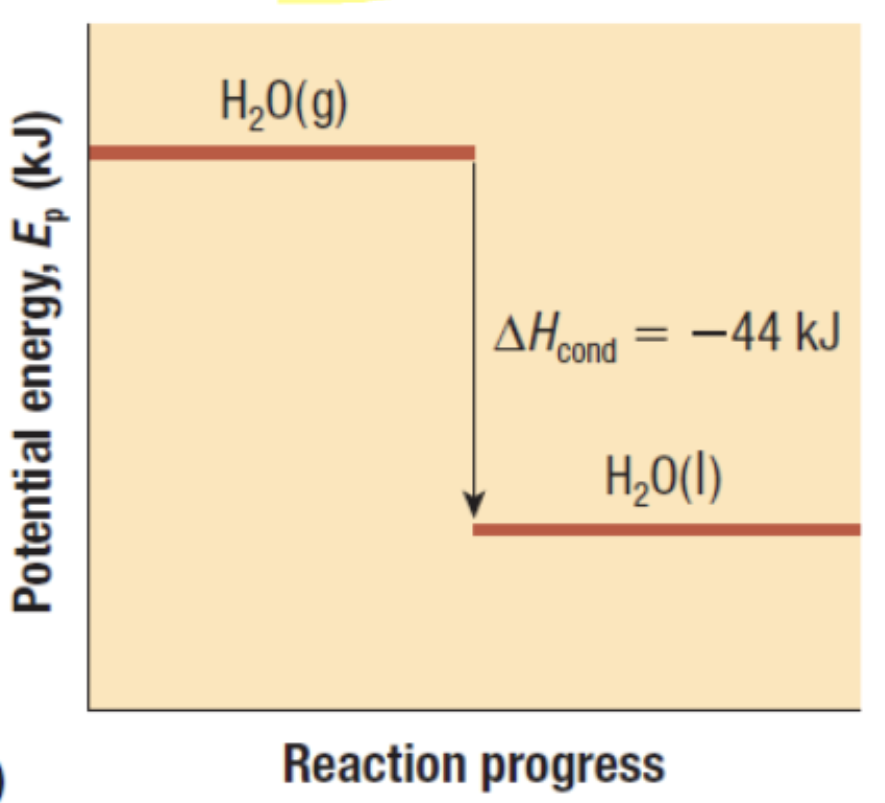
Exothermic or Endothermic?
Exothermic
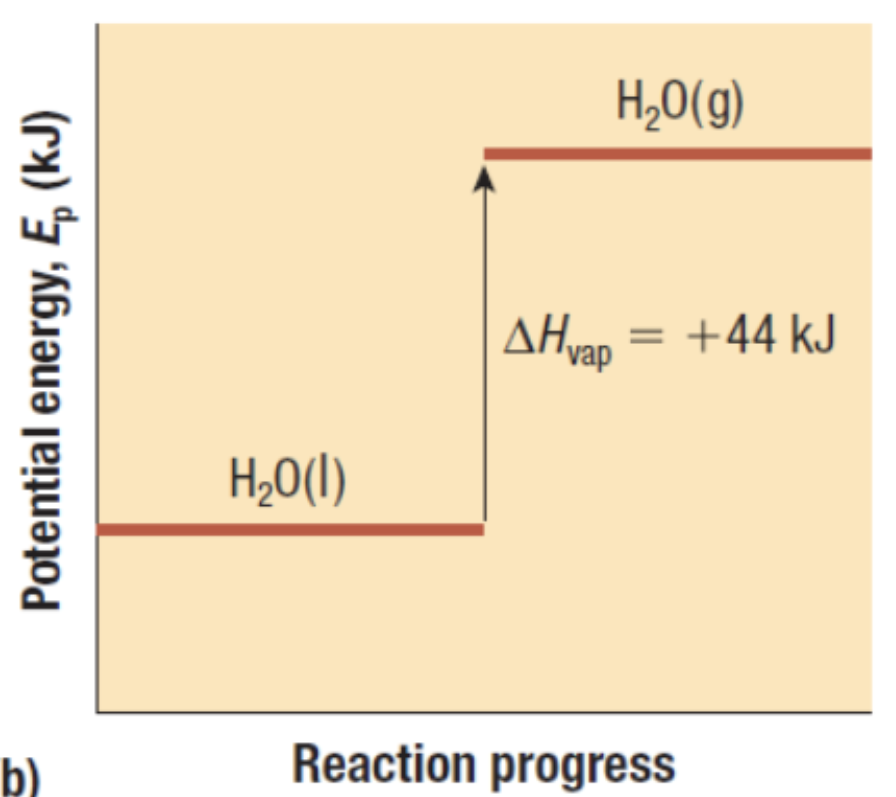
Exothermic or Endothermic?
Endothermic
A covalent bond between 2 atoms will break if…
enough energy is supplied
bond dissociation energy (4)
The quantity of energy required to break a chemical bond
They all have positive values
- All for 1 mol
(kJ/mol)
Bond dissociation energy for C = O
799 kJ/mol
Bond Energies
Bond energies can be used to calculate approximate enthalpy changes
ΔH=∑Ebonds broken−∑Ebonds formed
Bonds broken → energy is absorbed (positive)
Bonds formed → energy is released (negative)
D is the bond energy taken from the tables
Hess’s Law
The enthalpy change for the conversion of reactants to products is the same whether the conversion occurs in one step or several steps
Standard Enthalpy of Formation + formula (2)
The Standard Enthalpy of Formation (ΔHf) of a compound is the change in enthalpy that occurs when 1 mol of compound is formed from its elements, with all substances in their standard states. (kJ/mol)
ΔH reaction = {n products ΔH products - {n reactants ΔH reactants
Standard State + At standard state (4)
The most stable form of a substance under standard conditions 25oC and 100kPa
HOFNCl and Nobles gases are gases
Mercury and Bromine are liquids
All others are solids
Chemical Kinetics
the branch of chemistry that deals with rates of reactions
what is the reaction rate of a chemical reaction (2)
The reaction rate of a chemical reaction is the change in concentration of a reactant or product per unit of time
The stems from the concept that different reactions have different speeds.
How do chemists measure reaction rates if there is no “speedometer” for reactions?
how fast reactants are used up
products are formed over time
eactions don’t have “end point,”
scientists measure changes over time to determine arr
Average Reaction Rate + formula +Determining Average Reaction Rate using Graphical Data
the change of reactant or product concentration over a unit of time
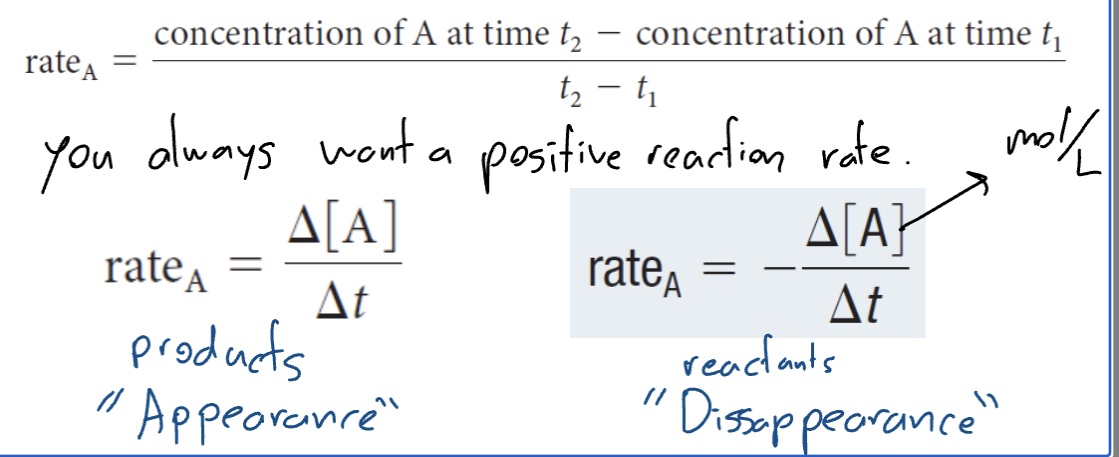
rate A = Conentration of A at time t2 - concentration of A at time 1 / t2- - t1
you would always want a positive reaction rate
rate a = change in (A)/change in T
change in y (concentration) /change in x (time)
(rise over run)
Factors Affecting Reaction Rates
Chemical Properties
Concentration of reactants
Surface Area
Temperature
Presence of a catalyst
Catalyst
a substance that alters the rate of a chemical reaction without itself being permanently changed
Why are reaction rates important in industry, and what role do catalysts play?
Reaction rates are important in industry because they make manufacturing processes faster, cheaper, and more efficient. Catalysts are substances that speed up reactions without being used up. They are used in real-life applications like catalytic converters and in food production (e.g., blue cheese).
Collision Theory, what is it? how do the 5 factors inc it?
Collision Theory states that chemical reactions can occur only if reactants collide with proper orientation and with enough kinetic energy. (activation energy)
Enough to break the bonds and form products By adjusting our 5 factors of reaction rate, we are increasing the amount of collisions that can occur making the reaction happen
“Enough kinetic energy” → Activation Energy
The minimum energy that reactant molecules must possess for a reaction to be successful.(Ea)
Think of the activation energy as a hill or barrier that the reactants must undergo to perform the reaction (hump on graph)
Temperature in correlation to rates of reactions
When temperature is increased, there is higher kinetic energy in the system, thus a higher likelihood of collisions
Faster reaction rate
Concentration affect on the rate of reaction:
As concentration increases → more reactant products in the same volume → higher likelihood of collisions → faster reaction
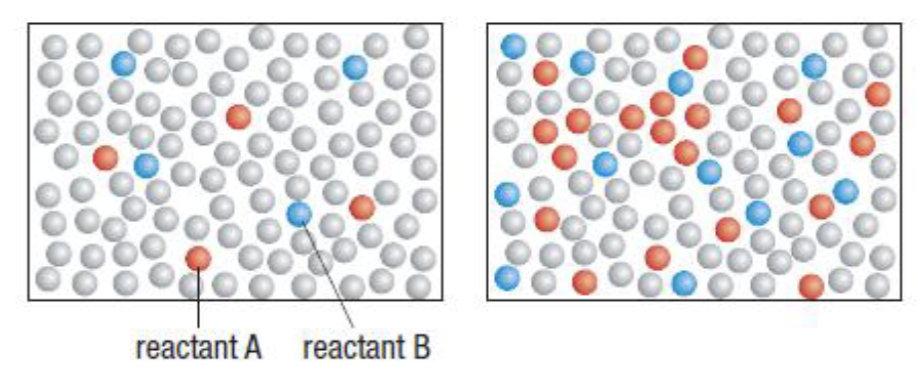
Where would the reaction be slower, wb faster? Why?
slow, fast - concentration because there are more particles in the same volume.
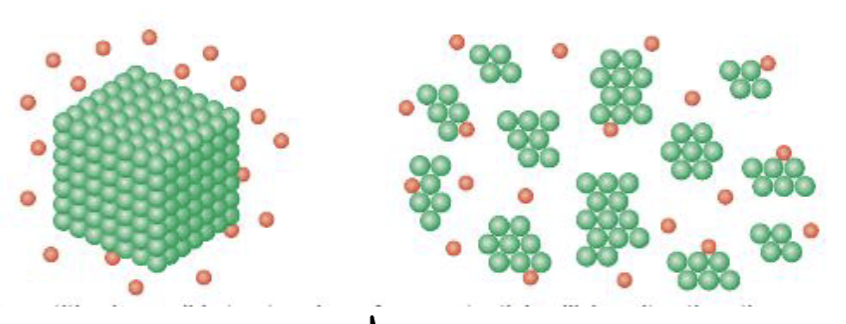
Surface Area affect on the rate of reaction: why?
As Surface Area increases → more opportunities for collisions → faster reaction
How do catalysts work + Two types of Catalyst: explain + biological catalysts
For any reaction to occur, the kinetic energy of colliding reactant entities must be equal to or greater than the activation energy. However, Catalysts don’t affect either of these things
Catalysts provides an alternative pathway for the reaction, which has a lower activation energy
Heterogeneous Catalyst: a catalyst in a reaction in which the reactants and the catalyst are in different physical states
Homogeneous Catalyst: a catalyst in a reaction in which the reactants and the catalysts are in the same physical state
A catalyst made by a living system, usually an enzyme eg) lactase to break down the sugars in milk products for someone who is lactose intolerant To speed up fermentation of alcohols, cheeses, yogurts etc