Gothic Art Through Medieval Eyes
 Call Kai
 Learn
Learn Practice Test
 Spaced Repetition
 Match
Match Flashcards
 Knowt Play
1/49

There's no tags or description
Looks like no tags are added yet.
Name | Mastery | Learn | Test | Matching | Spaced | Call with Kai |
|---|
No analytics yet
Send a link to your students to track their progress
50 Terms
Who wrote ‘Gothic Art: Glorious Visions’ and what does it argue?
Michael Camille
In his book, Camille argues that Gothic art is best understood through the medieval eye as the medieval people understood it. People in the 13th cent were not seeking to label architectural components or decipher symbols, but were enraptured witnesses to new ways of seeing. He sees Gothic as the first architectural style to fully permeate the world of things.
What kind of things were happening in Europe from 1000-1200?
Expansion of Monasticism
Rise in the cult of saints (more churches built to house the relics of these saints)
Building Boom
Christianisation of Roman forms - taking Roman forms and using them as a narrative space
St Giles-du-Gard, France
Abbey Church of Sainte Foy
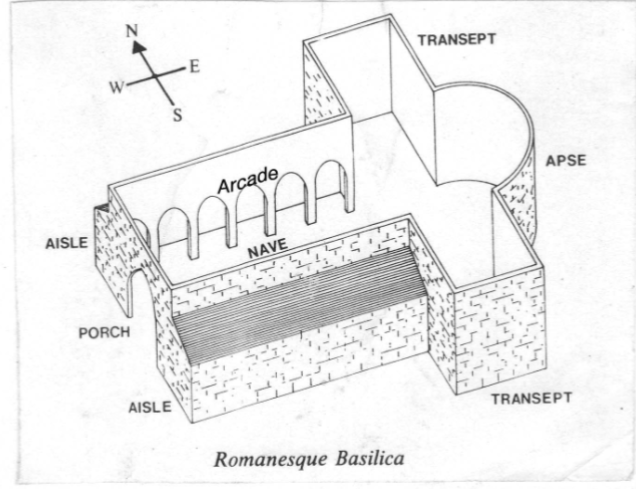
How were Romanesque Churches shaped?
They were cross-shaped, with a nave and transept
What does ‘Romanesque’ argue, and who wrote it?
Marian Bleeke
She argues that hybridity is a key to understanding the term ‘Romanesque’ and the 11th and 12th century artistic material to which it refers
The term was first used in the early 19th century referring to certain types of medieval architecture- some architecture that has a relationship to Ancient Rome but deviated away from it
Romano= purity, Romanesco= hybrid/corruption
Romanesque vs Gothic, Rounded vs Pointed, accepted vs denigrated- Romanesque is seen as closer to the classical, yet still the precursor of Gothic
Trachtenberg- Romanesque as ‘medieval historicism’, and Gothic as ‘Medieval Modernism’
She looks to the sculptures in the shrine to St Lazarus and the sculptures that formed a tableau of the resurrection of Lazarus
Separate traditions of scholarship on the sculptures from the church fabric and those from shrine demonstrate series of binary oppositions at work in the reading of Medieval sculpture as either Romanesque or Gothic: 2D or 3D, non naturalistic vs naturalistic, architectural vs devotional
Can Ireland have produced ‘Romanesque Art’?
tension between the national or local and the foreign or international as shaping Romanesque art in Ireland and elsewhere
Who wrote ‘GOTHIC’ and what does it argue?
Matthew Reeve
Breaks down Gothic’s many significations (ethnicity, fashion, art, music, literature, architecture)
Gothic is less suggestive of the nature of the middle ages itself than it is of the culture’s perceived temporal and ideological distance from it. The term is constantly reimagined, it is elastic
Shift from a retrospective to a ‘modern’ or progressive approach to spirituality and reform was a central narrative of religious thought during the 12th cent, the same years that gave birth to the Gothic
Gothic as a style that could morph to accommodate a wide range of ideas- erred by being profoundly unnatural (or anticlassical) in its complex ornamental language
Gothic intimately connected to the homosexuality when used in opposition to the classical ‘masculine and unaffected’
Horace Walpole- 18th century patron of the Gothic
Who wrote ‘Continuity and Contextuality: Saint Denis, Merovingians, Capetians and Paris’ and what did it argue?
William Clark
Many of the features modern scholarship has often regarded as ‘new’ in Suger’s commissions can be understood as deliberate appropriations and/or imitations of Merovingian capitals and columns deliberately reused or imitated in the abbey
Attempt by Louis VI and VII to associate themselves with Clovis
Early structure of the building not only affected decisions made by the 12th cent builders but also determined the choices of the patrons
He picks out the three categories of associations with earlier structures:
Dimensional and proportional transfers from the old church to the new additions (principally the Western bays)
Inclusion of actual pieces of the old church in the new east end
Imitations of older forms by the two 12th century builders
Efforts to harmonise the new with the old- many of ancient objects in treasury fashioned into liturgical pieces.
Many distinctive features appearing appearing ‘new’ to modern eyes and associated with the start of the Gothic style in Paris would have had different references for a 12th cent audience, potentially meaning ‘ancient’ and symbolising the continuous, living history of the community
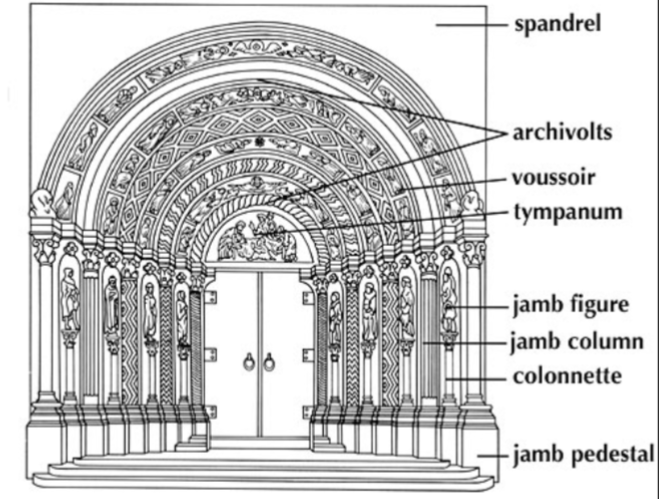
What are the components of a Romanesque church portal?
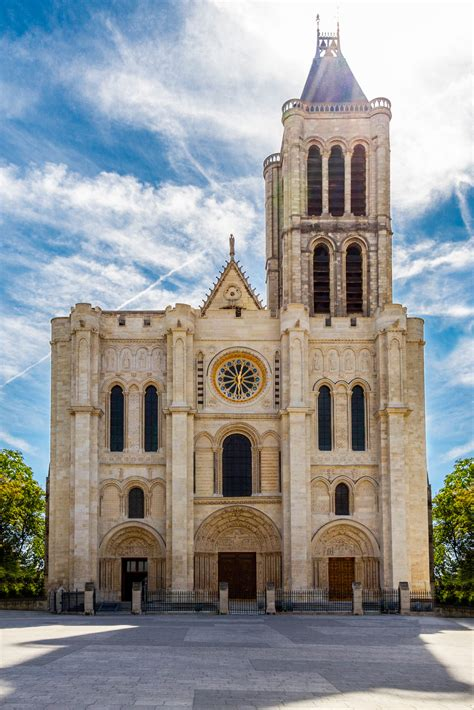
What structure is this and what is its significance?
The Basilica of St Denis, Paris
Much of the stylistic choices and commission work done by the Abbot Suger, who documented his process extensively
First rose window, to our knowledge, to appear as an integral element in the design of a Western façade of a church- form that would dominate Gothic architecture throughout history
Style was so unlike anything from the past that it was called opus modernum, modern architecture, and so French that it came to be known as opere francigena.
At first glance, the façade looks Romanesque- reminding of Christianisation of the Roman triumphal arch- it is the first Gothic building, but elements of it look to the past
Mix of rounded and pointed arches
This was the royal abbey and the church where all of the Kings of France were to be buried
Brightness links all architectural elements together- thinner walls, pointed arches, higher walls- cohesive programme of light
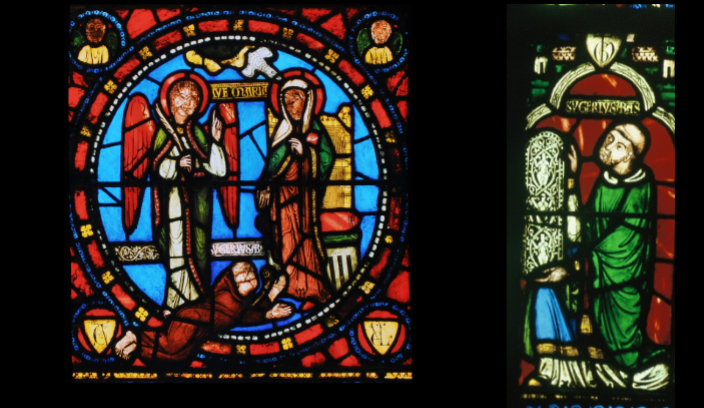
Who was Abbot Suger and what was his significance?
Suger is one of the most important men in French history- loyal advisor and intimate friend of Louis VI and Louis VII
He was the Abbot of St Denis and wrote ‘The Book of Suger’ to document his commissioning and choices in remodelling St Denis.
Suger’s workmen must be credited with creating a new style, the gothic Style, which dominated western Europe for almost three centuries
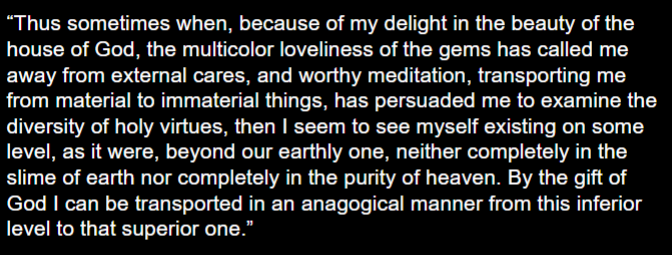
Gothic architecture is a way for Suger to ‘leave Earth’- conflates St Denis (matyr) and St Denis (Dionysius the aerophagies, writing on light and the divine)
Suger really wants to be remembered, wants to be associated with the building visually and textually- Inscriptions on the original doors, prayers for his soul
Interested in materials and gold but materials are a means to an end- use these as points of departure to let your mind travel to God- all about spiritual ascent
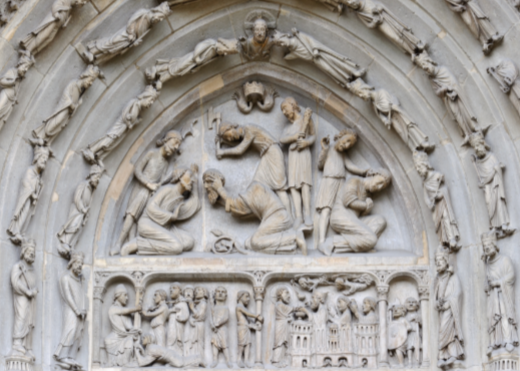
What is this and where?
The North Portal of the Church of St Denis
Depicting the beheading of St Denis (the 1st Bishop of Paris, martyred in 3rd C, Patron saint of French Monarchy
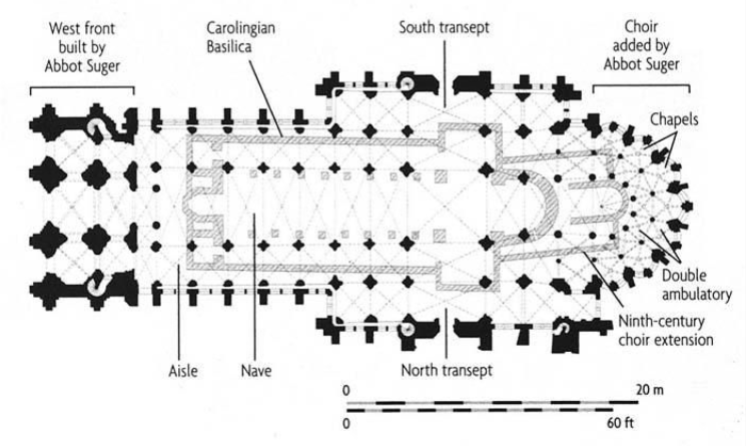
How does the ‘new’ building respond to the old?
Built around the structure of the old (Carolingian) church
Reused Merovingian and Carolingian columns and the crypt
Enlargement of the space to respond to a growing population
Unexpected obstruction in renovation- popular legend recounted that the old Church, believed to have been built by Dagobert, had been consecrated by Christ himself and a crowd of angels on the eve of its consecration by the clergy. This miraculous event of course endowed the building- and indeed every stone from which it was built- with the veneration due a relic
Suger was forced to build his new church piecemeal, beginning at the western entrance and then moving to the Eastern end to erect his splendid new choir, leaving the old nave and transept standing between the two
Striking contrast at Saint Denis between the crypt and the choir above it demonstrates vividly the difference between the Romanesque and Gothic construction
Who wrote ‘Suger’s Miracles, Branner’s Bourges: Reflections on ‘Gothic Architecture’ as Medieval Modernism’, and what does it argue?
Marvin Trachtenburg
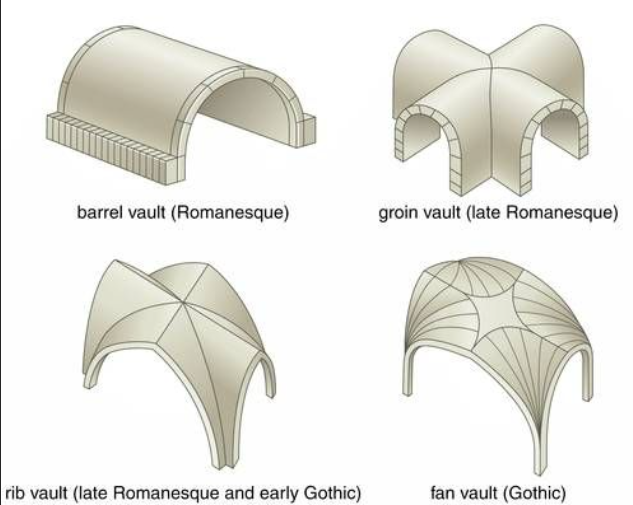
Gothic represents the ‘full architectural turn to modernism’. This turn involved a conscious ‘critique’ and ‘radical mutation and reversal’ of earlier forms like the Romanesque groin vault, leading to the rib vault
Movement towards medieval modernist was driven by a ‘powerful, iconoclastic anti historicist urge’ and ‘modernist consciousness and desire’
Features like the column persisted in Early Gothic but were gradually subverted and transformed, becoming ‘anticlassical’ in their usage and form
Approach allows for a new way of viewing architectural history, not in horizontal chronological layers (Romanesque vs Gothic), but vertically, as a continuum organised around the twin strands of modernist and historicist discourse
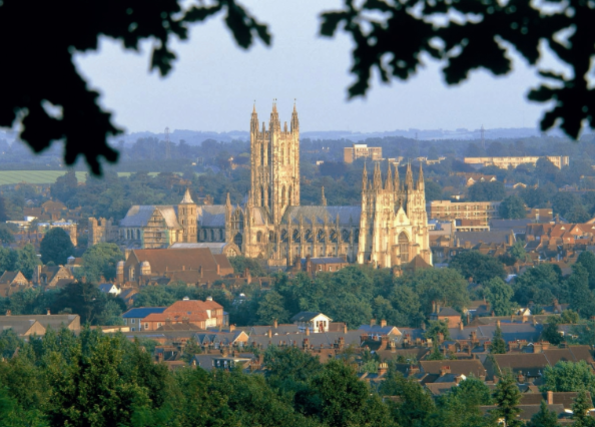
What structure is this and what is its significance?
Canterbury Cathedral
Transition of Gothic Art to England
Original structure caught fire in 1067, and was rebuilt by the Normans, elongating the shape and making it resemble the Gothic style
Archbishop Thomas Becket was murdered in the NW transept in 1170
The structure burned again in 1174 and was further remodelled by William of Sens and William the Englishman (adding quadripartite and sexpartite rib vaults, purbeck marble, emphasis on wall decoration, alternating pier/column and keystones)
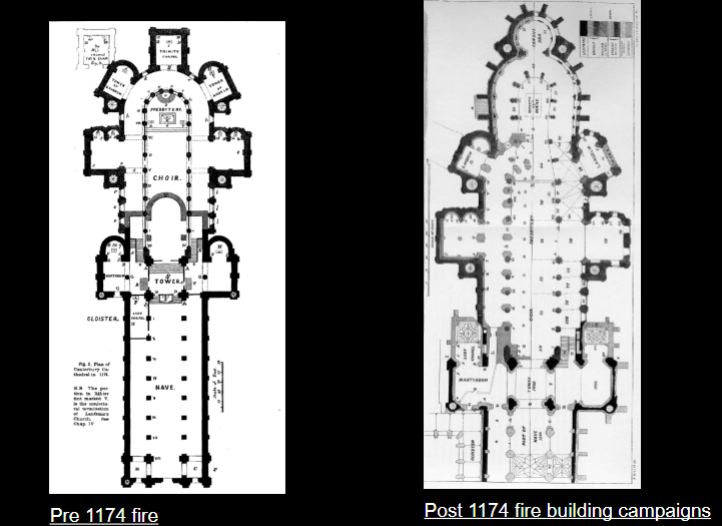
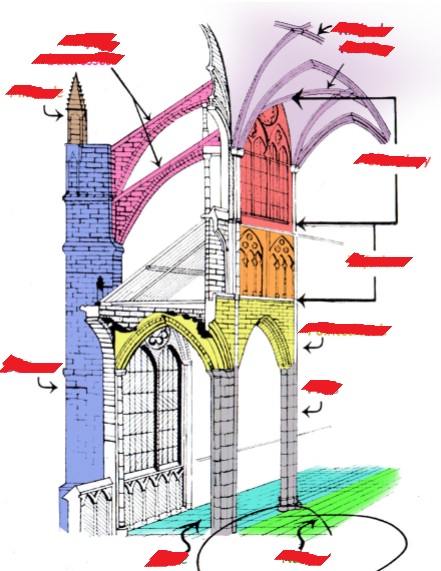
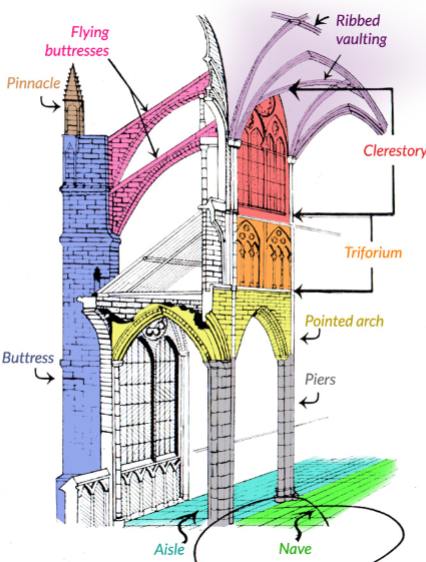
Name these structures
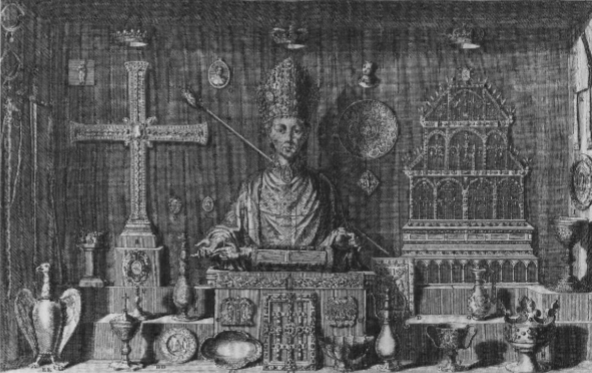
What happened to the treasury of St Denis?
Destruction of the tombs of the French Monarchy during the revolution
‘Escrain de Charlemagne’ in fragments- Cameo from the first century AD (Carolingian reliquary)
Cross of St Eloi destroyed
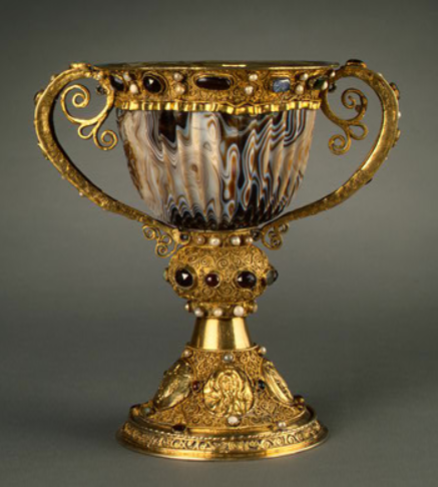
What is this and why is it significant?
This is the Chalice of Abbot Suger, made from the antique treasures of St Denis, and Christianised
Who was responsible for the documentation and commissioning of the rebuilding of Canterbury after the second fire?
Gervase of Canterbury
Half a century after Suger - represents the younger generation’s more factual attitude towards the world around him
The choir was consumed by fire, and he details the damage and repair very factually
Columns were exceedingly weakened by the fire- William of Sens (workman) confessed that pillars and all they supported needed to be destroyed- ordered stone from overseas- long and expensive process
laid foundation for the enlargement of the church at the eastern part- because a chapel of St Thomas [Becket] was to be built there
Dug cemetery of the monks - disturbed bones of many holy monks, Chapel of the Holy Trinity was then levelled to the ground
The new piers were increased in their length by about 12 feet’
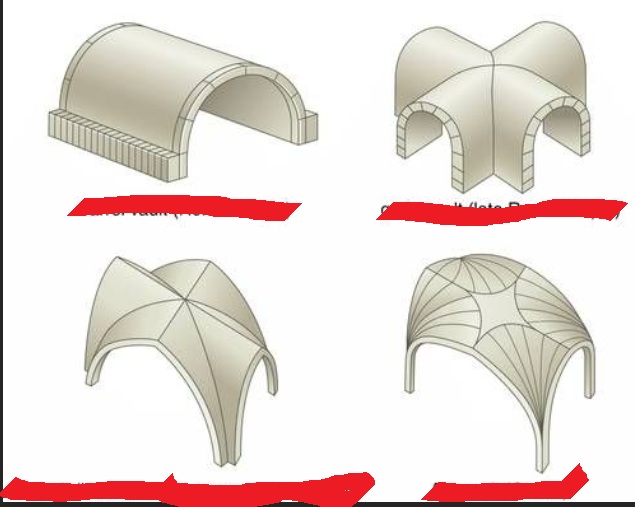
What type of vaults are these?
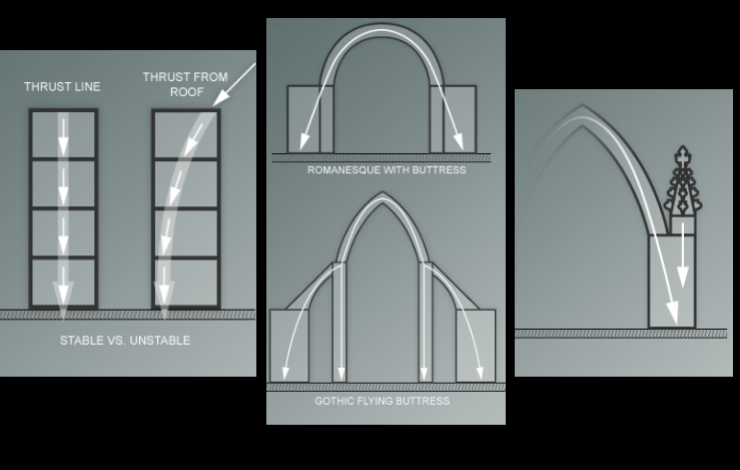
Why do Gothic arches need less strong buttressing systems to Romanesque?
Thrust lines- rounded roman arches have thrust lines that go further out to the side and need strong support. Gothic pointed arches need less support and can have flying buttresses and thinner walls.
Who wrote Gothic Architecture and Scholasticism and what does it argue?
Erwin Panofsky
He makes the argument that all of the architectural components that make up the cathedral structure were controlled by principles of Manifestatio and Concordia: they were strongly elucidated and operated as a comprehensible whole.
argues that the rise of Gothic Architecture coincided (both environmentally and chronologically) with the emergence of scholastic thought in France
Early scholasticism was born (Gilbert de la Porree, and Abelard) at the same moment in which Gothic architecture was born with Suger’s St Denis
High Scholasticism (turn of 12th cent) began when the High Gothic appeared with Chartres and Soissons (classic phase reached during the reign of St Louis)
Argues that the correlation came about due to the spreading of a mental habit
Builders of Gothic structures were exposed to the Gothic pov in many ways- schools, sermons- the entire social system was rapidly changing towards urban professionalism - a professional architect would rise from the ranks, travelled and well read- looked upon as kind of a scholastic
Two controlling principles of Early and High scholasticism
Elucidation (Manifestatio)
Scholastic thought felt compelled to make the orderliness and logic of their thought palpably explicit -( clarification for clarification’s sake)
Obsession with division and sub-division
Seemed necessary to make faith clearer through an appeal to reason
(Concordia)
Very principle of homology that controls the whole process implies and accounts for the relative uniformity which distinguished the High Gothic from the Romanesque
The whole is composed of smallest units- homologous in that they are all triangular in groundplan and in that each of these triangles shares its sides with its neighbours
We are faced neither with ‘rationalism’ in a purely functionslistic sense, nor with ‘illusion’ in a modern art for art sake aesthetics -Faced with what may be termed a ‘visual logic’- a man imbued with scholastic habit would look upon the mode of architectural presentation, just as he looked upon the mode of literary presentation, from the pov of manifestatio
Authorities of the divine often conflicted with each other - the solution of reinterpreting over and over until reconciliation was becoming an important part of the scholastic method
What is scholasticism?
Scholasticism, the philosophical systems and speculative tendencies of various medieval Christian thinkers, who, working against a background of fixed religious dogma, sought to solve anew general philosophical problems (as of faith and reason, will and intellect, realism and nominalism, and the provability of the existence of God), initially under the influence of the mystical and intuitional tradition of patristic philosophy, especially Augustinianism, and later under that of Aristotle.
What is the choir of Merton College significant?
(Remaking the Rayonnant Interior: The Choir of Merton College Chapel)- Tim Ayers
French Rayonnant Traditions in an English institution-Relationship proposed between this kind of brilliant illumination and the interest of 13th century scholars in light metaphysics
The imagery at Merton that suggests most forcibly the importance of viewing - sight was central to the late medieval devotional preoccupation with viewing the Eucharist- link to Camille
Robert Grossette, bishop of Lincoln and Roger Bacon had encouraged an exploration of optics and the cognitive process - which engaged William of Ockham and several Mertonians in the early 14th century
Viewing is also at issue here - the community of Merton college was the primary audience
Dazzling bar tracery of the windows that gives Merton its particular interest architecturally
Unusual choice of the 12 petalled rose as the central feature of the Merton tracery may be inspired by that in the new East facade of St Paul’s in London
Arguably a solution to a particular design challenge - the East window overlooks the front quadrangle and there was no immediate opportunity to create a West front
The intrusion of architectural sculpture is, arguably an attempt to acknowledge the east end as a facade, in the same way that St Paul’s incorporates a rose
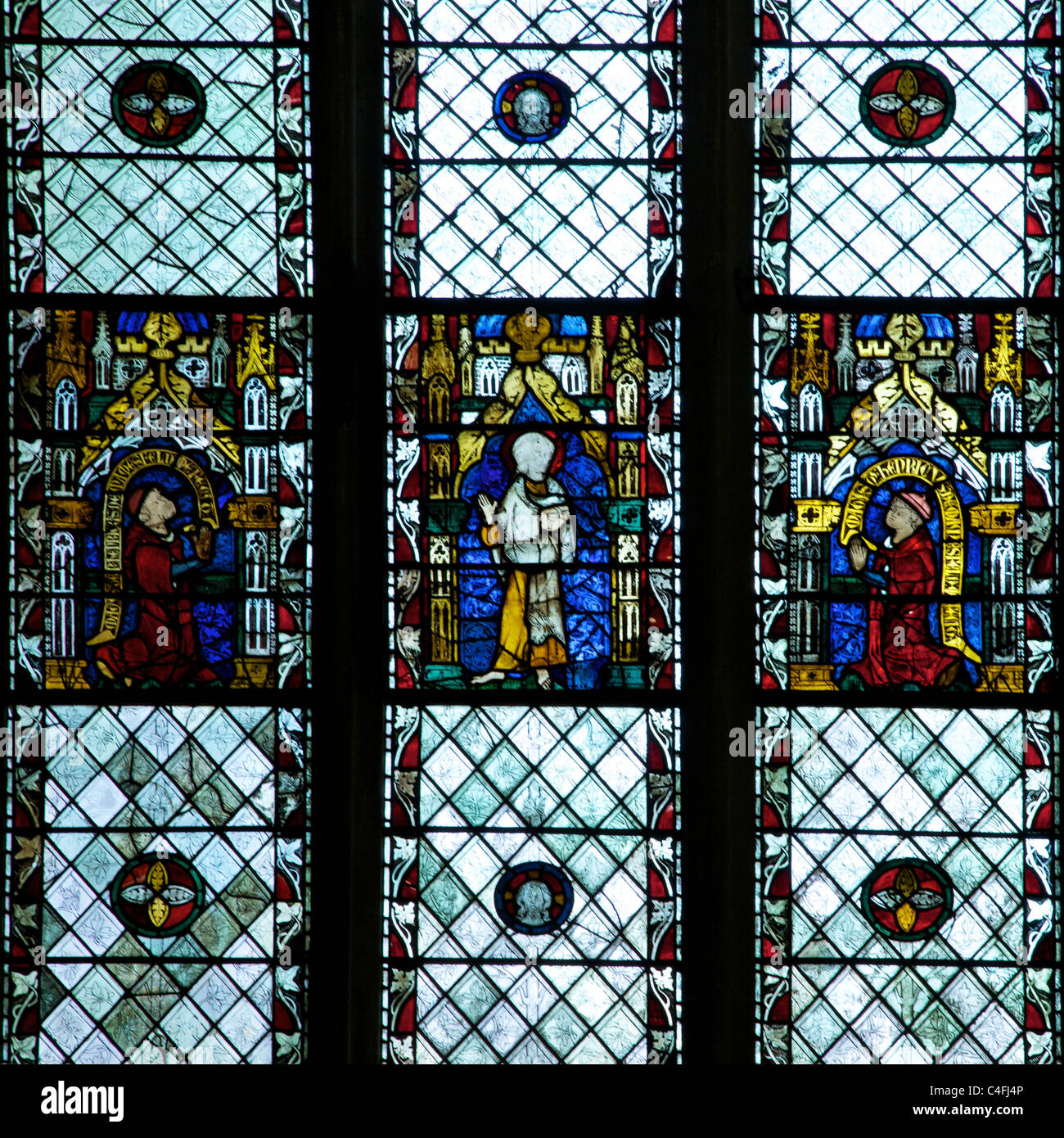
What is the significance of these windows?
Merton College Choir windows
Shows the influence of the patron - Chancellor Henry Mansfield (who is named/depicted 24 times in the windows)
Eminent donors found in stained glass attractive opportunities for self-representation and commemoration- English secular clergy at the forefront of exploiting this
Mansfield’s vanity has outraged, embarrassed and amused commentators in equal measure- prominence is interesting for both the self-image of the contemporary scholar and for the development of visual strategies for commemoration
He is depicted among images of the saints and apostles, as well as circular images of the Kings and Queens
What does Pvesner discuss?
Discusses the leaves on the capitals of Southwell Cathedral
Looks at how different people in 12th and 13th cent are looking at nature- what they are paying attention to and what they are not
Showing how people are paying attention to the natural world in ways they were not previously - paying attention to what they see more, ways of the reaching the divine
Leaves on capitals have functional justification: Capital is a halt/junction and therefore provides leisure for looking at ornament.
Leaves at the spring of the arch have no such reason- caprice of an artist who knew very clearly how far he could go in veiling functional lines without confusing them
Inexhaustible delight in live form that can be touched with worshipping fingers and felt with all senses is ennobled by the conviction that so much beauty can exist only because God is in every man and beast, every herb and stone
What does Michael Camille discuss in ‘Bestiary or Biology?’
Discusses Merton College MS 271
Medieval Bestiaries and Aristotle’s De Animalibus
Christian model views animals as a text to understand a higher, allegorical significance, the philosopher argues that they are interesting in their own right
In their new Aristotelian context, the representations of animals continues to show the persistent influence of Bestiary themes and traditional modes of animal apprehension
So powerful are the visual stereotypes of the artistic tradition, they override any new critical expectations in the text
Bulk of illuminated copies of Aristotle were produced in Paris - at the period where marginal art flourished- in this particular case there is no perceptible difference between the animals inside the initials and those in the lower and upper margins
Book IV treats bloodless animals and the initial represents fish swimming in water- Aristotle explains that this category includes molluscs, crustaceans, insects and animals with shells but NOT fish which he counts as blooded
Development of naturalistic representation is neither linear nor systematic
Science can never exist independent of religious and social worldviews that shape and transform it, constantly working against any notion of its grasping a ‘real’ or perceivable concrete universe in any crude empirical way
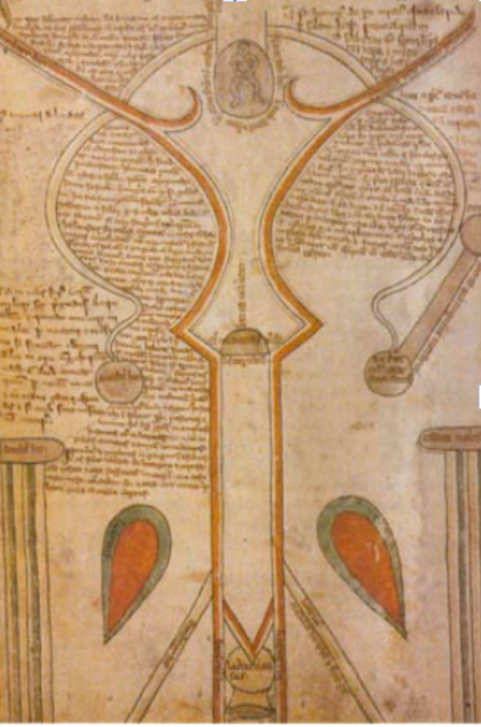
Discuss this image in relation to Karl Whittington’s observations
Diagram of female anatomy from a 13th century book, resembling some kind of map or abstract diagram
Diagram’s appearance and how the forms change our understanding of the ways that medieval scientists conceptualised the reproductive female body as a site of both theoretical processes and abstract systems, symbols and ideologies
Draws on diverse subjects and traditions of representation to create one image that remained logical and cohesive to its original viewers
Whilst it is difficult to place the Ashmore diagrams into a specific dialogue between Aristotle and Galen, they seem to bear a greater correspondence to Galen
Two diagrams in this manuscript may demonstrate how such ideas of physical seeing and ocular desire appear in diverse forms of imagery -visualise process of transmission rather than depicting carnality directly in the form of a body
Unexpected reading of this image- evocation of the crucified Christ within the forms of female anatomy
Arma Christi- passion reduced to meditation on individual moments, in the Ashmole female diagram, symbolic power resides visually within individual organs, separate from their role in the overall system
Most medieval world maps organise the continents into the shape of a cross- through the tripartite mapping system -Whole world into a macrocosm of Christ’s saving flesh
Redemptive power of birth and reproduction in general
Figures known as Vierges ouvrantes - small sculptures of Madonna and Child carved throughout Europe in the later Middle Ages that fold open to reveal a smaller, sculpted image of Christ on the inside
Christ’s crucified body is placed at the centre of the Virgin’s body, where her womb would be
Is it a stretch to say that the Ashmole diagram is meant specifically to depict Mary’s womb?
Health issues in relation to reproduction were often treated as symptoms of behavioural or spiritual problems rather than as a strictly medical condition
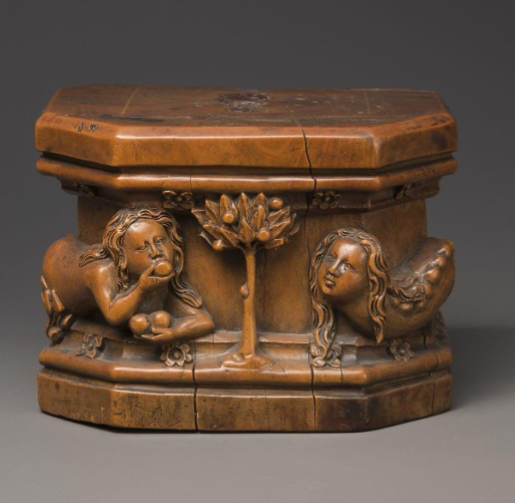
Base for a statuette, South Netherlandish 1470-80
Likely held a statue of the Virgin and Child
Depicts the temptation with Eve and a female serpent figure
Eating the Apple and changing bodies- become aware of their own bodies and sexuality- marks the beginning of lust and the downfall of their bodily state
Eve’s body is literally changing
Look like mirror images- both female gendered faces, longer hair
Eve is eating fruit and holding two in front of her body- evoking breasts
Other figure- spines along her back - something non-human
Erotically charged image has one woman tempting another - Eve is becoming her object of temptation
Snake - Lilith, female serpent
Think that there was a statue of the Virgin Mary on top of this base - anti-types of Mary’s pure virginal body that will redeem humanity for Eve’s Sin
Eve and serpent’s formal similarity- misogynistic reading, AND condemning an inappropriate desire for one’s self, as well as same sex desire - related to Sodomia (Category that applies to a range of sins)
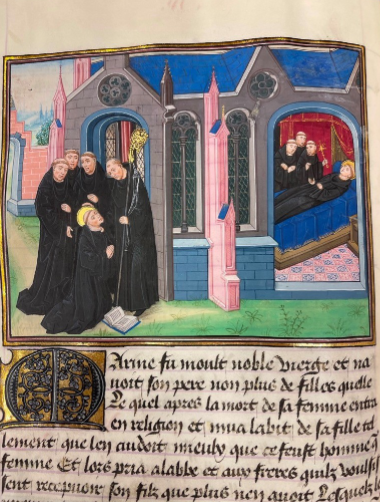
Saint Marin(e), Golden Legend, Belgium 1445
Saint born female, presents as male to join a monastery and dies there- no one knows until after death
At the risk of visual confusion, artist only depicts the saint as male- striking as typical representations of the saint depict their naked body- Visual deadnaming
What is the Medieval Bestiary?
One of the most popular illuminated book types in Europe 1180-1300
Imaginary creatures and real ones (many of which did not live in Europe)
Not intended to be Zoological; imparts symbolic worldview based on Christological truths
Contents are flexible but the lion is always first
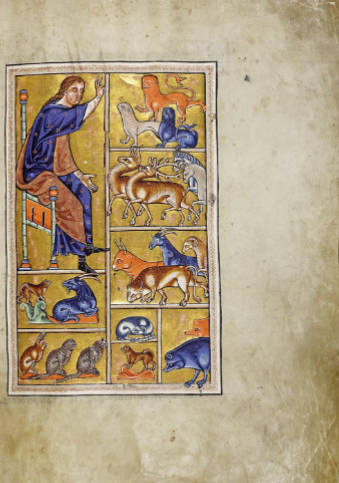
Aberdeen Bestiary 12th c England
Name a few approaches to studying the medieval body
Objects that ‘make’ bodies and shape relationships between bodies
Bodies of artists and bodies they’re making
Attending to the visual language of bodies- how they are constantly in flux
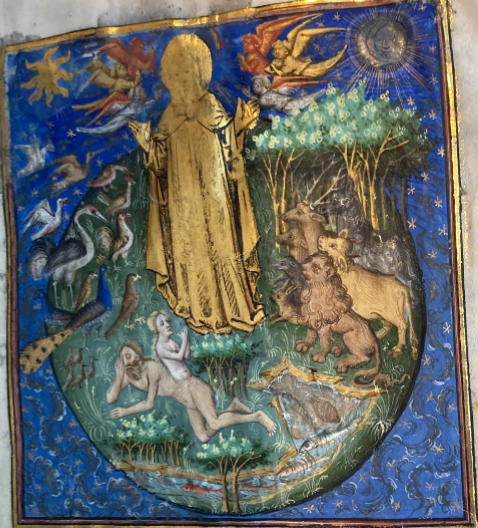
Creation of Adam and Eve, Regime du Corps, France 1440
Household medical compendium - circulated widely and popular with women
The author of the text appears in the capital D below, dressed as a philosopher- didactic text
God in gold creating scenes from the book of genesis
Adam and eve are depicted with their bodies still conjoined
Adam is darker than eve- signalling the idea of men being warm and women cold
Deliberately bi-sexed body-Share a lower half but ARE sexually distinct- theologians- primal androgene, perfect hermaphroditus
Later theologians talk about it as a monstrous form, but early discuss it as an ideal form
4 humours are derived from the four elements
What does Michael Camille’s ‘Love’s Gifts’ argue?
Representing the body and its parts, objects were more than fetishes in the modern sense: they served as social as well as sexual conduits of desire
Gifts were fundamental to the courtship process. Gift is most often represented as going from a man to a woman BUT the gender of the gift itself is more complicated
Discusses motifs that appear on ivories- chaplets, combs mirrors etc
Ivory was a substance suggestive of the flesh -Women encouraged to paint their faces with blaunchet or wheaten flour and used lead filled cosmetics to achieve the ivory white ideal
Roman de la Rose
Many medieval belts and girdles evoke in their decoration the divided human body- the notion of the rational human above the waist and the animal lust that drives what was described euphemistically as ‘below the waist’
The more that medieval objects can be linked to bodies, the more they can be brought to life again to form the polymorphously perverse roles that they sometimes assumed
Woman’s role was not only to be an object of desire but to exercise civilising influence over male sexual appetite
This object teaches both sexes their respective roles as regards courtly vs uncourtly behaviour
What does Emma Le Pouesard discuss in ‘Fighter, Player, Hunter: Queer Women and Female Agency on Secular Gothic Ivories’
Casting aside lens of comp het - allows countless queer depictions to come to the fore, especially in places where one might not expect them - secular Gothic ivories
Historical record is rife with men buying these gifts for other men and women purchasing them for themselves
She picks out three popular themes-
The Castle of Love
Depicting women defending themselves and their fortress from an onslaught of armed knights- usually through ineffective deployment of flowers
sex as war/violence- female body as a fortress
Might not such a homosocial space have encouraged or facilitated homoerotic and homosexual feelings between its female inhabitants?
Whilst such a reluctance to courtship might be an appropriately chaste female response, these women’s spirited defence is beyond the bounds of a medieval paradigm of feminine meekness. Similarly, those who enable and enthusiastically greet their assailants can be seen as a joyful display of female heterosexuality that is counter to ideals of chaste womanhood
The Game of Chess
Also stages an intellectual battlefield for the sexual conquest of a desired woman
Tent representative of female genetalia
14th century casket- She has beaten her opponent, and she is not a chaste aristocratic lady. The sex worker’s victory is twofold: she has secured him as a client, receiving his riches, and she has beaten him at chess.
By varying who is winning or losing, the setting of the game, and the genders of the players, ivory carvers deftly manipulate the symbolic codes of the amorous battlefield of chess. When closely examined in tandem with romance literature, ivory chess games reveal previously ignored queer women and female agents
The Courtly Hunt
Women and falcons- The comparison of women to animals in the medieval era was a frequent occurrence because they were seen as baser, more lowly, more carnal, and therefore more fallible and sinful than men
Hunting was thus a large part of noblewomen’s lives and tangled up in their identities due to its role in the performance of gender and class.
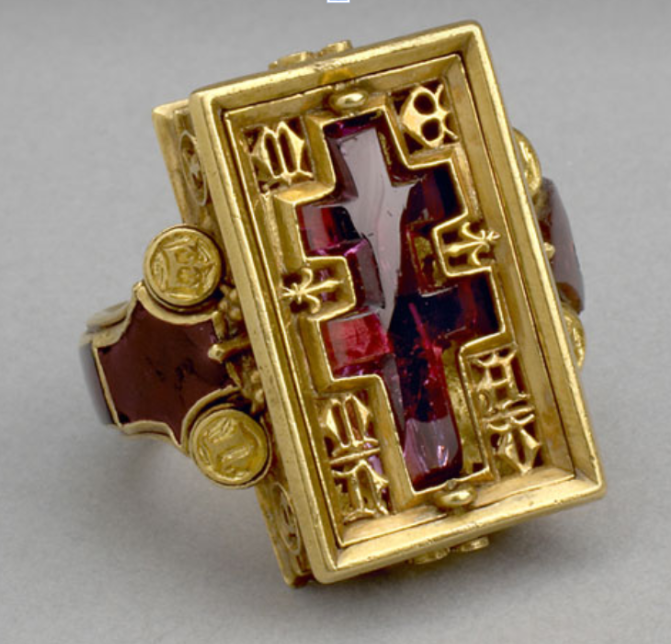
What is this object?
Thame Hoard Reliquary Ring
Found along the Thames alongside other rings and medieval groats (dates 1351-1407)
Gold rings considered a prestigious item of decoration- 14th cent decree that was only legal for the upper classes to wear such symbols of status ]
Suggested that the ring belonged to Robert King (abbot of Thame)
Set with amethyst in the shape of a double armed cross, may have once contained a holy relic
Engraved on the back with the crucifixion and is inscribed ‘Remember me, O Lord’
Maybe contained a relic of the True Cross
Meaning of the foliage- suggest - thorns- ref to crown - encouragement for wearer to reflect on suffering of Christ
What does Michael Camille’s ‘Image on the Edge’ argue?
The serious and laughing aspects of Medieval life coexisted, and this is reflected in 13th and 14th century manuscripts
Strict dividing line drawn between the pious and the grotesque; they exist side by side but never merge
The edges of the world were at the same time the limits of representation - world map- further one moves away from centre (Jerusalem) the more deformed and alien things become- in this sense illuminators often not inventing monsters but depicting creatures they might well have assumed existed at the limits of God’s creation
Once the manuscript page becomes a matrix of visual signs and is no longer one of flowing linear speech, the stage is set not only for supplementation and annotation but also for disagreement and juxtaposition
While often undermining the text, marginal images never step outside certain boundaries- play is to have a playground, there were rules governing the playing fields of the marginal images
Medieval image-world was rigidly structured and hierarchical - for this reason, resisting, ridiculing, overturning and inverting it was limitless. Every model has its opposite
Ironically, the medieval illuminator hardly ever read the text of a work he was formally illustrating -in the case of Bibles or Romances- where he followed earlier copies or models; but on the edge he was free to read the words for himself and make what he wanted of them.
In this respect, marginal images are conscious usurpations, perhaps even political statements about diffusing the power of the text through its unravelling
What style was All Souls College built in?
Perpendicular Gothic
(term invented by Gothic revivalist Thomas Rickman in the 19th century)
Term, though anachronistic, does capture the unity, based on repetition of forms, the essential clarity and simplicity of overall conception, the subordination of individual features to the effect of the whole, and the rectangularity that characterises so much architecture right across the country in the late 14th and 15th centuries
How and why was the original reredos of All Souls destroyed?
1548, man called Plummer paid 30 shillings to destroy the reredos
taken and stored in a hut in the garden
Statue-less niches survived, plastered over and covered in the 1660s by a mural of Last Judgement
Edward VI government embarked on a campaign of targeting paganism and idolatry
Idolatry of the mass with its worship of the supposed real presence of Christ in the consecrated host
Then idolatry of all images before which priests and laity might bow and scrape and kiss
Finally, the idolatry of superfluous decoration
Wanted a return to the primitive purity of the apostolic church
1547, Chantries Act removed All Souls’ core function of praying for the souls of deceased founders and benefactors
Why was the All-Souls Reredos rebuilt?
Montagu Burrows wrote the first serious history of All Souls in 1874- aimed to vindicate its history from his ignorant colleagues
Subtle argument for the chapel’s restoration - contraversial
restored/repaired during the crucial years of what has been described as the ‘nationalisation’ of Oxford university
After 1850, ceased to be an Anglican seminary - opening of fellowships and undergrad membership to non-conformists, papists and unbelievers matched by a massive expansion in numbers and a revolution in the curriculum
Finally, Lord Bathurst rose up to express his wish to restore the reredos at his own cost- donated at least £2000 to the restoration of the reredos
George Gilbert Scott to advise
Sculptor- Edmanuel Edward Geflowski - produced 35 large statues and 84 smaller for the reredos at All Souls
Bathurst paid for every one of these
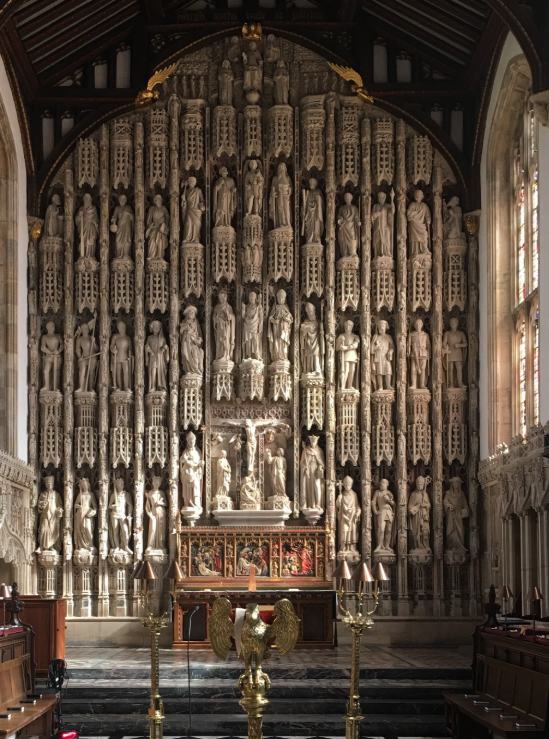
All Souls Reredos
What does John Ruskin argue in his ‘The Nature of the Gothic’ in the Stones of Venice?
(Aim of the Stones of Venice was to throw light upon the relationship between architecture and society)
When society, politics and religion were corrupted, a fatal rift would open up between the patrons of architecture and its practitioners- leading to over intellectualized, rule bound system epitomised by the architecture of the High Renaissance
Ruskin believed this stifled the creativity of the workmen, alienated the public and led eventually to a mechanistic and utilitarian dystopia
‘Nature of the Gothic’- he argued that the only creative input of the architect and the craftsman (saw as indistinguishable) could give life to inert structure - before this could happen must be free from stifling rules and constraints
Observance of three broad and simple rules:
Never encourage the manufacture of any article not absolutely necessary, in the production of which Invention has no share.
Never demand an exact finish for its own sake, but only for some practical or noble end.
Never encourage imitation or copying of any kind, except for the sake of preserving records of great works.
For observe, I have only dwelt upon the rudeness of Gothic, or any other kind of imperfectness, as admirable, where it was impossible to get design or thought without it.
So the rule is simple: Always look for invention first, and after that, for such execution as will help the invention, and as the inventor is capable of without painful effort, and no more
What was Ruskin’s influence on the Natural History Museum?
imagined a natural history museum that could represent the natural world itself in its forms and materials
The Oxford scientists John Phillips and Henry Acland, the latter an old Christ Church friend of Ruskin’s, embraced this conception of the museum. They envisaged a building that would at once teach and model a scientific worldview
Ruskin was inclined to overstate his role in its construction. He had a hand in the design and was instrumental in introducing the Oxford scientists to the Pre-Raphaelite artists who worked on the building and set the standard for its art, but the overall plan and schema were devised by Woodward, Acland and Phillips
The arts have capacity to engage and motivate which science on its own appears to lack - stimulate interest in new research, help cultivate care for nature
While Ruskin’s growing hostility to science over that decade may seem to disqualify him as a model for enlightened science communication, his insistence on the need for the emotional and moral engagement of the arts to sustain life remains deeply pertinent
Fulfilling his demands for art to be scientifically rigorous and for science to hold itself to the moral standard of art
What manuscripts does Camille discuss in ‘Bestiary or Biology’?
-Ms Ashmole 1511
-Huntington Library MS 1035
-Merton MS 271
Who first translated Aristotle’s De Animalibus?
Michael Scot 1220, Toledo
Who said that Animals exist for the sustenance and instruction of men?
Thomas of Chobham (After Augustine)
What is some of the imagery of Merton MS 271 that Camille picks up on?
First Volume- Lion in capital despite the text discussing the theory of division
Three hounds chasing a stag, fol1- metaphor for reading
Hounds and rabbit in Volume 2- sexual metaphor from vernacular love poetry
Depiction of fish in Book 4- despite fish NOT being included in the category o bloodless animals
Book V- depictions of human sexual activity
Ostrich with a horseshoe- stemming from Pliny
Hyena
Pelican feeding its young
What does Camille argue about realism and scientific purity?
Science can never exist independent of religious and social worldviews that shape and transform it, constantly working against any notion of its grasping a ‘real’ or perceivable concrete universe in any crude empirical way
What does Suger inscribe on the Doors of St Denis?
For the splendor of the church that has fostered and exalted him, Suger has labored for the splendor of the church. Giving thee a share of what is thine, O Martyr Denis, He prays to thee to pray that he may obtain a share of Paradise. The year was the One Thousand, One Hundred, and Fortieth Year of the Word when [this structure] was consecrated.”
Marvel not at the gold and expense but at the craftsmanship of the work. Bright is the noble work; but, being nobly bright, the work Should brighten the minds, so that they may travel, through the true lights, To the True Light, where Christ is the true door.
Who wrote ‘The Art of Courtly Love’?
Andreas Capellenus
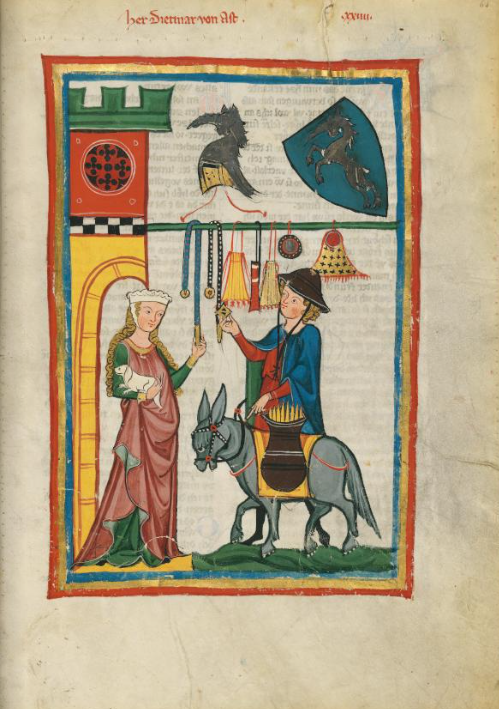
Manesse Codex, 1300 Zurich
-Dietmar disguised as a peddler