ESS topic 3.3 Conservation and regeneration - new syllabus
 Call Kai
 Learn
Learn Practice Test
 Spaced Repetition
 Match
Match Flashcards
 Knowt Play
1/28

There's no tags or description
Looks like no tags are added yet.
Name | Mastery | Learn | Test | Matching | Spaced | Call with Kai |
|---|
No analytics yet
Send a link to your students to track their progress
29 Terms
Why is biodiveristy preserved?
Aesthetic reasons, Ecological reasons, Economic reasons, Ethical reasons, Social reasons
Economic Reasons for Preserving Biodiversity
Ecotourism generates revenue and jobs for local economies
Natural ecosystems provide resources like timber and clean water
Essential for long-term economic prosperity and resource sustainability
Aesthetic Reasons for Preserving Biodiversity
Joy from nature's beauty
Inspiration for art, photography, poetry, and music
Aesthetic benefits enhance human well-being
Ecological Reasons for Preserving Biodiversity
Essential for ecological processes like pollination, climate regulation, and soil fertility
A diverse ecosystem is more stable and resilient
Keystone species (e.g., bush elephants) help maintain ecosystem balance and increase biodiversity
Social Reasons for Preserving Biodiversity
Natural spaces promote recreational activities (e.g., birdwatching, hiking)
Access to nature improves mental and physical health
Loss of biodiversity can reduce social benefits derived from nature
Ethical Reasons for Preserving Biodiversity
Species and habitats have intrinsic value
Moral obligation to prevent loss of biodiversity
Responsibility to protect organisms for future generations
what is species-based conservation (3.3.2)
Species-based conservation focuses on protecting individual species, especially those that are endangered.
This often involves ex situ strategies. → This means conservation actions are taken outside the natural habitat of the species
what is habitat-based conservation (3.3.2)
Habitat-based conservation focuses on protecting and restoring habitats to support the species that live there.
This is often involves in situ strategies:
This means conservation actions are taken within the natural habitat of the species
Ex situ conservation (3.3.2) + ways its done??
Preservation of species outside their natural habitat in zoos, botanic gardens and seed banks.
Botanic gardens: Botanic gardens are specially designed areas where a wide variety of plants are grown for scientific, educational and ornamental purposes
Zoos: Zoos keep and breed animals in captivity, often focusing on endangered species. They play a role in education, research and breeding programmes to reintroduce species into the wild
Seed banks: Seed banks are places where seeds of different plant species are stored to preserve genetic diversity
Examples: Botanic Gardens
In situ conservation (3.3.2) + ways its done??
Conservation of species within their natural habitat through protected areas and reserves.
National parks:National parks protect large areas of natural habitat, preserving the ecosystems and species within them + also provide opportunities for research, tourism and education
reserves and sanctuaries: Wildlife reserves and sanctuaries are areas set aside for the protection of particular species and their habitats
Examples: Yellowstone National Park → e USA protects a variety of ecosystems and species, including grizzly bears and wolves
What are mixed conservation approaches?
combines species-based and habitat-based strategies
This approach often focuses on flagship or keystone species to justify the conservation of entire ecosystems
Flagship species (3.3.3)
Flagship species are charismatic species that are well-known and popular with the public, such as elephants, pandas or tigers. They can be used as symbols for conservation efforts and can help to raise awareness and support for conservation efforts.
Examples: Giant panda
Keystone species (3.3.3)
Keystone species are species that have a disproportionate effect on the structure and function of their ecosystem. Their removal can cause significant changes in the ecosystem, including the loss of other species
Convention on Biological Diversity (CBD) (3.3.4)
UN treaty addressing species and habitat conservation, promoting sustainable use of biodiversity. Examples: Protected marine areas, Genetic resource sharing, Conservation strategies
Nagoya Protocol (3.3.4)
CBD agreement promoting fair sharing of genetic resources and traditional knowledge. Examples: Benefit-sharing agreements, Indigenous knowledge protection, Genetic resource access
Habitat management + 2 ways to do it?
conservation strategies aim to protect species by preserving and managing their natural environments
This may involve the protection of wild areas or active management
These strategies are crucial for maintaining biodiversity and ensuring the survival of various species
protection of wild areas involves what? why is it important?
setting aside land that is left in its natural state
ensuring this land remains free frm significan human interference
it is important becauyse this helps maintain the habitat necessary for the survival of many species. ecosystems—> function naturally
e.g large areas of amazon rainforest are protected to preserve rich biodiveristy
active management is what and what are the methods?
refers to human intervention to maintain orrestore habitats to a desired condition
methods include: controlled burning (manage grasslands and forests, promoting growth), reforestation (planting trees to restore deforestated areas) and invasive species control
When designing the size and shape(2) what are all the factors considered?
Shape
Size
Edge Effects
Corridors
Proximity to potential human infleunce
Wildlife corridors (3.3.6)
Corridors are narrow strips of land that connect otherwise isolated areas of habitat.
They can facilitate the movement of organisms and allow for gene flow between populations.
Corridors can also provide additional habitat and increase the effective size of a protected area .
The effectiveness of corridors depends on their width, length and the surrounding land use
Edge effects (3.3.6)+ impact
Edge effects refer to the changes that occur at the boundary between two different habitats or land-use types, e.g. at the boundary of a protected area
Protected areas with high edge-to-area ratios can have negative effects on biodiversity due to increased exposure to human disturbances, invasive species and variable microclimates
Minimising edge effects can be achieved by creating protected areas with simple shapes or using buffer zones around the edges
How do agricultural, urban and industrial areas effect habitat conservations( reserves) ?
Agricultural land: risk of pollution (e.g. via nutrientrunoff), habitatfragmentation and human-wildlife conflicts
Urban areas: higher risk of human disturbance and spread ofinvasive species, but can provide education and recreational opportunities
Industrial areas: potential pollution and habitat destruction
How does the distance from urban centres effect habitat conservation efforts (reserves)?
Close proximity: easier access for management and public education, but higher human pressure and disturbance
Remote locations: less human disturbance, better preservation of natural states, but harderfor conservation workers to access and manage
UNESCO biosphere reserve (3.3.6)
Protected areas balancing conservation with sustainable human use through zonation. Examples: Yellowstone, Great Barrier Reef.
Rewilding (3.3.7) + 4 ways to do it?
Restoration of natural processes and wildlife to degraded ecosystems. Examples: Yellowstone wolf reintroduction.
species reintroduction → can help bring balance back to the ecosystem(keystone species, apex predators)
improving habitat connectivity → This involves connecting fragmented habitats to allow free movement of species; which allows wildlife to roam over larger areas, increasing the resources available
Stopping agriculutre → allows land previously used for farming to return to its natural state. → can multiple plant breeds flourish and increasing biodiversity
Limiting human influence → Preventing the harvesting of resources, eg: logging or fishing
examples are: Yellostone park and New Zealand
Planetary boundary (3.3.8)
The biodiversity planetary boundary refers to the limits within which humanity can safely operate to maintain the Earth's biodiversity → also know as biosphere integrity.
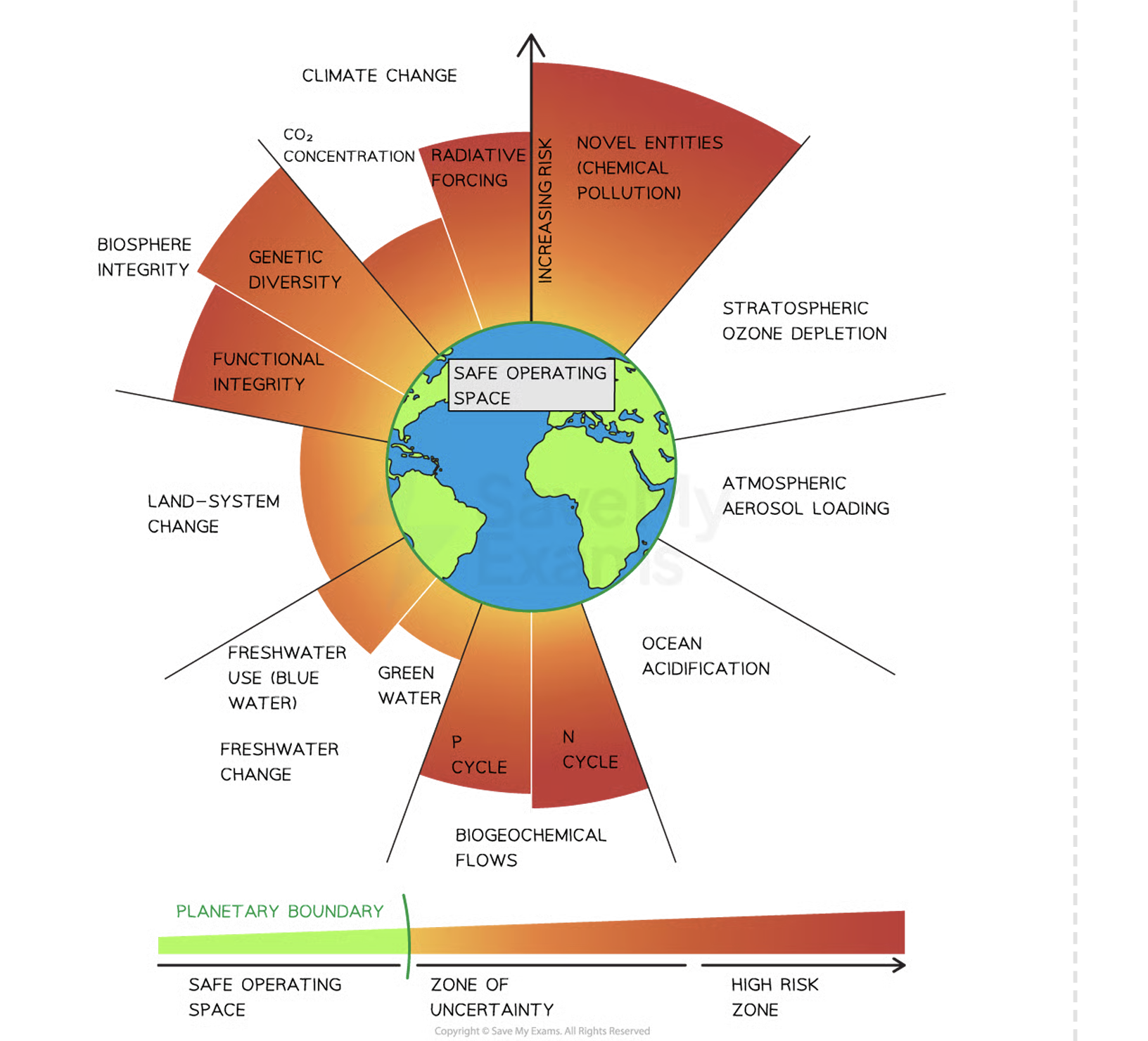
planetary boundary aims to?
It aims to highlight where action is needed in order to avoid abrupt and irreversible changes
What impacts do the planetary boundary have?
Protecting biosphere integrity means preventing the loss of species (and therefore genetic diversity) and the loss of ecosystem functioning → this is important as biodiversity loss can have significant negative impacts on human life and the planet's health
How can humans contribute to conservation and ecosystem regeneration to reduce decline in biodiversity?
individual behaviour (recycle, sustainable consumption)
collective actions (local conservation projects)
national measures (wildlife reserves and enforcing laws to prevent poaching)
international efforts (international treaties such a Convention on Biological Diversity (CBD))