MOD 2.2 Final
 Call Kai
 Learn
Learn Practice Test
 Spaced Repetition
 Match
Match Flashcards
 Knowt Play
1/34

There's no tags or description
Looks like no tags are added yet.
Name | Mastery | Learn | Test | Matching | Spaced | Call with Kai |
|---|
No analytics yet
Send a link to your students to track their progress
35 Terms
confidence intervals?
1.22-2.45 (RR>1)→ statistically significant (inc. risk)
0.85-2.46 → NOT statistically significant (risk is same) includes 1
0.56-0.94 (RR<1)→ statistically significant (dec. risk)
1-RR
prevalence? incidence proportion? incidence rate?
prevalence → # existing/total # in group
incidence proportion → # new cases during period/ total pop. @ start of period
incidence rate → # new cases/(total person-time rate)
independent events? mutually exclusive events?
multiply likelihood together OR add both probabilities together
probability → # of ways it can happen/ total # outcomes
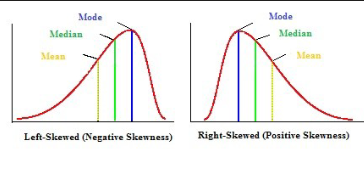
skewing distribution patterns?
(+) skew → mean>median>mode (tail on R.)
(-) skew → mean<median<mode (tail on L)
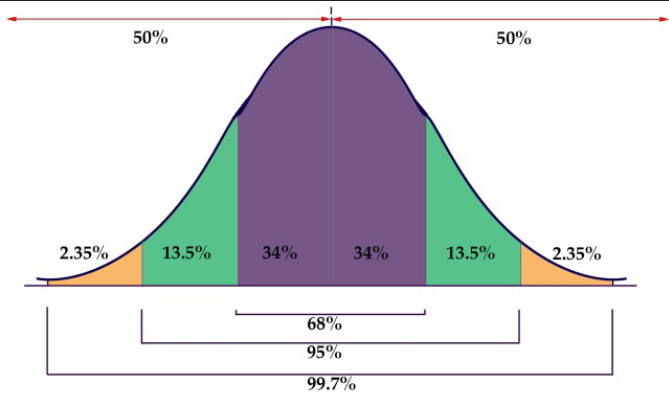
standard deviation distribution patterns?
2 SDs below mean → 2.35%
1 SD below mean → 16%
mean → 50%
1 SD above mean → 68%
2 SD above mean → 95%
3 SD above mean → 99.7%
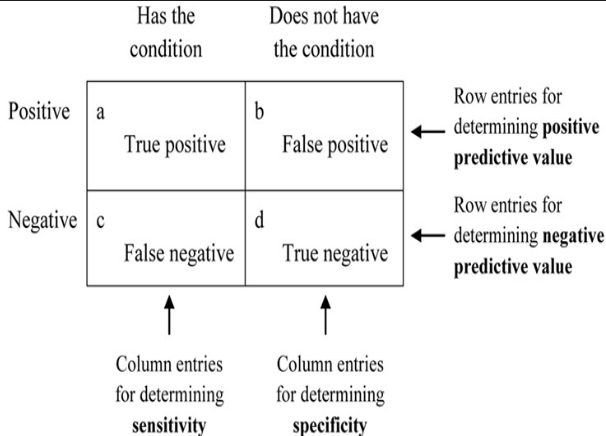
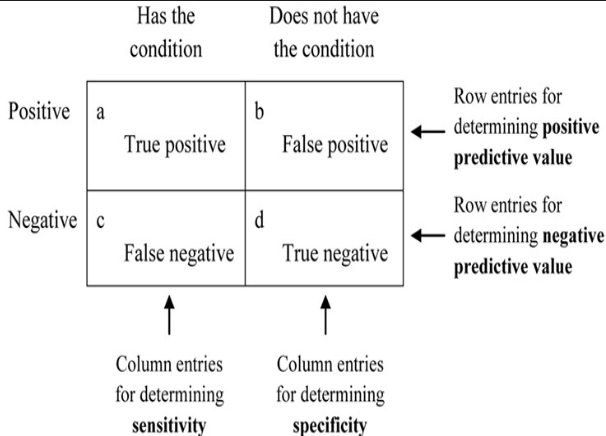
sensitivity? specificity?
sensitivity → TP/(TP+FN)
ability to screen who actually has disease
if inc. → (-) = absence of disease w/ confidence
specificity → TN/(TN+FP)
ability to screen who actually doesn’t have disease
if inc. → (+) = existence w/ confidence
positive predictive value (PPV)? negative predictive value (NPV)?
PPV → TP/(TP+FP)
prob. that (+) = disease
NPV → TN/(TN+FN)
prob. that (-) = no disease
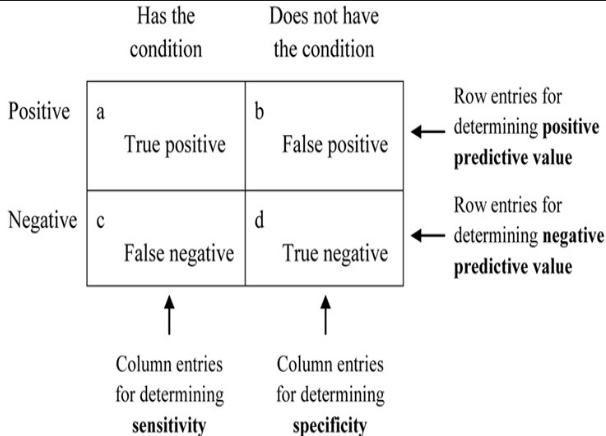
accuracy? prevalence?
accuracy → (TP + TN)/ total
prevalence → (TP + FN)/total
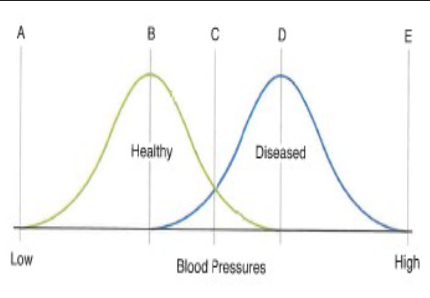
points of a double hump graph?
pt. B → highest sensitivity (predict disease)
pt. C (intersection) → most accurate/compromise btwn sens. + spec.
pt. D → highest specificity (predict no disease)
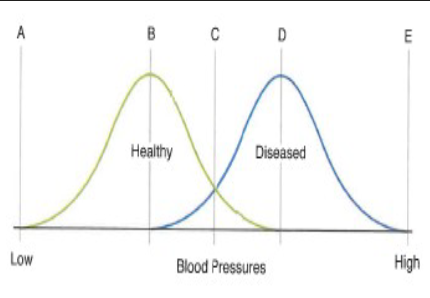
changes in cut off for point C effects?
lower (C → B/sens.) = inc. FP + dec. FNs
inc. sens. + inc. NPV
dec. spec. + dec. PPV
raise (C → D/spec.) = inc. FN + dec. FP
inc. spec. + inc. PPV
dec. sens. + dec. NPV
odds ratio (OR)?
(a/c)/(b/d) = ad/bc (odds case exposed/control exposed)
OR = 1 (odds of exposure = in cases + control)
OR >1 (inc. odds of exposure in cases)
OR <1 (dec. odds of exposure in cases)
case control → odds of prior exposure or risk factors differ by disease state (correlation)
relative risk (RR)?
[a/(a+b)]/[c/(c/d)] → if a+b & c+d-1 then a/c
RR=1 (no correlation)
RR>1 (exposure inc. disease)
RR<1 (exposure dec. disease)
cohort study → exposure or risk factor associated w/ later development of disease (causation)
relative risk reduction (RRR)? absolute risk reduction (ARR)?
RRR → 1-RR (dec.) & RR-1 (inc.)
RR = [a/(a+b)]/[c/(c/d)]
via intervention compared to control
ARR → ATC -ART
(c/c+d) - (a/a+b)
diff. btwn control + intervention group
AR = incidence rate
number needed to treat (NNT)? number needed to harm (NNH)?
NNT → 1/ARR
ARR = (c/c+d) - (a/a+b)
# pt. treated for 1 pt. benefit
NNH → 1/AR
IR = # new cases/ total person-time rate
AR = [a/(a+b)]/[c/(c/d)]
# pt. exposed for 1 pt. harm
![<ul><li><p>NNT → 1/ARR </p><ul><li><p>ARR = (c/c+d) - (a/a+b)</p></li><li><p># pt. treated for 1 pt. benefit</p></li></ul></li><li><p>NNH → 1/AR</p><ul><li><p>IR = # new cases/ total person-time rate</p></li><li><p>AR = [a/(a+b)]/[c/(c/d)] </p></li><li><p># pt. exposed for 1 pt. harm</p></li></ul></li></ul><p></p>](https://assets.knowt.com/user-attachments/18a40f89-748f-4637-b893-df4c253d9f57.png)
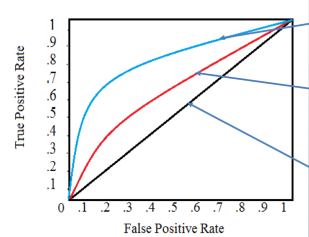
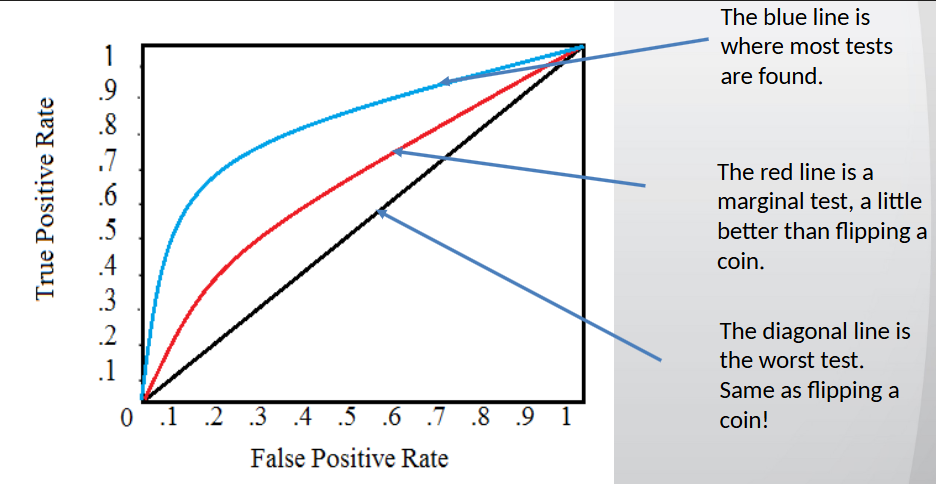
receiver operator curve (ROC) graph?
more area under curve = better
inc. TP rate/sensitivity
types of fungi?
dimorphic fungi → mold @ 25-30C and yeast/yeast-like @ 37C
yeast → oval unicellular fungi (reproduce via budding)
mold (filamentous fungi) → multinucleate mass made of hyphae (form mycelium)
grow via branching
fungal classifications (opportunistic, superficial, cutaneous, subcutaneous, systemic/endemic)
opportunistic → low virulence, but infection in debilitation/immunosuppress
superficial → skin/hair surface
cutaneous → keratinizes layer (skin, hair, nails)
subcutaneous → traumatic inoculation (forms deep, ulcerated lesion or fungating mass)
systemic/endemic → classic dimorphic fungi + deep viscera (wide disseminated)
antifungal treatment?
amphotericin B, echinocandins, -azoles (primary for systemic infections)
-azoles → fluconazole, itraconazole, ketoconazole, voriconazole
MOA: bind to ergosterol in fungi (not in host) → produce ion channels → destroy osmotic integrity of fungal cell membrane → cell death
fungi identification?
GMS stain
lactophenol cotton blue stain
sabouraud dextrose agar
candida albicans characteristics? symptoms? plate?
yeast
seen in immunocompromised pts. + pts. taking corticosteroids
vaginal discharge, oral thrush, esophagitis
white colonies on sabouraud
aspergillus fumigatus characteristics? symptoms?
mold
hyaline + septate hyphae w/ 45o angles
lower airway, fever, malaise, prod. cough
bastomyces spp. characteristics?
yeast → produces broad-based buds
mold → oval conidia on terminal hyphae
coccidioides immitis characteristics? symptoms? plate?
arthroconidia: infectious spherules in lungs → valley fever
fever, prod. cough, joint pain, skin bumps
arthroconidia = blocks sabouraud
praziquantel? ivermectin? albendazole?
inc. IC Ca levels → muscle paralysis
act. Cl channel → muscle paralysis
disrupt cytoplasmic microtubules + glucose uptake
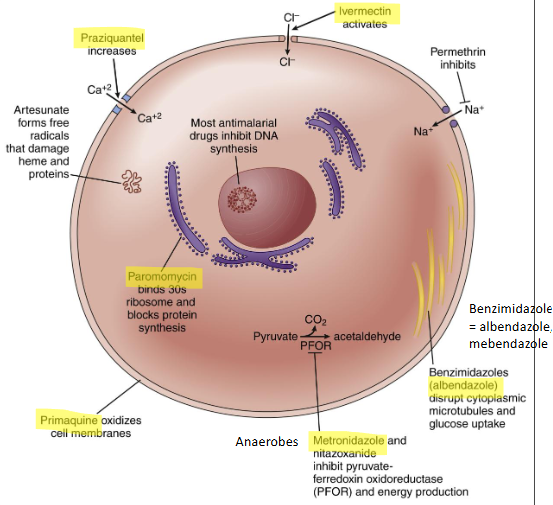
metronidazole and nitazoxanide? paromomycin?
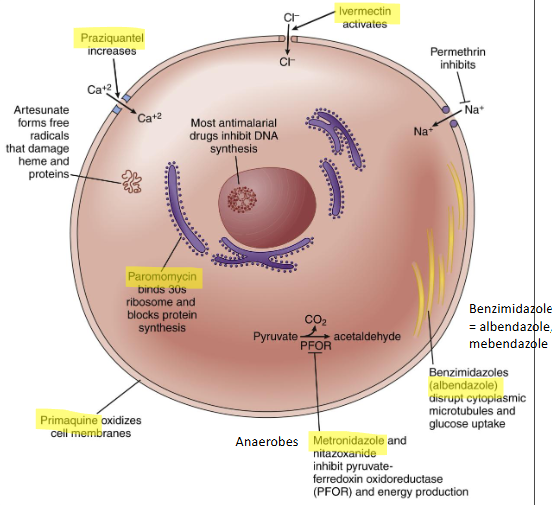
inhibit pyruvate-ferredoxin oxidoreductase (PFOR) + energy production → disulfiram-like rxn
binds 30s ribosome + blocks protein synthesis → aminoglycoside
entamoeba histolytica class/type? characteristics? symptoms? drugs?
amoebas (rhizopodes) → protozoa
nonmotile cyst + motile trophozoite, target spots (ingested RBCs)
abscess in liver + necrosis in LI= bloody diarrhea
metronidazole + paromomycin
giardia spp. class/type? characteristics? symptoms? drugs?
flagellates → protozoa
nonmotile cyst + motile trophozoite
flatulence, water/foul smelling/greasy diarrhea
metronidazole + nitrazoxanide
cryptosporidium spp. class/type? characteristics? symptoms? drugs?
apicomplexans → protozoa
oocytes (banana-shaped sporozoites), from chlorinated pool water
watery diarrhea (no blood), autoinfection possible
nitazoxanide (for immunocompetent), paromomycin + azithromycin (for HIV+)
trematodes (flatworm) type? name? characteristics? symptoms?
helminth
schistosoma (mansoni/lat., haematobium/term., japanicum/round)
flat, fleshy, leaf-shape; swim in lake
1st host → mollusks (snails)
2nd stage → cercariae (penetrate skin)
abdominal ascites, malnourished, rash (swimmer itch)
praziquantel
cestodes (tapeworm) type? name? characteristics? symptoms? drugs?
helminth, diphyllobothrium latum
flat, segmented, ribbon-like; rivers/lakes + raw/undercooked fish
diarrhea, stomach pain, B12 def.
praziquantel + parmomycin
nemotodes (roundworm) type? name? characteristics? symptoms? drugs?
helminth, enterobius vermicularis (pinworm)
large, cylindric, unsegmented; autoinfection possible
anal itch + nervous
albendazole
lifestyle risk for chronic disease? intervention?
tobacco, sedentary, poor nutrition, excess alcohol
DASH (high fruits + veg, low fat-dairy) + dec. Na/inc. K for HTN, sat. fat <7% of calories + inc. fiber for hypercholesterolemia, lose 5-7% body weight for diabetes
how to prevent weight gain? physical activity guidelines?
0.6-1.7lb/yr after 30 → annual monitor + intervention (dec. calorie, inc. physical act.)
ACSM + CDC → aerobic (150 min/wk) + strengthening all muscle groups (2 dy/wk)
role of sleep in chronic disease? role of stress in chronic disease?
women <5 hr hrs/night inc. obesity risk + T2D (via impaired circadian), obesity inc. OSA (tired + airway blocked), sleep hygiene
trigger HPA (leptin, ghrelin, NPY), inc. heart disease, diabetes, asthma, depression
social determinants of health?
CDC framework
built environment, community-clinical linkages, food + nutrition security, social connectedness, tobacco -free
contribute to disparities in HTN, diabetes, physical activity