11. Bio nanoengineering and environmental nanoengineering
 Call Kai
 Learn
Learn Practice Test
 Spaced Repetition
 Match
Match Flashcards
 Knowt Play
1/3

There's no tags or description
Looks like no tags are added yet.
Name | Mastery | Learn | Test | Matching | Spaced | Call with Kai |
|---|
No analytics yet
Send a link to your students to track their progress
4 Terms
What is biomimetic engineering?
many uses: artificial bone and muscles, photosynthesis
bone resists tension, torsion and compressive forces w nanostructures of mineral and collagen protein fibres
muscle made of fibre bundles connected to body joints via ligaments and tendons - biomimetic nanoscale muscle commonly uses electronically conducting polymers, dielectric elastomers or ionic polymer/metal composite
Photosynthesis - converts solar energy to chemical energy
What is the Gratzel cell?
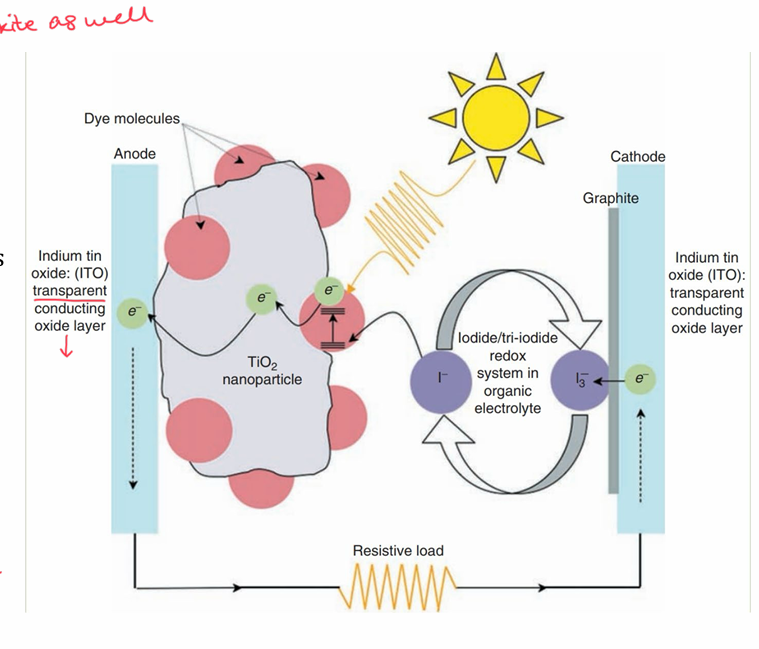
dye-sensitive solar cell - DSSC
organic dye, like plant chlorophyll, captures photons and transfers energy to electrons
tethered dye molecules absorb photons and transfer energy to titanium dioxide semiconductor nanoparticles
visible light absorption is possible
DSSC overcomes difficulty in separating absorbers and charge separator materials - prevents recombination of electrons and holes
Electron in transition metal complex excited by photon transfer excited electron to conduction band of semiconductor through injection
semiconductor - charge carrier for electron transfer from dye molecule
max voltage able to deliver is difference between I-/I3 redox couple and Fermi level of semi conductor
modifications to cell design, electrolyte, dye materials can further increase cell efficiency
What are medical applications of nanotech?
NPs for medical imaging
NPs for targeting cancer cells - functional ferromagnetic NPs to deliver anticancer drugs or separate cancer cells from bone marrow and other tissue
Nanoencapsulation for drug delivery - nanoscale polymer implants can slowly release drugs e.g. beta-lapachone has cytotoxic effects in a number of malignant human cell types or used for insulin delivery
What are bio applications of the QD?
narrow emission peaks allows to be used as a diagnostic where different diseases will be highlighted by a different colour
conjugation of QDs to biomolecules