adaptations and mutations
 Call Kai
 Learn
Learn Practice Test
 Spaced Repetition
 Match
Match Flashcards
 Knowt Play
1/26

There's no tags or description
Looks like no tags are added yet.
Name | Mastery | Learn | Test | Matching | Spaced | Call with Kai |
|---|
No analytics yet
Send a link to your students to track their progress
27 Terms
natural selection
the process by which organisms with traits best suited to their environment are more likely to survive and reproduce
adaptions
a physical or behavioral trait that helps an organism survive and reproduce in its specific environment
camouflage
a disguise or concealing tactic that allows an organism or object to blend into its surroundings, making it difficult to see
environmental pressures
the biological, physical, or human-driven stresses placed on an ecosystem or organism that alter their state, survival, or evolutionary traits
population
the total number of inhabitants—whether people, animals, or plants—living in a specific geographic area, region, or country
mutation
a permanent alteration in the DNA sequence that makes up a gene
environmental mutagens
physical, chemical, or biological agents present in the ambient environment that can induce stable, heritable changes (mutations) in the genetic material (DNA or RNA) of living organisms
Whole Chromosome Mutation
a genetic alteration that changes the entire number or structure of chromosomes, rather than just an individual gene or nucleotide
Gene Mutation
a permanent change in the DNA sequence that makes up a gene
substitution mutation
a genetic change where one nucleotide base in a DNA sequence is replaced by a different base
insertion mutation
a genetic alteration where one or more extra nucleotide base pairs are added into a DNA sequence
deletion mutation
a genetic alteration where one or more nucleotides (base pairs) are removed from a DNA sequence
artifical selection
the evolutionary process by which humans consciously choose specific plants or animals with desirable traits and breed them to ensure those characteristics are passed on to future generations
genetic engineering
the artificial alteration of an organism's DNA using laboratory technologies
GMO
any plant, animal, or microorganism whose genetic material (DNA) has been altered using laboratory biotechnology rather than conventional breeding or natural recombination
transgenic organisms
any plant, animal, or microbe whose genome has been altered by the artificial introduction of one or more foreign DNA sequences from another species
gene therapy
a medical technique that treats or prevents disease by modifying a person's DNA or RNA
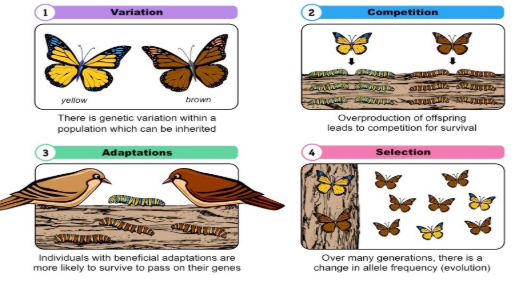
Label and explain how natural selection is at work in the four diagrams.
Yellow caterpillars are easier for birds to spot (and eat). Brown caterpillars are more likely to survive to produce offspring. They pass their genes for brown coloration to their offspring. In the next generation, brown butterflies are more common than in the previous generation. If the population of caterpillars were 100% yellow, natural selection would not have any effect because the genetic make-up of the population of butterflies could not be selected due to predation over time.
Natural selection: Organisms that are more adapted to their environment are more likely to survive and pass on the genes to the next ___________ of offspring.
generation
Artificial selection: Breeders choose which _________ continue to the next generation of offspring.
organisms
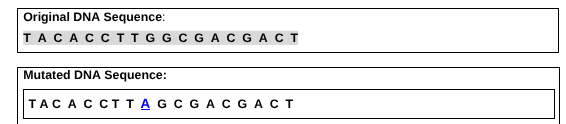
what mutation is this?
substitution

Identify the type of gene mutation below. (insertion, deletion, or substitution)
substitution
Genetic engineering: Changing the ___ in living organisms.
DNA
Genetically Modified Organisms: called _____, organisms that have had their DNA altered or modified in some way through genetic engineering.
GMOs
Transgenic Organisms: Trans: _____ Genic: _____
change, genes
transgenic means that one or more DNA sequences from another species have been introduced into _________ by artificial means.
another spieces
Gene therapy: When disease-causing genes are ___out and a _____ gene is inserted.
cut, beneficial